
Joe Nall Fly-In
by Ben Lanterman
As I was trying to organize the words to describe our visit to the 2004 Joe Nall Fly-In, held May 12–15, and wondering how to summarize the feelings about and impact of the event, I received an e-mail from John Hunton, who is well known as a prolific model designer and builder and generally a nice guy. He described his visit with such excitement that I asked permission to use his words.
The "our" in the preceding paragraph consists of me and my wife Bonnie. She has tolerated my airplane obsession for more than 39 years. Bonnie carried my bag of heavy lenses, extra batteries, a clipboard, and other camera equipment all day for four days with not a single complaint and was always ready with a smile as I was dragging at the end of the day. She is priceless.
John wrote: "Joe Nall and Pat Hartness were good personal friends who shared interests in aviation and model aviation. Once a year, Joe would open his private airport to modelers from around the country to have a fly-in session.
"Joe Nall was an inspector for the FAA (Federal Aviation Administration), one whose responsibilities included analyzing an airplane crash scene to help determine the cause. On his way to examine a crash site in South America, the airliner that Joe Nall was flying in crashed, killing him.
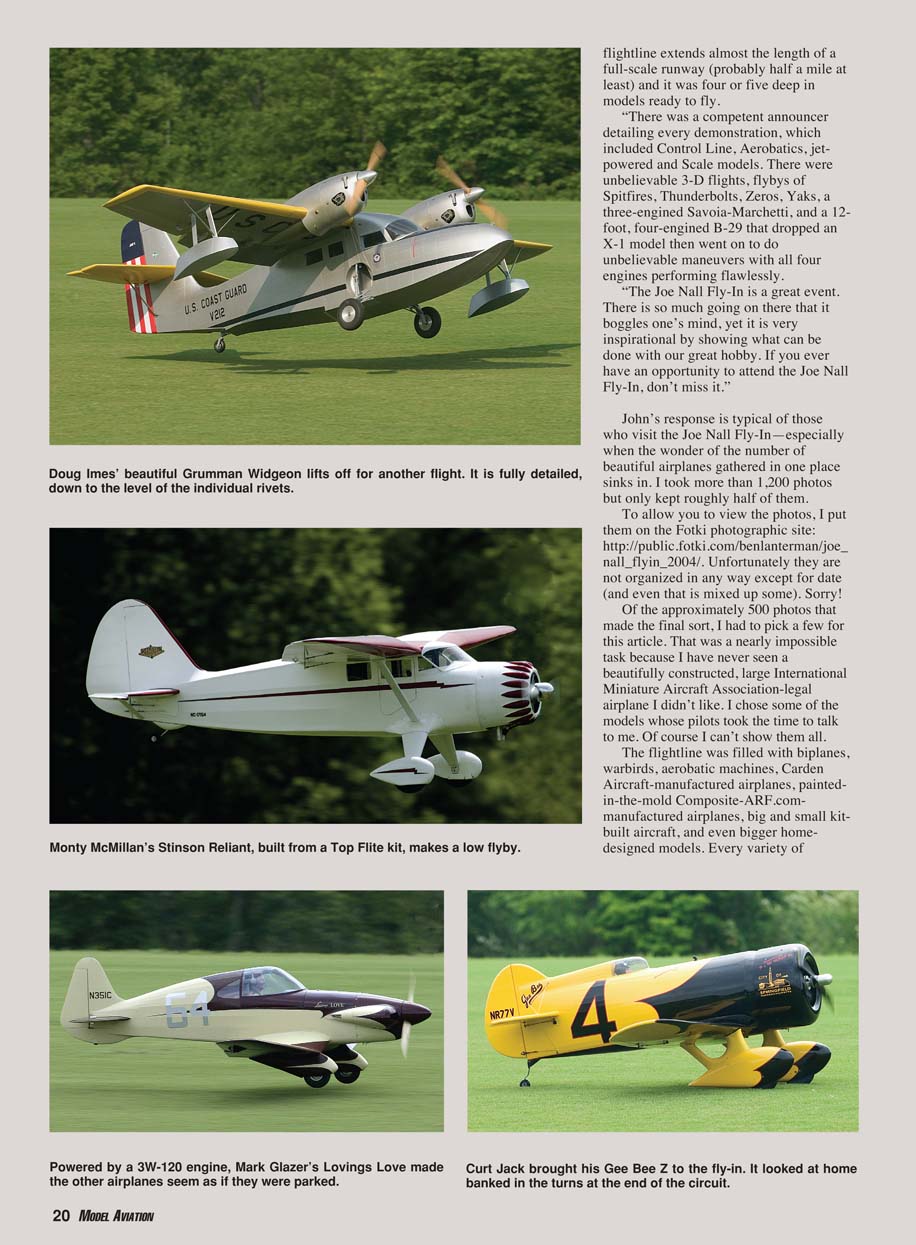
"After the death of Mr. Nall, Pat Hartness decided to continue the annual model fly-in as a tribute to his friend. In fact, Mr. Hartness developed an even larger site farther from town near Woodruff, South Carolina—the Triple Tree Aerodrome. This airport is immaculately maintained and is now the site of the annual Joe Nall Fly-In. The event starts on a Tuesday in May and runs to the following Saturday.
"Many of us have seen photos of the Joe Nall Fly-In in model magazines, but few of us have had the opportunity to attend it. This changed recently when Mike Dale invited a few of us to fly there on a Friday—one of the big days of the event, with full-scale flybys and model flight demonstrations performed by some of the leading Pattern and Scale modelers in the world.
"There were food and refreshments available and kiosks by all of the leading manufacturers with bargains galore. There were servos, links, batteries, screws of all sizes, prebuilt models of all sizes, etc. If you thought you needed it, it was there.
"The full-scale runway of 6,000 feet was all grass, and the particular area that the modelers used looked like a putting green at the Masters. The flightline was closely cropped Bermuda grass with nary a weed in sight. Behind the flightline there were lines of recreational vehicles (RVs), including Don Lowe's. (We got to chat with him a little while.)
"But back to the flightline. It is difficult to imagine from magazine photos that the flightline extends almost the length of a full-scale runway (probably half a mile at least) and it was four or five deep in models ready to fly. There was a competent announcer detailing every demonstration, which included Control Line, Aerobatic, Pattern, and Scale. There were unbelievable 3-D flights, flybys of Spitfires, Thunderbolts, Zeros, Yaks, a three-engined Savoia-Marchetti, and a 12-foot, four-engined B-29 that dropped an X-1 model then went on to perform maneuvers with all four engines performing flawlessly.
"The Joe Nall Fly-In is a great event. There is so much going on there that it boggles one's mind, yet it is very inspirational by showing what can be done with our great hobby. If you ever have an opportunity to attend the Joe Nall Fly-In, don't miss it."
John's response is typical of those who visit the event—especially when the wonder of the number of beautiful airplanes gathered in one place sinks in. I took more than 1,200 photos but kept roughly half of them.
To allow others to view the photos, I put them on the Fotki photographic site: http://public.fotki.com/benlanterman/joe_nall_flyin_2004/. They are not well organized—only roughly by date—so apologies for that.
Of the approximately 500 photos that made the final sort, I had to pick a few for this article. That was a nearly impossible task because I have never seen a beautifully constructed, large International Miniature Aircraft Association–legal airplane I didn't like. I chose some of the models whose pilots took the time to talk to me; of course I can't show them all.
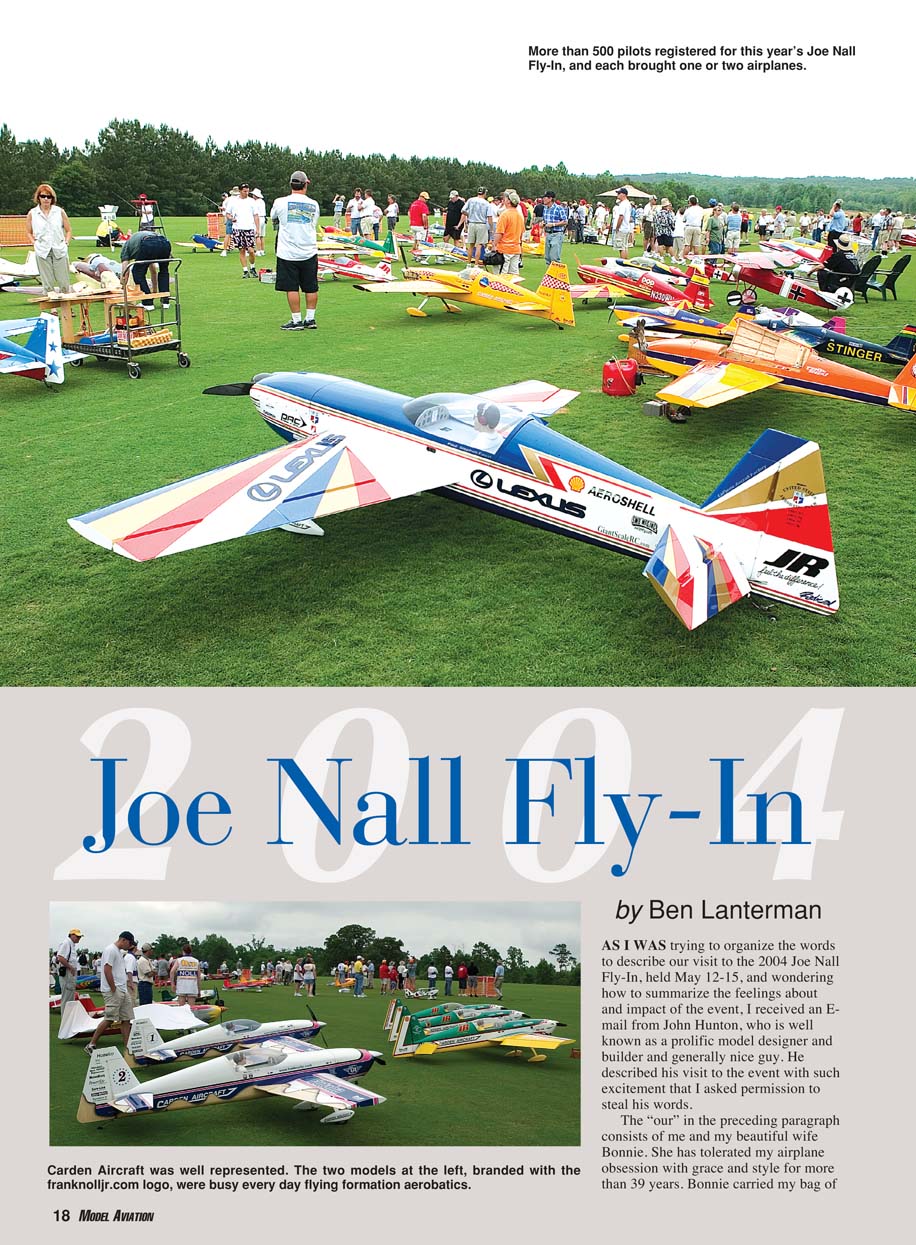
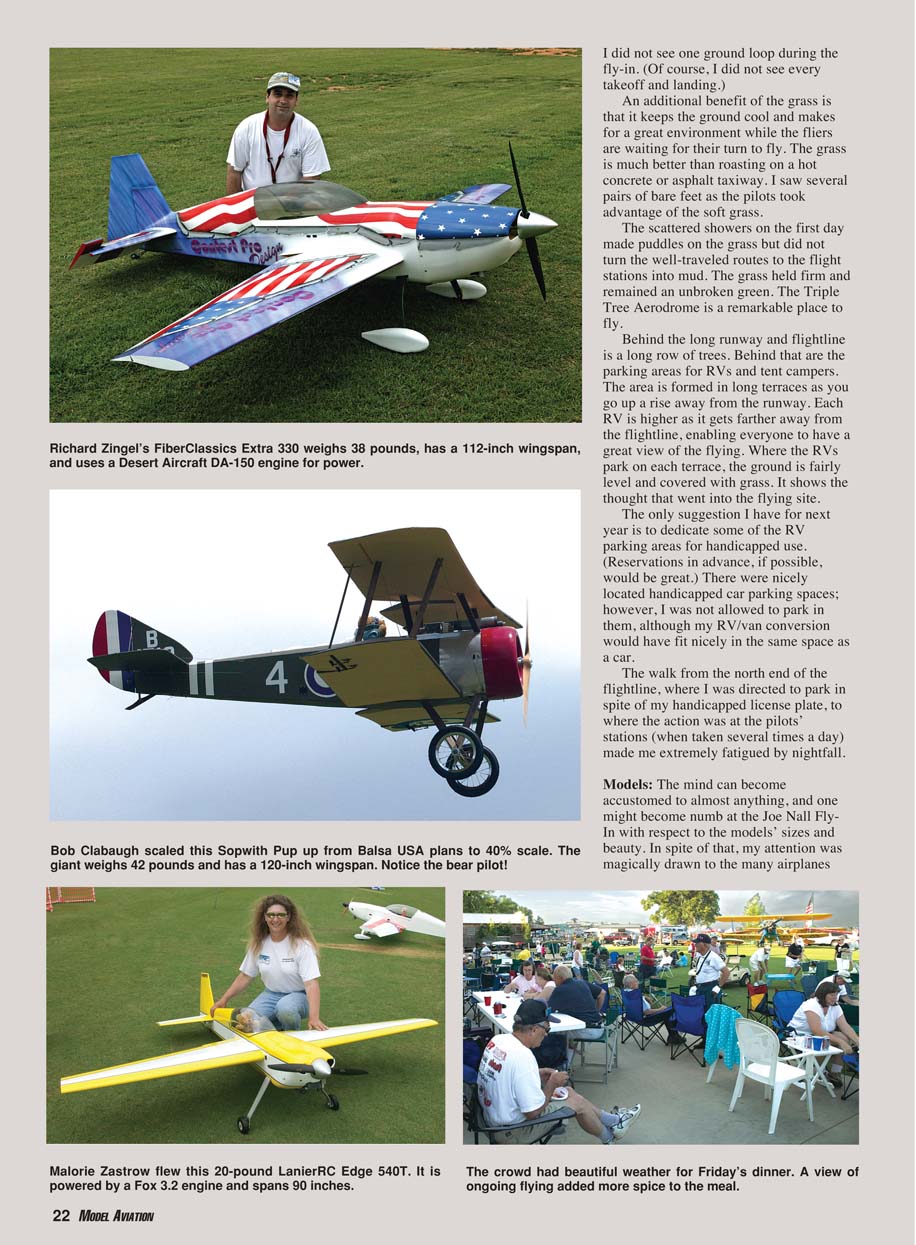
The flightline was filled with biplanes, warbirds, aerobatic machines, Carden Aircraft-manufactured airplanes, painted-in-the-mold Composite-ARF.com and FiberClassics models, big and small kit-built aircraft, and even larger home-designed models. Every variety of airplane you could imagine was there, arranged three- to four-deep along the extensive flightline. The photos give some sense of the numbers.
It is an interesting feeling to stand at the center of the pilots' stations and look to see the flightline tents and airplanes disappearing from view in both directions. A reasonable estimate of the number of airplanes is 800–1,000, although not all of them flew.
Triple Tree Aerodrome
Stating that the facility is beautiful is an understatement. I want to build a retirement home there. Waking up to models flying in the morning is the only way to go.
The long grass runway is nicer overall than most yards will ever be, but the center section used for model operations is many hundreds of feet long and wide and is beautifully manicured 1/2-inch-high Bermuda grass. It is the perfect surface for tail-dragger model operations. I did not see one ground loop during the fly-in (though I did not see every takeoff and landing).
An additional benefit of the grass is that it keeps the ground cool and makes for a great environment while fliers wait their turn. The grass is much better than roasting on a hot concrete or asphalt taxiway. I saw several pairs of bare feet as the pilots enjoyed the soft turf.
Scattered showers on the first day made puddles on the grass but did not turn the well-traveled routes to the pilots' stations into mud. The grass held firm and remained an unbroken green. Triple Tree Aerodrome is a remarkable place to fly.
Behind the long runway and flightline is a long row of trees, and behind that are the parking areas for RVs and tent campers. The area is formed in long terraces as you go up a rise away from the runway. Each RV parking terrace is higher as it gets farther from the flightline, enabling everyone a great view of the flying. Where the RVs park on each terrace, the ground is fairly level and covered with grass. It shows the thought that went into the flying site.
One suggestion for next year is to dedicate some RV parking areas for handicapped use (reservations in advance, if possible). There were nicely located handicapped car parking spaces; however, I was not allowed to park my RV/van conversion in them, even though my vehicle would have fit. The walk from the north end of the flightline, where I was directed to park in spite of my handicapped license plate, to the pilots' stations—in the course of several trips a day—made me extremely fatigued by nightfall.
Models
The mind can become accustomed to almost anything, and one might become numb at the Joe Nall Fly-In to the models' sizes and beauty. In spite of that, certain airplanes were true works of art—those that were impossible to look at without saying, "Wow! That's beautiful."
Composite-ARF.com and FiberClassics airplanes excelled with their painted-in-the-mold finishes. Several Carden Aircraft models were exceptional as well. Those and other airplanes featured color gradations and complex design work worthy of serious study.
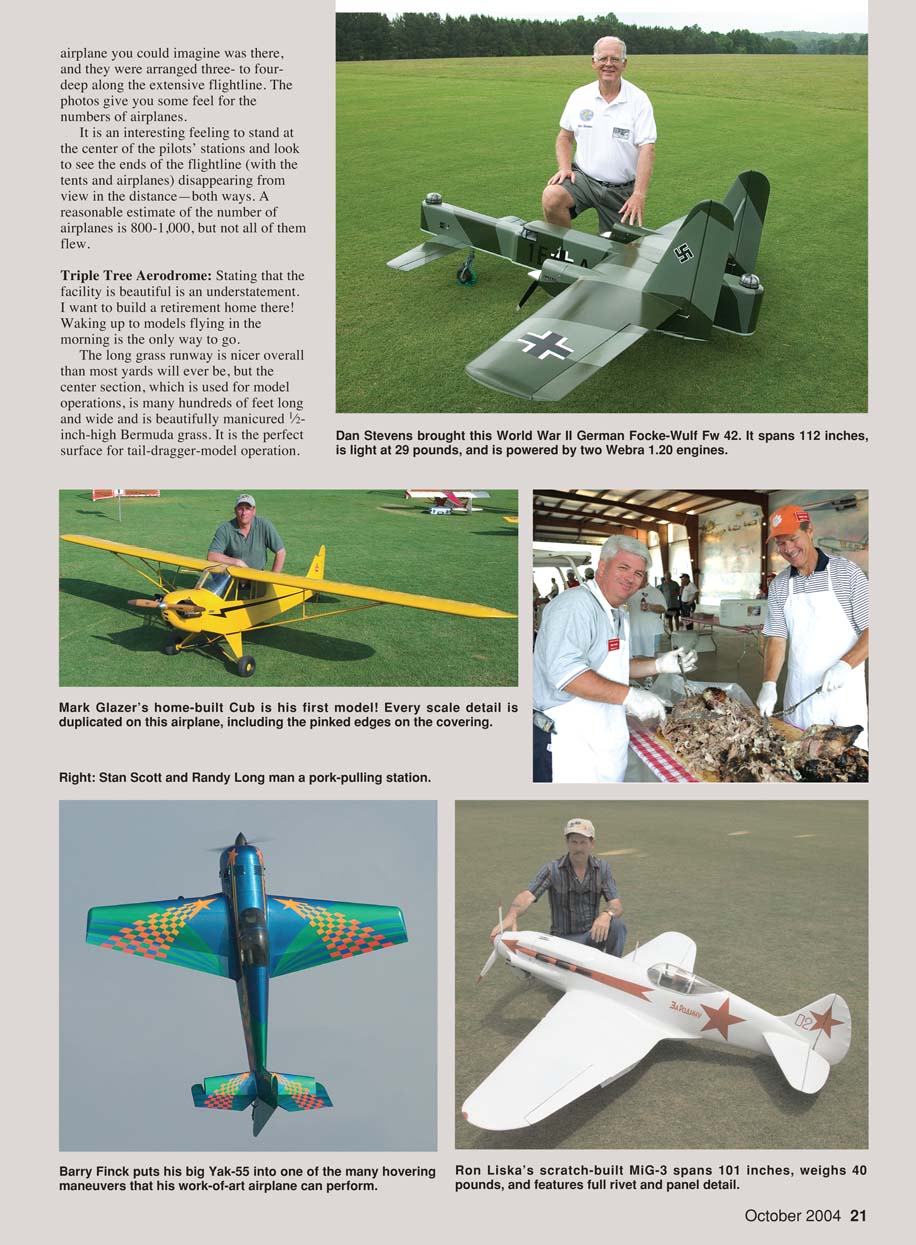
The many fabulous Scale aircraft also grabbed my attention. They would be at home in any Masters Scale contest. Mark Glazer's Cub and Doug Imes' Grumman Widgeon were excellent illustrations of the scale master's art. The Widgeon's rivet detail and the Cub's reinforcing covering strips with pinked edges were to scale. Not only did these airplanes look great, but they flew often and well.
Time slots were set exclusively for warbird flying. The lineup was divided into groups representing different time periods:
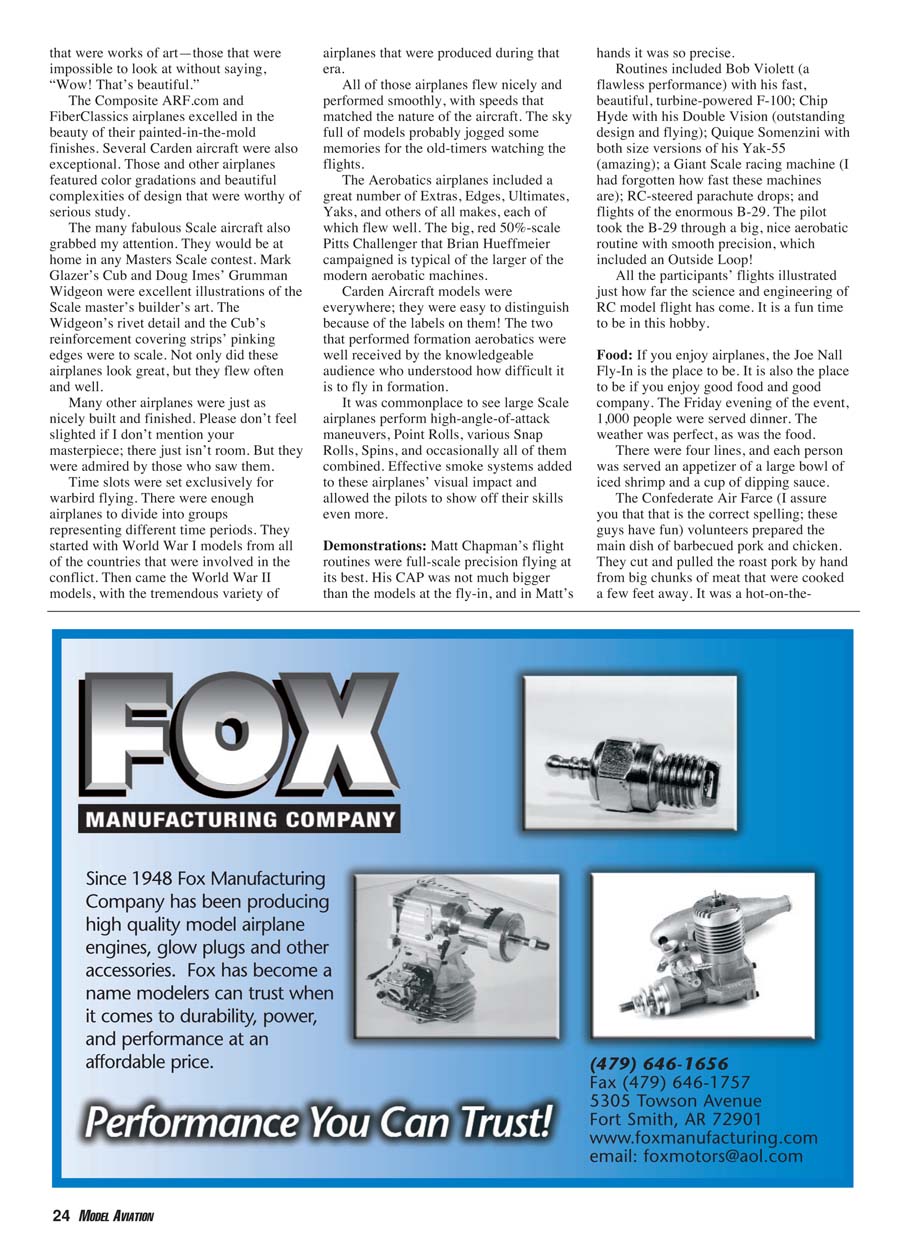
- World War I models from many countries
- World War II models, with the tremendous variety of airplanes produced during that era
All of those airplanes flew nicely and performed smoothly, with speeds matching the nature of each aircraft. The full display probably jogged some memories for the old-timers in the crowd.
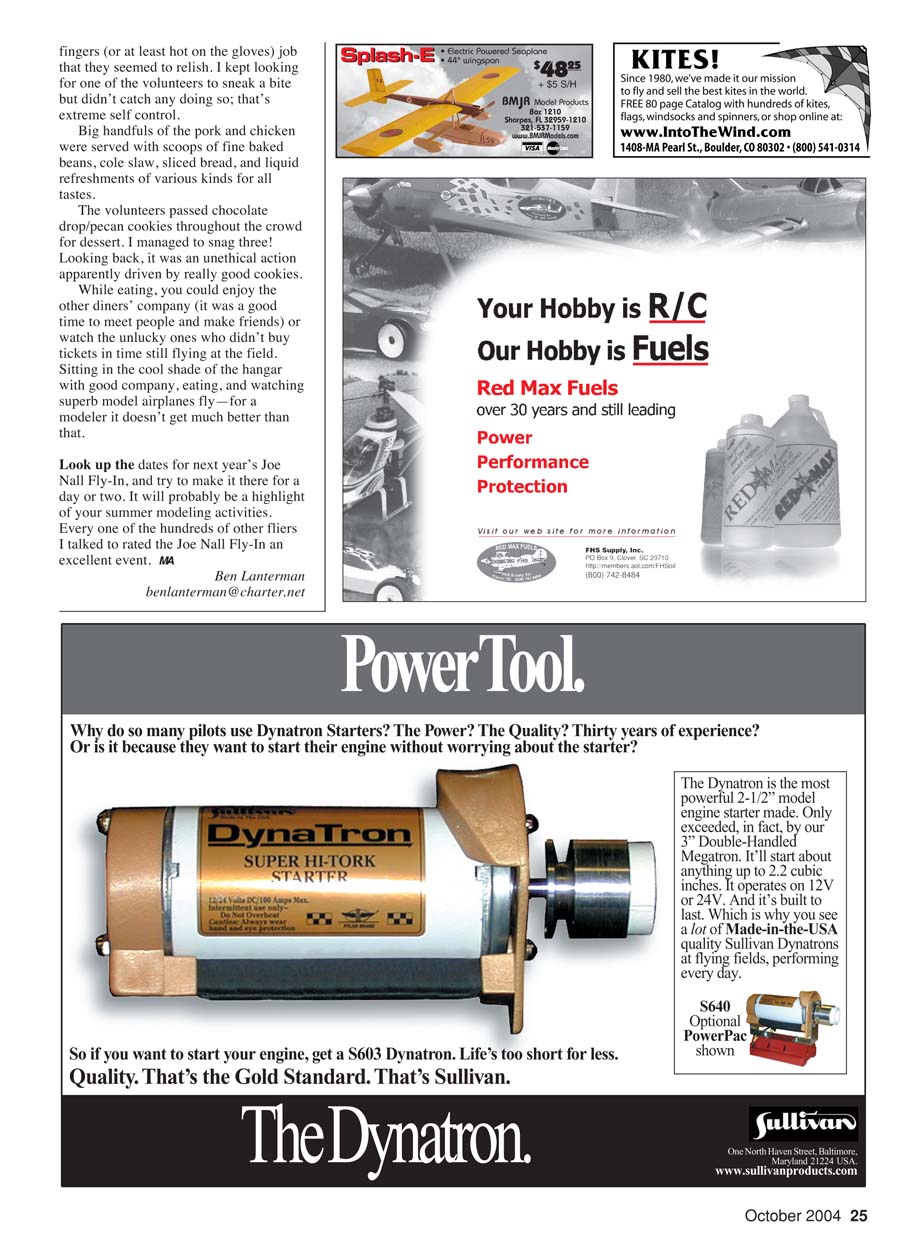
The aerobatics ranks included many Extras, Edges, Ultimates, Yaks, and others of various makes, each of which flew well. The big, red 50%-scale Pitts Challenger campaigned by Brian Hueffmeier is typical of the larger modern aerobatic machines.
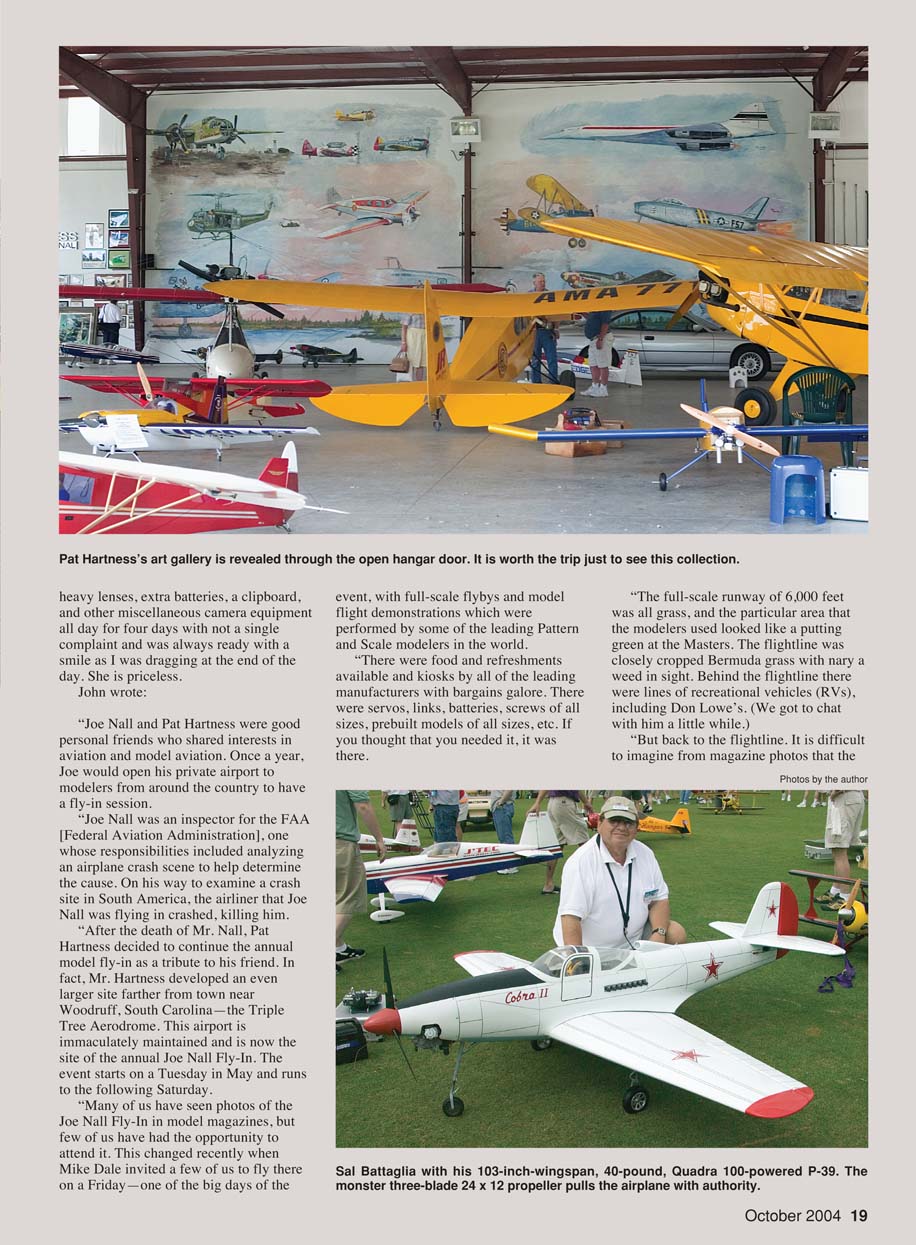
Carden Aircraft models were everywhere; they were easy to distinguish because of the labels on them. Two Carden models performed formation aerobatics and were well received by an audience that understood how difficult formation flying is.
It was commonplace to see large scale airplanes perform high-angle-of-attack maneuvers, point rolls, various snap rolls, spins, and occasionally combinations of those. Effective smoke systems added to the visual impact and allowed the pilots to show off their skills even more.
Demonstrations
The demonstrations illustrated just how far the science and engineering of radio-control model flight has come. Highlights included:
- Matt Chapman's flight routines—full-scale precision flying at its best. His CAP was so precise it seemed hardly bigger than the models at the fly-in.
- Bob Violett—flawless performance with a fast, beautiful turbine-powered F-100.
- Chip Hyde—with his Double Vision design and outstanding flying.
- Quique Somenzini—with both size versions of his Yak-55—amazing demonstrations.
- Giant-scale racing machines—reminders of how fast these models can be.
- RC-steered parachute drops.
- Flights of the enormous B-29; the pilot took it through a big, smooth aerobatic routine that even included an outside loop.
There were also unbelievable 3-D flights, and full-scale flybys of Spitfires, Thunderbolts, Zeros, Yaks, a three-engined Savoia-Marchetti, and a 12-foot, four-engined B-29 that dropped an X-1 model before continuing its demonstration.
All the participants' flights illustrated the progress in the hobby and made it a fun time to be involved.
Food
If you enjoy airplanes, the Joe Nall Fly-In is the place to be. It is also the place to be if you enjoy good food and good company. On Friday evening about 1,000 people were served dinner. The weather was perfect, as was the food.
There were four serving lines. Each person was served an appetizer of a large bowl of iced shrimp with dipping sauce. The Confederate Air Force volunteers prepared the main dish of barbecued pork and chicken. They cut and pulled the roast pork by hand from big chunks of meat cooked nearby. The servers dished out large helpings of pork and chicken with scoops of baked beans, cole slaw, sliced bread, and various beverages.
Volunteers passed chocolate-drop/pecan cookies throughout the crowd for dessert. I managed to snag three.
While eating, you could enjoy the company of other diners (a good time to meet people and make friends) or watch superb model airplanes fly from the shade of the hangar. For a modeler, it doesn't get much better than that.
Look up the dates for next year's Joe Nall Fly-In and try to make it for a day or two. It will probably be a highlight of your summer modeling activities. Every one of the hundreds of other fliers I talked to rated the Joe Nall Fly-In an excellent event.
Ben Lanterman [email protected]
Transcribed from original scans by AI. Minor OCR errors may remain.

