
JN THIRTY YEARS OF SOUTHERN HOSPITALITY
JOE NALL
by Jay Smith
Whether you have been to Joe Nall once or a dozen times, there’s a level of excitement and anticipation as you drive under the Triple Tree Aerodrome archway and along the winding road. You know that Pat Hartness’s beautiful facility, with all of its amenities, is open for your enjoyment.
Similar to Model Aviation magazine, Joe Nall caters to a broad range of participants who can enjoy their favorite segment of the hobby at one of six flightlines, or take it all in. Joe Nall isn’t so much an event as it is an experience. Here is an overview from each flightline.
Main Flightline
The main flightline is the hub of activity where you will find the majority of vendors set up and the noontime demonstration show. Open to aircraft that fly the racetrack pattern, this is also the place to see the scale masterpieces taking to the sky.
Basic aerobatics are allowed as long as pilots keep with the flow of air traffic. Aircraft on this flightline must meet International Miniature Aircraft Association (IMAA) standards.
A familiar face on this line is Jim Malek, the flight boss. Jim is easy to spot walking the line wearing his drill-sergeant hat. He does a great job ensuring pilots communicate with one another and won’t hesitate to enforce the rules to ensure everyone’s safety.
For added safety, the main flightline has a warning system installed at each pilot station. If a pilot loses control of his or her aircraft, a spotter can quickly sound the alarm to let those in attendance know an aircraft may be in distress.
3-D Flightline
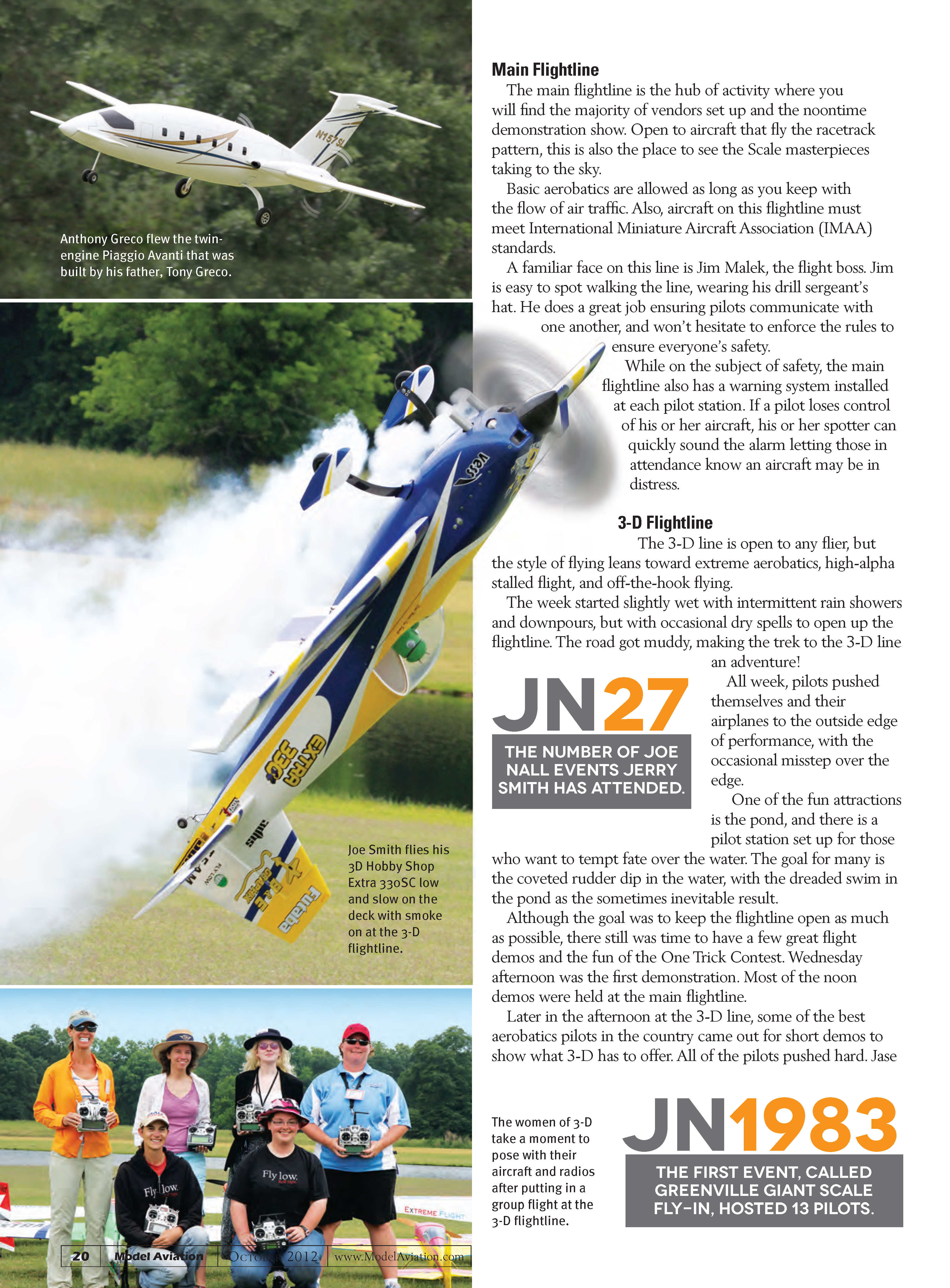
The 3-D line is open to any flier, but the style of flying leans toward extreme aerobatics, high-alpha stalled flight, and off-the-hook maneuvers.
The week started slightly wet with intermittent rain showers and downpours, but with occasional dry spells that opened up the flightline. The road got muddy, making the trek to the 3-D line an adventure. All week, pilots pushed themselves and their airplanes to the outside edge of performance, with the occasional misstep over the edge.
One of the fun attractions is the pond, with a pilot station set up for those who want to tempt fate over the water. The goal for many is the coveted rudder dip in the water, with the dreaded swim in the pond as the sometimes inevitable result.
Although the goal was to keep the flightline open as much as possible, there was still time for a few great flight demos and the fun of the One Trick contest. Wednesday afternoon featured the first demonstration. Most of the noon demos were held at the main flightline, while later-in-the-afternoon 3-D demos showcased some of the best aerobatics pilots in the country.
Jase Dussia pushed too much with his rolling-harrier landing—oh, for two more inches of clearance! The crowd loved the action and the pilots had a ball.
Another demo planned for Thursday was stopped by storms, but once the storms cleared it was a great afternoon of flying. Thursday night brought live music from The Out of Towners band. Many attendees had fun and plenty got up and danced while electric flying was going on at the pilots’ stations.
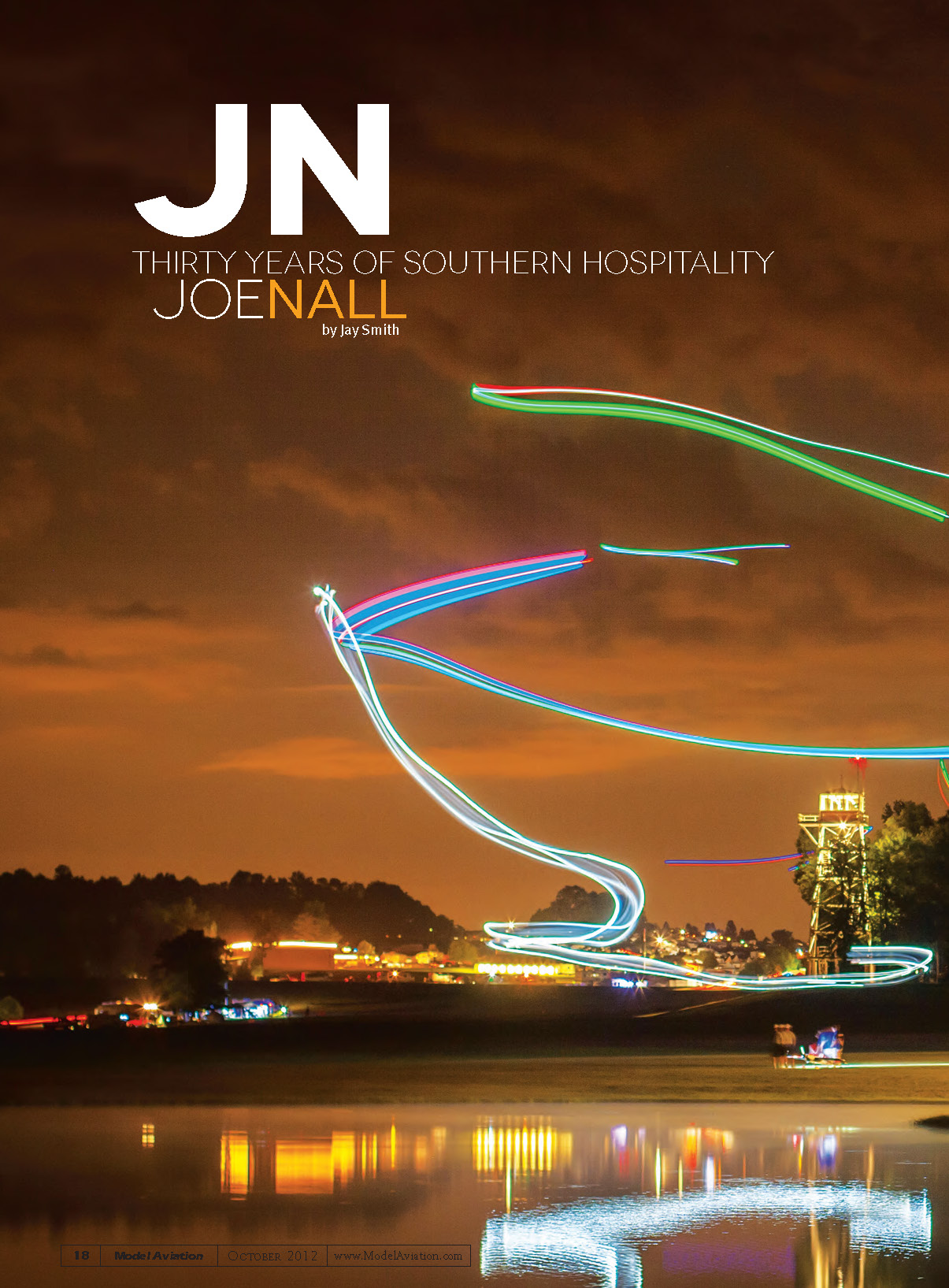
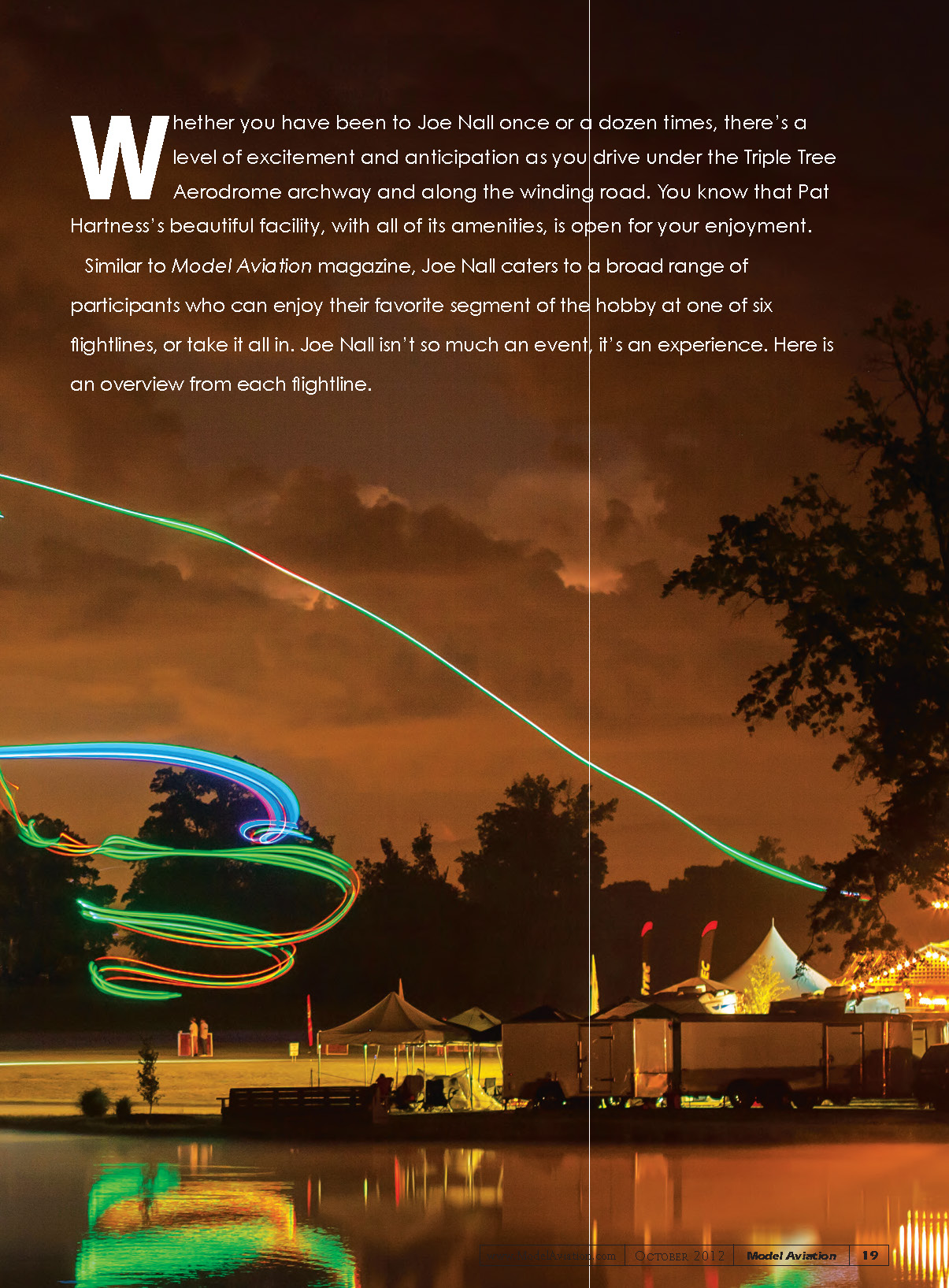
Each night of the week, flying continued well into the night with various night-flying setups—from small foamies all the way to 120cc airframes. During the band’s set breaks on Thursday, several special night-flying demos entertained the crowd. The most spectacular was Nick Maxwell’s night-heli demo, which culminated in a fantastic blade stop. Unfortunately, the restart was not so good; Nick took it in stride with a smile and the crowd had a great time.
The parties and fellowship continued late into the night, making new friends and rekindling old friendships from Joe Nalls of the past.
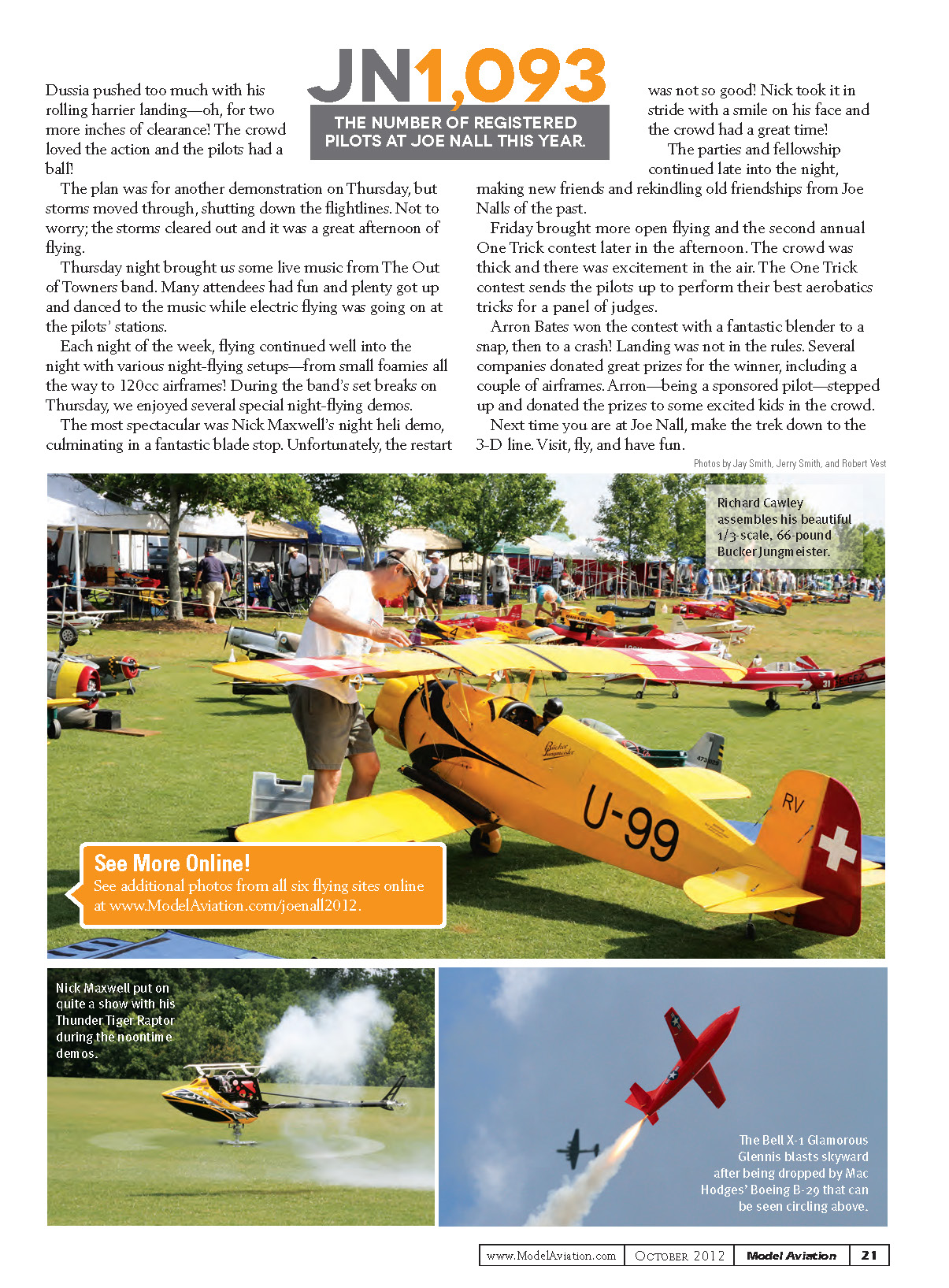
Friday brought more open flying and the second annual One Trick contest later in the afternoon. The crowd was thick and excitement was high. The One Trick contest sends pilots up to perform their best aerobatic trick for a panel of judges. Arron Bates won the contest with a fantastic blender to a snap, then to a crash—landing was not in the rules. Several companies donated great prizes for the winner, including a couple of airframes. Arron, being a sponsored pilot, stepped up and donated the prizes to some excited kids in the crowd.
Next time you are at Joe Nall, make the trek down to the 3-D line. Visit, fly, and have fun.
Control Line
Some of the best control-line (CL) aerobatics pilots came to fly, enjoy themselves, and put on demonstrations. Included in that group were former World Team member Derek Barry, William Davis, Dale Barry, Allen Brickhaus, Tom Morris, Joe Adamusko, and Craig Gunder. Many RC pilots also dropped by with their CL airplanes and enjoyed the open flying.
Mark Weiss shared the following:
"A fleet of models was prepared for the event for two main purposes: one, to demonstrate radio control line. Two CL planes were modified to fly around a tether and be controlled from outside the circle by radio, using elevator and throttle control. This was a real crowd pleaser and was Pat's idea for me to develop and bring. Pat took the transmitter and put on a very nice flight on his own.
"Secondly, I wanted attendees to be able to fly a CL plane and feel that special sensation. That became more popular than I had thought. In addition to many, many demonstration flights, attendees logged 241 training flights.
"A close friend, Bruce Jennings, was in the circle for the first three days and then I took the rest of the folks for the next four days. Every one of them told me how much they appreciated the opportunity and enjoyed flying by wire. Here is an approximate breakdown:
- 40% told me they had not picked up a handle in 25–50 years.
- 20% said that their fathers or grandfathers used to fly CL, but they had not.
- 20% were RC fliers wanting to see what it was like and had never done it before.
- 20% were children and spouses who flew a model for the first time.
"The ages of trainees ranged from 2 up to 86 (Jerry Smith). Some of the best-known RC folks took the handle during the week. The comment that seemed to sum it all up came from Mac Hodges, Mr. B-29 and X-1 showman. After he landed the little CL plane on Friday morning, he turned to his two friends and passionately said, 'Now that was pure fun!' I also had the pleasure of giving NASCAR/F1 driver Juan Pablo Montoya his first CL flight.
"Without support, this would have been an even more daunting challenge. The following companies really helped: Stevens AeroModel, Thunder Power RC, Sonic-Tronics, Bob Smith Industries, P3 Models, Brodak Manufacturing, SP Lube, S&W, Byron, Sullivan Products, Fox Manufacturing, Horizon Hobby, and Radical RC.
“The AMA was a tremendous partner with their assistance, as was my home RC club, the Delaware RC Club, home of Warbirds Over Delaware.
“Of course, none of this would have happened without Pat Hartness and his wonderful crew at Triple Tree. They treated all of us like VIPs and prepared a CL area that was just wonderful.”
Electric Flightline
Located between the main flightline and the 3-D flightline, the electric group had a large number of pilots and the support of Precision Aerobatics and After Dark, which set up there.
Throughout the event, a wide cross-section of aircraft was flown—from micros to large Pattern and 3-D aircraft. Night flying was encouraged, thanks to Tom from After Dark whose well-lit and colorful tent could be seen by everyone.
Water Flying
Few modelers get the opportunity to fly off a picturesque 50-acre lake. The ParkZone ICON was the most commonly flown aircraft on the lake this year.
The most impressive aircraft to grace the lake was the 60% L-4 Cub flown by Robert Komro. The Bill Hemple ARF is powered by a 3W275 and made countless flights at the event. Thanks to its large size and scale flight characteristics, many in attendance did a double take to ensure it wasn’t a full-scale aircraft.
Several model boaters also enjoyed the lake. The Chris-Craft built and driven by Tom Drake was fantastic. The 1/3-scale boat is powered with a water-cooled G26 engine. Tom generously provided the opportunity to drive his scale masterpiece, which was a blast.
The lake always draws a good crowd of pilots and spectators, and this year was no exception. This group was eager to allow others to try their boats and aircraft.
Helicopter Flightline
Castle sponsored the heli flightline for the third successive year. This worked out great because it allowed Clint Akins and Steve Rogers to attend the entire week to help out. This was the second year at the new heli site, and Mike Gregory and others did a fantastic job prepping the area for helicopter flying.
This year saw more growth and interest in the heli line. More scale helicopters were flown, and it is always a pleasure to hang out with these pilots and watch their beautiful aircraft fly.
Notable scale pilots who attended included Peter Wales, Darrell Sprayberry, Joe Howard, Sandy Jaffe, and Bob Burgo. These pilots brought some nice helis to share with everyone and entertained questions all week.
It is not uncommon to run into professional pilots such as Matt Botos (owner and designer of Synergy Helicopters), Jared Granzow, Henry Caldwell, Marcus Kim, or John Adams from Horizon Hobby.
The heli pilots enjoy this event because they can visit the other flightlines during the day and then return to the heli flightline to lay down some smack.
Although every year at Joe Nall is special, the nostalgia of an event that has spanned 30 years was exciting. Pat Hartness has a beautiful facility that he happily allows us all to enjoy, and the Joe Nall staff embodies its motto: "Fun, Fellowship, and Hospitality." Anyone who hasn't attended at least once is missing out!
I would like to thank Jerry Smith, Clint Akins, Robert Vest, Curtis Cozier, and Mark Weiss for their assistance in putting together this article.
— Jay Smith [email protected]
SOURCES: Joe Nall — www.joenall.com
Transcribed from original scans by AI. Minor OCR errors may remain.

