
JR Indoor Electric Festival - 2005/03
by Tom Hunt
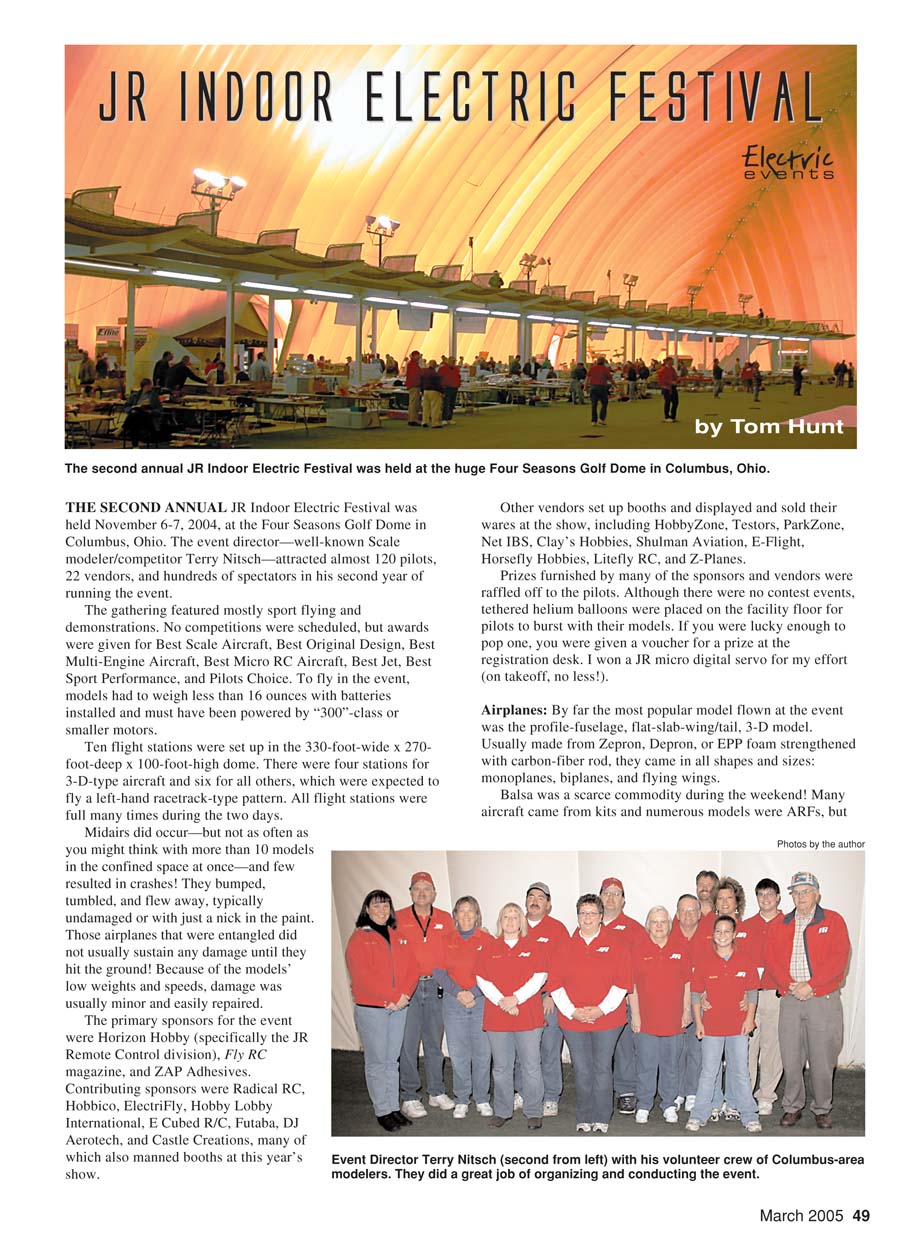
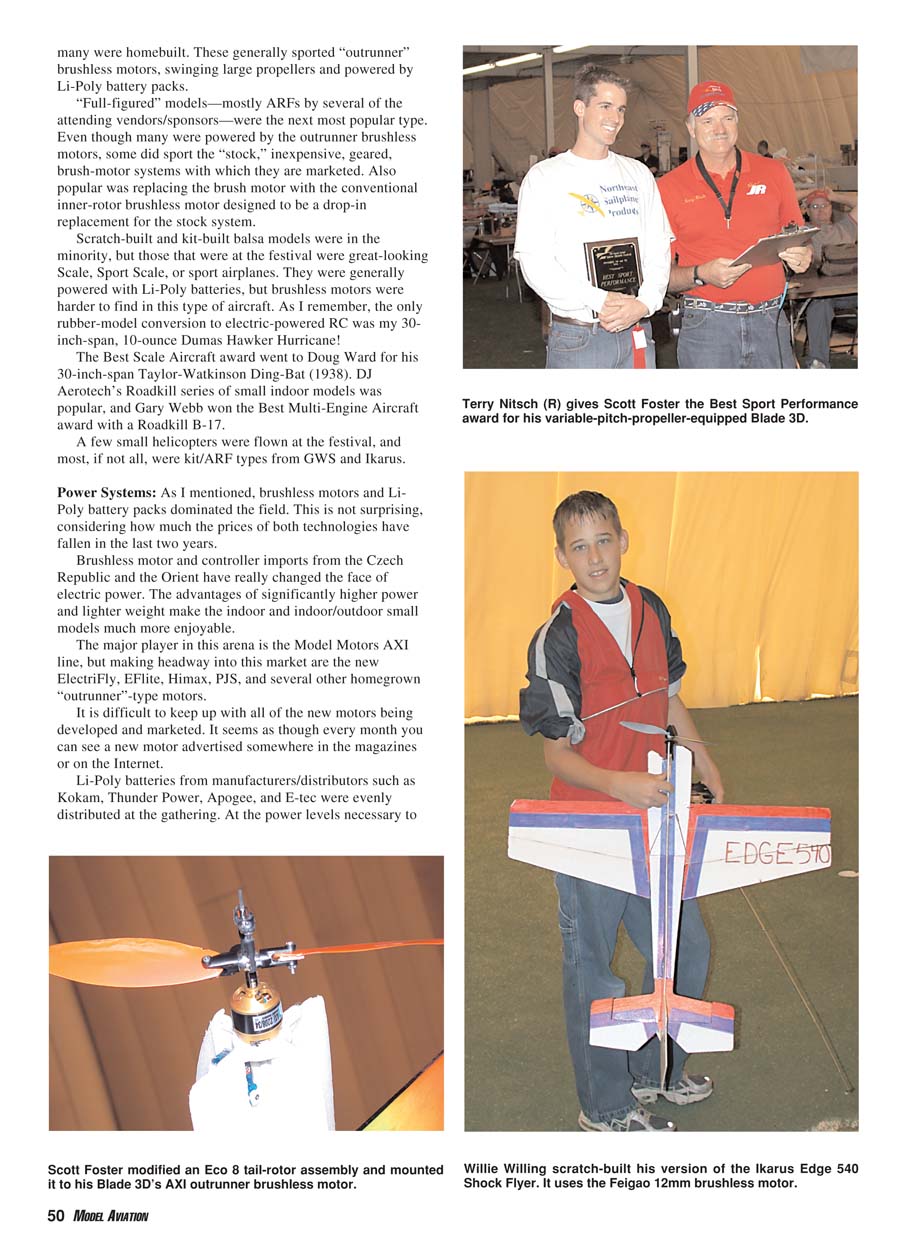
The second annual JR Indoor Electric Festival was held November 6–7, 2004, at the Four Seasons Golf Dome in Columbus, Ohio. Event director—well-known scale modeler and competitor Terry Nitsch—attracted almost 120 pilots, 22 vendors, and hundreds of spectators in his second year running the event.
The gathering featured mostly sport flying and demonstrations. No competitions were scheduled, but awards were given for Best Scale Aircraft, Best Original Design, Best Multi-Engine Aircraft, Best Micro RC Aircraft, Best Jet, Best Sport Performance, and Pilots Choice. To fly in the event, models had to weigh less than 16 ounces with batteries installed and be powered by “300”-class or smaller motors.
Ten flight stations were set up in the 330-foot-wide × 270-foot-deep × 100-foot-high dome. There were four stations for 3-D-type aircraft and six for all others, which were expected to fly a left-hand racetrack-type pattern. All flight stations were full many times during the two days.
Midairs did occur—but not as often as you might think with more than 10 models in the confined space at once—and few resulted in crashes. They bumped, tumbled, and flew away, typically undamaged or with just a nick in the paint. Airplanes that became entangled did not usually sustain damage until they hit the ground. Because of the models’ low weights and speeds, damage was usually minor and easily repaired.
The primary sponsors for the event were:
- Horizon Hobby (specifically the JR Remote Control division)
- Fly RC magazine
- ZAP Adhesives
Contributing sponsors included:
- Radical RC
- Hobbico
- ElectriFly
- Hobby Lobby International
- E Cubed R/C
- Futaba
- DJ Aerotech
- Castle Creations
Other vendors who set up booths and displayed or sold wares included:
- HobbyZone
- Testors
- ParkZone
- Net IBS
- Clay’s Hobbies
- Shulman Aviation
- E-Flight
- Horsefly Hobbies
- Litefly RC
- Z-Planes
Prizes furnished by many of the sponsors and vendors were raffled off to pilots. Although there were no contest events, tethered helium balloons were placed on the facility floor for pilots to burst with their models. If you popped one you were given a voucher for a prize at the registration desk. I won a JR micro digital servo for my effort (on takeoff, no less!).
Airplanes By far the most popular models flown at the event were profile-fuselage, flat-slab-wing/tail 3-D models. Usually made from Zepron, Depron, or EPP foam and strengthened with carbon-fiber rod, they came in all shapes and sizes: monoplanes, biplanes, and flying wings. Many were homebuilt; others came from kits or were ARFs. These generally sported “outrunner” brushless motors, swinging large propellers and powered by Li-Poly battery packs.
Balsa was a scarce commodity during the weekend. “Full-figured” models—mostly ARFs from several attending vendors and sponsors—were the next most popular type. Even though many were powered by outrunner brushless motors, some still used the stock, inexpensive geared brushed-motor systems with which they are marketed. Replacing the brush motor with a conventional inner-rotor brushless motor designed as a drop-in replacement was also common.
Scratch-built and kit-built balsa models were in the minority, but those present were great-looking scale, sport-scale, or sport airplanes. They were generally powered with Li-Poly batteries, though brushless motors were less common in this type of aircraft. The only rubber-model conversion to electric-powered RC I remember was my 30-inch-span, 10-ounce Dumas Hawker Hurricane.
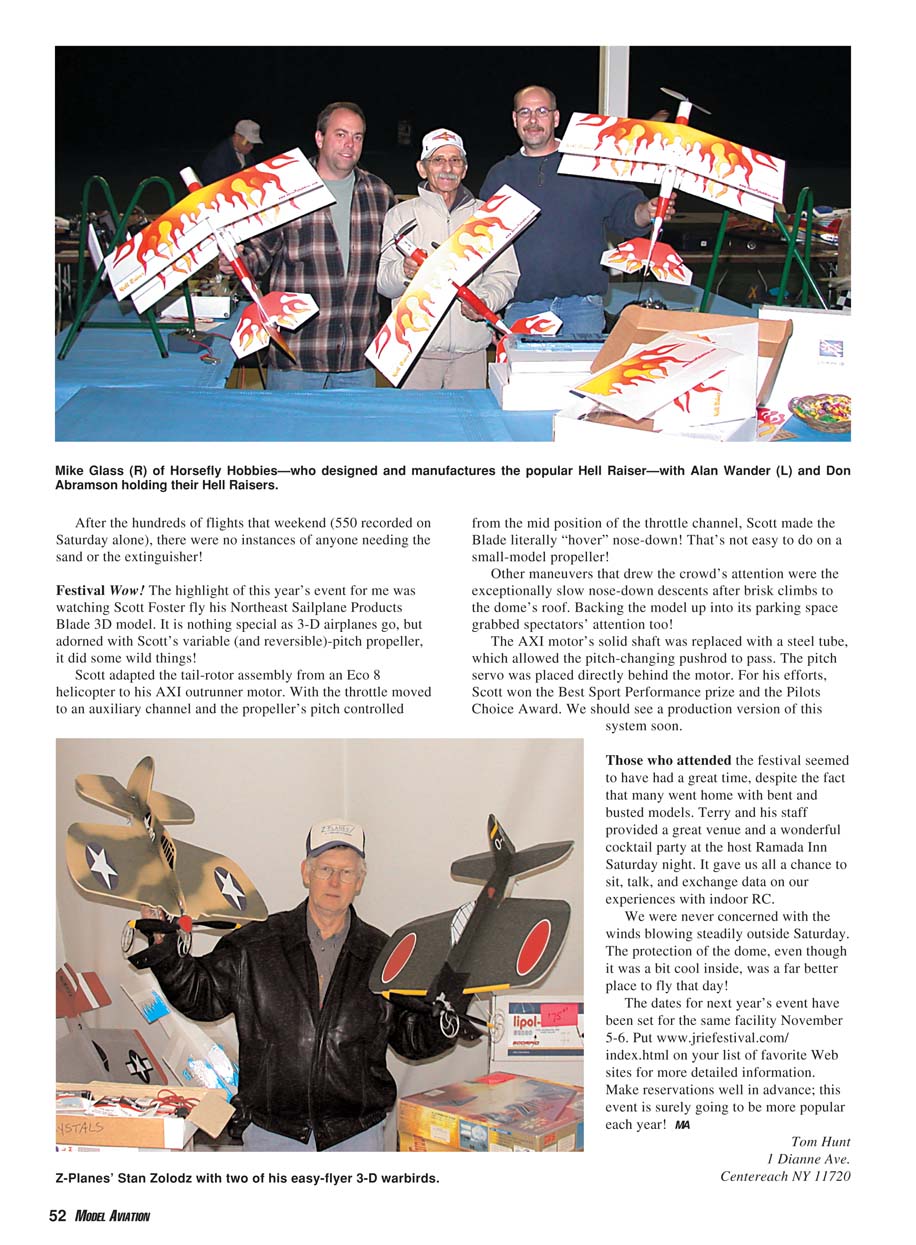
The Best Scale Aircraft award went to Doug Ward for his 30-inch-span Taylor-Watkinson Ding-Bat (1938). DJ Aerotech’s Roadkill series of small indoor models was popular; Gary Webb won the Best Multi-Engine Aircraft award with a Roadkill B-17.
A few small helicopters were flown at the festival, most of them kit/ARF types from GWS and Ikarus.
Power Systems
Brushless motors and Li-Poly battery packs dominated the field. This is not surprising given how much prices for both technologies have fallen in the past two years.
Brushless motor and controller imports from the Czech Republic and the Orient have really changed the face of electric power. The advantages of significantly higher power and lighter weight make indoor and indoor/outdoor small models much more enjoyable.
Major motor players included the Model Motors AXI line, with growing competition from ElectriFly, EFlite, Himax, PJS, and several other homegrown outrunner-type motors. It seems a new motor is advertised almost every month.
Li-Poly batteries from manufacturers and distributors such as Kokam, Thunder Power, Apogee, and E-tec were common at the gathering. At the power levels necessary to fly these types of models, two- to three-cell single-series packs are usually all that are needed, which helps keep cost down. When one pack can fly a model for more than 20 minutes, most pilots buy two packs: one to fly with and one to charge. The turnaround time is only long enough for one good conversation, and it's back to flying!
Cell capacities ranged from a diminutive 90 mAh up to the normally outdoor-only 2100 mAh.
Because of the expected high volume of modelers using Li-Poly cells—and the reported, though erroneous, propensity for these cells to catch fire when properly handled—the event director had a large fire extinguisher and sand buckets strategically placed throughout the pit areas. After the hundreds of flights that weekend (550 recorded on Saturday alone), there were no instances of anyone needing the sand or the extinguisher.
Festival Wow!
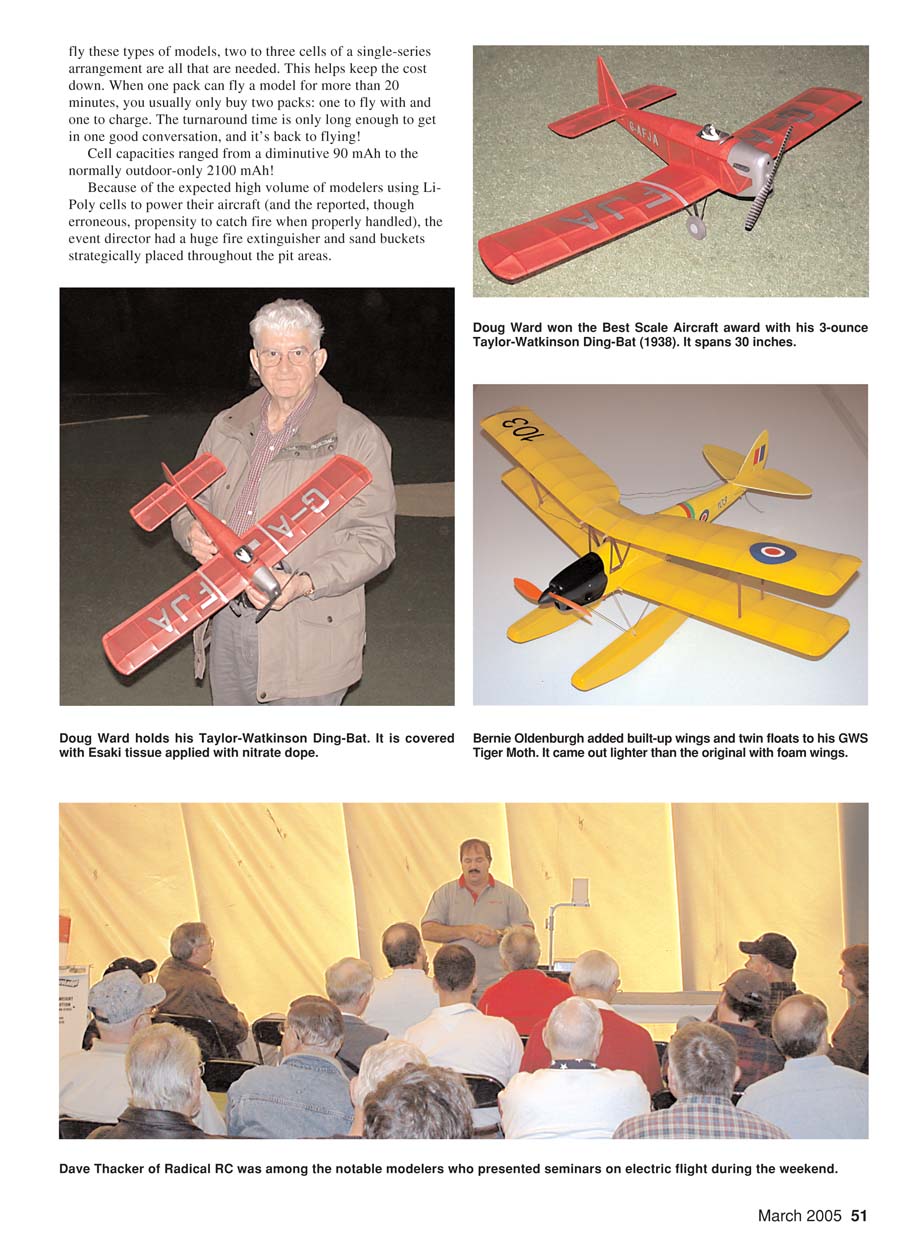
The highlight of this year’s event for me was watching Scott Foster fly his Northeast Sailplane Products Blade 3D model. It is nothing special as 3-D airplanes go, but adorned with Scott’s variable (and reversible)-pitch propeller, it did some wild things.
Scott adapted the tail-rotor assembly from an Eco 8 helicopter to his AXI outrunner motor. With the throttle moved to an auxiliary channel and the propeller’s pitch controlled from the mid position of the throttle channel, Scott made the Blade literally “hover” nose-down—a difficult feat on a small-model propeller. Other maneuvers that drew the crowd’s attention were exceptionally slow nose-down descents after brisk climbs to the dome’s roof. He also backed the model up into its parking space, which grabbed spectators’ attention.
The AXI motor’s solid shaft was replaced with a steel tube that allowed the pitch-changing pushrod to pass. The pitch servo was placed directly behind the motor. For his efforts, Scott won the Best Sport Performance prize and the Pilots Choice Award. We should see a production version of this system soon.
Those who attended the festival seemed to have had a great time, despite the fact that many went home with bent and busted models. Terry and his staff provided a great venue and a wonderful cocktail party at the host Ramada Inn Saturday night, giving everyone a chance to sit, talk, and exchange data on indoor RC experiences.
We were never concerned with the steady winds blowing outside on Saturday. The protection of the dome, even though it was a bit cool inside, was a far better place to fly that day.
The dates for next year’s event have been set for the same facility: November 5–6. Put www.jrfestival.com/index.html on your list of favorite websites for more detailed information. Make reservations well in advance; this event is surely going to be more popular each year.
Tom Hunt 1 Dianne Ave. Centereach, NY 11720
Transcribed from original scans by AI. Minor OCR errors may remain.

