
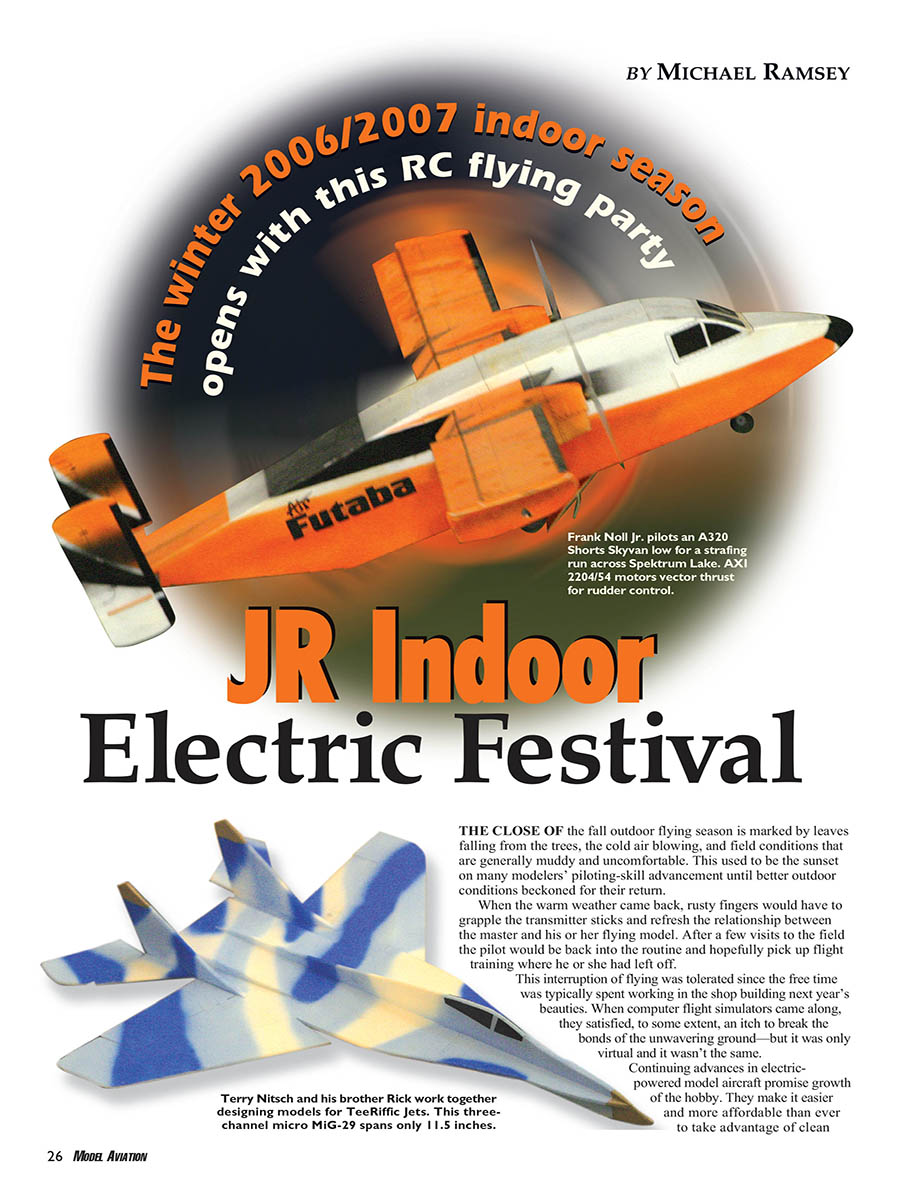
JR Indoor Electric Festival
By Michael Ramsey
The close of the fall outdoor flying season is marked by leaves falling from the trees, cold air blowing, and field conditions that are generally muddy and uncomfortable. That used to be the sunset on many modelers' piloting-skill advancement until better outdoor conditions beckoned for their return. When warm weather came back, rusty fingers would have to grapple the transmitter sticks and refresh the relationship between the master and his or her flying model. After a few visits to the field the pilot would be back into the routine and hopefully pick up flight training where he or she had left off.
This interruption of flying was tolerated since the free time was typically spent working in the shop building next year’s beauties. When computer flight simulators came along, they satisfied, to some extent, an itch to break the bonds of the unwavering ground—but it was only virtual and it wasn't the same.
Continuing advances in electric-powered model aircraft promise growth of the hobby. They make it easier and more affordable than ever to take advantage of clean and quiet flight whether a modeler is a beginner or an expert. Because electric models are small and light, they impose fewer safety hazards. Flying these aircraft indoors in close proximity has gained enough popularity that the number of events in which to do so has increased steadily in the last five years.
For the last four years the JR Indoor Electric Festival has kicked off the indoor flying season. It is usually held the first week of November; in 2006 it was Saturday the 4th and Sunday the 5th. The event is hosted by the Columbus Indoor Flight Association (CIFA) and directed under the guidance of master modeler Terry Nitsch. For a number of years the CIFA has been flying at the Four Seasons Golf Dome in Columbus, Ohio, usually on Saturday mornings throughout the winter months.
Top 10 Reasons to Fly Indoors
- 10. It never rains.
- 9. There's always someplace to land.
- 8. Electric power is used, so there's no cleanup.
- 7. There are no trees to crash into.
- 6. Flying out of sight isn't an option.
- 5. You can fly all year.
- 4. The runway is smooth.
- 3. Landings are into the wind.
- 2. The sun is always out, even at night.
- 1. It's a thrill for everyone!
These flying engagements are normally exclusive to members, but any AMA member is welcome to participate in the JR Indoor Electric Festival. To fly through Saturday and Sunday a pilot must register and pay a fee of $30. For that modest amount he or she receives 19 hours of flying time, increased steadily in the last five years. In addition, as a gift from Horizon Hobby this year every pilot received a pair of Spektrum microservos (a $30 value) and the chance to win one of the many products given away all weekend as door prizes.
Venue and Facilities
Flying an RC model aircraft indoors is a challenge but is not outside the average model pilot's grasp. The golf dome's inflated structure (basically a balloon staked to the ground) is unique in that the atmosphere inside is at a slightly different pressure; you'll feel your ears pop while passing through the revolving door. The temperature inside is kept comfortable (about 58°–60°). Although the "ground" is technically on six sides of the airspace, the semisoft walls are netted and fairly harmless to any models that make contact.
The floor is extremely active, with plenty of flying and vendors and exhibitors organized in a double row that stretches across the entrance wall. The pit area is underneath and in front of the second-floor driving area. The second floor accommodates a few vendors but is mostly kept open for spectators who want to relax and enjoy the air show. The view of the 87,000-square-foot area is great from up there.
Flying Zones and Event Flow
The flying area is partitioned into three zones:
- South wall: 3-D flying and helicopters.
- Center: the "racetrack" area for open or feature flying.
- North wall: the micro-flying area for models weighing less than about 2–3 ounces and flying slower than 10 mph.
Depending on participation, time slots are sometimes reserved for specific aircraft types to fly within the racetrack. In practice most pilots flew whatever they wanted and when they wanted, which is how fun-fly events usually are.
Models and Flying Styles
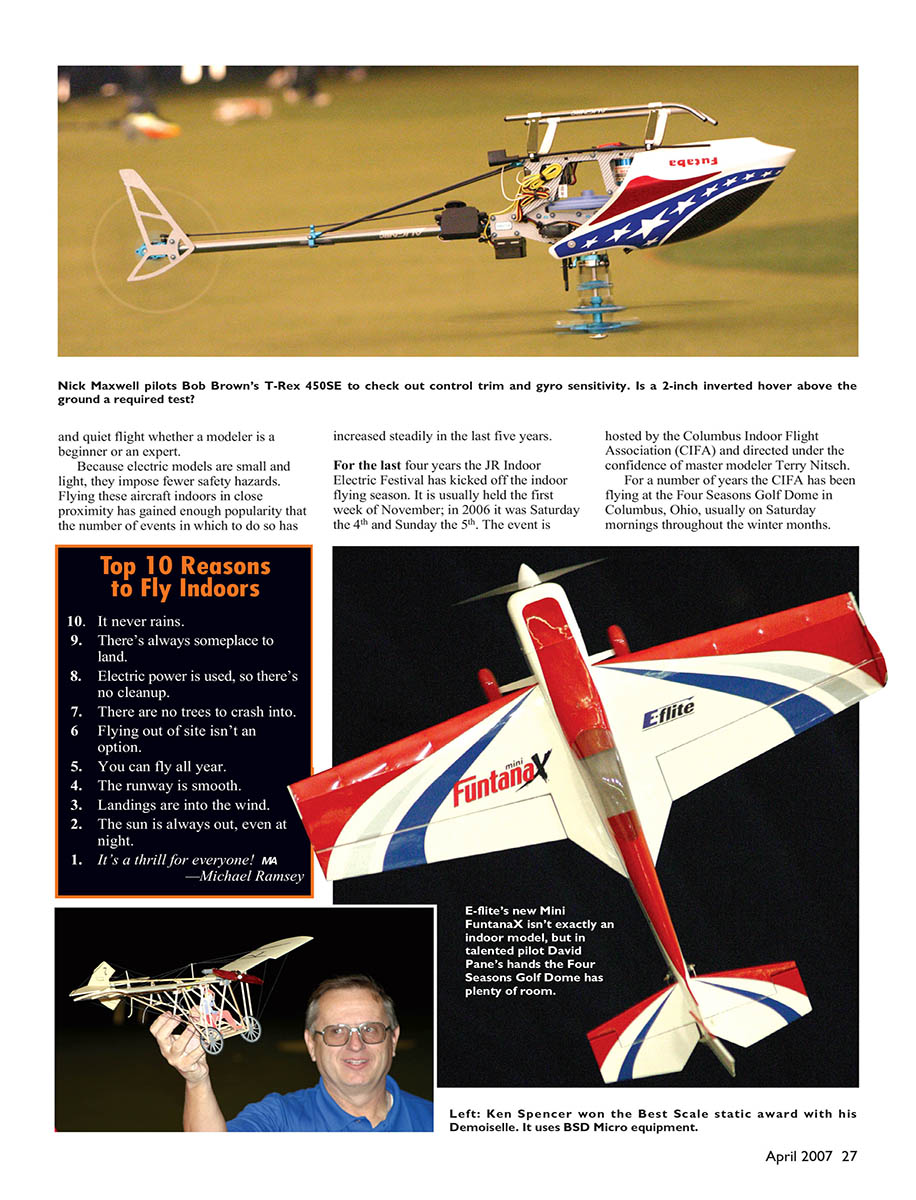
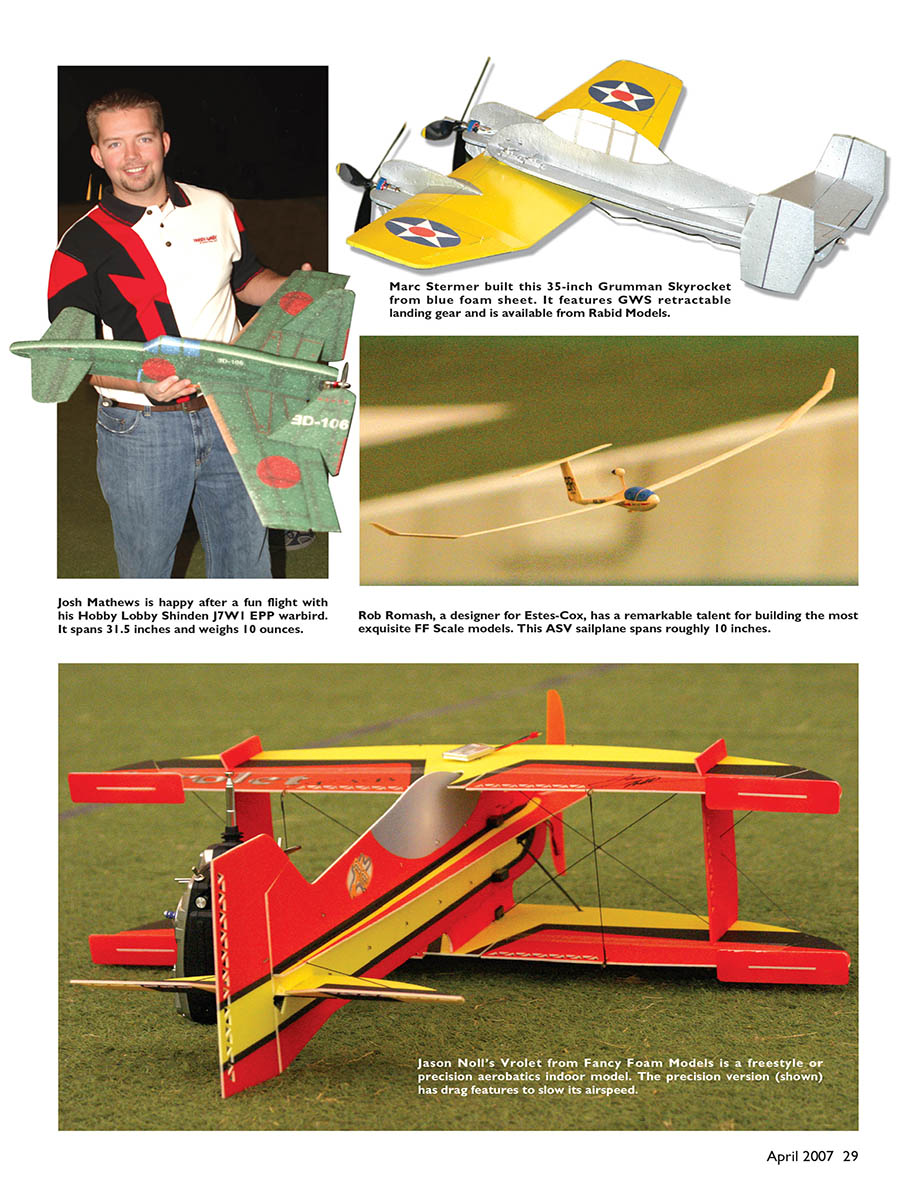
I found the jets' popularity remarkable. Not too long ago "slow" was the way to go indoors; recently it seems almost any type of flying is possible. The flat foamie still reigns supreme as the model of choice for most indoor activity. They were the most common at the event. For versatility and capability the 3-D foam aircraft can't be beaten: they're easy to fly, inexpensive to set up, and an excellent training tool for any RC pilot.
The "flat foam" style isn't limited to aerobatics. With a little imagination modelers have been exploring scale subjects that are remarkably attractive and fly with relative ease in profile. Many of the jets at the event were built with flat-foam construction; there was a variety of warbirds and civilian aircraft. In fact, three of the seven event awards went to models constructed from foam.
Spektrum Lake
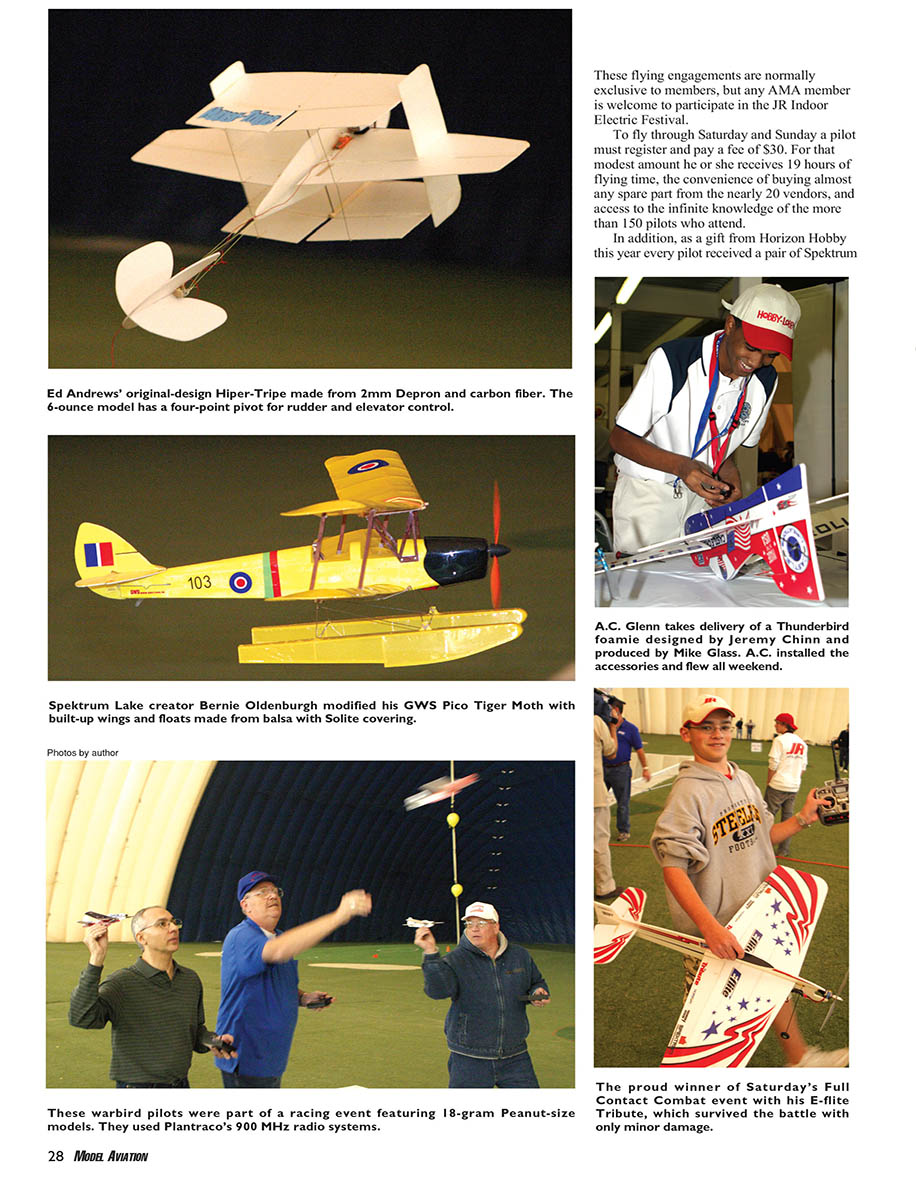
One of the most original features added to the landing zone was "Spektrum Lake." Bernie Oldenburgh engineered the 15 x 50-foot pond from 2-inch PVC pipe and thick plastic drop cloths. Bernie was often seen enjoying his creation while flying his modified GWS Pico Tiger Moth. The yellow biplane was unique because he made its built-up balsa wings and custom stick-built balsa floats covered in Solite film.
Bernie's model took advantage of foam simplicity and balsa-engineering opportunities. His Tiger Moth was actually lighter than the stock GWS model on floats, so it flew at scale speeds and was a pleasure to watch do touch-and-gos.
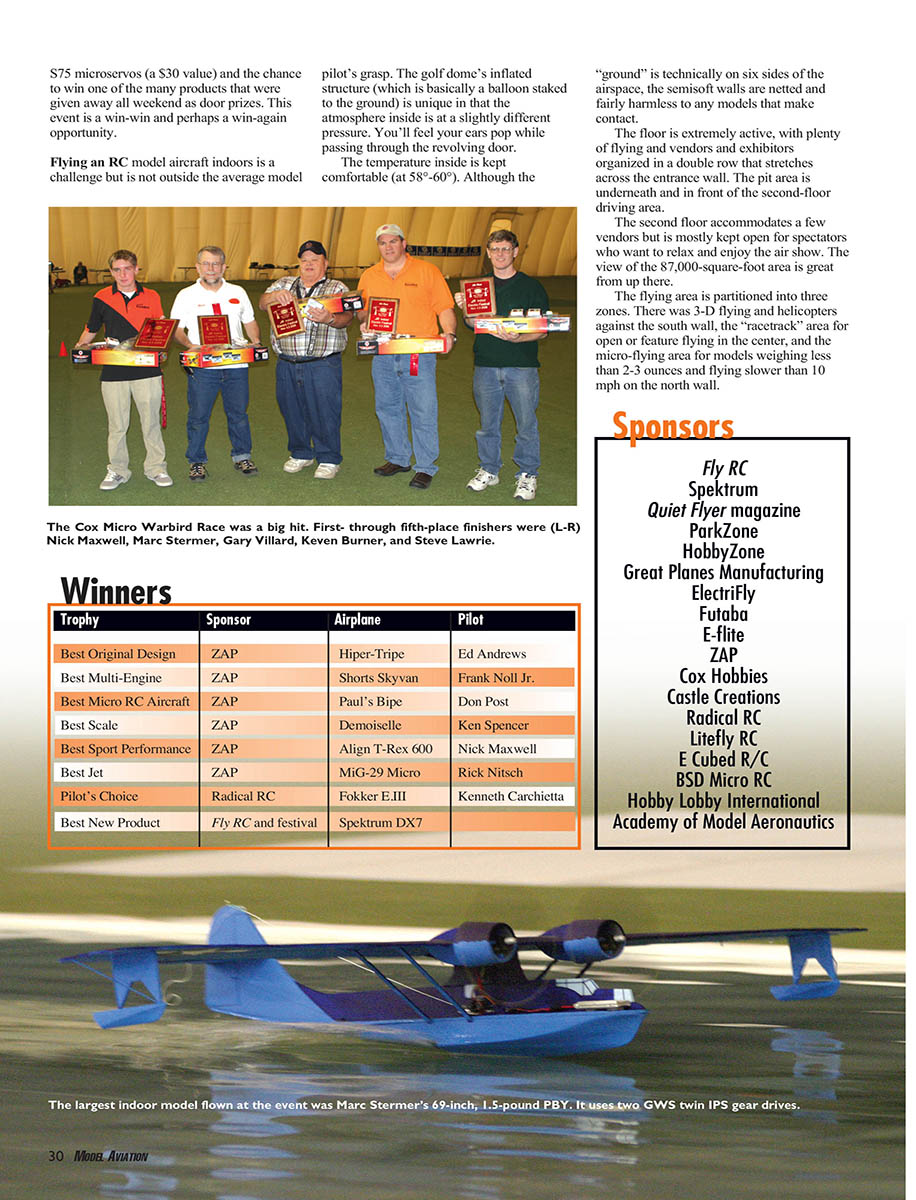
Cox Micro Warbird Air Races
Another feature added to this year's festival was the Cox Micro Warbird Air Races. The popularity of these little 20-inch airplanes is remarkable. They can be purchased as kits for approximately $30 or as complete RTFs for roughly $90. If you think about it, getting involved with indoor electric flight for less than $100 is astounding.
These heavy metal models need to be lightened to be decent racers, but the rules were written so that the only allowable change to the stock model is the battery pack. Changing from a six-cell NiMH to a 7.4-volt Li-Poly makes a world of difference, and these airplanes get easier to fly the faster they go. Keeping the warbirds on the tight track was the hardest part of the contest, and that's the trick the winning pilots had mastered. Approximately 30 pilots competed in the Cox races; I think you'll see this event at many future fun-flys.
Seminars
Several seminars were held during the weekend. Hosted by John Adams of Horizon Hobby, these lectures updated modelers on hot new technologies in the sport, including the broadband radio system by Spektrum and mini helicopters such as the Blade and T-Rex machines. John is an excellent speaker and is basically the horse's mouth when it comes to those subjects. Attendees came away with a much better understanding and found John's donated time valuable to their enjoyment of the sport.
Full Contact Combat
Full Contact Combat was one of the more extreme events held. It wasn't for everyone, but it attracted many willing pilots who had the entry fees and the sacrificial models to participate. Pilots flew tightly packed and demolished their opponents; it was easy to see they were having a good time. The crowd cheered on roughly a dozen fliers on Saturday, and a second event was held by popular demand on Sunday that included approximately 17 pilots.
Some competitors had built combat models as flying wings that were fast and durable. Among the slow flyers piloted by entrants who played for the heck of it, about the best the flying wings could do was make "near miss" strafing runs. In the end each Combat contest was won by the seemingly hopeless underdog. Dramatics like that are part of what makes the JR indoor event special.
Night Moves and Hospitality
If you're not a morning or day person, the event won't leave you hanging. After the Cox racing, the interior lights were dimmed at 7 p.m. for the "Night Moves" simulated night-flight session. It wasn't totally dark in the dome; it was more like dusk, which meant only a few colored LEDs were needed to identify a model. Helicopters and fixed-wing aircraft were flown.
Later that night, from 8:00 until late, Saturday's activities concluded with a hospitality party featuring Thacker's Texas hold 'em in the "ZAP Tap Room" at the Ramada Inn (the host hotel that was just a block away).
Conclusion
I found the JR Indoor Electric Festival to be well organized with strong sponsor support that attracts active and enthusiastic members into the hobby. Experiencing this event for the second year in a row definitely raises the bar as far as my expectations for the next indoor event I attend.
MA —Michael Ramsey [email protected]
Other Resources
- RCgroups.com
- http://www.rcgroups.com/jr-indoor-electric-festival-2006-439/
- Quiet Flyer, January 2007
- Fly RC, March 2007
- CIFA, http://www.jriefestival.com
Transcribed from original scans by AI. Minor OCR errors may remain.

