
JR Indoor Electric Festival - 2010/04
by Jay Smith
The 6th annual JR Indoor Electric Festival was held November 6–8, 2009, at the Four Seasons Golf Dome in Columbus, Ohio. Nearly 200 pilots turned out at the newly reconstructed venue after the previous year’s fly-in was canceled due to heavy wind damage to the dome. The flattened structure warranted a total rebuild, and pilots were glad to be back.
Venue and organization
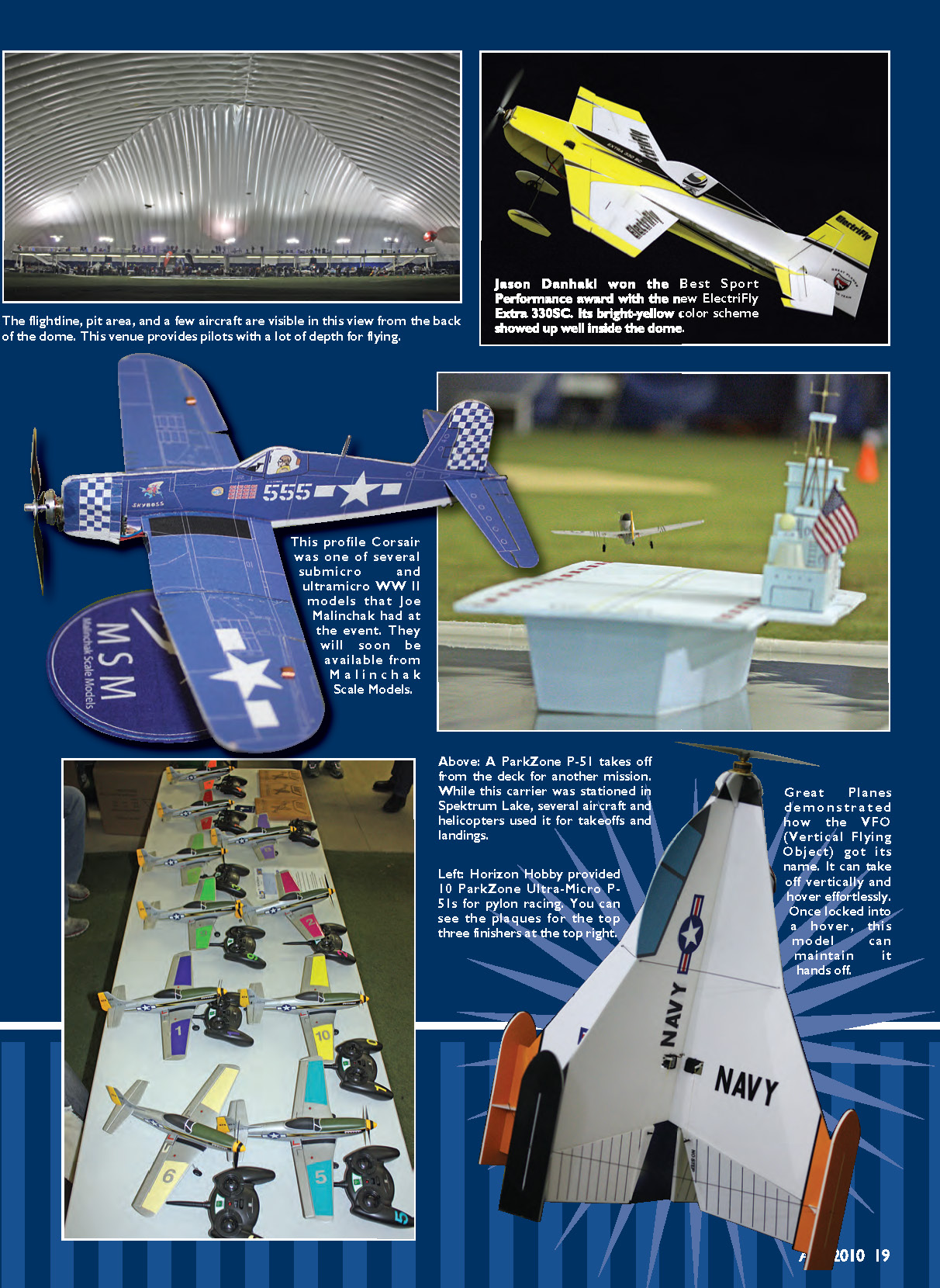
At a distance, the dome looks almost like a giant, overinflated first-base bag from Little League days. Up close you realize its size is perfect for letting golf balls—or aircraft—fly inside. To keep the dome inflated, constant air pressure is maintained; that is achieved with a revolving door. It can be challenging to get both pilots and models through it, but once inside you can appreciate the wide-open flying space with considerable depth.
Lighting in the dome was provided by spotlights positioned behind the pilot stations, allowing the flying area to be well lit without blinding the fliers. Behind the flying area was a pit area with numerous tables for charging batteries and working on aircraft. Just above the pits, a second level provided a different perspective on the action. Food and RC vendors lined the back wall inside the dome.
Event organizer Terry Nitsch and his Columbus Indoor Modelers Association crew did an excellent job of keeping the fly-in running smoothly and giving all modeling disciplines time to fly. There were scheduled slots for jets, helicopters, ultramicro aircraft, and scale models for those who preferred to avoid heavy open-flying traffic.
Spektrum Lake and special attractions
One of the best features of the JR Indoor event is "Spektrum Lake." The 16 x 48-foot water runway allowed floatplanes and float-equipped helicopters to operate indoors, adding a great deal to the gathering. Even if models took a dive, they were usually easy to recover and ready to fly again quickly.
- Floats were popular on many models, including a Vapor and an oversized RC version of the AMA Cub, both of which handled water takeoffs well.
- Several fliers attempted takeoffs and landings from the deck of an RC aircraft carrier built from foam by Steve Sripol; that spectacle entertained many spectators.
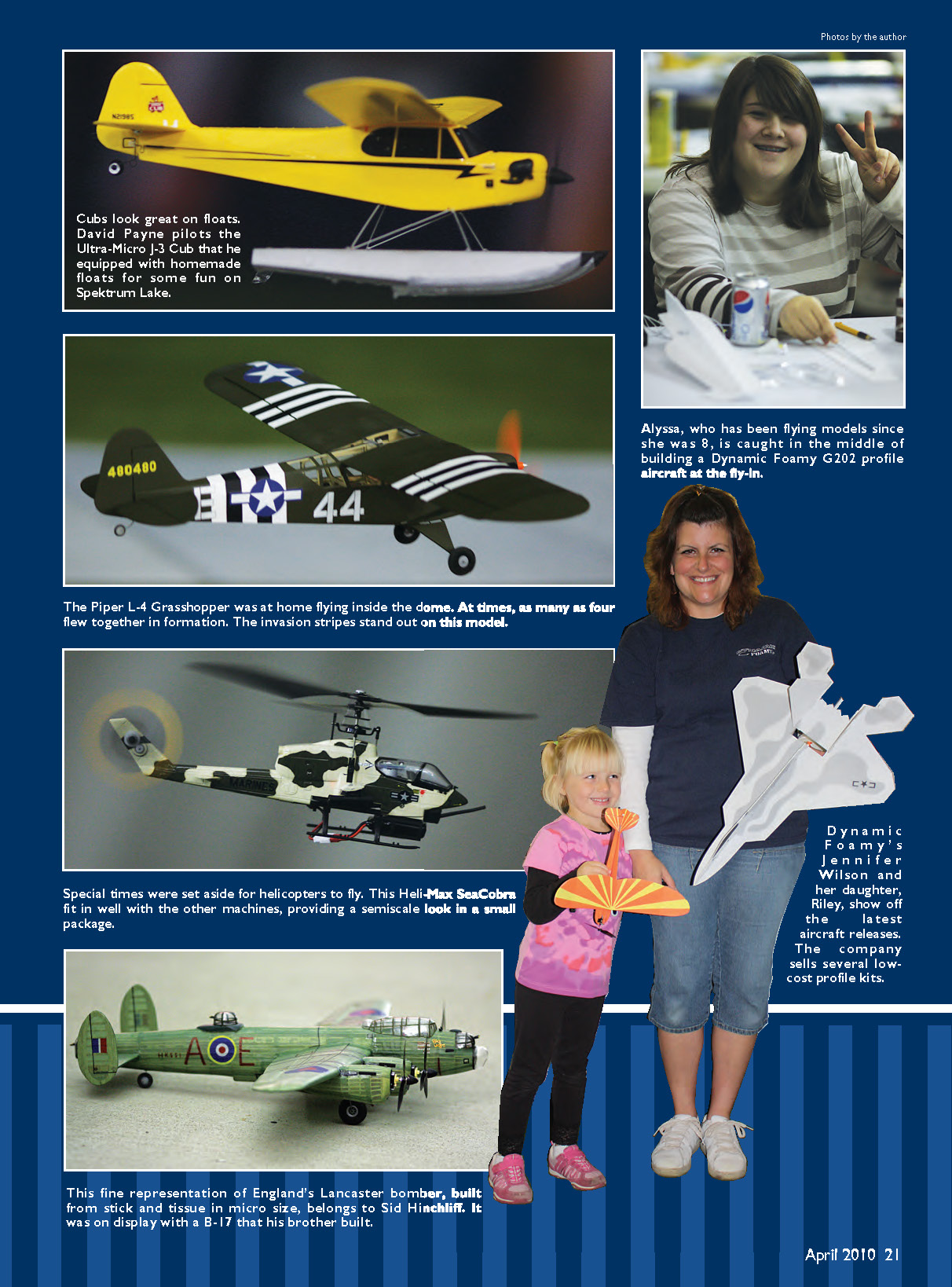
- Special helicopter-only flying times were set aside. The Heli-Max SeaCobra, for example, provided a semiscale look in a small package.
Notable aircraft and pilots
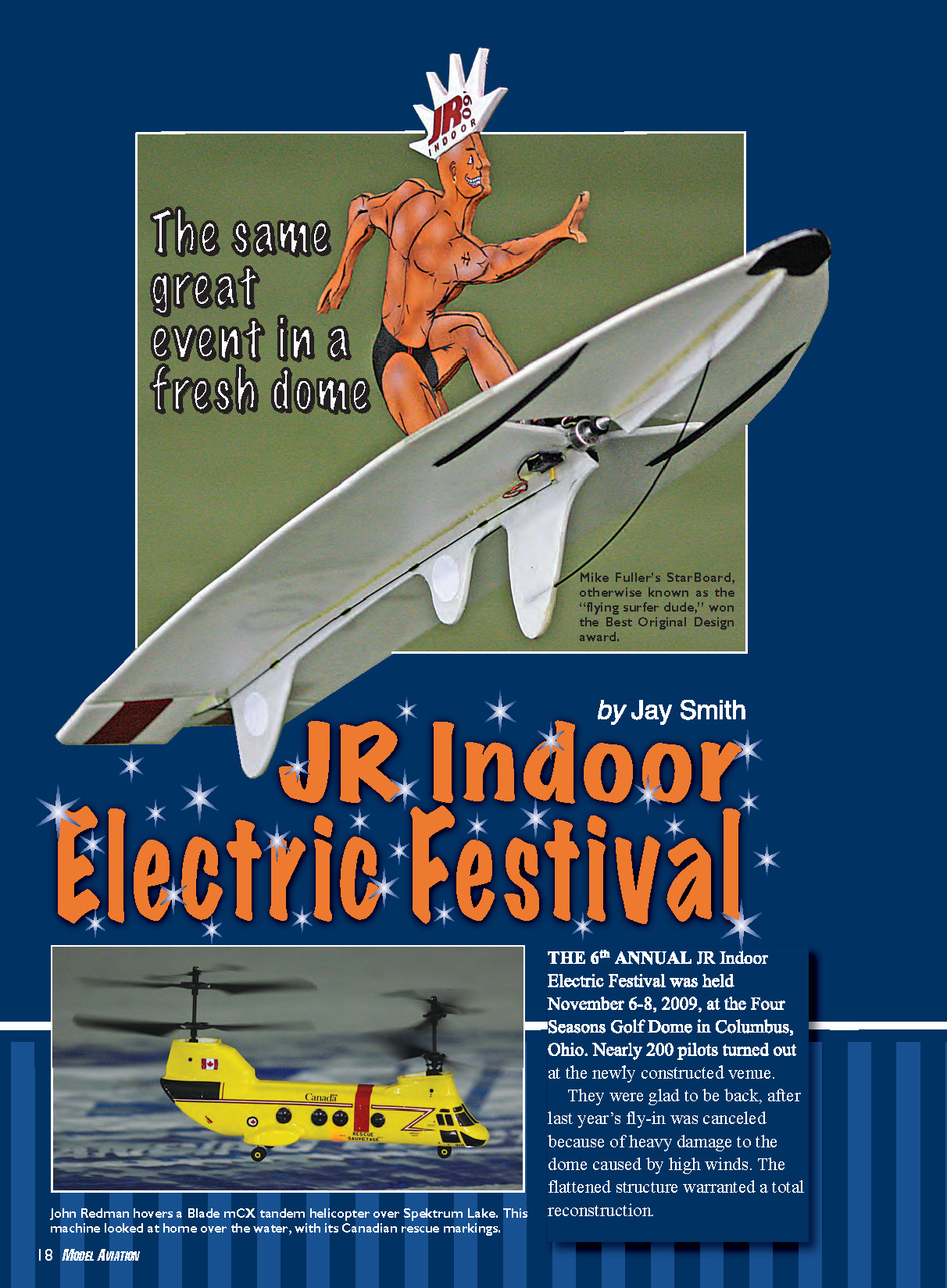
- Mike Fuller’s StarBoard, the “flying surfer dude,” performed low, slow passes over Spektrum Lake and won Best Original Design.
- Jason Danhakl won Best Sport Performance with the ElectriFly Extra 330SC, whose bright-yellow color scheme showed up well inside the dome.
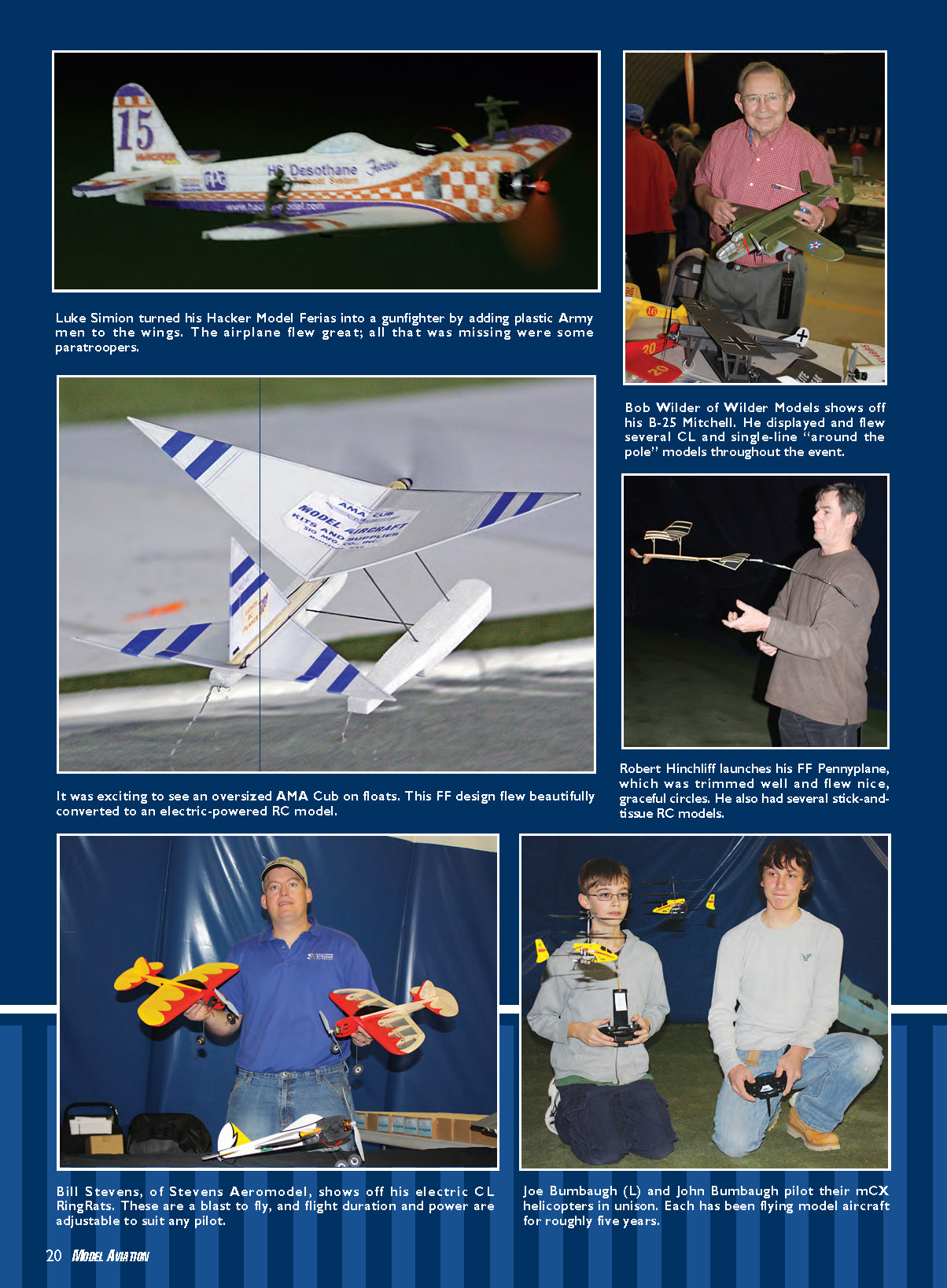
- Robert Hinchliff launched his free-flight (FF) Pennyplane, which was nicely trimmed and flew graceful circles; he and his brother Sid brought many stick-and-tissue micro models.
- Sid Hinchliff displayed a fine micro stick-and-tissue representation of England’s Lancaster bomber alongside a B-17 his brother built.
- Bob Wilder of Wilder Models showed off a B-25 Mitchell and flew several control-line and single-line “around the pole” models throughout the event.
- Joe and John Bumbaugh flew their mCX helicopters in unison; each has been flying model aircraft for roughly five years.
- Luke Simion converted a Hacker Model Ferias into a “gunfighter” by adding plastic Army men to the wings—the airplane flew great.
- An oversized AMA Cub on floats and an Ultra-Micro J-3 Cub equipped with homemade floats (piloted by David Payne) were among the floatplane highlights.
- Bill Stevens, of Stevens AeroModel, displayed electric control-line RingRats—adjustable for duration and power—and hosted flights of his new CL electric RingRat.
- Jennifer Wilson and her daughter Riley of Dynamic Foamy showcased the company’s low-cost profile kits, including the Dynamic Foamy G202.
- Joe Malinchak’s line of submicro and ultramicro profile WWII fighters impressed crowds; his full-fuselage PT-17 Stearman earned Best Micro RC Aircraft.
Competitions and events
The festival featured several contests to keep things interesting between open-flying sessions:
- Full-contact Combat: Contested on Saturday with about two dozen participants competing for a $240 prize. Many pilots and aircraft went down in glory; Matt Andren and his ParkZone Mini Super Cub emerged victorious.
- ParkZone P-51 Mustang air races: Four aircraft raced at a time with winners determined by lap count. Horizon Hobby donated all RTFs for the contest to keep the competition equal. David Payne was named the winner of the races; the top fliers received the models they flew.
- A hanging bulls-eye (banner) contest challenged pilots to fly their models through it for prizes.
Vendors, products, and giveaways
- Goody bags were handed out at check-in. Depending on arrival time, pilots received items such as a Spektrum AR6100 receiver, a Thunder Power battery, or a Zap CA fix-it kit.
- Vendors and manufacturers on site included: Hobbico, Horizon Hobby, 2DogRC, Hobby Lobby, Model Aero, Dynamic Foamy, Lazertoyz, Stevens AeroModel, and others. New releases spanned World War I and II models, jets, helicopters, and aerobatic/3-D aircraft.
- Bill Stevens provided the author an opportunity to fly the new CL electric RingRat. The model was electronically adjusted for one-minute flights at 70% power; the author enjoyed multiple flights and was reminded how fun control-line flying can be.
Awards and highlights
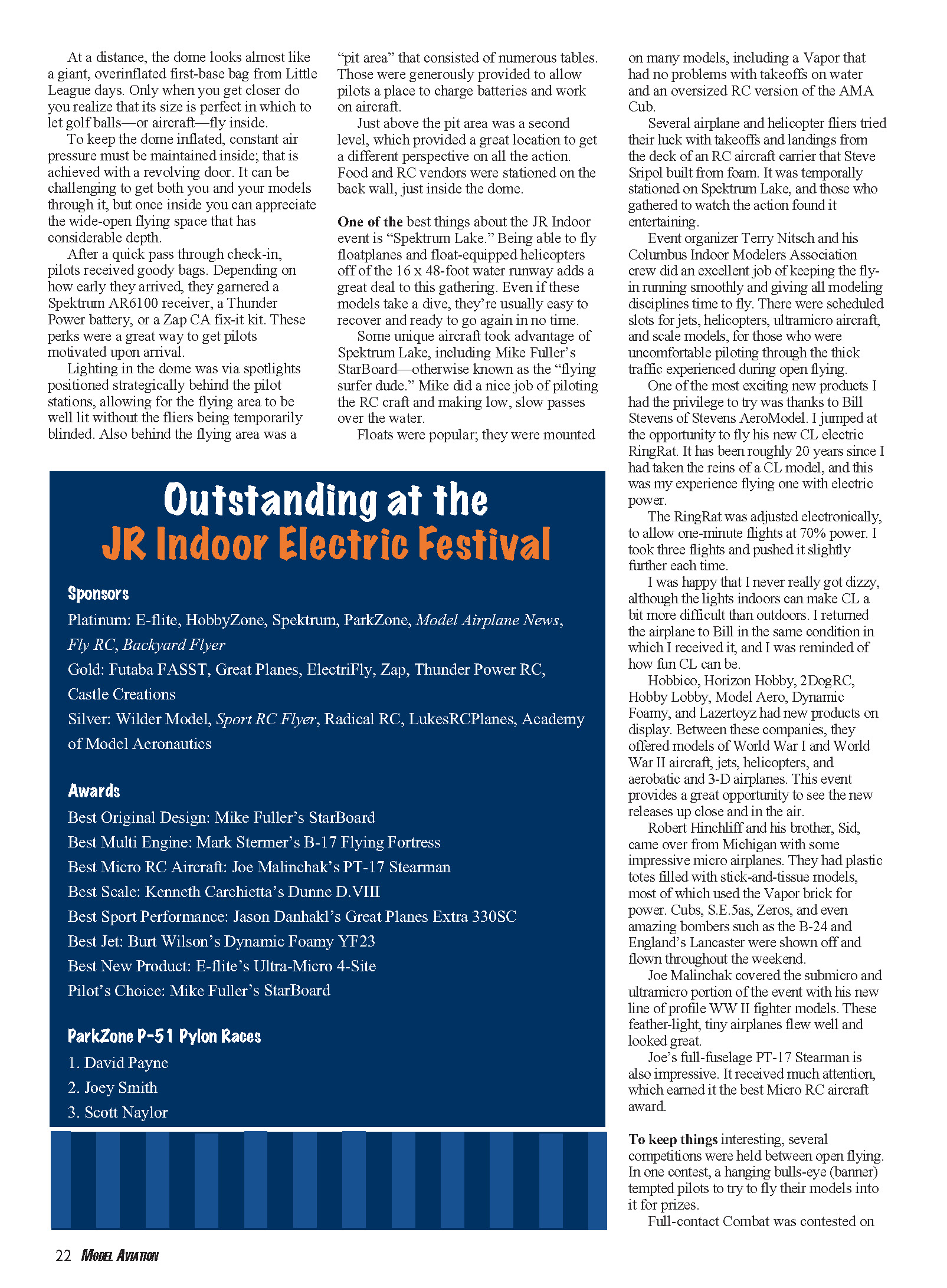
- Best Original Design: Mike Fuller — StarBoard ("flying surfer dude")
- Best Sport Performance: Jason Danhakl — ElectriFly Extra 330SC
- Best Micro RC Aircraft: Joe Malinchak — PT-17 Stearman
- Full-contact Combat winner: Matt Andren — ParkZone Mini Super Cub
- ParkZone P-51 race winner: David Payne
Sponsors (Platinum)
- E-flite
- HobbyZone
- Spektrum
Other participating vendors and supporters
- Hobbico, Horizon Hobby, 2DogRC, Hobby Lobby, Model Aero, Dynamic Foamy, Lazertoyz, Stevens AeroModel
Conclusion
The JR Indoor Electric Festival is a great way to kick off the winter indoor flying season. Whether you live in a climate that permits year-round outdoor flying or not, the event offers a welcome chance to fly small electric-powered models without concern for wind and weather. It’s inspiring to see builders pushing the limits with diminutive components and ultra-light materials to create micromasterpieces. If you want a great venue to fly, or a sneak peek at upcoming products, the JR Indoor Electric Festival won’t disappoint.
Jay Smith [email protected]
Sources: JR Indoor Electric Festival — www.jriefestival.com
Transcribed from original scans by AI. Minor OCR errors may remain.

