
Junior FF World Championships
By Dave Rounsaville and Terri Popiel
An historic first: Team USA Juniors sweep all team events; Cody Secor takes individual F1P Power title
It all came together for the American kids on a former MiG fighter base near Staßfurt, Germany, in Magdeburg-Cochstedt, August 21–25, 2006. You couldn't have written a better script; there was excitement and drama, and it was a magical experience for Team USA.
The organization of the contest was exceptional overall—especially considering the challenging weather and retrieval conditions. Many round-schedule changes and postponements throughout the competition didn't seem to phase the US Juniors, as they "took all the marbles."
I've been to many Senior FF World Championships throughout the years (at least 16) and even represented Team USA on one of those trips. World Championships contests are an incredible experience for so many reasons. The people, friendships, and memories are long-lasting and special; the stories are entertaining, exciting, and unforgettable. This was my first Junior World Championships, and it was one of the best contests I have ever witnessed on any level.
I knew a few of the kids who competed beforehand but got to know them all much better as the contest progressed. I was impressed by their camaraderie and chemistry. They had that rare ability to clown around and have fun, but then be able to get down to serious flying.
F1P World Champ Cody Secor
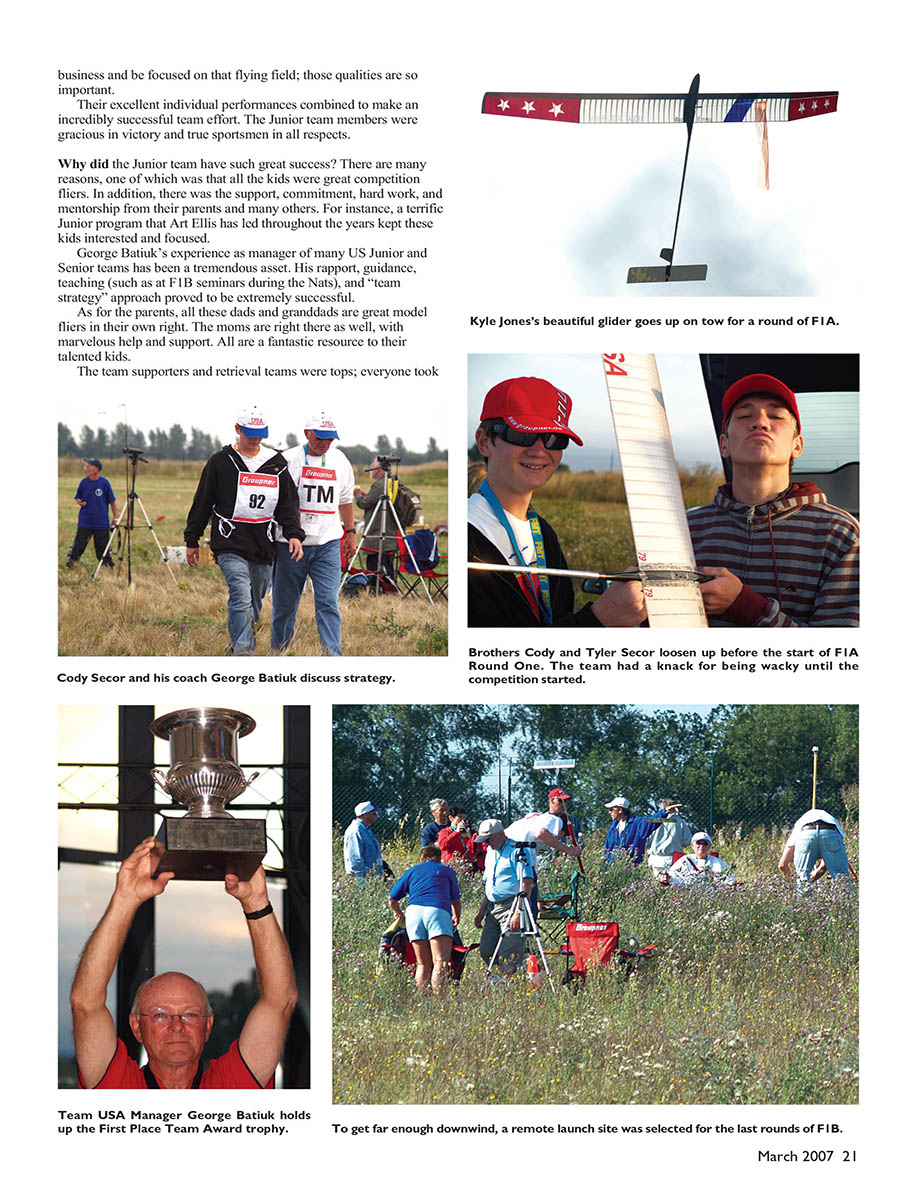
Born in Southern California on February 8, 1990, Cody Secor has been flying free-flight models with his dad Randy, sister Janessa, and brother Tyler since age three. Cody has always been spirited and has had a strong idea of what he wants to do and how to do it.
The performance he put in to become World Champ on the morning of August 24 at Cochstedt airfield in Germany is a fine example of his clear thinking and tenacity. It became his goal after he came up one second short of reaching the flyoffs in the World Champs in France in August 2004 (Cody placed fourth overall in that contest and helped the US team earn its well-deserved victory in F1P Power).
Cody comes from a long line of great model-airplane fliers. His dad Randy has held many national records and won many national titles in Rubber and Power events. His grandfather Al Hotard is the "father" of the America's Cup and a perennial team supporter.
Cody currently holds the Junior National Record in F1P and now has his sights set on winning the America's Cup this year. He has many contest wins to his credit in local California contests and Nats competitions at Muncie. Cody is a team player as well, and helped Team USA achieve its well-deserved victory at the Junior World Champs.
At the 2006 World Champs Cody flew a tested and proven Astro-Star modified with VIT (variable incidence tailplane) and forward rudder, powered by a Galbreath-tuned .061 Cyclon glow engine. His power patterns were extremely consistent and "on rails" for each flight. His model was usually the highest climber when viewed from any part of the flying field. Fuel shutoff and DT were via a 3F unit by Texas Timers.
Their excellent individual performances combined to make an incredibly successful team effort. The Junior team members were gracious in victory and true sportsmen in all respects.
Why did the Junior team have such great success? There are many reasons. All the kids were great competition fliers. In addition, there was the support, commitment, hard work, and mentorship from their parents and many others. For instance, a terrific Junior program that Art Ellis has led throughout the years kept these kids interested and focused.
George Batiuk's experience as manager of many US Junior and Senior teams has been a tremendous asset. His rapport, guidance, teaching (such as at F1B seminars during the Nats), and "team strategy" approach proved to be extremely successful.
As for the parents, all these dads and granddads are great model fliers in their own right. The moms are right there as well, with marvelous help and support. All are a fantastic resource to their talented kids.
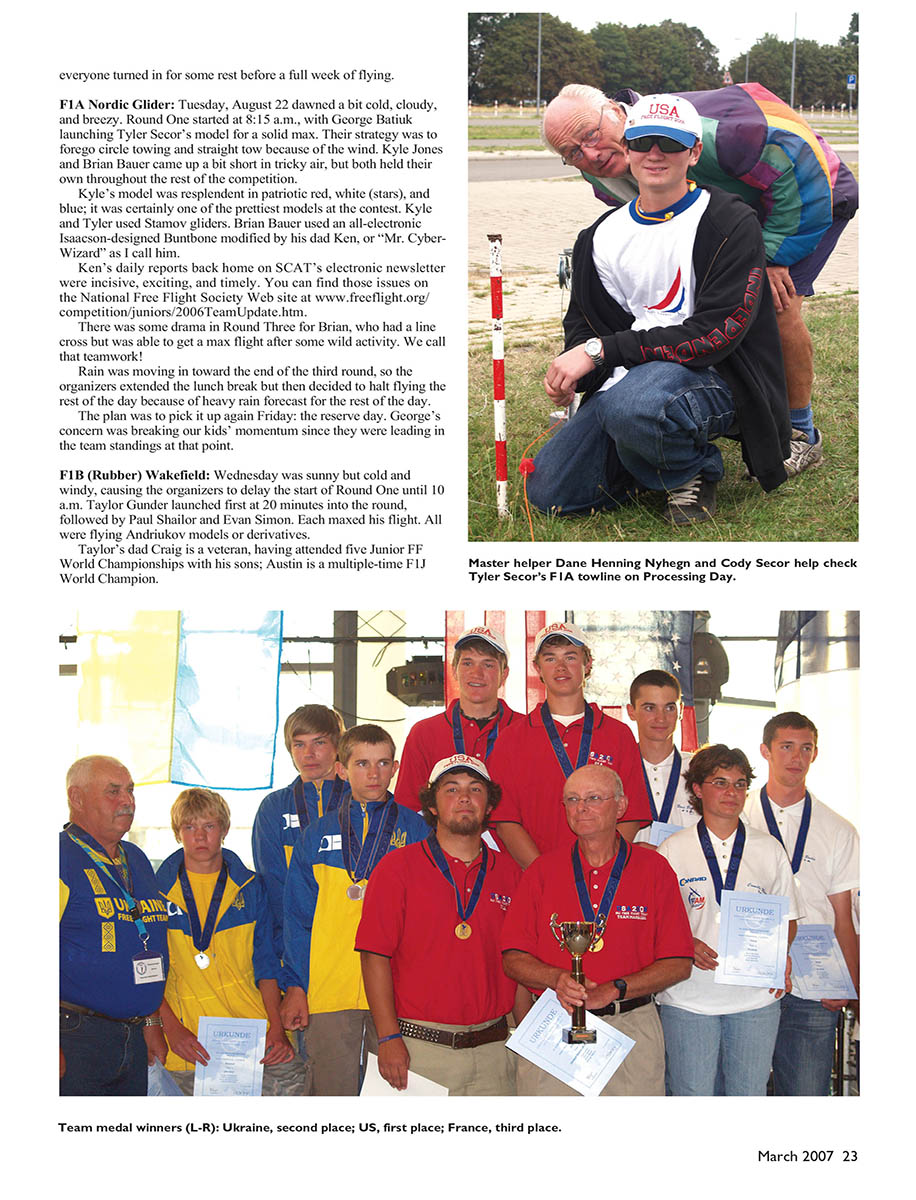
The team supporters and retrieval teams were tops; everyone took an active role. Our Danish friend Henning Nyhegn (pronounced new-hine) brought his motorbike, know-how, and tree-extraction poles. His expertise on the GPS, along with Ken Bauer's, for those extra-long chases was invaluable.
Danish teams have always been known for their incredible teamwork ethic. There is a longstanding US/Danish team friendship dating back to the 1960s, which Henning continues.
World Championships veterans Craig Gunder, along with Bob and Connie Piserchio, were a constant support and presence in so many ways, especially for retrieval.
Al and Judy Hotard were definitely missed; Tyler and Cody Secor's grandparents had to stay home for medical reasons and couldn't be there to cheer on their grandsons as they did at the last Junior World Champs in France in 2004. That's the Champs I had to miss because of a severe shattered wrist—bad timing on my part. I learned my lesson, though: don't clean gutters two days before a big trip!
My beautiful helper Terri and I arrived at Berlin, Germany, at 8 a.m. Monday, August 21, after a smooth flight with no security issues. Our ever-faithful friend Henning was there early to pick us up. We arrived at the flying site two hours later, with the help of Henning's Danish-speaking car GPS unit nicknamed "Niels."
Still on East Coast time, Terri and I stumbled around to the hotel where we found fabulous accommodations with clean rooms, great food, and many activities for the fliers, including an indoor pool and "Bowling for Euros." A big thanks to AMA and George for planning the trip so well.
Next on the agenda was to get cleaned up and back to the field for the opening ceremonies. That is where Evan Simon's dad Greg came to our rescue, as he did so many times (five, in fact). We enjoyed our rides to and from the field with the "Simon Clan" throughout the contest—what great hospitality. We also got to know Greg's wonderful dad Paul, who is a super contest flier.
At the field a band played and the teams marched onto the airport terminal tarmac carrying their respective flags and colors. This is always a great spectacle to see, especially as a participant. Afterward there was a relaxing dinner at the hotel before everyone turned in for some rest before a full week of flying.
F1A Nordic Glider
Tuesday, August 22 dawned a bit cold, cloudy, and breezy. Round One started at 8:15 a.m., with George Batiuk launching Tyler Secor’s model for a solid max. Their strategy was to forego circle towing and straight tow because of the wind. Kyle Jones and Brian Bauer came up a bit short in tricky air, but both held their own throughout the rest of the competition.
Kyle’s model was resplendent in patriotic red, white (stars), and blue; it was certainly one of the prettiest models at the contest. Kyle and Tyler used Stanov gliders. Brian Bauer used an all-electronic Isaacson-designed Buntbone modified by his dad Ken, or “Mr. Cyber-Wizard” as I call him.
Ken’s daily reports back home on SCAT’s electronic newsletter were incisive, exciting, and timely. You can find those issues on the National Free Flight Society Web site at www.freeflight.org/competition/juniors/2006TeamUpdate.htm.
There was some drama in Round Three for Brian, who had a line cross but was able to get a max flight after some wild activity. We call that teamwork!
Rain was moving in toward the end of the third round, so the organizers extended the lunch break but then decided to halt flying the rest of the day because heavy rain was forecast. The plan was to pick it up again Friday, the reserve day. George’s concern was breaking our kids’ momentum since they were leading in the team standings at that point.
F1B (Rubber) Wakefield
Wednesday was sunny but cold and windy, causing the organizers to delay the start of Round One until 10 a.m. Taylor Gunder launched first at 20 minutes into the round, followed by Paul Shailor and Evan Simon. Each maxed his flight. All were flying Andriukov models or derivatives.
Taylor’s dad Craig is a veteran, having attended five Junior FF World Championships with his sons; Austin is a multiple-time F1J World Champion. The two boys are different, hence the different events in which they compete. However, they share an objective: to have two models prepared that perform equally. If something happens to the first model, the backup is available and should fly the same.
After four more rounds of competition, a combination of wind and a farmer’s complaints about models and retrievers in his crops prompted a move for two start lines. The final move was to the far west end of the field, where the sixth and seventh rounds and the flyoffs would be flown.
There was much more drama in the sixth round. Evan Simon was the last to fly with just minutes to go. He launched, but the DPR (delayed propeller release) time was set too long. The model stalled before the propeller started and then crashed.
Taylor Gunder helped Evan ready his backup model. Evan wound and launched with only a few minutes left and got the max flight. What impressive teamwork.
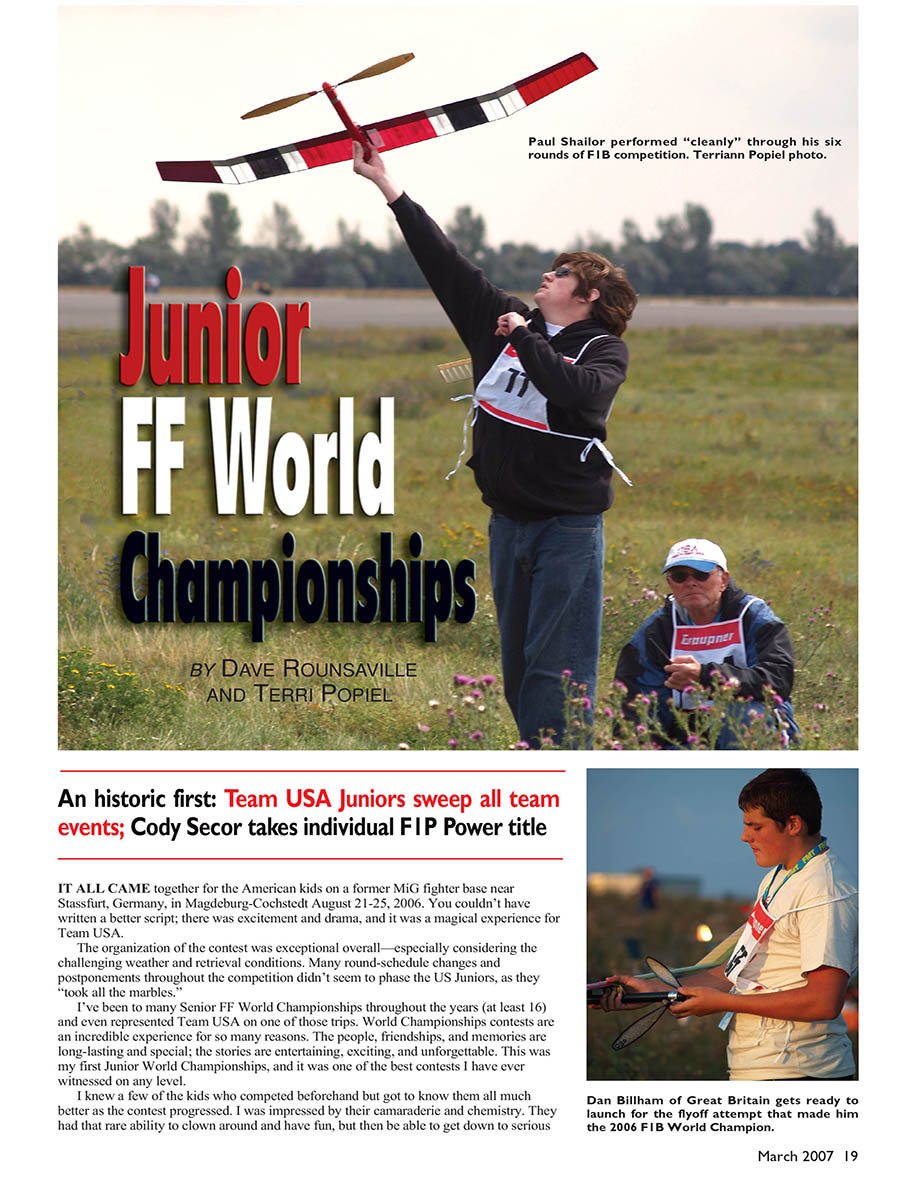
The seventh and last round started at 6 p.m. A zany pilot’s light-aircraft, low-altitude antics halted flying, but it was resumed after a short delay. Despite all his bad-luck experiences, Paul Shailor still had full max flights; he overcame many problems throughout the day to maintain his perfect score, including broken propeller blades in Round Four.
During the model-processing check Paul was told that his airplane was too big, but it was given the okay later. A TV crew that was watching caused enough of a distraction for Paul to crash in Round Five. His coolness under pressure probably comes from his dad Bill and the rest of those great Rubber fliers from Michigan.
Taylor launched first for a max to start the last round. The retrieval position was perfect to keep the models in sight.
Randy Secor headed up this crew. Craig Gunder took the first day and Charlie Jones managed F1P. All boys who were not flying took their turn, as did the parents and team supporters whose boys weren’t flying. Retrieving was made more difficult throughout the contest because of a high fence around the entire perimeter of the airport.
Paul was next and he launched into what looked like good air, but the model veered slightly toward the runway and was down at 2:49 according to our watches. However, the official timers clocked his flight at less. Paul was still happy, though, to be part of a great winning team.
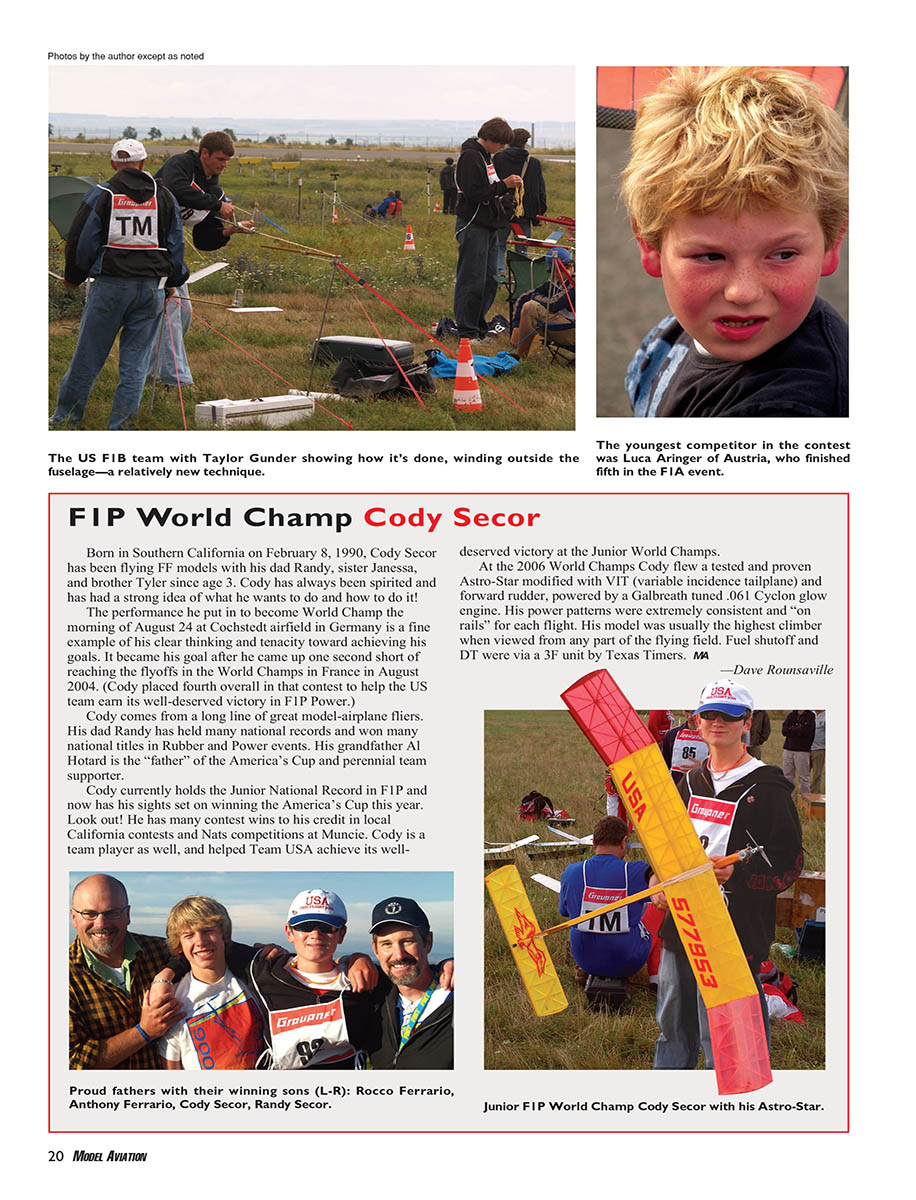
Evan finished the day with a close max near a tree. Dan Billham of the United Kingdom, whose climb I had been impressed with throughout the day, won the flyoff, which started at 7:30. A young Polish flier named Bartlomiej Skibicki came in second.
F1P Power
Thursday dawned as the best day of the week; it was warm and sunny. The first round started on time at 8 a.m.
This was the first time this new event was flown in World competition as a single event. F1J and F1P were flown together at the 2004 World Championships in France. US Champion Austin Gunder defended his title, but teammate John Lorbiecki edged him out to become the new Junior F1J Champion. Cody Secor dropped just one second to become the fourth man, which gave the US the first team position in Power.
Fast forward to this contest. Cody Secor was first up in Round One and got off to a good start with a nice max that used most of the nine-second motor run; his screaming Galbreath-tuned .061 Cyclon got his model away.
Brian Pacelli had an off-power pattern for a seemingly short flight, but his model hit the only chair on the field and suffered a damaged left LE. That flight didn’t have enough time to count as an official score. Undaunted, Brian got out another Vasily model and tried again.
The pattern was off slightly again, but it was decent enough for a good score. Brian held his own throughout the competition to help ensure the team victory. The day was beautiful and we never had to move the flightline.
Although they looked impressive, the composite models were not as consistent as Cody’s and Anthony’s well-built and trimmed balsa aircraft. Cody flew a forward-fin Astro-Star and Anthony flew a Dad Rocco original that incorporated a secret undercambered airfoil. The boys built most or all of their models.
Cody and Anthony have been in shoot-out flyoffs with each other before, and the performance of each of their models is close. Both used Texas Timers 3F timers and were extremely consistent. (Thanks, Hank Nystrom!)
The day ended with the US team in first place, with Cody, Anthony, and Poland's Pavlo Kildau maxed out. The flyoff was to be the next morning.
Next on the agenda were the F1A rounds that were postponed from two days prior. Another big thunderstorm moved through as the fourth, fifth, and sixth rounds were completed.
There was some excitement in Round Six. Brian Bauer was last to go and was circle towing with a thunderstorm approaching. His model DTed on the line, for some unexplained reason, as an attempt. The wind shifted 90° at that moment with high velocity as the storm hit. Brian straight-towed the same model immediately up and off with a perfect burst. It was in good air and maxed as the rain started coming down.
On Friday, the reserve day, the F1P flyoff started first at 7:30 a.m. It was a nice day again, with calm winds and sunny skies. The launch area was from the grass at midfield; all was ready.
Anthony was out doing a test flight that went a little longer than planned, but our marvelous retrieval crew got it back in plenty of time. Anthony was the first to fly in the round, and Cody fired up his Cyclon and launched soon thereafter.
Both had excellent power patterns. Cody got the highest for the win, and Anthony followed for second place. Poland's Robert Sawka's power pattern was a bit off and did not get as high but glided well for a respectable third place.
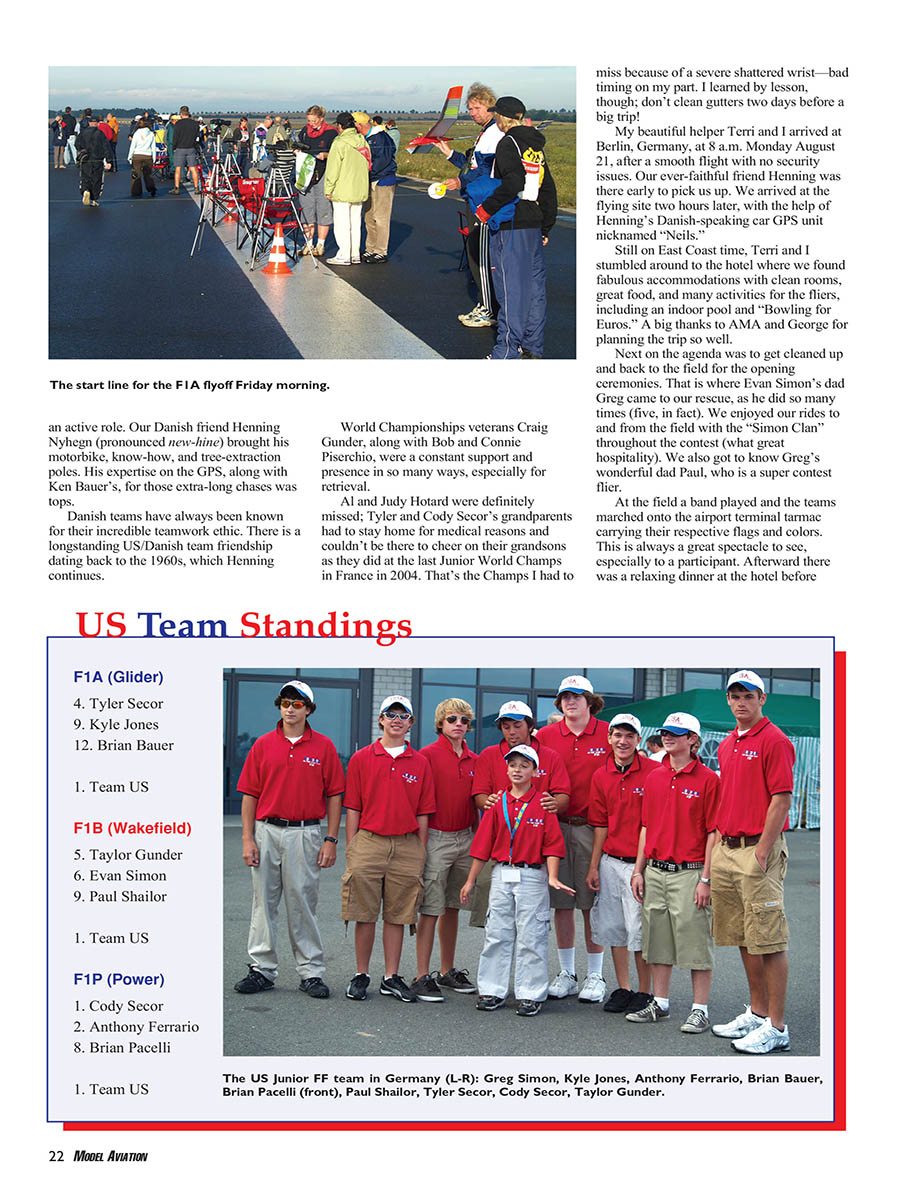
The F1A flyoff started at 8 a.m. in the same pleasant weather conditions with seven fliers. Tyler Secor was one of the first to go up and start circle towing upwind and to the right of the line over the runway. Halfway through the 10-minute window he decided to take his turn and had a beautiful launch that was followed by several other fliers.
Tyler's model glided well for a time of 3:49 and ended up in fourth place. The winner was Gabriela Domokova of Slovakia with a 4:40 flight. Tyler and all the US kids were happy overall!
The winning models were processed again to make sure they were within the required parameters. There were some tense moments because Anthony's airplane was extremely close, as noted during the first check. All turned out okay, although Anthony's dad Rocco may have lost a few pounds in sweat over the situation.
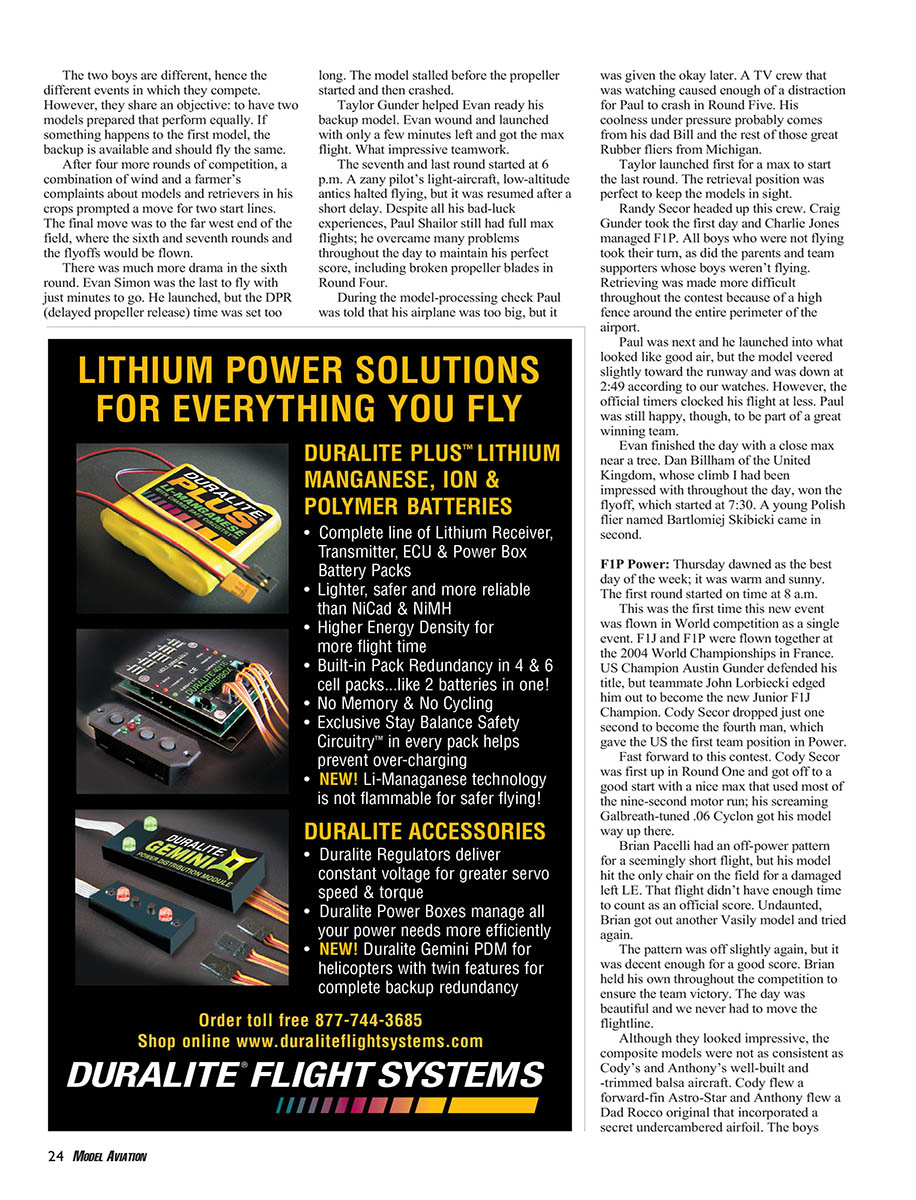
The rest of the day was left open, so people could decide whether to rest or go on some excursions in the beautiful German cities, towns, and countryside. The closing ceremony was beautiful and the awards presentation was moving. Hearing our national anthem played four or five times can give you goose bumps.
This US team took the coveted overall team award for winning all the individual events. It was the first Western country to do so, I believe. That is no small achievement.
Everyone parted ways with the thrill of the contest still sinking in. Terri and I went on our way to Denmark to visit and help celebrate my good and longtime friend Thomas Koster's (three-time World Champion) 60th birthday for a few days.
Randy Secor is a terrific model flier and longtime friend. I went to Germany to support him and his two boys this year. I've watched Tyler and Cody grow up. We've shared many wonderful flying experiences throughout the years, mostly in California.
We all worked together and supported each other to make this contest happen in many ways, and I am thrilled by the US Juniors' success. I'm certainly as proud as grandpa Al Hotard—the father of the America's Cup—and grandma Judy.
This contest ranked up there as one of the most thrilling and enjoyable World Championships I have had the privilege of witnessing. I hope I have been able to "take you there" to experience and share this amazing success story.
Dave Rounsaville [email protected]
Terri Popiel
Transcribed from original scans by AI. Minor OCR errors may remain.

