
King International Orange
A Look Back at 60 Years of Competition
by Brian Malin
At dinner one evening in 1954, my father, a master sergeant in the Marines, announced he had just received new orders and we were moving. Little did I know that it was to be the start of a life with model airplanes.
At Opa-locka Naval Air Station in Miami, my dad ran the motor pool and his orders were to organize soldiers with jeeps to retrieve Free Flight (FF) model airplanes at the first King Orange. The King Orange International (KOI) was organized to replace the Tangerine International that had been held in Orlando, Florida. In 1954, AMA Executive Director Russell W. Nichols approached Tom Sutor, a National Airlines pilot from Miami, and asked if he would take on the task of organizing a replacement meet. With the support of eight Miami-area clubs, the KOI Exchange Club Youth Aviation Association was formed. Tom later became known as “Mr. KOI” after organizing nine KOI meets between 1954 and 1963.
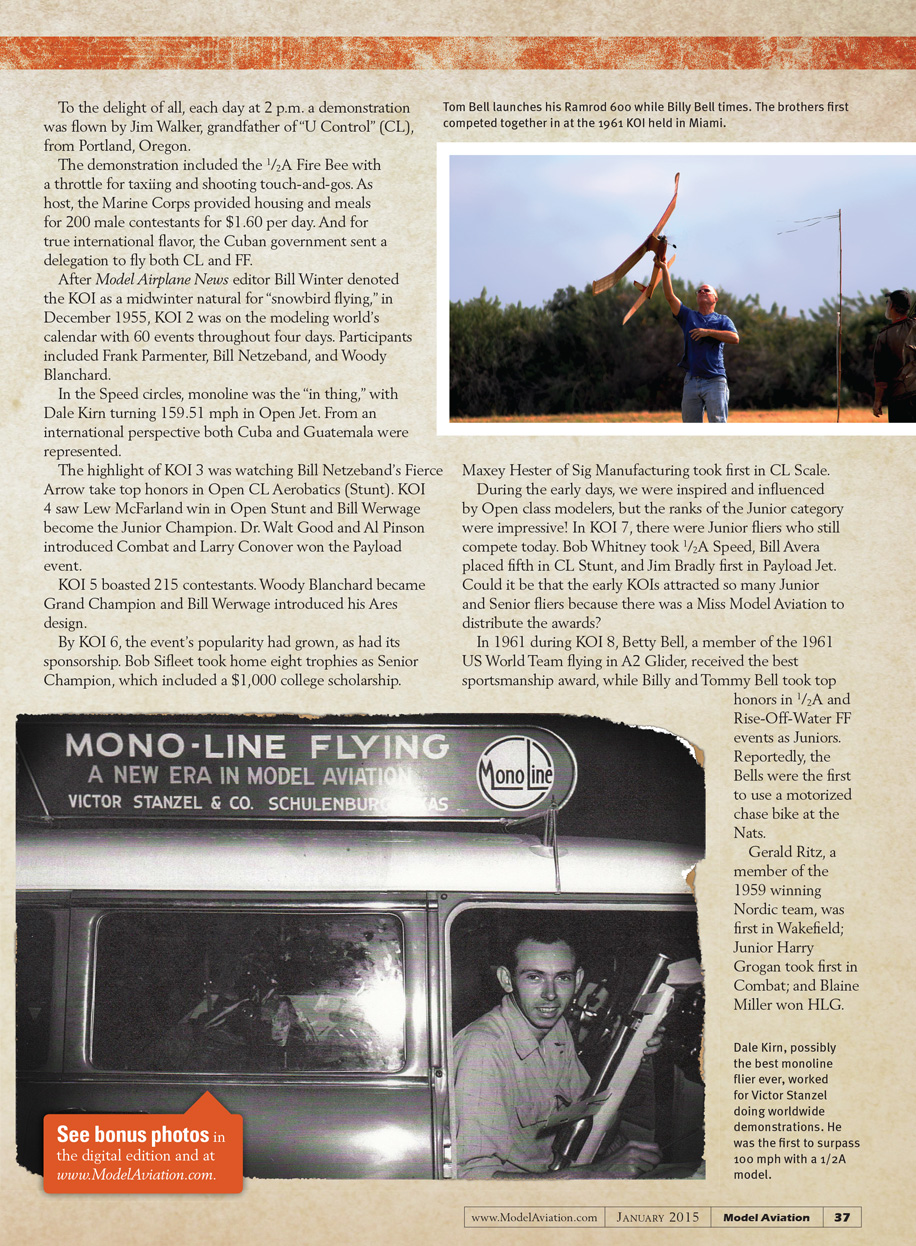
The first KOI (KOI 1) was at the Marine Corps Air Station main base at Opa-locka. From 1955 to 1963 the meet was held at Masters Field, roughly 5 miles southeast of the main base. Masters Field was also known as Amelia Earhart Field because she landed there on May 23, 1937, during her around-the-world flight. The KOI remained at this site until construction began on Miami-Dade Junior College, which now occupies the site.
The meet moved from Miami to Sebring, Florida (1967–1969), then to Jacksonville, Florida. In Jacksonville the meet was initially held at Imeson Airport and later moved to Whitehouse Field in 1988. Between 1995 and 1999 the Control Line (CL) portion was held in Bunnell, Florida. In 1985 the FF component moved to Palm Bay, Florida, where it has continued to be hosted by the Florida Modelers Association. After the move from Miami, the radio-control (RC) portion separated from KOI; although held as independent events, CL and FF continue today.
KOI 1 was chaired by contest director Ray Mathews, designer of the Fubar. Events were flown in morning and afternoon sessions: 13 FF events and 17 CL events covering all AMA categories. Junior, Senior, and Open were listed as separate divisions. There was also RC Precision Aerobatics and Racing. On the final afternoon a sub-Junior (12 years and younger) Hand Launch Glider (HLG) event drew 29 entries; the top 20 received awards. The winner was Ray Mathews III with a flight of 3 minutes 52 seconds. His first-place trophy has been donated to AMA’s National Model Aviation Museum.
Each day at 2 p.m. Jim Walker — the grandfather of “U Control” (CL) from Portland, Oregon — gave a demonstration, which included the 1/2A Fire Bee with a throttle for taxiing and touch-and-goes. As host, the Marine Corps provided housing and meals for 200 male contestants for $1.60 per day. For true international flavor, the Cuban government sent a delegation to fly both CL and FF.
After Model Airplane News editor Bill Winter denoted KOI as a midwinter natural for “snowbird flying” (December 1955), KOI 2 was firmly on the modeling world’s calendar. KOI 2 featured 60 events across four days and participants such as Frank Parmenter, Bill Netzeband, and Woody Blanchard. In speed circles monoline was the trend; Dale Kirn turned 159.51 mph in Open Jet. Cuba and Guatemala were represented among the international entries.
KOI 3’s highlight was Bill Netzeband’s Fierce Arrow taking top honors in Open CL Aerobatics (Stunt). KOI 4 saw Lew McFarland win Open Stunt and Bill Werwage become Junior Champion. Dr. Walt Good and Al Pinson introduced RC Combat, and Larry Conover won the Payload event. KOI 5 boasted 215 contestants; Woody Blanchard became Grand Champion and Bill Werwage introduced his Ares design.
By KOI 6 the event’s popularity and sponsorship had grown. Bob Sifleet took home eight trophies as Senior Champion, including a $1,000 college scholarship. Maxey Hester of Sig Manufacturing took first in CL Scale.
During the early days we were inspired by Open-class modelers, but the ranks of Junior competitors were impressive. At KOI 7 several juniors who still compete today made top showings: Bob Whitney won 1/2A Speed, Bill Avera placed fifth in CL Stunt, and Jim Bradley took first in Payload Jet. It’s possible the presence of Miss Model Aviation handing out awards helped attract many Junior and Senior fliers.
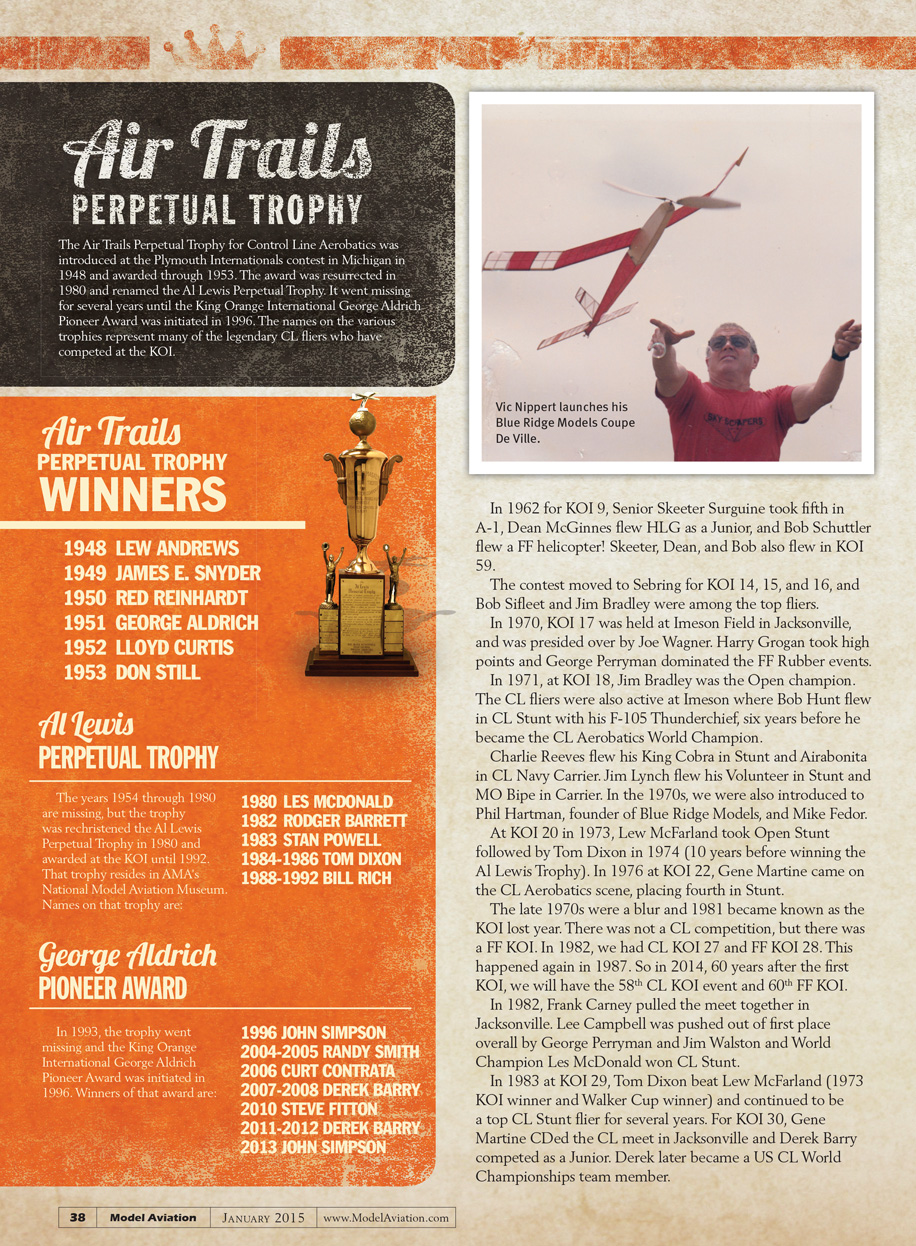
In 1961 (KOI 8), Betty Bell — a member of the 1961 U.S. World Team flying in A2 Glider — received the best sportsmanship award. Billy and Tommy Bell took top honors in 1/2A and Rise-Off-Water FF events as juniors; reportedly, the Bells were the first to use a motorized chase bike at the Nats. Gerald Ritz, a member of the 1959 winning Nordic team, won Wakefield; junior Harry Grogan won Combat; and Blaine Miller won HLG. Dale Kirn, possibly the best monoline flier ever, worked for Victor Stanzel doing worldwide demonstrations and was the first to surpass 100 mph with a 1/2A model.
In 1962 (KOI 9), senior Skeeter Surguine took fifth in A-1; Dean McGinnes flew HLG as a junior; and Bob Schuttler flew a FF helicopter. Skeeter, Dean, and Bob also flew in KOI 59 decades later.
The contest moved to Sebring for KOI 14–16, with Bob Sifleet and Jim Bradley among the top fliers. In 1970 KOI 17 was held at Imeson Field in Jacksonville under CD Joe Wagner; Harry Grogan took high points and George Perryman dominated the FF Rubber events. In 1971 (KOI 18) Jim Bradley was the Open champion.
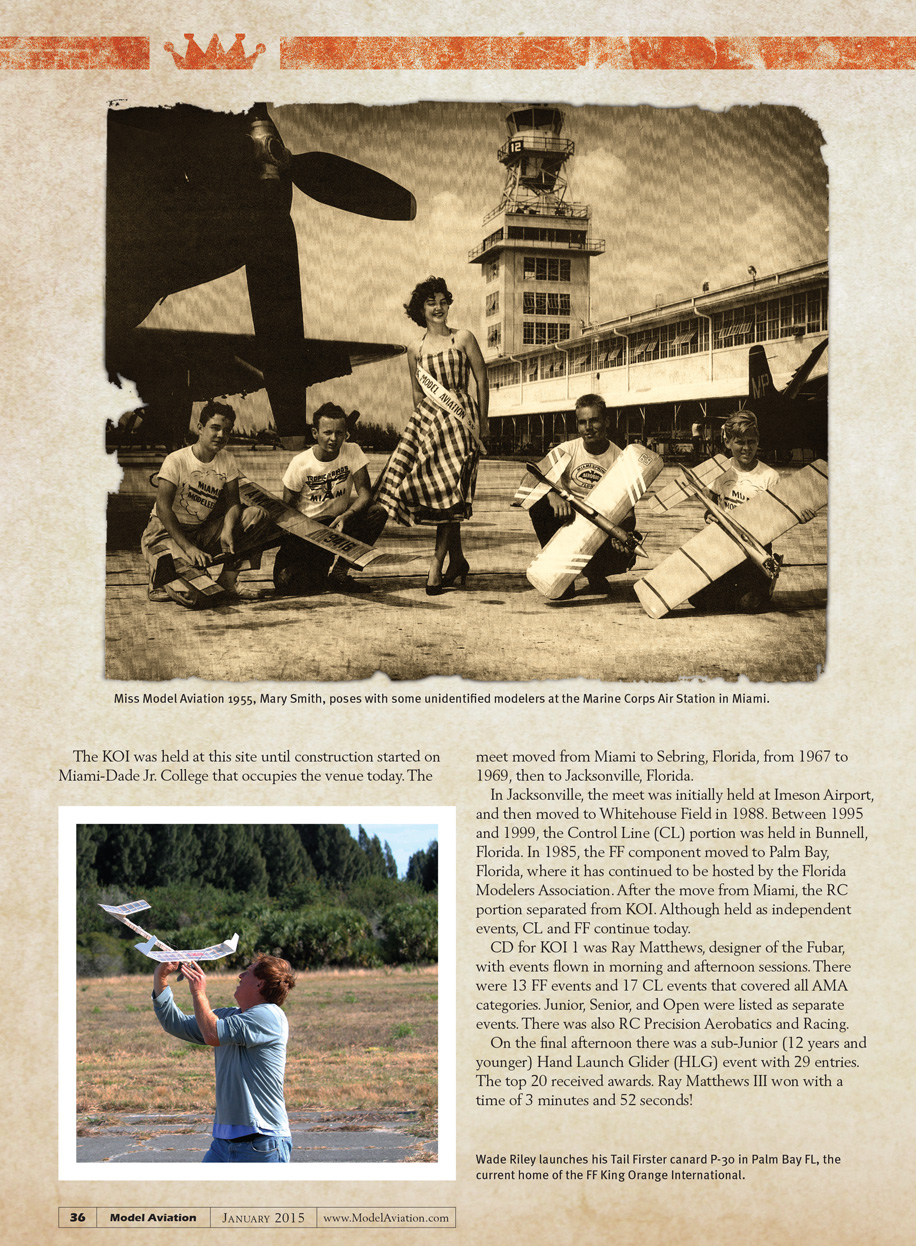
Imeson hosted many active CL fliers: Bob Hunt flew in CL Stunt with his F-105 Thunderchief six years before becoming the CL Aerobatics World Champion. Charlie Reeves flew his King Cobra in Stunt and Airabonita in CL Navy Carrier. Jim Lynch flew his Volunteer in Stunt and MO Pipe in Carrier. The 1970s also introduced Phil Hartman (founder of Blue Ridge Models) and Mike Fedor.
At KOI 20 (1973) Lew McFarland won Open Stunt; Tom Dixon won in 1974 (a decade before winning the Al Lewis Trophy). In 1976 (KOI 22) Gene Martine emerged on the CL Aerobatics scene, placing fourth in Stunt.
The late 1970s were a blur; 1981 became known as the KOI “lost year” because there was no CL competition, though there was a FF KOI. In 1982 there were separate CL and FF events again (CL KOI 27 and FF KOI 28). The same split happened again in 1987. As a result of these separations, in 2014 the KOI community marked the 58th CL KOI event and the 60th FF KOI event.
In 1982 Frank Carney pulled the meet together in Jacksonville. Lee Campbell was edged out of first place overall by George Perryman and Jim Walston, and world champion Les McDonald won CL Stunt. In 1983 (KOI 29) Tom Dixon beat Lew McFarland and continued as a top CL Stunt flier for several years. For KOI 30, Gene Martine ceded the CL meet in Jacksonville and Derek Barry competed as a junior; Derek later became a member of the U.S. CL World Championships team.
In 1993, with Jerry Wagner as CD, FF KOI 40 had 103 contestants competing in 55 events and enjoyed beautiful weather over three days. One highlight was an Unlimited Towline Glider flight by Dave Platt on a calm Sunday morning that found lift and was never again seen. Vic Nippert flew in 14 events that year and won the FIG Coupe d’Hiver — significant because it was the year many quit flying FAI events after the FAI abandoned the Builder-of-the-Model rule and expensive ready-to-fly models became more common in international competition. Norm Rosenstock, author of Tales of an Ancient Modeler, flew a Texaco Miss America; Elmer Jordan flew in 11 events and set a Payload record.
In the late 1990s KOI bounced around the Bunnell, Florida, area and returned to Jacksonville in 2000 with CD Gene Martine at the helm. In FF, Ron Sharpton’s Dixie shirt and Confederate wings became a signature; Dave Platt brought class to Mulvihill Rubber with his pink, silk-covered Satin Doll; and Larry Davidson’s yellow-and-black color scheme remains popular. At KOI 49 Bud Romak placed first in four events.
Although a FF perpetual trophy has come and gone, the lineage of the Perpetual Trophy for CL Precision Aerobatics is noteworthy. In 2014 the trophy was awarded to Curt Contrata. The award’s lineage goes back to 1948 when the Air Trails Perpetual Trophy was initiated at the Plymouth Internationals in Michigan. The trophy was presented each year until 1953 and now resides at the AMA’s National Model Aviation Museum in Muncie, Indiana.
During the 59th KOI, Indoor FF was introduced with enough interest for it to be included in the 2014 event. The KOI’s 60th anniversary will be in 2015.
Upcoming meets (as of this writing):
- KOI FF meet: December 29–31, 2014, in Palm Bay, Florida. Arrive early for test flying with the Florida Modelers Association at one of the top FF sites on the East Coast. For a schedule of events including AMA, Society of Antique Modelers, Flying Aces Club, and FAI competitions, contact CD Jim Demeritte (see Sources).
- KOI CL meet: January 10–11, 2015, at OLF Whitehouse Field in Jacksonville, Florida. For information contact Lynn Weedman (see Sources).
You may also contact me and I will be happy to address your questions or email you information about the CL and FF meets.
—Brian Malin [email protected]
Sources
- Jim Demeritte
(727) 712-0996 [email protected]
- Lynn Weedman
(904) 669-3242 [email protected]
- National Free Flight Society (NFFS)
- Precision Aerobatics Model Pilots Association (PAMPA)
Transcribed from original scans by AI. Minor OCR errors may remain.

