
Letters to the Editor
5161 E. Memorial Dr., Muncie IN 47302
George Aldrich
I never met George Aldrich and have never been to a Nats or watched an organized Stunt contest. However, I flew Control Line as a teenager in the '60s and you can rest assured I knew what a Nobler was and who flew it.
It was with a lump in my throat and a few tears that I finished [Bob Hunt's] column [in the October issue]. Another Legacy has left us, and the torchbearers are getting few and far between. Thanks for all you do.
Tommy Mabry Jacksonville, Florida
Now You're Talking
Jean's comments [in the October 2001 "Now You're Talking"] about flying a store-bought model aircraft leaves one with the feeling that they have done something wrong and, indeed, some fliers I have spoken to almost apologize because they are flying an ARF [Almost Ready to Fly] or a model built by someone else.
Perhaps Jean's comments are appropriate for Free Flight and other models flown in this category, and I must agree that Free Flight should be a development hobby open to new designs and technology.
However, for us that fly RC [Radio Control] Pattern and IMAA [International Miniature Aircraft Association] formats, we are not there to build models, we are there to fly to the best of our ability.
When I took my first full-scale flying lessons, no one expected me to build the Cessna 150 that I took lessons in.
And therein lies the difference between the hobby of building model aircraft and the sport of flying model aircraft. I have a couple of IMAA aerobatic models that I fly but feel quite free to buy an ARF and fly it as well.
No one in RC should apologize for flying a model built by someone else or an ARF. The goal for some is to build and the goal for others is to fly. And in RC, the goal is almost entirely to fly, with building secondary and only a means to an end.
When I began RC back in the late '50s we felt lucky to get anything to fly at all, but with the technology available today, we can concentrate on flying because our equipment is so reliable.
One of the definitions of "sport" is "to amuse oneself with a diversion." Certainly, flying RC fits this definition, but we could go one further and state that it is also to challenge oneself; and in this case, to fly better and perhaps to compete against other fliers.
Stated again, the building of a model is a hobby and the flying is a sport.
In the category of RC, I hope to never again have a fellow flier apologize for having a model built by someone else or a prebuilt ARF. They need only apologize if they mess up and fly into the ground.
Bob Wilson Franklin, North Carolina
Let's Talk Center of Gravity
I'd like to draw your attention to an article in the October issue of Model Aviation. It's entitled "Let's Talk Center of Gravity." The article has some good points in it, but some inaccuracies.
On the first page, Mr. Kosmala's comments about CG and weight are correct, but he states that the neutral point (NP) is where all the lift acts. This is not true. If it were, and the neutral point were behind the CG, which it should be for stability, then the airplane wouldn't be balanced in steady level flight. It would dive into an outside loop.
In fact, because the forces on the airplane are all balanced in steady level flight (otherwise it wouldn't be steady!), the lift acts almost directly over the CG.
The only reason for adding "almost" is that if the thrust is not directly in line with the drag term, there will be a small pitching moment which will have to be countered by a similar but opposite pitching moment of the lift relative to the weight.
But that's never sufficient to move the lift vector back to the neutral point. (If it were, then the airplane would be neutrally stable, as is accurately described in the article.)
The next comment is that "When an airplane is stable in pitch, it will go to a nose-down attitude when the pilot stops controlling it." This is also not correct.
A more correct comment would be, "When an airplane is stable in pitch, it will return to its steady-state flight path when the pilot stops controlling it."
So what is the neutral point? It is the point where any incremental lift acts if the airplane changes angle of attack (its local angle to the airstream). Typically, the main lifting surface will produce extra lift from changing the chordwise lift distribution and some extra lift from changing the horizontal tail angle the same amount.
Thus you can see that the neutral point can be thought of as the pivot point of a lever, where the large lift from the wing is counterbalanced by the smaller lift from the tail at a greater distance away.
To a first approximation, the distance from the neutral point to the wing 1/4 chord point times its area is equal to the distance to the tail 1/4 chord point times its area. Relative aspect ratios of the two surfaces change this somewhat, but it's not a bad approximation for starters.
If the neutral point is behind the CG, then an increase of angle of attack due to a gust or similar disturbance will generate extra lift at the neutral point and be accompanied by a nose-down pitching moment, bringing the model back to its original attitude.
Note that if the disturbance results in a reduced angle of attack, then there will be a nose-up pitching moment due to a negative lift force acting at the neutral point. This will also bring the airplane back toward its original attitude.
That may seem a little pedantic, but I hope it clarifies an often misunderstood situation. In conclusion, may I say that I really enjoy the magazine, which continues to improve, so please excuse my small criticisms. I am, or was before I retired, a professional airplane designer with Lockheed Corporation.
Alan Brown Watsonville, California
From my reading, there seems to be general concurrence that the neutral point (NP) is where the total lift acts, just as the center of gravity (CG) is the point where the total weight acts, but in the opposite direction.
When the CG is forward of the NP, the resulting moment is opposed by the downward force generated by the stabilizer—a fact which Mr. Brown does not seem to recognize. In steady, level flight these two opposing moments equal each other.
A nose-up pitching disturbance will find the center of lift behind the center of gravity, and the resulting increase in angle of attack, and therefore lift, will tend to stabilize the airplane by lowering the nose.
A pitch-down disturbance, such as caused by a stall, will cause the speed to increase due to gravity, thereby increasing the downward force generated by the aftly mounted stabilizer, raising the nose of the airplane until a steady state of flight is achieved.
An article of this nature, which is aimed at the interested modeler who is not trained in aerodynamics, must necessarily simplify the subject—a more difficult task than making it complicated.
For those who want to know more about why their models fly, there are many good books on aerodynamics; one which can be highly recommended is Model Aircraft Aerodynamics by Martin Simons, ISBN 0 85242 441 8.
Rupert Kosmala
(Continued on page 17)
Letters to the Editor
Publicize Modeling Competition
I enjoyed [Bob Hunt's October 2001] account of the FAA (Federal Aviation Administration) recognition of this fine young AMA member [Austin Gunder].
I believe this supports my oft-reiterated point that the AMA should use competition in promoting model aviation to the general public. This account shows that the non-AMA public is willing to recognize and approve of AMA members who do well in competition.
We have several young AMA members who have enviable success records in major competitions. These should be the poster children for our efforts to recruit youth into the AMA.
I understand that the AMA is largely an organization of Sunday sport fliers who have no interest in competition. However, is our situation any different from golf, tennis, bowling, cycling, etc., where most participants are "sport fliers?"
How do these activities present their value to the public? They do it through publicizing competition. Why is the AMA impervious to this lesson?
I must mention that I would have been pleased to see some official AMA participation in this recognition.
Jim Thomerson Austin, Texas
Reliving Memories
...browsing through the October issue, I came across a photo of a Handley Page 42 on page 12. I wonder how many people on this side of the Atlantic can claim to have seen one?
Certainly I was very young, but it had to have been '39 when the last civilian flights were made, so that would have been about when this very small boy witnessed the type rumbling over our house inbound to Croydon—the original airport for London, UK.
The wonderful thing about aeromodeling which few, if any, have touched on is that we can relive memories of old, and, with a little imagination, we can "hear" the sounds of that era, too.
It was a sad day in the early '60s when the only flyable Bristol Bulldog crashed at the Farnborough air show, for there went the only opportunity to hear that beautiful, mellow rumbling of a Bristol Jupiter radial engine. Can you imagine what four Jupiters sounded like?
Although it was 60 years ago, I can assure you that it was a completely different music than that sung by Pratts or Wrigleys, largely because of that huge collector ring exhaust ahead of the cylinders, and which cooled the gases before they hit cold air, thus lessening the bark.
The H.P.42s were no rockets. 'Twas said they took off at 80, climbed at 80, and cruised at 80. Others claimed they were as stable as the Rock of Gibraltar—and just about as fast!
However slow, they reliably carried passengers from Croydon to major cities in Europe, across the Mediterranean to Egypt, and down the Nile to Khartoum. It was a sad day when high winds wrecked one of the two remaining near the birthplace of its engines, while an enemy bomb got the other.
Forgive me if I ramble, but those who love older aircraft will understand. The only way I will ever see that stack of wings and engines in flight once more—unless someone builds a replica with genuine Jupiters—will be via this wonderful hobby of ours.
I have not seen Lewis Creedon's slightly boxy model in flight and likely never will, but yes, I can believe that it is as majestic as the originals. My imagination supplies the deep, gentle thunder of the four Bristol-revolving four huge, wooden draft-makers.
To the builder I say, "Thank you, Lewis, for allowing me to relive a little of the past."
Jim Newman Kent City, Michigan
Testors Alumni
Those who flew Testors wood CL (Control Line) models in the very late 1940s through the 1960s; i.e., Freshman, Sophomore, Junior, and Senior, will surely remember their pleasing lines and fine flying ability.
If you ever enjoyed flying the Testors GO-III, the same is true, simple glider or not.
The designer of these models was Nate Bast, who is now a resident of Fairhaven Christian Retirement, Center Rockford, Illinois, with serious health problems.
If you've ever enjoyed flying these Testors wood models, why not drop Nate a "thank you" and perhaps share your experiences with his designs? He'll appreciate it, I'm sure, although he is unable to write back in reply.
Doug Dahlke Oshkosh, Wisconsin
Newcomer's Experience
If you can stand one more letter about how newcomers are treated, please allow me to share my experience. I, too, wanted to become involved in the hobby back in the mid '70s, but for a couple of reasons, cost of entering the hobby being one, I passed on it.
Last November, a coworker who is involved with RC [Radio Control] left a Tower Hobbies catalog laying around and I thumbed through it, and wanted, hooked.
Now with the kids about grown and a few extra bucks available, I took the plunge. I immediately started attending the meetings for two local clubs, got to know people at both, put together an ARF [Almost Ready to Fly], and by summer had soloed.
All that said, what I really want to pass on is that I couldn't have had a greater group of guys to learn from.
I've read several letters in your column recently about newcomers being shunned and ignored by the "old-timers" foul language, and poor field etiquette. It's a real shame they couldn't have had my experience.
When I first started, several people told me never to hesitate asking any questions— all these guys want to do is talk about R/C. They were right. I got advice at every turn. One gave of his own time in his home to help me put my first airplane together, and another to help me repair it after a crash.
Several instructors gave me a lesson until I lined up with someone to take me all the way through. In short, a wonderful experience. I'm starting at 44 years of age, but I really don't think that had any bearing on how I was accepted. I've observed younger people at both clubs being readily accepted.
I'll say this, though: you have to get out there and ask questions. Don't just stand around waiting for them to come to you. They have friends they want to talk to, and they have airplanes they want to fly.
Get involved with the club meetings and show up at the field sometimes, even if you don't have an airplane to fly. The camaraderie you'll experience is worth it.
Mark Berkemeyer Boothwyn, Pennsylvania
Inspired by The Microhenrys
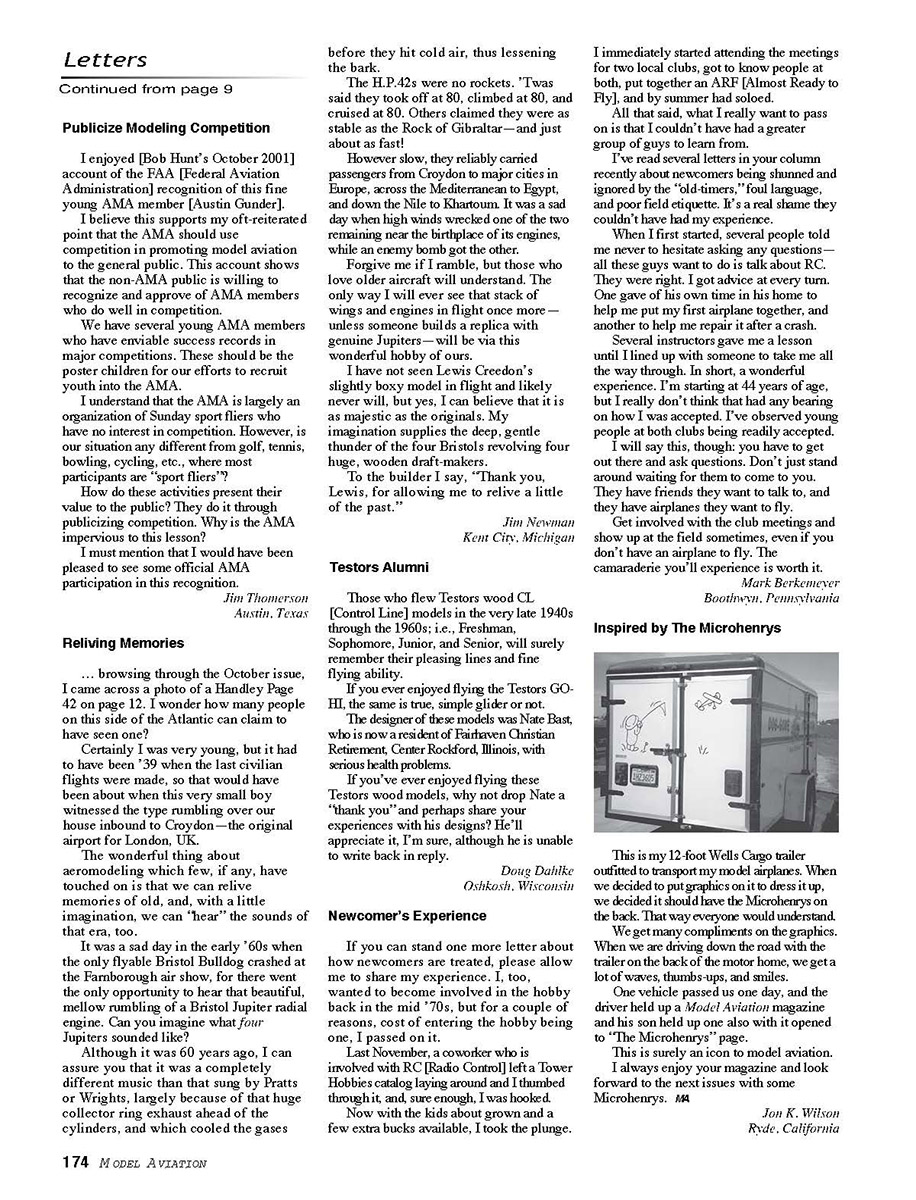
This is my 12-foot Wells Cargo trailer outfitted to transport my model airplanes. When we decided to put graphics on it to dress it up, we decided it should have the Microhenrys on the back. That way everyone would understand.
We get many compliments on the graphics. When we are driving down the road with the trailer on the back of the motor home, we get a lot of waves, thumbs-ups, and smiles.
One vehicle passes us one day, and the driver held up a Model Aviation magazine and his son held up one also with it opened to "The Microhenrys" page.
This is surely an icon to model aviation. I always enjoy your magazine and look forward to the next issues with some Microhenrys.
John K. Wilson Rydel, California
Transcribed from original scans by AI. Minor OCR errors may remain.

