
Letters to the Editor
5161 E. Memorial Dr., Muncie IN 47302
Updated Site
In your November 2000 issue you were kind enough to publish my letter where I recommended that members log onto our then new Web site at tss.homestead.com.
I must apologize for the lack of updated information recently. Our webmaster was just too ill to keep up the site. The good news is that the site is up, running, and better than ever! In it are reviews of RC [Radio Control] electric and nonpowered airplanes, all sorts of helpful advice from building straight to saving money, some fantastic pictures, and our own brand of humor. It is constantly being updated, and I'm sure people who log on will have an enjoyable experience.
Charles R. Varvaro Norco, California
Mother's Day in Model History
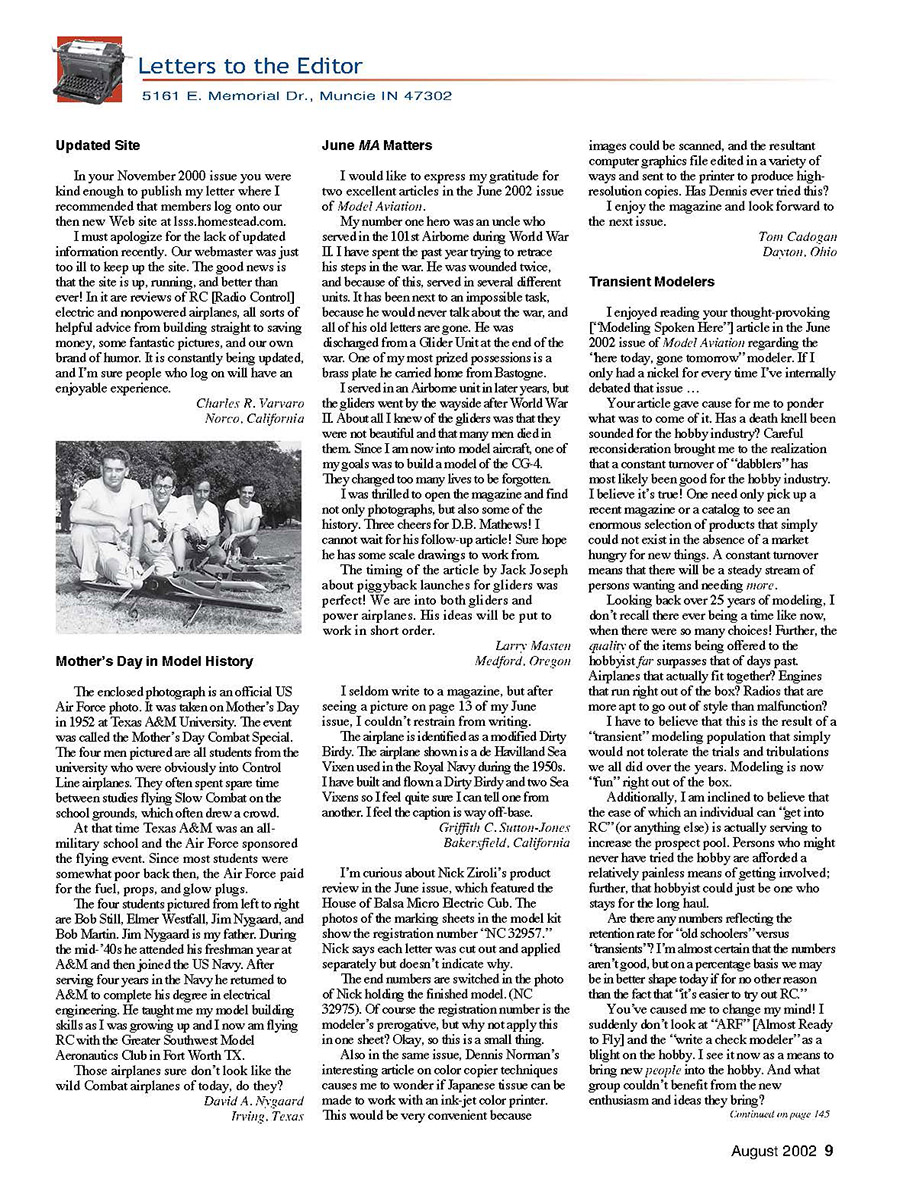
The enclosed photograph is an official US Air Force photo. It was taken on Mother's Day in 1952 at Texas A&M University. The event was called the Mother's Day Combat Special. The four men pictured are all students from the university who were obviously into Control Line airplanes. They often spent spare time between studies flying Slow Combat on the school grounds, which often drew a crowd.
At that time Texas A&M was an all-military school and the Air Force sponsored the flying event. Since most students were somewhat poor back then, the Air Force paid for the fuel, props, and glow plugs.
The four students pictured from left to right are Bob Still, Elmer Westfall, Jim Nygaard, and Bob Martin. Jim Nygaard is my father. During the mid-'40s he attended his freshman year at A&M and then joined the US Navy. After serving four years in the Navy he returned to A&M to complete his degree in electrical engineering. He taught me my model building skills as I was growing up and I now am flying RC with the Greater Southwest Model Aeronautics Club in Fort Worth TX.
Those airplanes sure don't look like the wild Combat airplanes of today, do they?
David A. Nygaard Irving, Texas
June MA Matters
I would like to express my gratitude for two excellent articles in the June 2002 issue of Model Aviation.
My number one hero was an uncle who served in the 101st Airborne during World War II. I have spent the past year trying to retrace his steps in the war. He was wounded twice, and because of this, served in several different units. It has been next to an impossible task, because he would never talk about the war, and all of his old letters are gone. He was discharged from a Glider Unit at the end of the war. One of my most prized possessions is a brass plate he carried home from Bastogne.
I served in an Airborne unit in later years, but the gliders were by the wayside after World War II. About all I know of the gliders was that they were not beautiful and that many men died in them. Since I am now into model aircraft, one of my goals was to build a model of the CG-4. They changed too many lives to be forgotten.
I was thrilled to open the magazine and find not only photographs, but also some of the history. Three cheers for D.B. Mathews! I cannot wait for his follow-up article! Sure hope he has some scale drawings to work from.
The timing of the article by Jack Joseph about piggyback launches for gliders was perfect! We are into both gliders and power airplanes. His ideas will be put to work in short order.
Larry Mastern Medford, Oregon
I seldom write to a magazine, but after seeing a picture on page 13 of my June issue, I couldn't restrain from writing.
The airplane is identified as a modified Dirty Birdy. The airplane shown is a de Havilland Sea Vixen used in the Royal Navy during the 1950s. I have built and flown a Dirty Birdy and two Sea Vixens so I feel quite sure I can tell one from another. I feel the caption is way off base.
Griffith C. Sutton-Jones Bakersfield, California
I'm curious about Nick Ziroli's product review in the June issue, which featured the House of Balsa Micro Electric Club. The photos of the markings in the model kit show the registration number "NC 32957." Nick says each letter was cut out and applied separately but doesn't indicate why.
The end numbers are switched in the photo of Nick holding the finished model. (NC 32975). Of course the registration number is the modeler's prerogative, but why not apply this in one sheet? Okay, so this is a small thing.
Also in the same issue, Dennis Normann's interesting article on rotor servo techniques causes me to wonder if Japanese tissue can be made to work with an ink-jet color printer. This would be very convenient because images could be scanned, and the resultant computer graphics file edited in a variety of ways and sent to the printer to produce high-resolution copies. Has Dennis ever tried this?
I enjoy the magazine and look forward to the next issue.
Tom Cadogan Dayton, Ohio
Transient Modelers
I enjoyed reading your thought-provoking ["Modeling Spoken Here"] article in the June 2002 issue of Model Aviation regarding the "here today, gone tomorrow" modeler. If I only had a nickel for every time I've internally debated that issue ...
Your article gave cause for me to ponder what was to come of it. Has a death knell been sounded for the hobby industry? Careful reconsideration brought me to the realization that a constant turnover of "dabblers" has most likely been good for the hobby industry. I believe it's true! One need only pick up a recent magazine or a catalog to see an enormous selection of products that simply could not exist in the absence of a market hungry for new things. A constant turnover means that there will be a steady stream of persons wanting and needing more.
Looking back over 25 years of modeling, I don't recall there ever being a time like now, when there were so many choices! Further, the quality of products being offered to the hobbyist far surpasses that of days past. Airplanes that actually fit together? Engines that run right out of the box? Radios that are more apt to go out of style than malfunction?
I have to believe that this is the result of a "transient" modeling population that simply would not tolerate the trials and tribulations we all did over the years. Modeling is now "fun" right out of the box.
Additionally, I am inclined to believe that the ease of which an individual can "get into RC" (or anything else) is actually serving to increase the prospect pool. Persons who might never have tried the hobby are afforded a relatively painless means of getting involved; further, that hobbyist could just be one who stays for the long haul.
Are there any numbers reflecting the retention rate for "old schoolers" versus "transients"? I'm almost certain that the numbers aren't good, but on a percentage basis we may be in better shape today if for no other reason than the fact that it's easier to try out RC!
You've caused me to change my mind! I suddenly don't look at "ARF" [Almost Ready to Fly] and the "write a check modeler" as a blight on the hobby. I see it now as a means to bring new people into the hobby. And what group couldn't benefit from the new enthusiasm and ideas they bring?
Letters to the Editor
I just finished reading your "Modeling Spoken Here" column and felt compelled to write you. In many ways I am exactly the person you're writing about. This is the first issue of MA that I've received since signing up with the AMA in February of this year. I've been toying with the idea of getting into RC modeling for quite some time now. This year, I decided to take the plunge — and it isn't a change. Not only a monetary commitment but one in time as well. I also signed up with a local club.
As you've noted, there is a wealth of information available online these days and one would be a fool not to take advantage of it. I feel as if I've been able to come quite a long way in learning many different areas of the hobby just by surfing and reading.
But you do make a very valid point. The information I've been so happy taking in may have taken others quite some time to learn. Those that share their shortcuts and methods that have only come through years of trials, experience, and sweat should be commended, and on behalf of my fellow newcomers and myself, I would like to offer you all a very hearty thank-you.
Since we who are new to the sport have been able to pick it up quickly, maybe our responsibility lies with taking it to its next level, wherever that may be: ... a computer uplink to an actual RC model so that a severely disabled person might be able to enjoy the thrill of virtually flying or the first transoceanic flight of a scale RC Spirit of St. Louis, retracing Lindbergh's history-making flight.
It could be as simple as building a model from scratch and actually flying it, or something more grandiose like those above. Whatever they may be, the realization of these goals will only come with the commitment of an individual or group. A commitment to do something that's never been done before. It's only boring if we let it be so.
Thanks for a very interesting column. —Bill H.
I was struck by your editorial and broke my own rule of not bothering those who write articles with my own thoughts. As a three-year newcomer to the hobby/sport and a second-year club president, I do kinda resemble most of your remarks (I am in deep).
My wife suggested that maybe I could buy an RC airplane and go fly with my nine-year-old son for something to do together. She now realizes that the genie is hard to put back into the bottle. I know that I do my research, cyber, and logging time with any expert I can find. I usually follow the research with careful purchases of the "best" equipment I can find. I then enjoy the activity until something new comes along to take its place.
I am happy to report that several unique "anchors" have securely held my feet in this hobby/sport:
- The right guys who collectively make me feel welcome, wanted, useful (and yes, even welcome and wanted);
- A hobby which is so vast that mastery will probably take two or three lifetimes (if mastery is possible at all);
- Variety and tolerance of diversity which allows the airplane, helicopter, glider, warbird, Tournament of Champions-3-D, and electric park flyer to exist with the owners in the same spot on the same Sunday afternoon. There are retired fighter pilots, engineers, truck drivers, hospital administrators, and high-school students who gather together talking about life and RC. Where else on earth could such a mix exist and thrive?
My experience is that the RC hobby does provide very different things for different folks. It amazes me that it does not explode from the resulting chaos. If one is inclined to participate, there is no way to get bored with this hobby. It is possible to get too busy for leisure activity or run out of money. I consider these valid reasons for leaving the hobby — and the only for long enough to get the time or money to get back into it.
The right people are at this hobby and willing to share of themselves. —Jim Miller
I would like to share my thoughts on the subject of newcomers getting into the hobby and then getting out shortly thereafter. I am assuming that the ones leaving are primarily short-term members.
The influx of ARFs probably has had more influence on the increasing numbers than any one thing. This is good and bad. Some of the ARFs are difficult to learn to, if not impossible, as they are underpowered, and this makes it very hard to teach someone to take off.
I also feel that the newcomers are not being properly trained and get into trouble by being soloed too soon. Case in point: I was at the field where the newcomer who had just soloed was having so much trouble landing that he was going to quit the hobby. I pointed out what his problem was, and now he flies better than his instructor, who has been in the hobby forever.
This newcomer is above average in ability, and he would learn better instruction, he would not have been close to quitting, and he has two sons who are potential members. So you are not always losing just one member.
I think that the entry level of the hobby needs an evaluation by the AMA. —James S.
Transcribed from original scans by AI. Minor OCR errors may remain.

