
Letters to the Editor
Model Aviation, 5161 E. Memorial Dr., Muncie IN 47302
Correction
In the May 2005 "Worth a Closer Look" on page 15, a Web site address was inadvertently omitted. The free Flight Model Simulator software you can use with Hitec RCD's simulator interface cables can be downloaded at http://n.ethz.ch/student/mmoeller/fms/index_e.html.
Our apologies for the error.
—MA staff
Soldering Guns
Reading the letters in the April issue on soldering guns/irons, the real issue is heat. The basic rule is, "Do not use soldering guns on electronic circuits. The temperature generated by these devices can lift the printed circuit from its substrate, causing cracking of copper traces. This high heat can also propagate to other soldered components, causing component lifting and/or cold solder joints.
An inexperienced person will have the tendency to leave the tip on a circuit longer than necessary for good solder flow. The soldering gun is best used for piano wire used for pushrods and landing gear applications and related items.
The low-temp (25W) irons are better suited for circuit boards and terminals. Terminals on motors for attaching connection wires are also used to attach the internal magnet wires. Too much heat can cause detachment of these wires when soldering lead wires.
David C. Thomas Jr. via E-mail
Electric Sea Cat
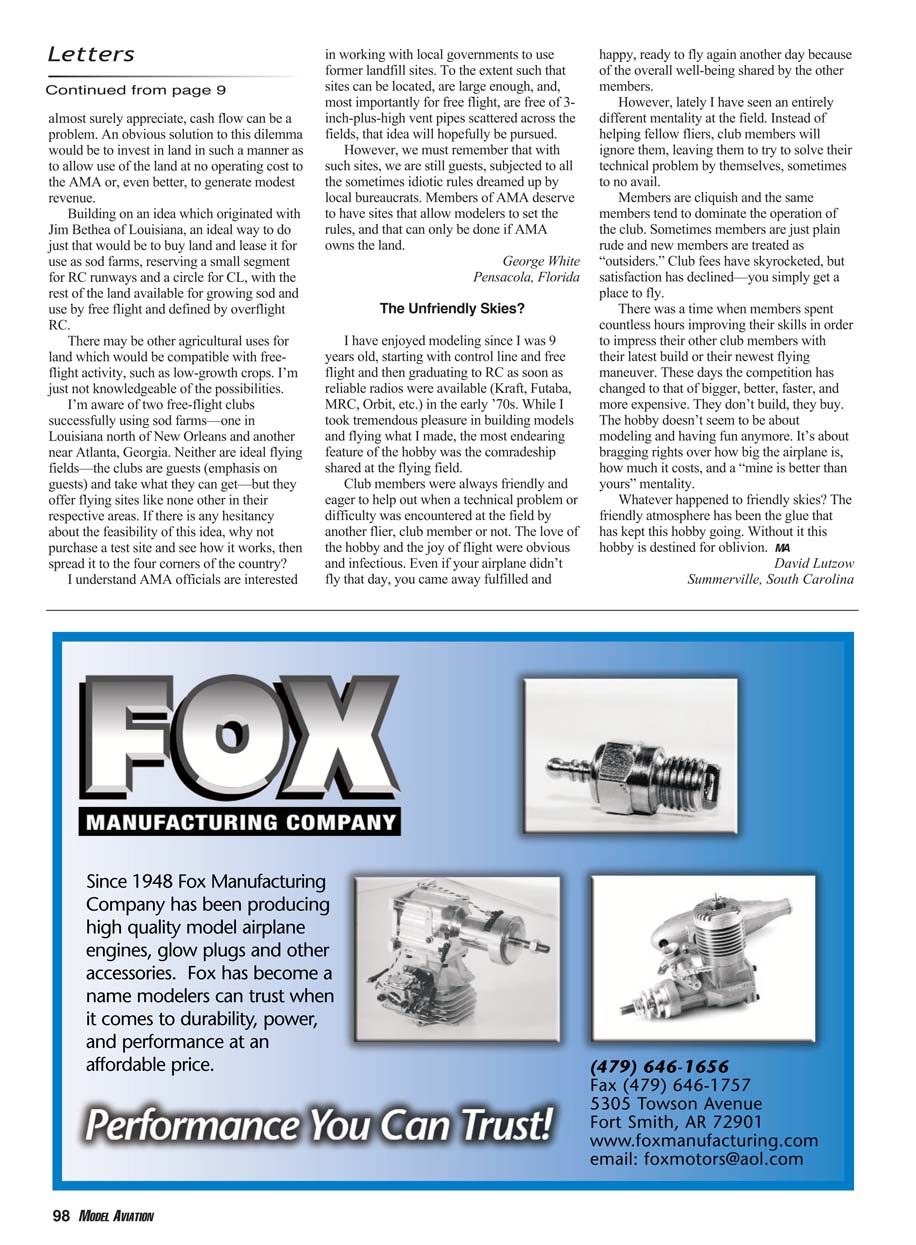
[Bob Aberle] may recall receiving an E-mail from me a few weeks ago regarding electric power for a Sea Cat (a Henry Struck classic design). Thanks to [Bob's] articles ("Selecting Electric Power Systems" parts 1 and 2 in the March and April issues) on motor selection, aircraft weight, wing area, etc., I have moved ahead.
Included is a photo of the airplane as it now stands (after cleaning up some dust and brakes from 50 years of hanging in my rafters). I am going with an AXI 2820/10 motor with a Kokam three-cell 3200 mAh battery pack.
The original plan called for a rudder-only escapement with an unthrottled .15-.15 glow engine. I have added servo-controlled rudder, elevator, aileron, and, of course, the electronic motor control.
The wheels are simply strapped on for land flying. The controller and engine are in the nacelle on the wing. The wires for power, ailerons, and channel 3 control are directed up through the pylon.
The large compartment in the hull will be covered with a hatch, and you can see the battery and receiver located in that compartment. The servo wires for the rudder and elevator are led through a tube to the rear of the hull.
I plan to cover the airplane with lightweight clear Solarfilm. As the airplane stands, it weighs 4 pounds.
Thanks for your good advice.
Bill Friedlander Hudson, Wisconsin
Top Trainers
I have been a member of AMA for several years and look forward to receiving Model Aviation. The May 2005 edition of Model Aviation is fantastic, as always, but I would like to make a brief comment on one of the articles included therein.
The article titled "Selecting Your First ARF Trainer" by Frank Granelli is wonderful and gives some outstanding advice. However, there are two additional trainers, and everyone has their favorites that I believe should be included in the list.
I have been associated with the Chesapeake Bay Radio Control Club in the Annapolis, Maryland, area for a few years. We have been using Sig LT-40s with great success. Personally, I have an LT-25, powered by an O.S. .25 FX [engine], and an LT-40, powered by an O.S. .46 FX. In my opinion they are the greatest trainers ever designed. I know that the LT-40 is available as an ARF.
Bill Truelblood Edgewater, Maryland
What About Bob?
Your decision to replace Bob Kopski is, to me, a great disappointment. I have read his column for the past twenty-some years and always found it to be interesting and informative. It soon became, and remained, the first thing I turned to when the magazine arrived.
Whatever the future may bring, losing Bob is like losing an old friend. I think you may regret this action.
Weldon Smith Cary, Illinois
Invest in Free Flight
A comment heard over and over whenever free-flight fliers get together is that "AMA seems to have little or no interest in helping promote free-flight activity." Among the points made in defense of AMA is that there are just a lot more RC fliers, and AMA's emphasis reflects that.
While MA will publish any free-flight article that is worthy, few people bother to send them. A quick look at the District VP reports in several of the recent MA magazines is instructive. In four issues scanned at random, I found only one small reference to free flight (indoor only) out of all the reports—indicative of where the interests of our VPs might be.
There are plenty of reasons for the growth of RC, not the least of which is rapidly shrinking access to free-flight flying sites. How do you keep interest in free flight when you can't find a place to fly?
There are also powerful commercial forces pushing the rapid growth of RC (count the ads), and AMA is wise to ride that wave. With virtually no commercial vendor incentives to promote free flight, it is very apparent that AMA is going to have to step up to the plate and become proactive if free flight is to continue to be a viable sport.
We constantly read of the shrinking access to flying fields, in parallel with the shrinking numbers of members who participate in free-flight activities. Lack of flying sites may not be the only factor in the later phenomenon, but not having a place to fly within a reasonable distance from home is obviously not helping.
I applaud AMA's entrepreneurial focus in looking actively for ways to generate revenue (trade shows, the recent DVD, roughly $4 million in the stock market, and the soon-to-be credit-card deal). Having sufficient revenue to carry on is many activities is obviously important, but perhaps it's time, in addition to just generating revenue, for the AMA to start looking for ways to create more value for its members with some emphasis on free flight.
Short of maintaining our insurance coverage and maintaining accurate records of membership, I can't think of a more important use for AMA's investment of money than the expansion of available flying sites throughout the US—with emphasis on sites to accommodate free flight.
Purchasing land for flying fields would be an investment in the future of the organization, the sport in general, and a nice enhancement to the AMA balance sheet. The downside of land ownership is that taxes and maintenance can easily become a revenue drain. Even though the land will
(Continued on page 98)
Letters to the Editor
in working with local governments to use former landfill sites. To the extent such sites can be located, are large enough, and most importantly for free flight, are free of 3-inch-plus-high vent pipes scattered across the fields, that idea will hopefully be pursued.
However, we must remember that with such sites, we are still guests, subjected to all the sometimes idiotic rules dreamed up by local bureaucrats. Members of AMA deserve to have sites that allow modelers to set the rules, and that can only be done if AMA owns the land.
George White Pensacola, Florida
The Unfriendly Skies?
I have enjoyed modeling since I was 9 years old, starting with control line and free flight and then graduating to RC as soon as reliable radios were available (Kraft, Futaba, MRC, Orbit, etc.) in the early '70s. While I took tremendous pleasure in building models and flying what I made, the most endearing feature of the hobby was the comradeship shared at the flying field.
Club members were always friendly and eager to help out when a technical problem or difficulty was encountered at the field by another flier, club member or not. The love of the hobby and the joy of flight were obvious and infectious. Even if your airplane didn't fly that day, you came away fulfilled and happy, ready to fly again another day because of the overall well-being shared by the other members.
However, lately I have seen an entirely different mentality at the field. Instead of helping fellow fliers, club members will ignore them, leaving them to try to solve their technical problem by themselves, sometimes for no avail.
Members are cliquish and the same members tend to dominate the operation of the club. Sometimes members are just plain rude and new members are treated as "outsiders." Club fees have skyrocketed, but satisfaction has declined—you simply get a place to fly.
There was a time when members spent countless hours improving their skills in order to impress their other club members with their latest build or their newest flying maneuver. These days the competition has changed to that of bigger, better, faster, and more expensive. They don't build, they buy. The hobby doesn't seem to be about modeling and having fun anymore. It's about bragging rights over how big the airplane is, how much it costs, and a "mine is better than yours" mentality.
Whatever happened to friendly skies? The friendly atmosphere has been the glue that has kept this hobby going. Without it the hobby is destined for oblivion.
MA David Lutzow Summerville, South Carolina
Transcribed from original scans by AI. Minor OCR errors may remain.

