
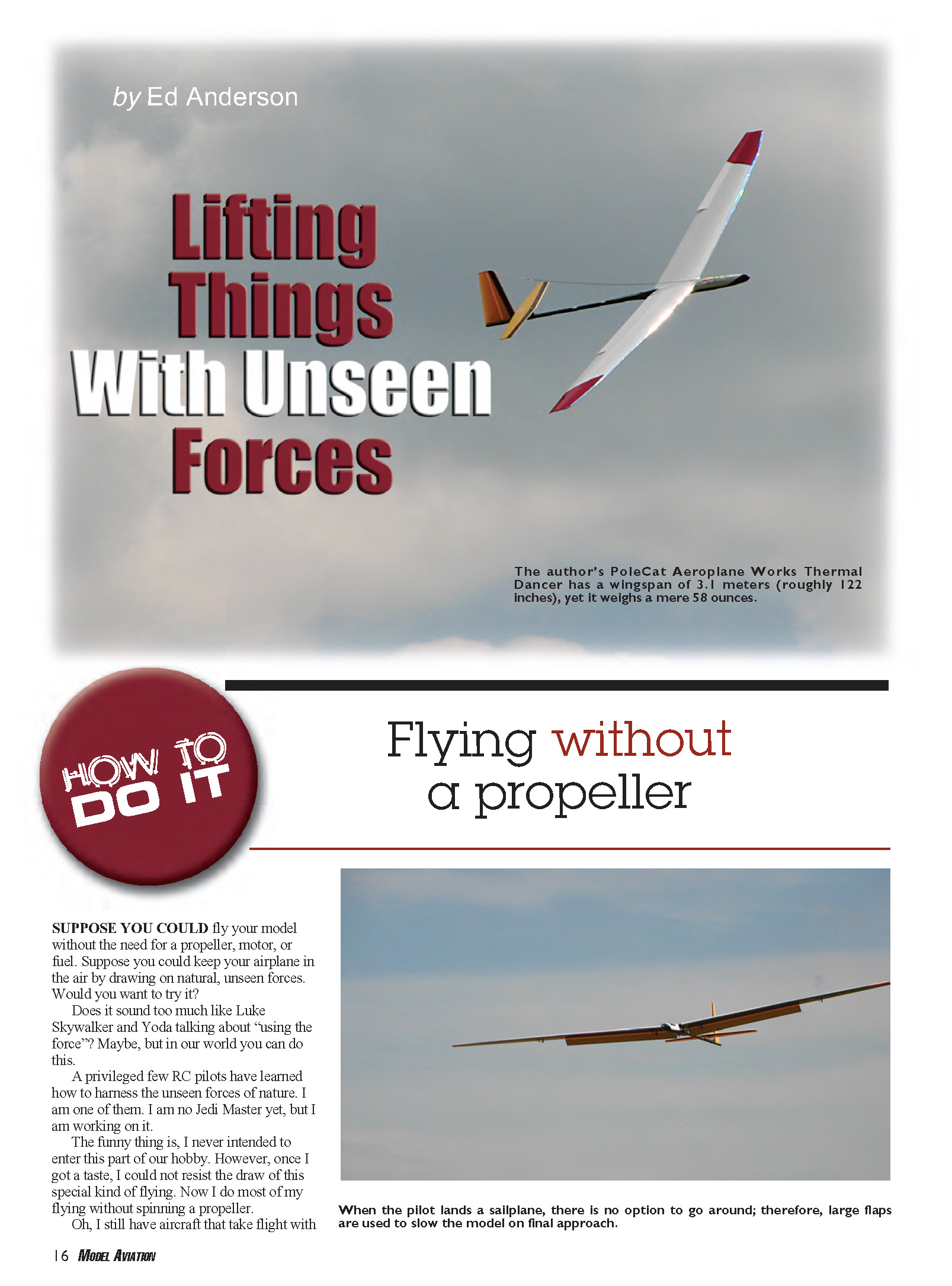
Lifting Things with Unseen Forces
by Ed Anderson
Flying without a propeller
Suppose you could fly your model without the need for a propeller, motor, or fuel. Suppose you could keep your airplane in the air by drawing on natural, unseen forces. Would you want to try it?
Does it sound too much like Luke Skywalker and Yoda talking about "using the force"? Maybe, but in our world you can do this.
A privileged few RC pilots have learned how to harness the unseen forces of nature. I am one of them. I am no Jedi Master yet, but I am working on it.
The funny thing is, I never intended to enter this part of our hobby. However, once I got a taste, I could not resist the draw of this special kind of flying. Now I do most of my flying without spinning a propeller.
Oh, I still have aircraft that take flight with propellers, but the lure of turning that motor off is so irresistible that I find myself doing it more and more. I get the model into the air, flying on the propeller, and then turn off the motor to go hunting for energy in the air around me to keep my airplane aloft. Follow me into the world of unseen forces and I’ll introduce you to flying without a propeller. Try it; you might like it. But this can become addictive, so participate at your own risk.
Unseen Forces
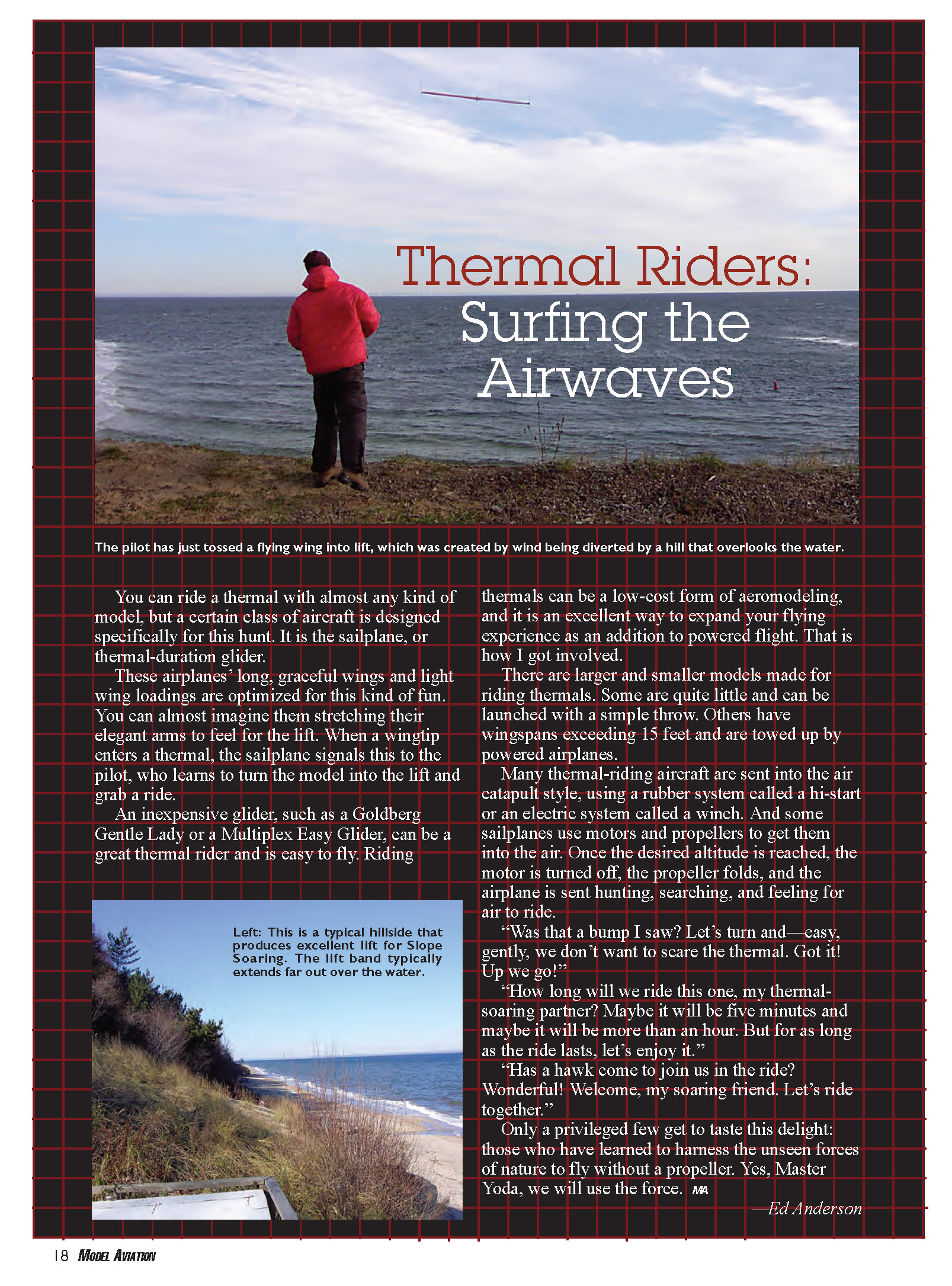
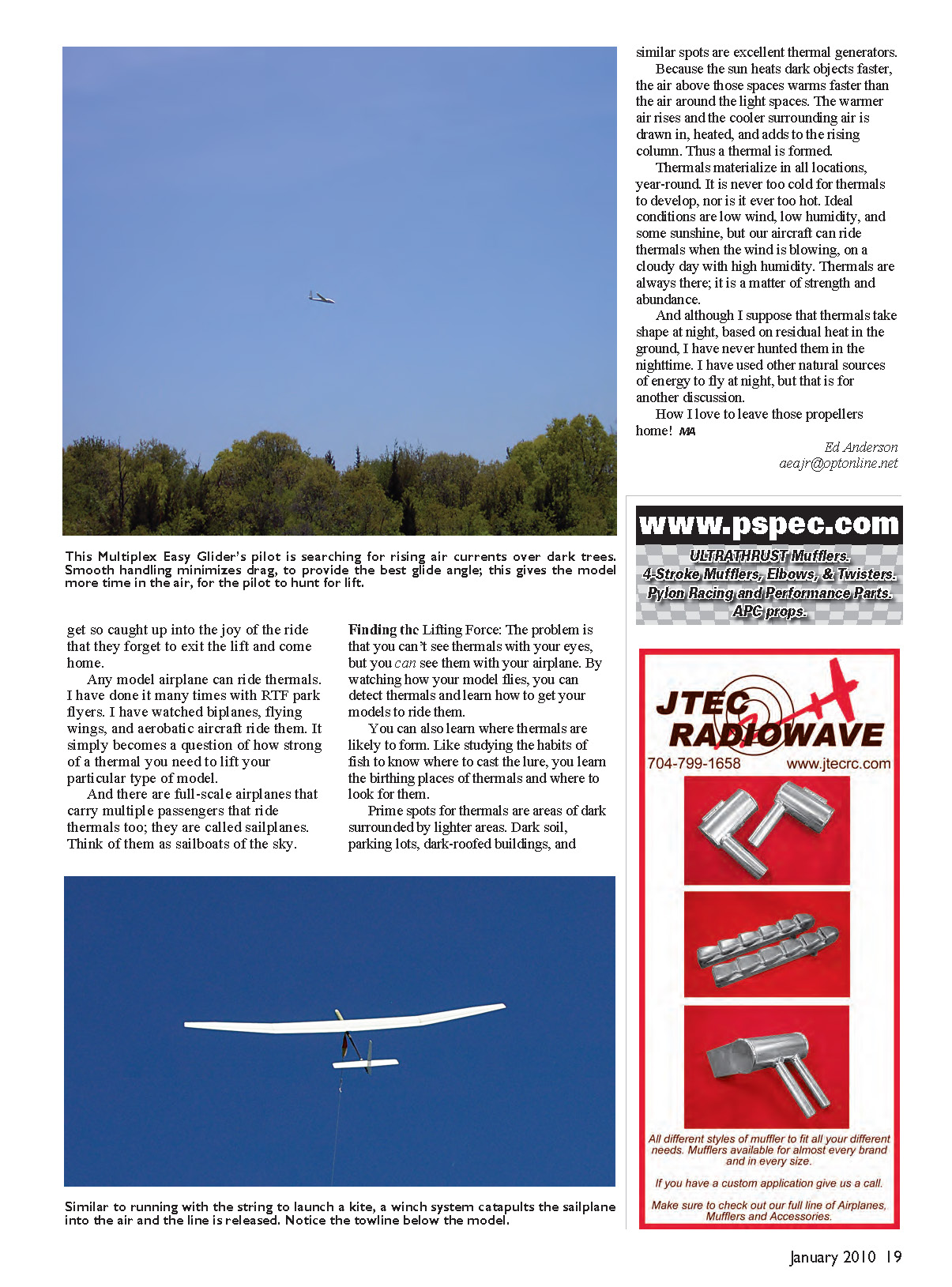
The air surrounding us is constantly moving. As the sun heats the ground, the ground heats the air around it, causing it to rise. These rising currents are normally mild, but they are the same forces that produce cyclones, tornadoes, and hurricanes. These rising columns of air—called thermals—often shoot into the air like a water fountain. With experience, we can ride these columns of air with our models. It’s a lot of fun!
Thermals can be huge and powerful, stretching thousands of feet into the sky. They can carry our airplanes high and far from us. A valuable part of learning to ride thermals is knowing when to get out of the lift. If you ride them too long, they will carry your aircraft out of sight. It happens infrequently, but sometimes pilots, in a form of rapture, get so caught up in the joy of the ride that they forget to exit the lift and come home.
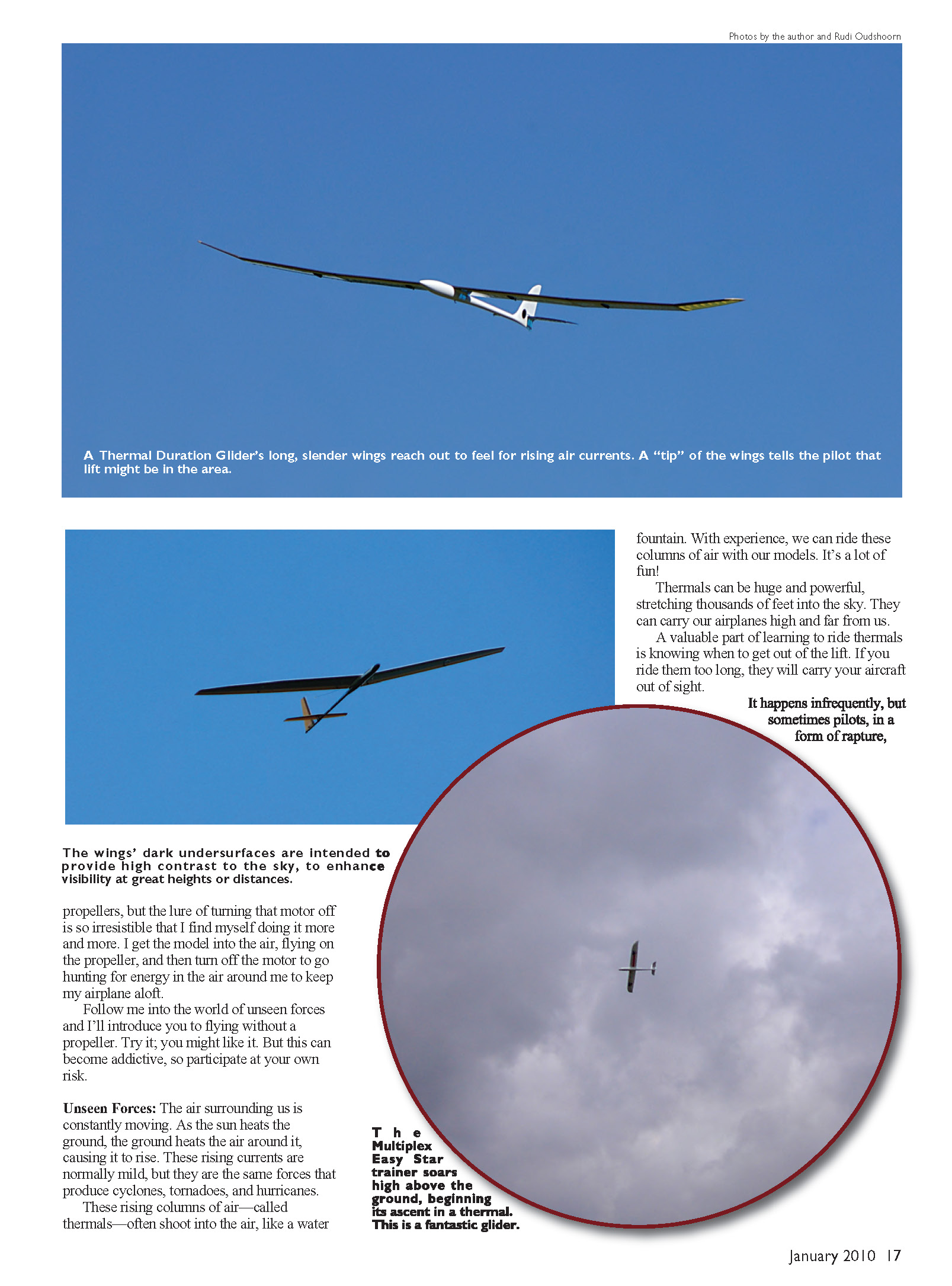
Any model airplane can ride thermals. I have done it many times with RTF park flyers. I have watched biplanes, flying wings, and aerobatic aircraft ride them. It simply becomes a question of how strong a thermal you need to lift your particular type of model.
There are larger and smaller models made for riding thermals. Some are quite little and can be launched with a simple throw. Others have wingspans exceeding 15 feet and are towed up by powered airplanes.
Many thermal-riding aircraft are sent into the air catapult style, using a rubber system called a hi-start or an electric system called a winch. And some sailplanes use motors and propellers to get them into the air. Once the desired altitude is reached, the motor is turned off, the propeller folds, and the airplane is sent hunting, searching, and feeling for air to ride.
"Was that a bump I saw? Let's turn and—easy, gently, we don't want to scare the thermal. Got it! Up we go!"
"How long will we ride this one, my thermal-soaring partner? Maybe it will be five minutes and maybe it will be more than an hour. But for as long as the ride lasts, let's enjoy it."
"Has a hawk come to join us in the ride? Wonderful! Welcome, my soaring friend. Let's ride together."
Only a privileged few get to taste this delight: those who have learned to harness the unseen forces of nature to fly without a propeller. Yes, Master Yoda, we will use the force.
There are full-scale airplanes that carry multiple passengers that ride thermals too; they are called sailplanes. Think of them as sailboats of the sky.
Finding the Lifting Force
The problem is that you can't see thermals with your eyes, but you can see them with your airplane. By watching how your model flies, you can detect thermals and learn how to get your models to ride them.
You can also learn where thermals are likely to form. Like studying the habits of fish to know where to cast the lure, you learn the birthing places of thermals and where to look for them.
Prime spots for thermals are areas of dark surfaces surrounded by lighter areas:
- Dark soil
- Parking lots
- Dark-roofed buildings
- Paved areas and similar spots
Because the sun heats dark objects faster, the air above those spaces warms faster than the air around the light spaces. The warmer air rises and the cooler surrounding air is drawn in, heated, and adds to the rising column. Thus a thermal is formed.
Thermals materialize in all locations, year-round. It is never too cold for thermals to develop, nor is it ever too hot. Ideal conditions are low wind, low humidity, and some sunshine, but our aircraft can ride thermals when the wind is blowing, or on a cloudy day with high humidity. Thermals are always there; it is a matter of strength and abundance.
And although I suppose that thermals take shape at night, based on residual heat in the ground, I have never hunted them in the nighttime. I have used other natural sources of energy to fly at night, but that is for another discussion.
How I love to leave those propellers home!
—Ed Anderson
Transcribed from original scans by AI. Minor OCR errors may remain.

