
MA Profiles: Nilton Renno
Gordon Schimmel
Radio Control models used for research
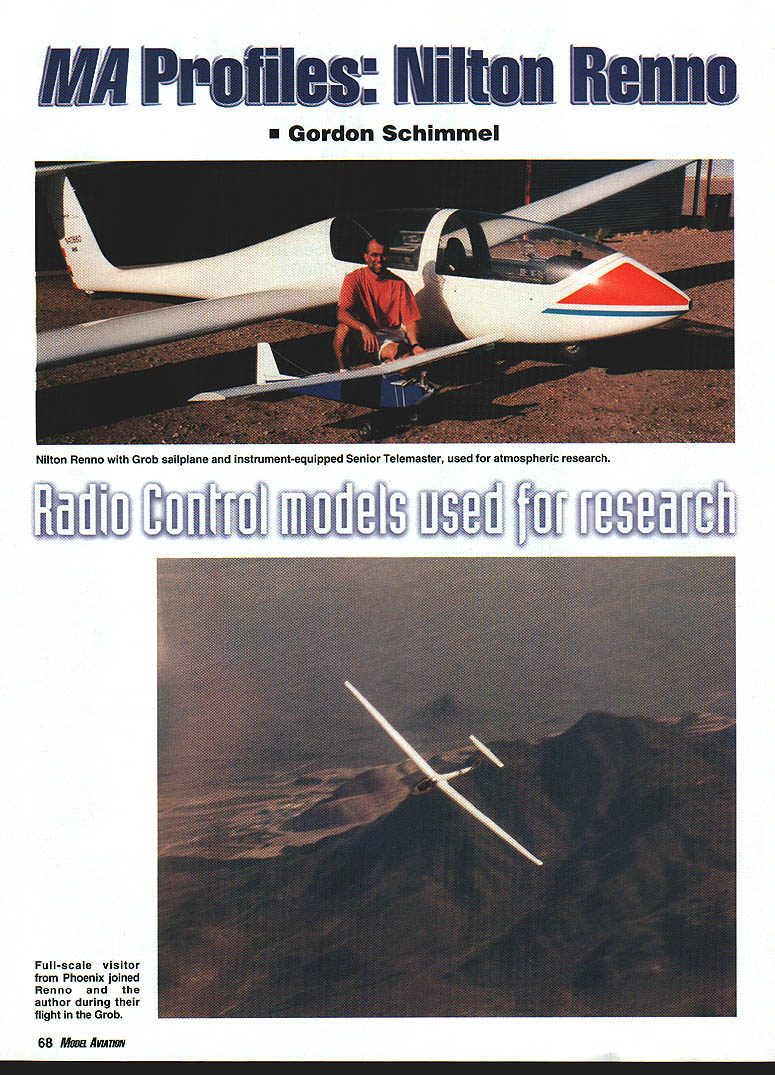
The sun shines bright in a turquoise sky; it's nearly 90°, with thermals rising; and I am strapping into a German-made Grob sailplane to ride the wind.
My instructor is Nilton Renno, a frequent competitor in full-scale soaring contests. He is also an experienced modeler who flies radio-control airplanes to 20,000 feet to gather data for atmospheric research projects at the University of Arizona. He is an assistant professor in the Department of Atmospheric Sciences, and his work is a unique example of a marriage of modeling, flying full-scale airplanes, and a professional career.
Nilton does most of the flying. As an experienced flight instructor and atmospheric-research scientist, he is at home in his element. The thermals we are riding have been the focus of academic study for more than 50 years.
Renno is a native of Brazil and began this career as a 10-year-old, flying free flight and control-line models. Eventually he taught himself to fly radio-control models. He informed me that there were many crashes!
A friend took him flying at a local glider club, and from that point on he concentrated on full-scale soaring machines. He soloed and got his "ticket" at 16, and by age 18 he had his instructor's license. Every summer, to make money for the glider club, Nilton and three or four others would take gliders and a towplane to mountain resorts to clean up, giving rides to the tourists.
"We made lots and lots of money for the club," he said, "and we ate like kings!"
He entered the University of Campinas in Brazil, eventually earning a Bachelor of Science degree in civil engineering. His arrival in the United States was facilitated by a scholarship from MIT, where he earned a Ph.D. in atmospheric sciences. It was during this study that he became interested in thermals, and he returned to his earlier interest in model airplanes to study atmospheric convection.
"The problem with full-scale aircraft is they can't stay in a thermal long enough to accurately gather the data," he said. "Big planes fly through them too fast." He noted that full-scale aircraft tend to affect the research results more than a model, because of friction and compressional heating of the air.
When he began his research, there was some controversy over whether thermals were being fed from the surface of the ground or whether they were formed above the surface. As a graduate student, he came up with the idea of using a hand-launched electric sailplane (an ASW 22, with a wingspan of 2.5 meters) to haul an instrument package into thermals. He logged more than 200 flights, nearly losing the model several times as it flew out of sight. His major advisor secured a grant that took him to New Mexico and Florida.
His work confirmed that thermals are fed from the surface, forming continuous columns of rising air, based on a temperature increase of only 1.5 degrees from the surrounding air in the desert, and only 3 degrees in the tropics.
Although the temperature difference may seem small, these moving air masses are the enormous energy sources that drive our weather systems.
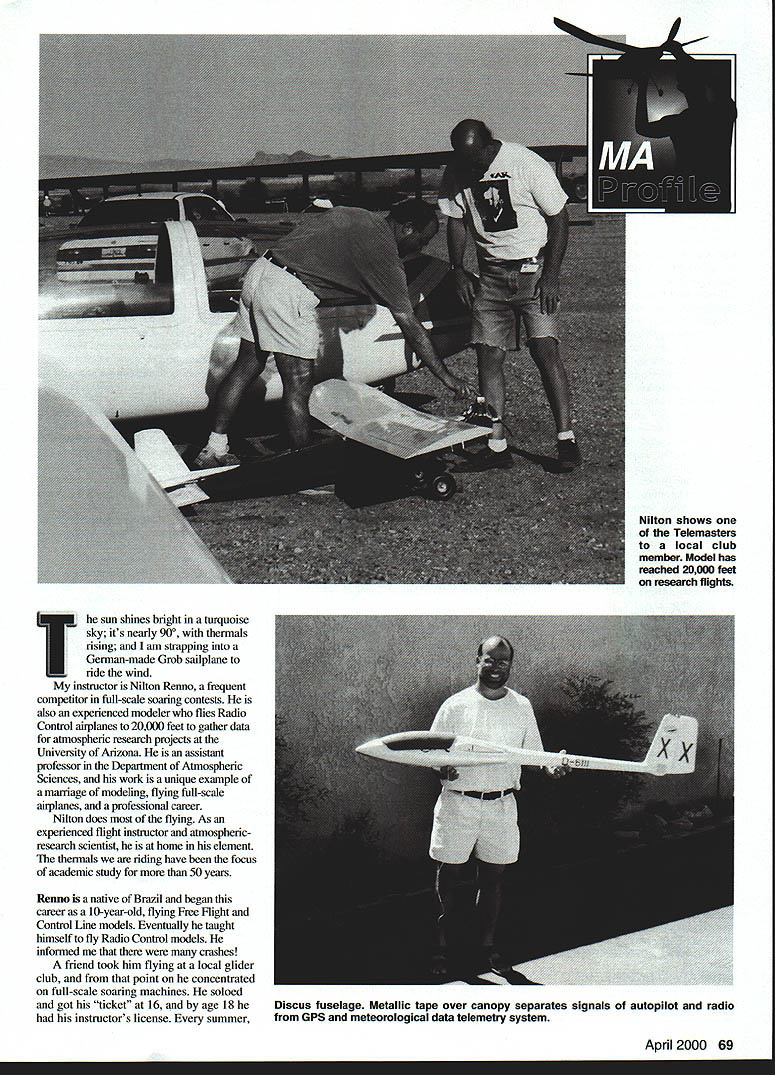
Nilton soon realized that an autopilot and a gas-powered engine would be necessary to fly higher, so he switched his research platform to a 1/4-scale Piper Cub. Eventually the Cub gave way to a fleet of four Telemaster Seniors, powered by supercharged O.S. 1.2 engines. He coupled the autopilot with a Global Positioning System (GPS) unit, enabling him to track flights from his laptop on the ground.
He has logged approximately 100 flights with these models—some of which have flown as high as 20,000 feet. Each is equipped with a wingtip instrument package that relays continuous data on barometric pressure, temperature, and humidity. Altitude, wind speed, and wind direction information can be factored in, using the GPS.
Nilton's work in atmospheric sciences has not been confined to our planet. He was invited as a postdoctoral fellow to Caltech to study the atmospheres of Venus and Jupiter.
While he was there, he met Paul MacCready, the pioneer of human-powered flight who is presently setting altitude records with the radio-controlled Pathfinder. He later met with MacCready at his headquarters to discuss research topics that could be part of these missions.
Nilton was recently visited by a film crew from The Discovery Channel, who will make him the subject of a research sequence for an upcoming show.
Nilton's present research is focused on the nature of "dust devils," those unusual phenomena that are especially prevalent in the American Southwest.
"Wind shear creates vortices on the edges of thermals," he noted. "These vortices become dust devils that rise to altitudes of several thousand feet. Their physics is similar to that of waterspouts and tornadoes. There is a lot of interest these days in better understanding tornadoes!"
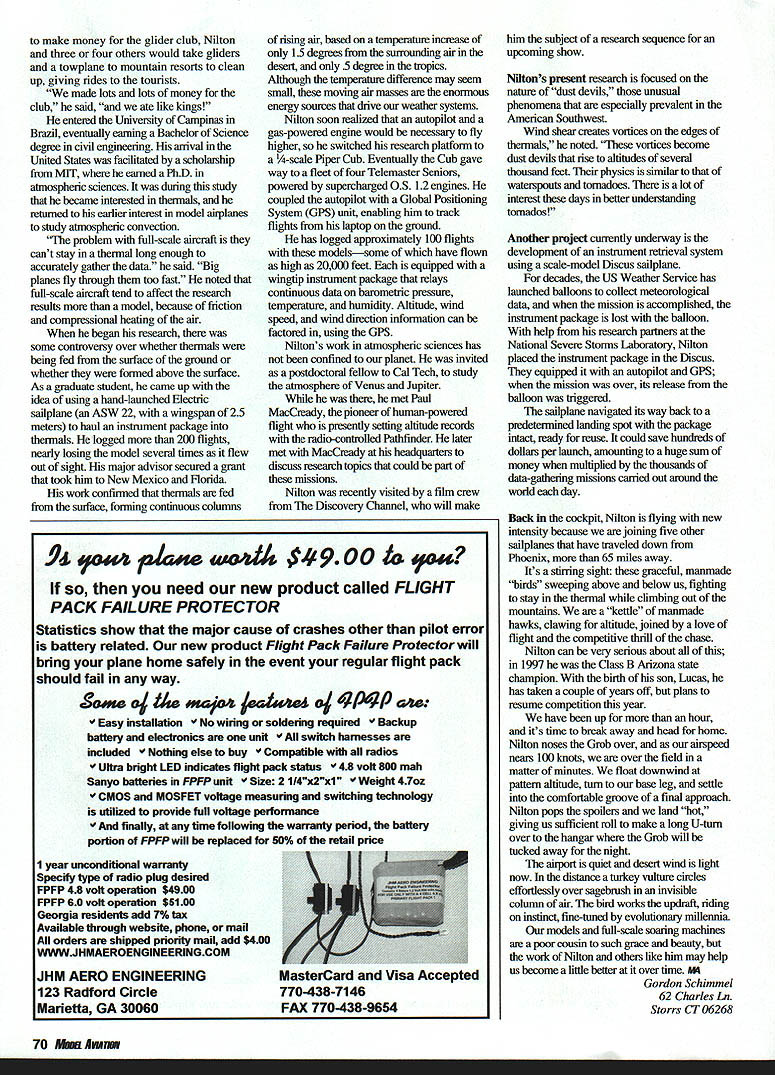
Another project currently underway is the development of an instrument-retrieval system using a scale-model Discus sailplane.
For decades, the U.S. Weather Service has launched balloons to collect meteorological data, and when the mission is accomplished, the instrument package is lost with the balloon. With help from his research partners at the National Severe Storms Laboratory, Nilton placed the instrument package in the Discus. They equipped it with an autopilot and GPS; when the mission was over, its release from the balloon was triggered.
The sailplane navigated its way back to a predetermined landing spot with the package intact, ready for reuse. It could save hundreds of dollars per launch, amounting to a huge sum of money when multiplied by the thousands of data-gathering missions carried out around the world each year.
Back in the cockpit, Nilton is flying with new intensity because we are joining five other sailplanes that have traveled down from Phoenix, more than 65 miles away.
It's a stirring sight: these graceful, manmade "birds" sweeping above and below us, fighting to stay in the thermal while climbing out of the mountains. We are a "kettle" of manmade hawks, clawing for altitude, joined by a love of flight and the competitive thrill of the chase.
Nilton can be very serious about all of this; in 1997 he was the Class B Arizona state champion. With the birth of his son, Lucas, he has taken a couple of years off, but plans to resume competition this year.
We have been up for more than an hour, and it's time to break away and head for home. Nilton noses the Grob over, and as our airspeed nears 100 knots, we are over the field in a matter of minutes. We float downwind at pattern altitude, turn to our base leg, and settle into the comfortable groove of a final approach. Nilton pops the spoilers and we land "hot," giving us sufficient roll to make a long U-turn over to the hangar where the Grob will be tied down for the day.
The airport is quiet and desert wind is light now. In the distance a turkey vulture circles effortlessly over sagebrush in a vast churn of thermal air. The bird works the updraft, riding an instinct, fine-tuned by evolutionary millennia.
Our models and full-scale soaring machines are poor cousins to such grace and beauty, but the work of Nilton and others like him may help us become a little better at it over time.
—Gordon Schimmel 62 Charles Ln. Storrs CT 06268
Transcribed from original scans by AI. Minor OCR errors may remain.

