
■ Jerry Smith
MASTERS WORLD AEROBATICS CHAMPIONSHIPS
The fourth-annual Masters, held September 21–25, 1999, was an unforgettable event and will linger on most as one of the best Pattern events held at the Hartness Estate in Greenville, South Carolina.
Perfect weather and exceptional flying conditions were all that we could hope for, and we were not disappointed. Light winds, with temperatures in the 80s, allowed the pilots to score high, making it very difficult for the judges.
The first Masters was held at Greenville in 1996. The intent was to bring to the East Coast the Tournament of Champions–type Pattern flying that many of us had not seen before. I think the contest has achieved that goal.
The Masters had a shaky start because it was not widely known. It has had its growing pains, but after a change in the event date and plenty of persistence by Mike Gregory, Kirby McKinney, and Don Lowe, the contest has become an event worth noting. It's to the point where qualifications are necessary to pick out the semifinalists.
I have seen the Masters grow from the start, and I can tell you that it will go on for many years to become a popular premier event.
Site and Conditions
Hartness Field has its good attributes, such as a fairly wide and well-kept Bermuda-grass runway (thanks to Randy Long, local golf course greenskeeper), beautiful surroundings, a nearby workshop for damage repair, and a hangar in which to store airplanes at night.
The downside is that you look directly into the sun in the morning hours, which is not great for the pilots or for judging maneuvers. You fly over trees most of the time, and the runway is—for the most part—a downhill grade. The site is also located under the Greer, SC, airport landing pattern.
In order to promote safety, whenever a full-scale aircraft was spotted coming in or leaving, the model pilot was asked to abort the pattern and come down to a safe altitude before resuming. This worked very well.
New at this Masters was a complaint from a nearby retirement home regarding noisy engines. Pat Hartness is well aware of all these problems, but he would like to continue having the Masters at this site—at least for the time being. It is beginning to close in more and more for this flying site.
After hearing the noise complaint, out came the decibel meter. Each engine was checked at the required distance as the pilot started it, but not on a hard surface. The readings ranged from 103 to 108 dB. There was no doubt that most of the noise came from the propellers. The jets landing at the airport made far more noise, but theirs was temporary and ours was all day long.
Qualifications and Entries
The qualifications yielded 20 pilots—by far the most who have ever attended the Masters.
The qualifying standings after two Known pattern flights and one Unknown flight on Tuesday, and one Unknown flight and one Freestyle flight on Wednesday, yielded 10 of the 20 as semifinalists.
Top qualifiers included:
- Rick Byrd (Fort Worth, TX) — 992.57
- John Gleczellis (Boston, MA), 15 years old — 982.35
Hoping for a total of 20 pilots in the semifinals, 10 were invited back from 1998. Only six of those returned. With the 10 chosen from the qualifications, a total of 16 pilots were committed to the semifinals.
Contest Schedule
- Thursday: two rounds of the Known pattern and one round of Freestyle. The pilots were given the Unknown pattern Thursday night with no chance to practice.
- Friday: two rounds of the Unknown pattern and one round of Freestyle.
- Saturday (final flyoff): two rounds of Known, two rounds of Unknown, and one round of Freestyle by the nine pilots who made the cut.
Actually, 10 pilots made the cut, but Gerald Candito became sick with a sinus infection on Friday night and decided to stay out of the finals.
Aircraft, Engines, and Props
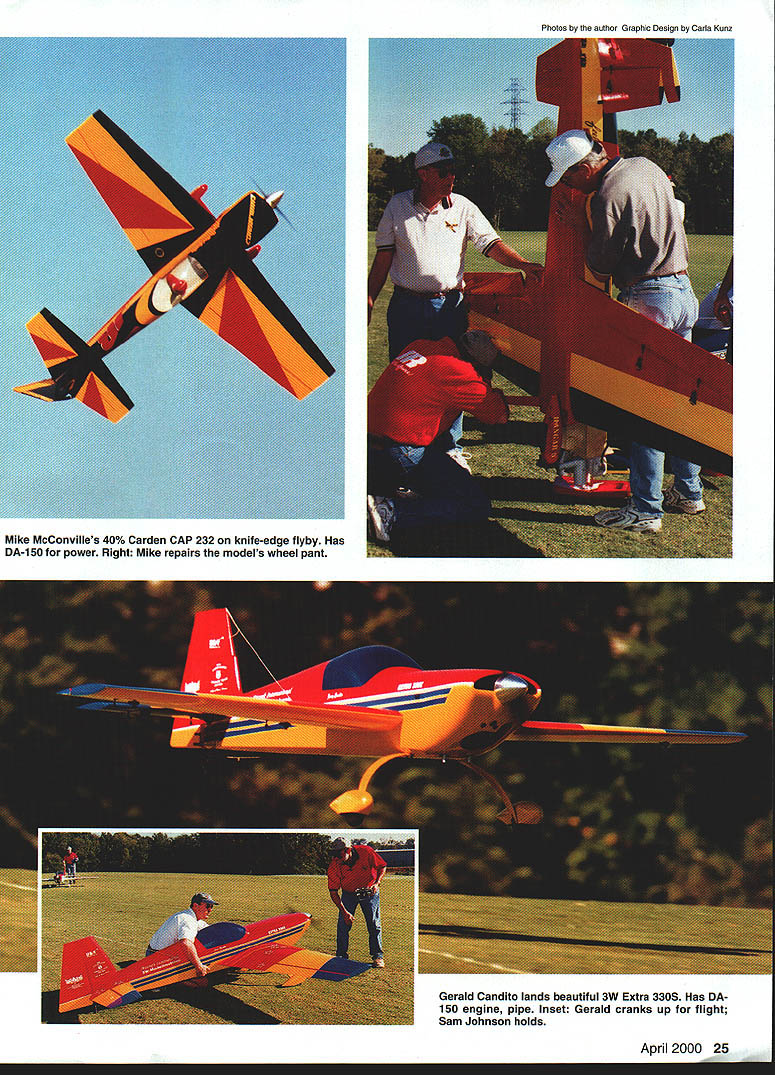
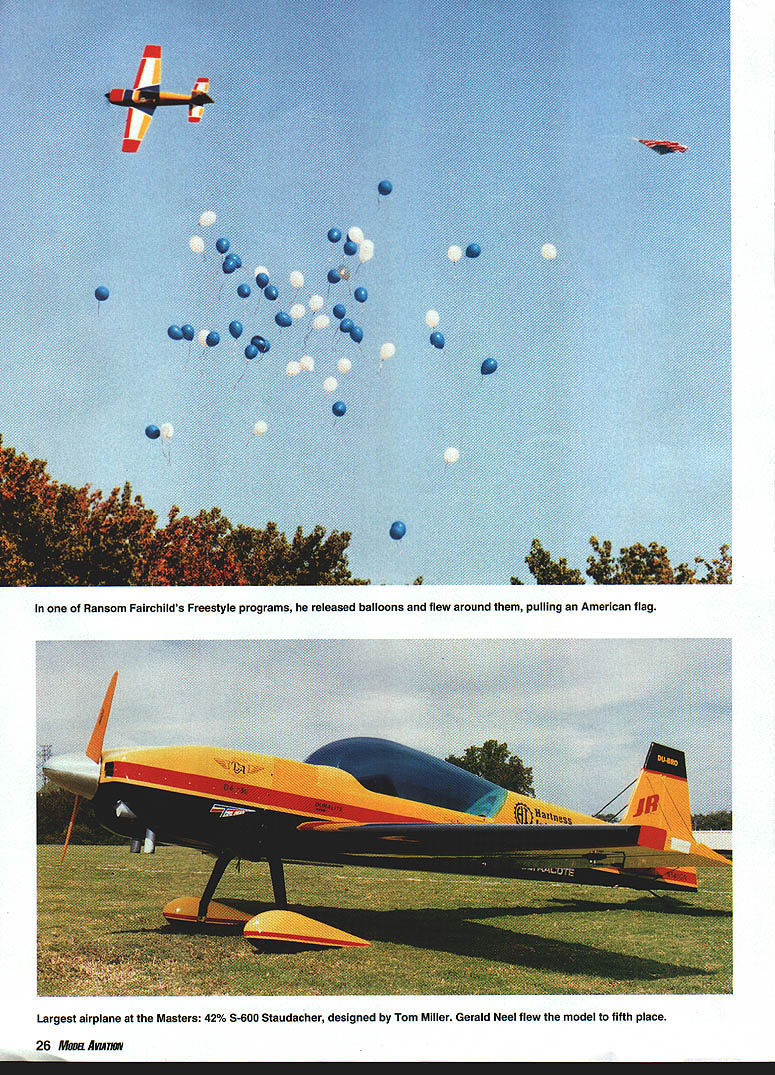
The airplanes flown ranged from 33–42% in size and were typically Extra 300Ls, Staudachers, Giles, and CAP 232s.
Most airplanes were powered with 3W engines, except for one Bison 5.8, a Quadra 110, and an M&R—the newest engine on the scene. The 3W seems to be the choice for engines. Gerhard Stejskal of Aircraft International said 3W would be coming out with 38cc and 50cc single-cylinder engines, and a 170cc four-cylinder was due this year and would be on display at Toledo 2000.
The propellers used at the contest were fairly evenly distributed among Bolly, Menz, and Meizlik.
Judges and Organization
The judges have a tough job, looking up into the bright sky, watching every maneuver, and doing their best to be as objective as possible. It really is a tiresome job. Six judges alternated between flights.
I have particularly high regard for Don Lowe, who most likely spent many hours putting together the Known and Unknown patterns, contacting judges, and coordinating the flying and judging at the contest.
The flying was fantastic—especially with the excellent weather conditions.
Semifinals and Notable Pilots
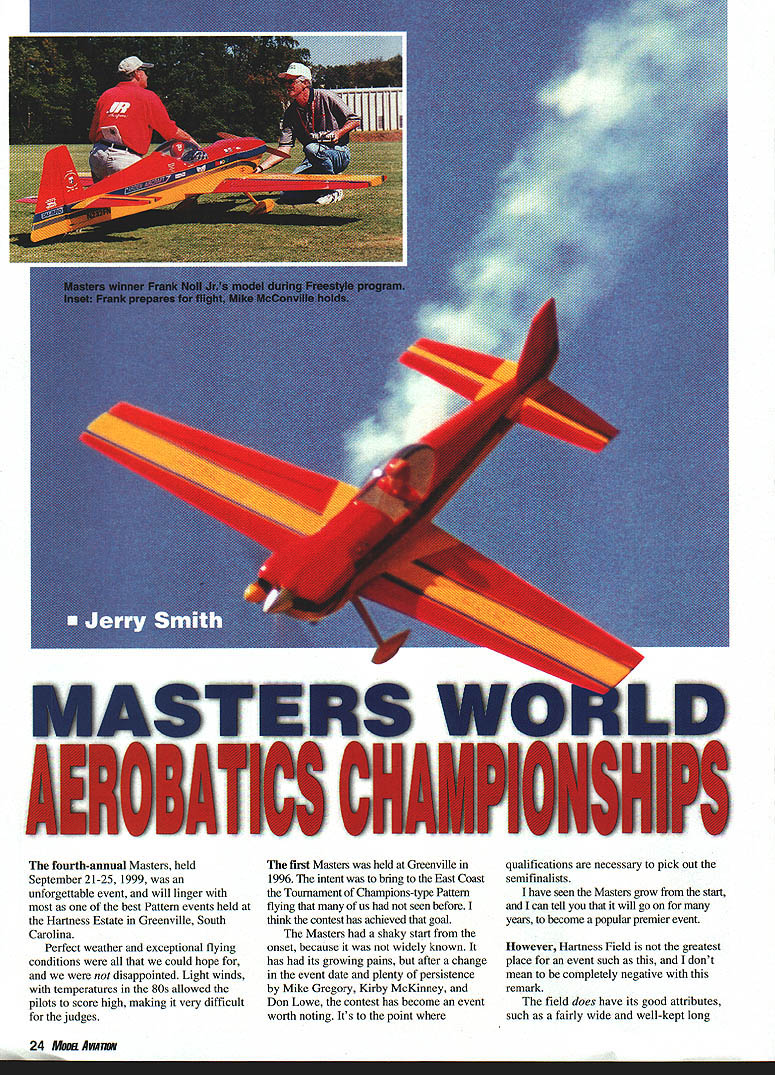
At the end of the semifinal standings, it looked as if Warren Thomas Jr. was in command with a score of 991.8 and would go on to win. Frank Noll had a score of 987.64, followed by Gerald Neel, Rick Byrd, and Mike McConville. Mike has been in second place for the last three years but never could quite make first place; he told me he was somewhat concerned about the younger pilots.
Notable young pilots:
- Fabio Trento (17, from Brazil) flew an Ohio RC Extra 300L powered by a 3W-100.
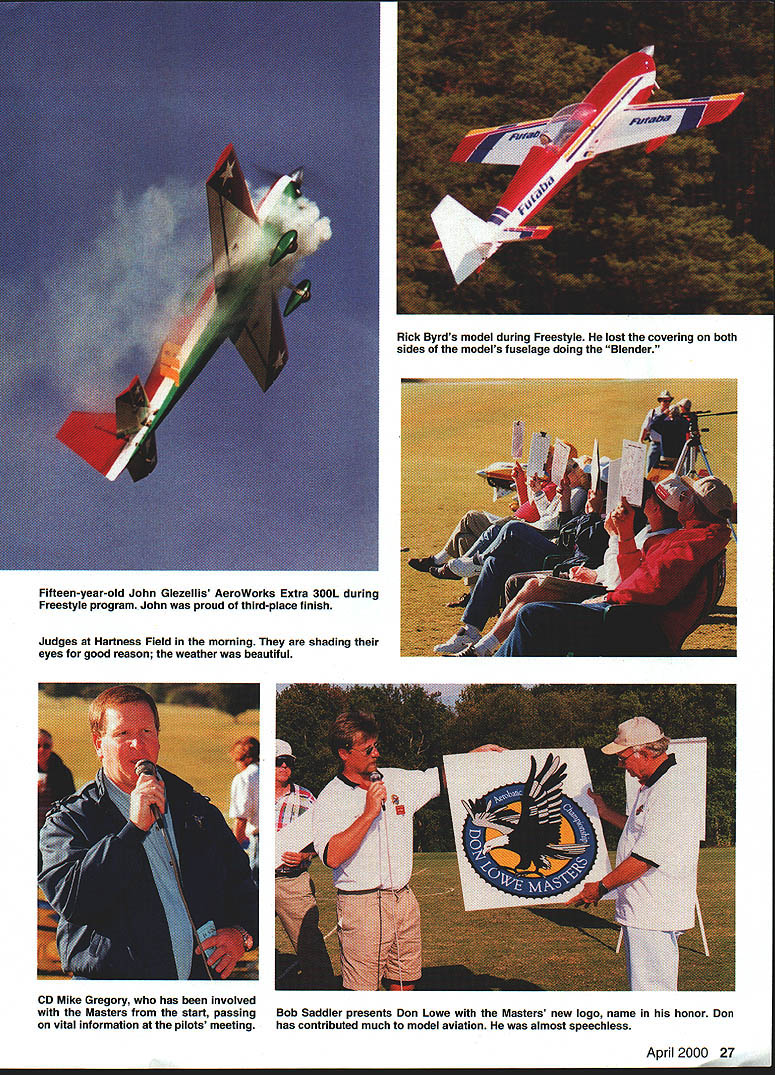
- John Gleczellis (15) flew an Aero Works 37% Extra 300L powered by a 3W-140 and impressed with his Freestyle program.
Incidents and Highlights
A couple of unusual things happened at this Masters:
- During his Freestyle program, Rick Byrd did a Blender. As the airplane went into the flat-spin part of the maneuver, the covering popped off both sides of the fuselage. Rick also broke a spring on his transmitter stick the next day, eliminating stick centering; fortunately it was near the end of his flight.
- A blissful, first-time happening at the Masters was a marriage proposal integrated into a Freestyle program. Ransom Fairchild proposed to his girlfriend Amy by picking up a limbo line with a trailer sign on it and asking her to marry him. Upon the model's landing, she said yes, and he placed a ring on her finger. The wedding will take place in February 2000, according to Ransom.
Those with current AMA membership cards were allowed in to watch the contest. Spectators especially enjoyed the Freestyle; the wildest 3-D maneuvers choreographed to music made for a thrilling time, with some maneuvers performed very close to the ground!
All of the pilots were given T-shirts and hats with their names on them, and enjoyed a Friday-night barbecue for them and their friends in Pat Hartness's backyard. Wayne Matthews of Sew Busy embroidered the hats and T-shirts; he turns out an excellent product (www.rcplanet.com/sewbusy/).
Awards and Honors
The awards program was held Saturday afternoon after the last flight.
- Masters champion: Frank Noll Jr. — presented a cast eagle mounted on a piece of granite.
- 2nd: Warren Thomas Jr.
- 3rd: John Gleczellis
- 4th: Mike McConville
- 5th: Gerald Neel
A very special award was given to Don Lowe: the Masters event was named the Don Lowe Masters, with a new logo featuring his name and a large eagle. The road going into the new location for the Joe Nall event next year will be named Don and Clara Lowe Boulevard. Don was given a copy of the eagle trophy so he could bring it back each year to have the winner's name inscribed on it. That is a fine tribute—congratulations, Don!
Thanks and Acknowledgments
Many thanks to the Hartness gang and to:
- Contest Director Mike Gregory
- Kirby McKinney (greeting with Southern humor)
- Announcer Bob Saddler (kept us laughing)
- Mike Letourneau (scoring table, compiling results)
- Pat Hartness (for allowing it all to happen)
MA
Jerry Smith 2416 Carina Terr. Acworth, GA 30101 [email protected]
Transcribed from original scans by AI. Minor OCR errors may remain.

