
Maxford USA Nieuport 28 EP 40
Terry Dunn [email protected]
Fly Eddie Rickenbacker's French fighter
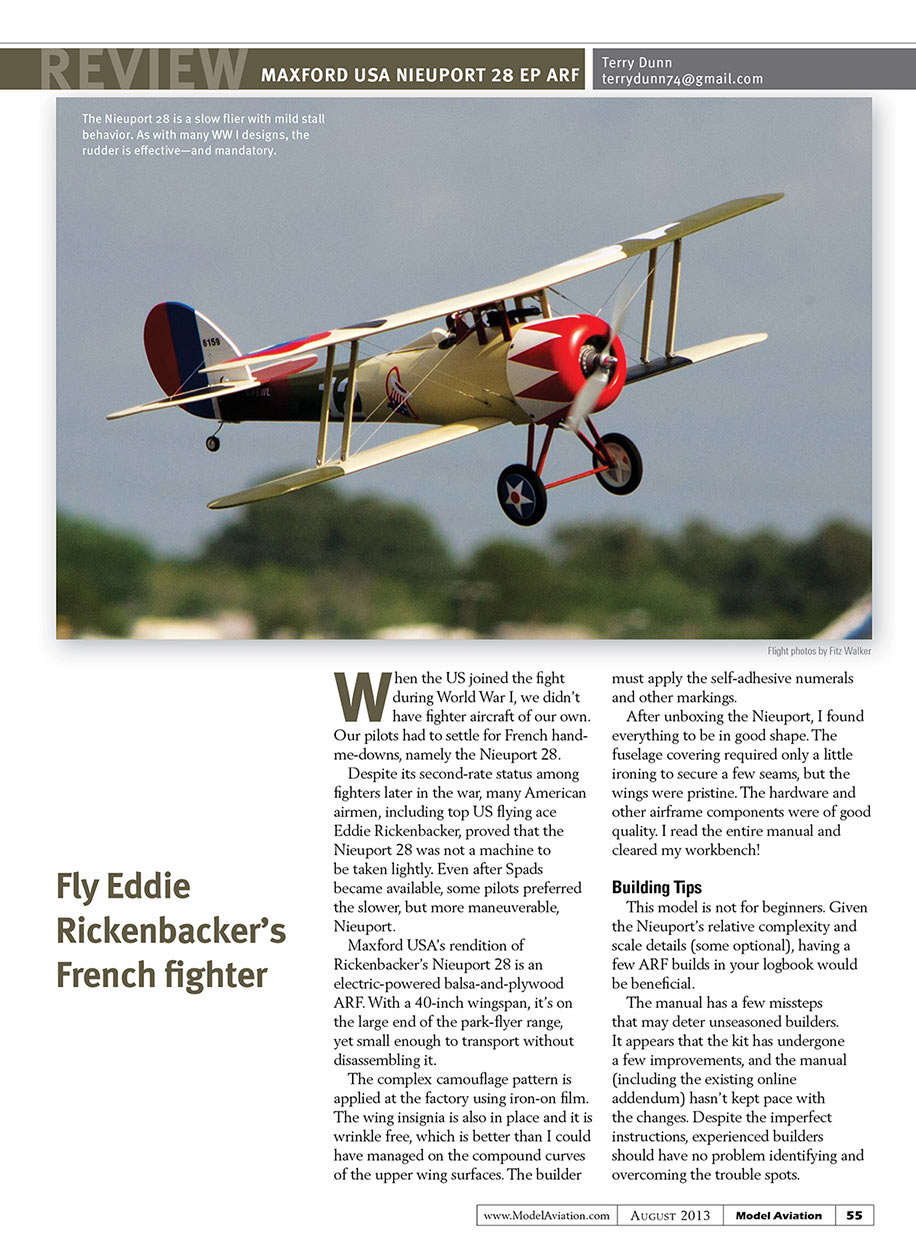
When the US joined the fight during World War I, we didn't have fighter aircraft of our own. Our pilots had to settle for French hand-me-downs, namely the Nieuport 28.
Despite its second-rate status among fighters later in the war, many American airmen, including top US flying ace Eddie Rickenbacker, proved that the Nieuport 28 was not a machine to be taken lightly. Even after Spads became available, some pilots preferred the slower, but more maneuverable, Nieuport.
Maxford USA's rendition of Rickenbacker's Nieuport 28 is an electric-powered balsa-and-plywood ARF. With a 40-inch wingspan, it's on the large end of the park-flyer range, yet small enough to transport without disassembling it.
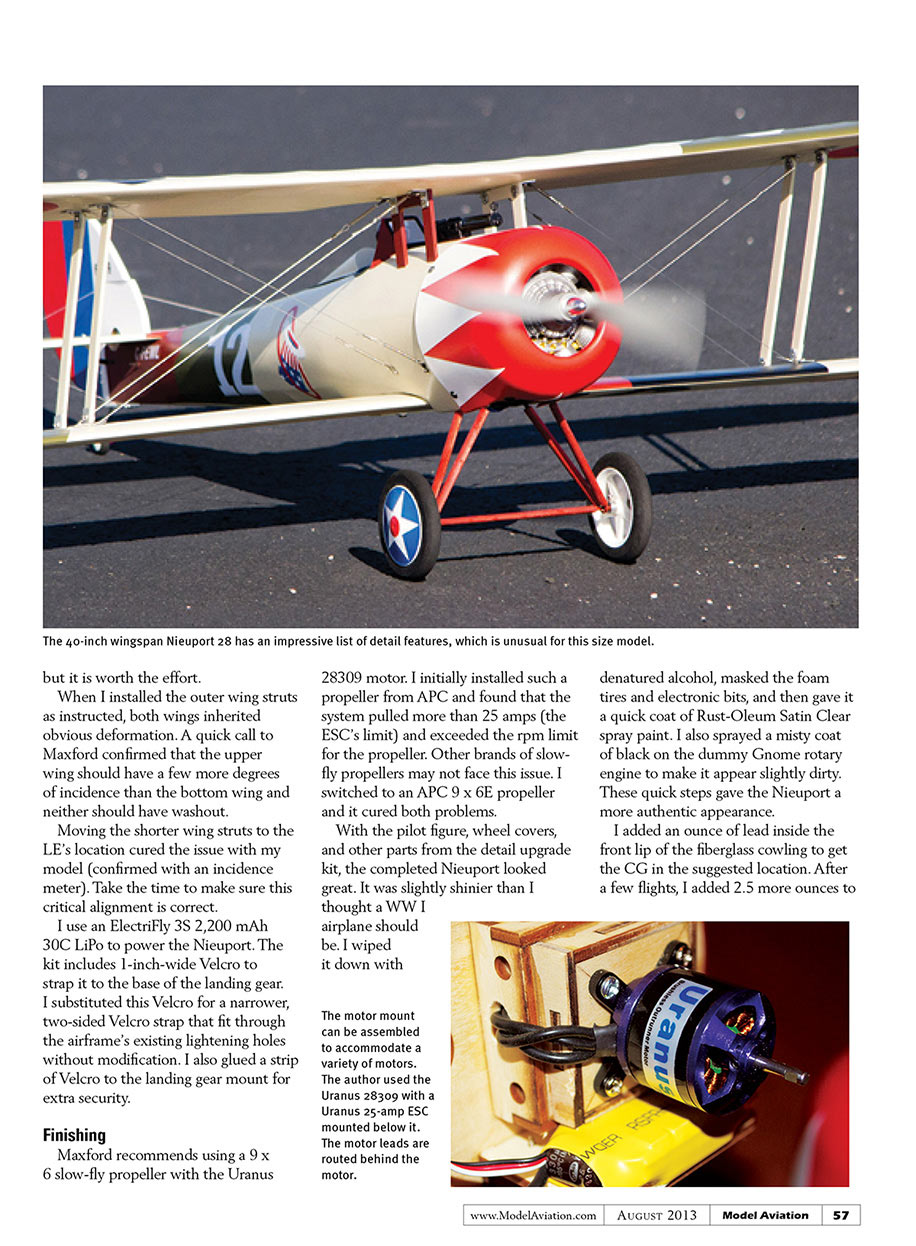
The complex camouflage pattern is applied at the factory using iron-on film. The wing insignia is also in place and it is wrinkle free, which is better than I could have managed on the compound curves of the upper wing surfaces. The builder must apply the self-adhesive numerals and other markings.
After unboxing the Nieuport, I found everything to be in good shape. The fuselage covering required only a little ironing to secure a few seams, but the wings were pristine. The hardware and other airframe components were of good quality. I read the entire manual and cleared my workbench!
Building Tips
This model is not for beginners. Given the Nieuport's relative complexity and scale details (some optional), having a few ARF builds in your logbook would be beneficial.
The manual has a few missteps that may deter unseasoned builders. It appears that the kit has undergone a few improvements, and the manual (including the existing online addendum) hasn't kept pace with the changes. Despite the imperfect instructions, experienced builders should have no problem identifying and overcoming the trouble spots.
Maxford USA Nieuport 28 EP 40
Terry Dunn
My tail wheel assembly would not fit as described in the manual. To cure this, I beveled the bottom opening in the tail wheel mounting bracket with a countersink bit in my hand drill. It only took a few twists to remove enough material for a perfect fit.
The cabane struts also required some improvisation. They are a tight fit in the fuselage slots where they are to be mounted. I found it much easier to install the cabanes with them detached from the top wing.
I also removed the covering on the portions of the cabanes that are imbedded in the fuselage slots.
I used Futaba S3114 microservos on all of the control surfaces. They are slightly smaller than the factory cutouts, but I was easily able to install them. What surprised me was that all of the pushrods have a Z-bend at the servo and a 90° bend with a plastic keeper at the control surface.
It is a simple, slop-free design, but the resulting lack of length adjustment leaves little margin for error when imparting the 90° bend.
For the elevator and rudder, I utilized the pushrods as designed. I adjusted the substrims for each servo with my Futaba 7C transmitter to center the control surfaces. Because both ailerons share a single servo, I could not use substrim to absorb any errors in their pushrod lengths. The included pushrods were long enough that I was able to include a V-bend in each rod, which allowed me to fine-tune their final lengths.
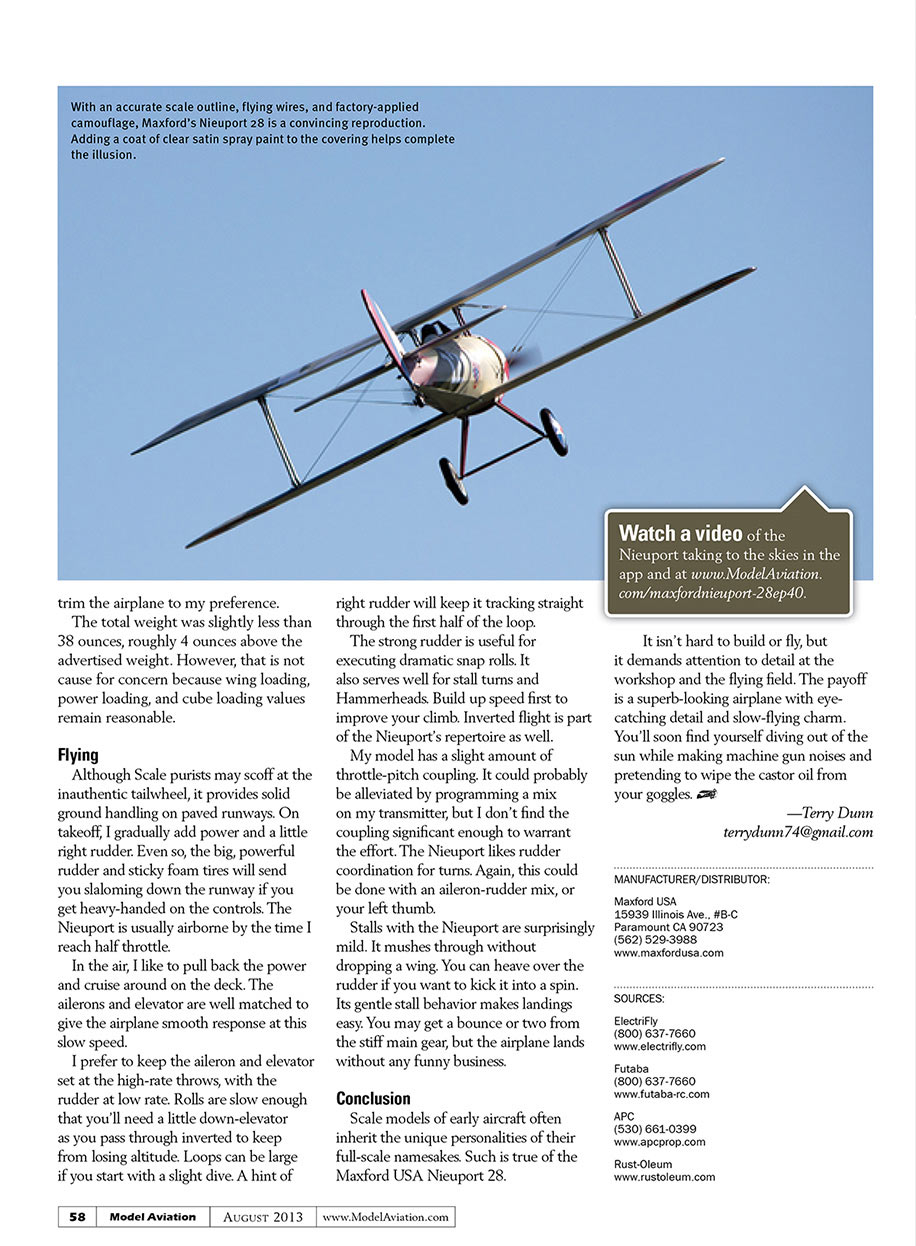
The Nieuport includes a floating motor mount that allows it to accommodate motors of varying lengths. After I had it set to utilize Maxford's Uranus 28309 outrunner motor, I noticed that there was room below to also mount the Uranus 25-amp ESC.
I chose this spot over the internal location noted in the manual to move a little mass toward the nose and expose the ESC to more cooling air. I opened up a slot in the motor mount to route the motor leads and keep them clear of the spinning motor can. Mounting the wing struts and flying wires takes time, but the final result is very scale looking.
Flying
On the first flight I kept everything soft and easy. The Nieuport tracked well on takeoff, and with a little up elevator I was airborne in short order. The model is not a trainer by any stretch — it is responsive and sporty. I found that a little down elevator was required to counteract the initial power-on climb tendency, and trimming was straightforward.
Stalls are gentle with plenty of warning. I used flaperons for landing and found them quite effective in allowing slower speeds and steeper approaches. The model lands in a predictable fashion and the tailwheel steering works well on grass.
The Nieuport shows a distinct personality in the air — crisp aileron rolls, quick snap rolls when prompted, and a stable glide when the power is reduced. It is a fun model to fly for anyone with ARF-building experience and a taste for scale WWI types.
Conclusion
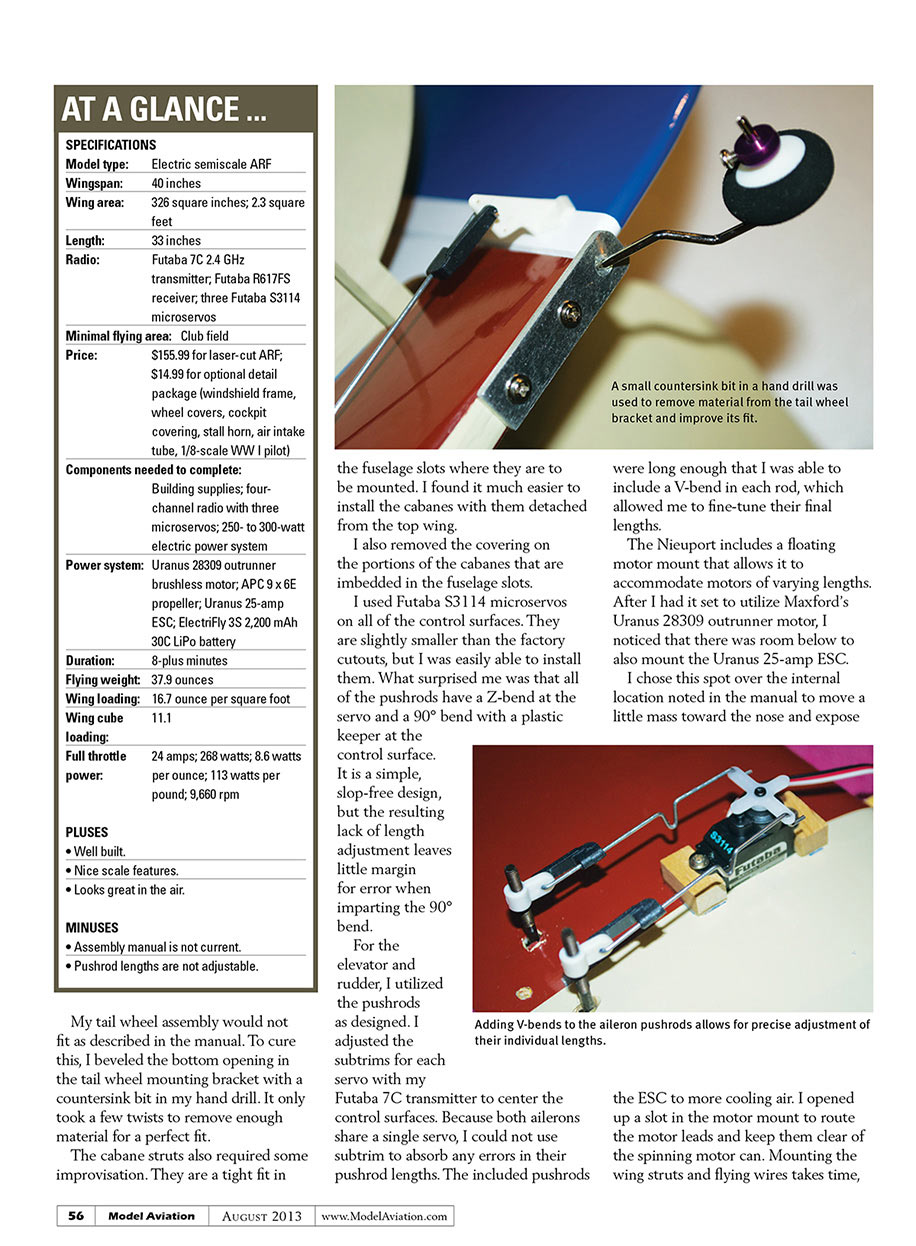
Maxford's Nieuport 28 EP 40 is a well-built, nicely finished scale model that delivers enjoyable flying characteristics. The kit requires some experience to assemble and a few minor modifications, but the result is a compact, attractive biplane that flies very well. With attention to the few fit issues and careful setup of the pushrods, the Nieuport is a rewarding park-flyer-scale model for intermediate builders and pilots. The 40-inch wingspan Nieuport 28 has an impressive list of detail features, which is unusual for this size model.
but it is worth the effort.
When I installed the outer wing struts as instructed, both wings inherited obvious deformation. A quick call to Maxford confirmed that the upper wing should have a few more degrees of incidence than the bottom wing and neither should have washout.
Moving the shorter wing struts to the LE's location cured the issue with my model (confirmed with an incidence meter). Take the time to make sure this critical alignment is correct.
I use an ElectriFly 3S 2,200 mAh 30C LiPo to power the Nieuport. The kit includes 1-inch-wide Velcro to strap it to the base of the landing gear. I substituted this Velcro for a narrower, two-sided Velcro strap that fit through the airframe's existing lightening holes without modification. I also glued a strip of Velcro to the landing gear mount for extra security.
Finishing
Maxford recommends using a 9 x 6 slow-fly propeller with the Uranus 28309 motor. I initially installed such a propeller from APC and found that the system pulled more than 25 amps (the ESC's limit) and exceeded the rpm limit for the propeller. Other brands of slow-fly propellers may not face this issue. I switched to an APC 9 x 6E propeller and it cured both problems.
With the pilot figure, wheel covers, and other parts from the detail upgrade kit, the completed Nieuport looked great. It was slightly shinier than I thought a WW I airplane should be. I wiped it down with denatured alcohol, masked the foam tires and electronic bits, and then gave it a quick coat of Rust-Oleum Satin Clear spray paint. I also sprayed a misty coat of black on the dummy Gnome rotary engine to make it appear slightly dirty. These quick steps gave the Nieuport a more authentic appearance.
I added an ounce of lead inside the front lip of the fiberglass cowling to get the CG in the suggested location. After a few flights, I added 2.5 more ounces to
The motor mount can be assembled to accommodate a variety of motors. The author used the Uranus 28309 with a Uranus 25-amp ESC mounted below it. The motor leads are routed behind the motor. trim the airplane to my preference.
The total weight was slightly less than 38 ounces, roughly 4 ounces above the advertised weight. However, that is not cause for concern because wing loading, power loading, and cube loading values remain reasonable.
Flying
Although Scale purists may scoff at the inauthentic tailwheel, it provides solid ground handling on paved runways. On takeoff, I gradually add power and a little right rudder. Even so, the big, powerful rudder and sticky foam tires will send you slaloming down the runway if you get heavy-handed on the controls. The Nieuport is usually airborne by the time I reach half throttle.
In the air, I like to pull back the power and cruise around on the deck. The ailerons and elevator are well matched to give the airplane smooth response at this slow speed.
I prefer to keep the aileron and elevator set at the high-rate throws, with the rudder at low rate. Rolls are slow enough that you'll need a little down-elevator as you pass through inverted to keep from losing altitude. Loops can be large if you start with a slight dive. A hint of right rudder will keep it tracking straight through the first half of the loop.
The strong rudder is useful for executing dramatic snap rolls. It also serves well for stall turns and Hammerheads. Build up speed first to improve your climb. Inverted flight is part of the Nieuport's repertoire as well.
My model has a slight amount of throttle-pitch coupling. It could probably be alleviated by programming a mix on my transmitter, but I don't find the coupling significant enough to warrant the effort. The Nieuport likes rudder coordination for turns. Again, this could be done with an aileron-rudder mix, or your left thumb.
Stalls with the Nieuport are surprisingly mild. It mushes through without dropping a wing. You can heave over the rudder if you want to kick it into a spin. Its gentle stall behavior makes landings easy. You may get a bounce or two from the stiff main gear, but the airplane lands without any funny business.
Conclusion
Scale models of early aircraft often inherit the unique personalities of their full-scale namesakes. Such is true of the Maxford USA Nieuport 28.
It isn't hard to build or fly, but it demands attention to detail at the workshop and the flying field. The payoff is a superb-looking airplane with eye-catching detail and slow-flying charm. You'll soon find yourself diving out of the sun while making machine gun noises and pretending to wipe the castor oil from your goggles.
— Terry Dunn [email protected]
MANUFACTURER/DISTRIBUTOR: Maxford USA 15399 Illinois Ave., #B-C Paramount CA 90723 (562) 529-3988 www.maxfordusa.com
SOURCES: ElectriFly (800) 637-7660 www.electrifly.com
Futaba (800) 637-7660 www.futaba-rc.com
APC (530) 661-0399 www.apcprop.com
Rust-Oleum www.rustoleum.com
Transcribed from original scans by AI. Minor OCR errors may remain.

