
MECA EXPO V
by Robert M. Bennett
The weekend before the SAM (Society of Antique Modelers) Championships each year there is a gathering of model-engine enthusiasts who are members of the Model Engine Collectors Association (MECA). Although collecting is MECA's primary focus, many members are engine users/accumulators, performance modifiers, constructors, part manufacturers, or simply interested parties.
The gathering, referred to as the Expo, consists of displays, lectures, engine-running sessions, and a swap shop (collecto). Expo V was held at the Horizon Convention Center in Muncie, Indiana, September 10–12, 2004. The convention center, located in downtown Muncie, is an excellent facility; staff cooperation and quality accommodations—well known to model-airplane people—were confirmed at the Expo.
The event began with a board of directors meeting Friday afternoon, September 10, where several items were discussed and later brought to the general membership meeting. Membership activities began with a social hour Friday evening in the facility’s open area near the ballrooms. The annual MECA business meeting took place Saturday morning in a meeting room at the convention center. Numerous topics were discussed; the primary action was to continue holding the Expo with the SAM Champs each year, with plans to alternate between Muncie and the Las Vegas, Nevada, area.
Featured Presentations
Several presentations about model-engine manufacturing, collecting, and history were featured Saturday morning and afternoon:
- Jack Conrad: Jack related his experiences working with Bill Brown. He worked for Bill 10–12 years after “graduating” (retiring) from his job in 1989. Jack reviewed events in Bill’s life: Bill’s father built a sea-fishing reel in 1926 and introduced Bill to operating machinery; Bill had 12 years of machining experience before building his “high school engine” in 1930. Jack helped Bill with his CO2 engines for no pay until the venture became profitable—primarily to employ Bill’s son. Bill was a master miniature toolmaker, but Jack discovered there was no documentation for the 22 parts in the CO2 engine—it existed only in Bill’s head or tooling. After Bill’s stroke in 1997, he continued to build engines with his left hand.
- Karl Spielmaker: Karl described his efforts in model-engine and parts production. Inspired in high school by an article in Mechanix Illustrated about how to build midget engines, he built an engine that never ran and was later used as a shop example. As a summer job he worked in Lear’s model shop doing small-batch production. After some control-line (CL) flying, he became interested in FAI free-flight gas and developed his own .15—the Copperhead—which performed well on its first flight but suffered a thrown rod on the next. Karl went on to produce parts and full engines such as the Spielmaker .60. He observed that some people are addicted to model-airplane engines; his wife is married to someone addicted to machinery such as lathes and has a basement full of them.
- Tim Dannels: Tim, editor and publisher of the Engine Collectors’ Journal (ECJ), gave an overview of the early days of engine collecting. He noted that one of the first records of collecting appeared in the February 1946 Model Airplane News, when John Hanson’s collection (on loan to the Smithsonian) included 31 engines such as the Scrapper, the Mighty Midget, and the Hurleman—many donated by manufacturers. Early collecting publications were organized by Bruce Underwood and later by Joe Wagner. As a printer, Tim had offered to help Joe with the Bulletin, but that arrangement did not work out. Since others were publishing histories, Tim started the ECJ separate from MECA to provide a different niche and reading option. Tim began collecting in 1959 and shared several anecdotes; audience members then contributed stories of how they started collecting.
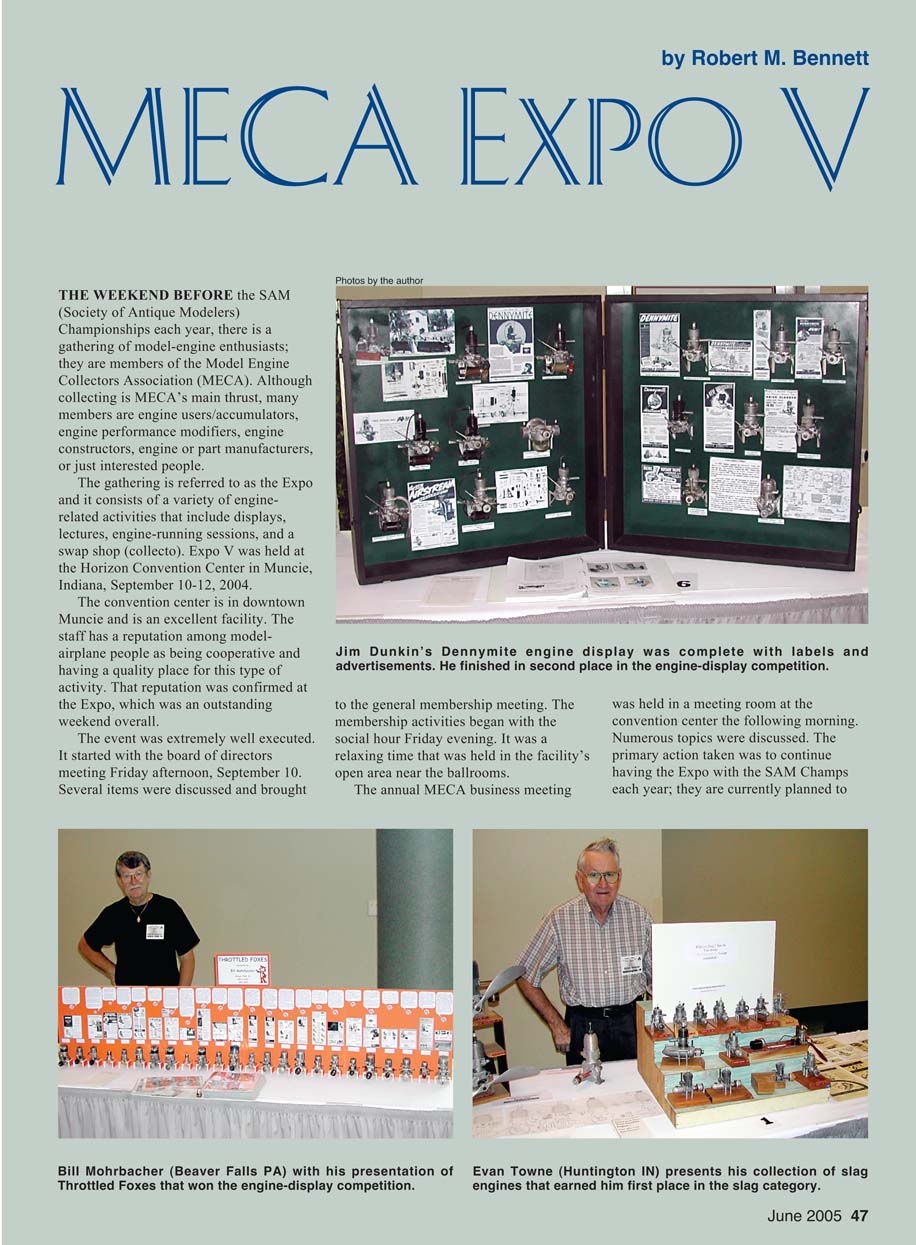
- Jim Dunkin: Jim, who presented a history of the Dennymite engine at Expo IV, followed up in 2004 with an update and overview of the Righter and Dennymite engines. The story began in 1936 when Walter Righter, then unemployed, wanted to design, build, and market a model engine, continuing through the World War II era with several manufacturers and vendors involved.
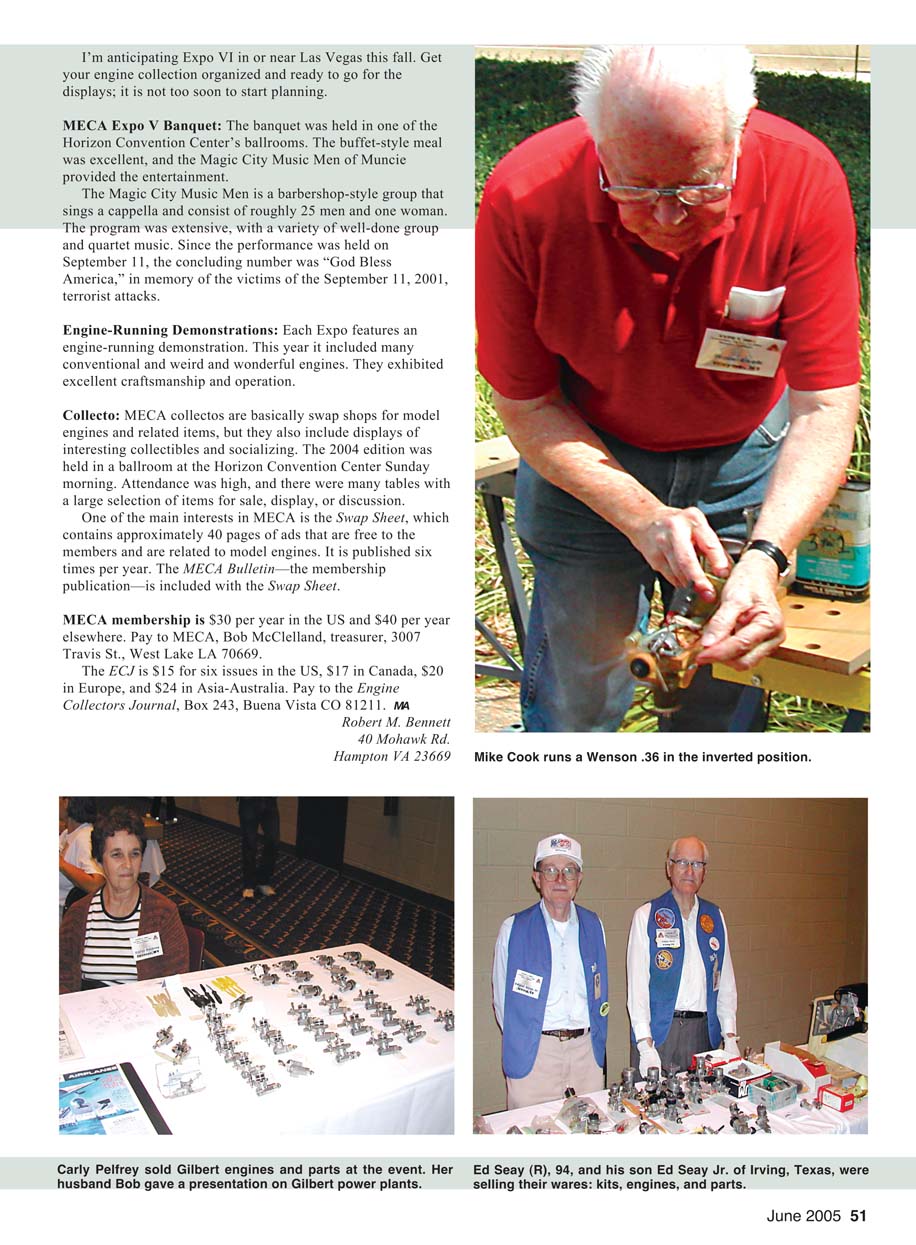
- Bob Pelfrey: In “The Gilbert Mystery,” Bob explored who designed the Gilbert engines. The A.C. Gilbert Co. was known for Erector sets, American Flyer trains, Chemcraft chemistry sets, and quality toys. A.C. Gilbert died in 1961 and the company was sold; in 1962 Gilbert reduced the train line and added airplanes sold through toy stores. The company went bankrupt in 1966 and Polk bought the airplane items. After reviewing engines and marketing, Bob concluded that Hi Johnson and Bob Holland designed the Gilbert engines.
Expo events will alternate between Muncie and the Las Vegas area. Anticipate Expo VI in or near Las Vegas this fall—get your engine collection organized and ready for display.
Model-Engine Displays
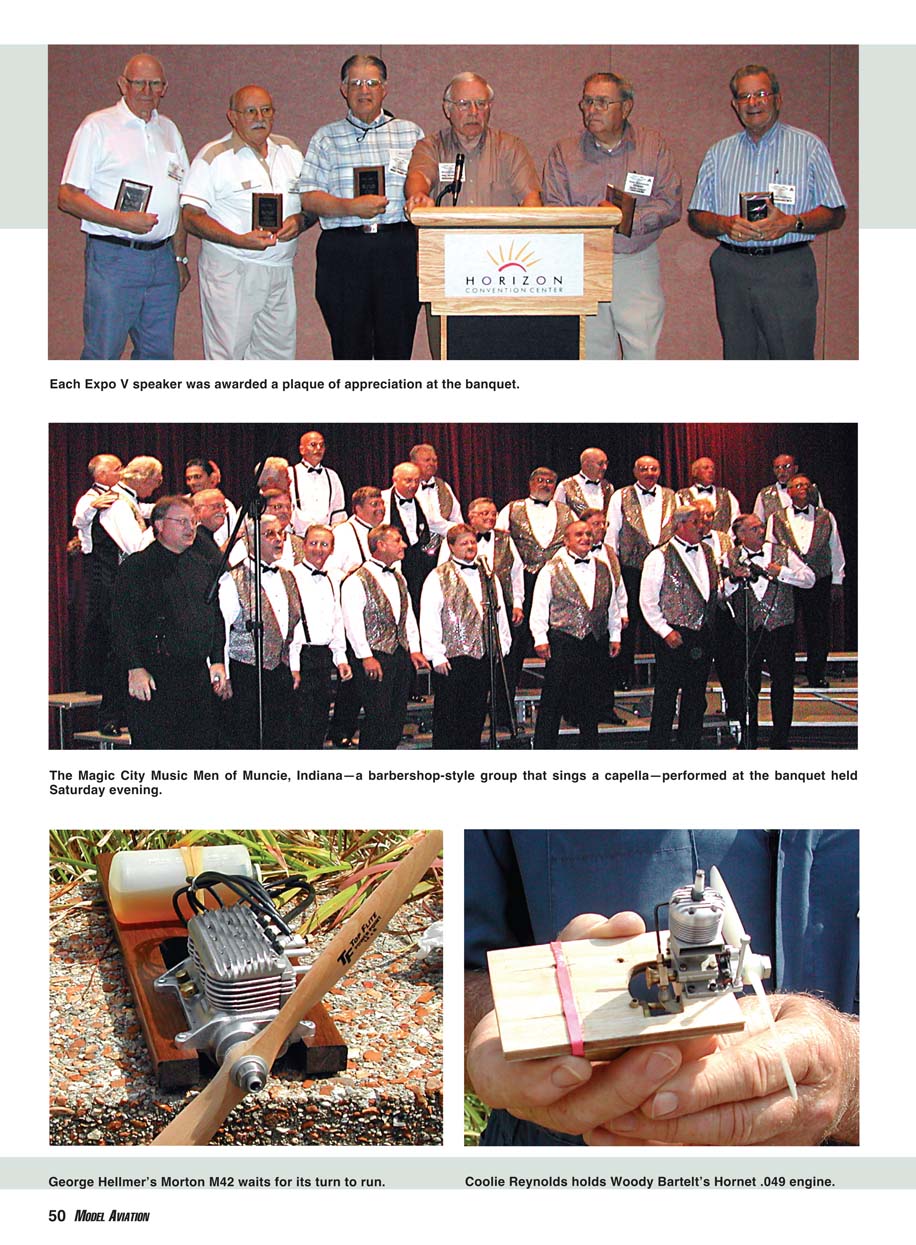
Engine collections and unusual collectible items are exhibited at each Expo. Saturday daytime displays were set up in the hallway/foyer near the meeting room. The theme was “slag engines,” including notable power plants such as the Thor and GHG. Winners were determined by a popular “beauty contest” vote of attendees.
Award winners:
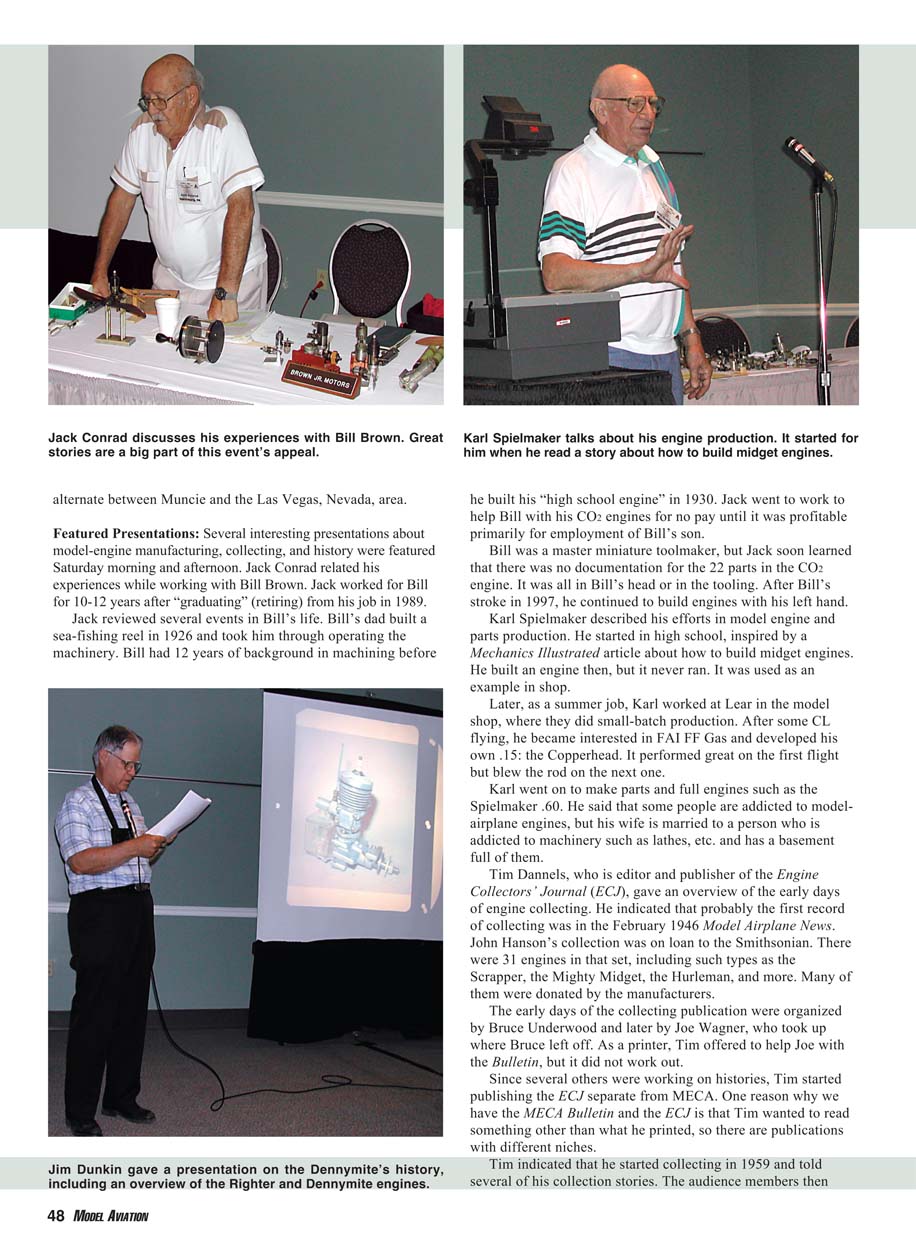
- Overall winner: Bill Mohrbacher — “Throttled Foxes.” Each engine was mounted on foam board with the original advertisement above it and a balloon containing engine descriptions. The display was arranged as a manufacturing timeline and ranged from 1/2A to large .60s. Bill’s meticulous presentation earned him first place; attendees dubbed him a “Foxaholic” and a “Fox Hound.”
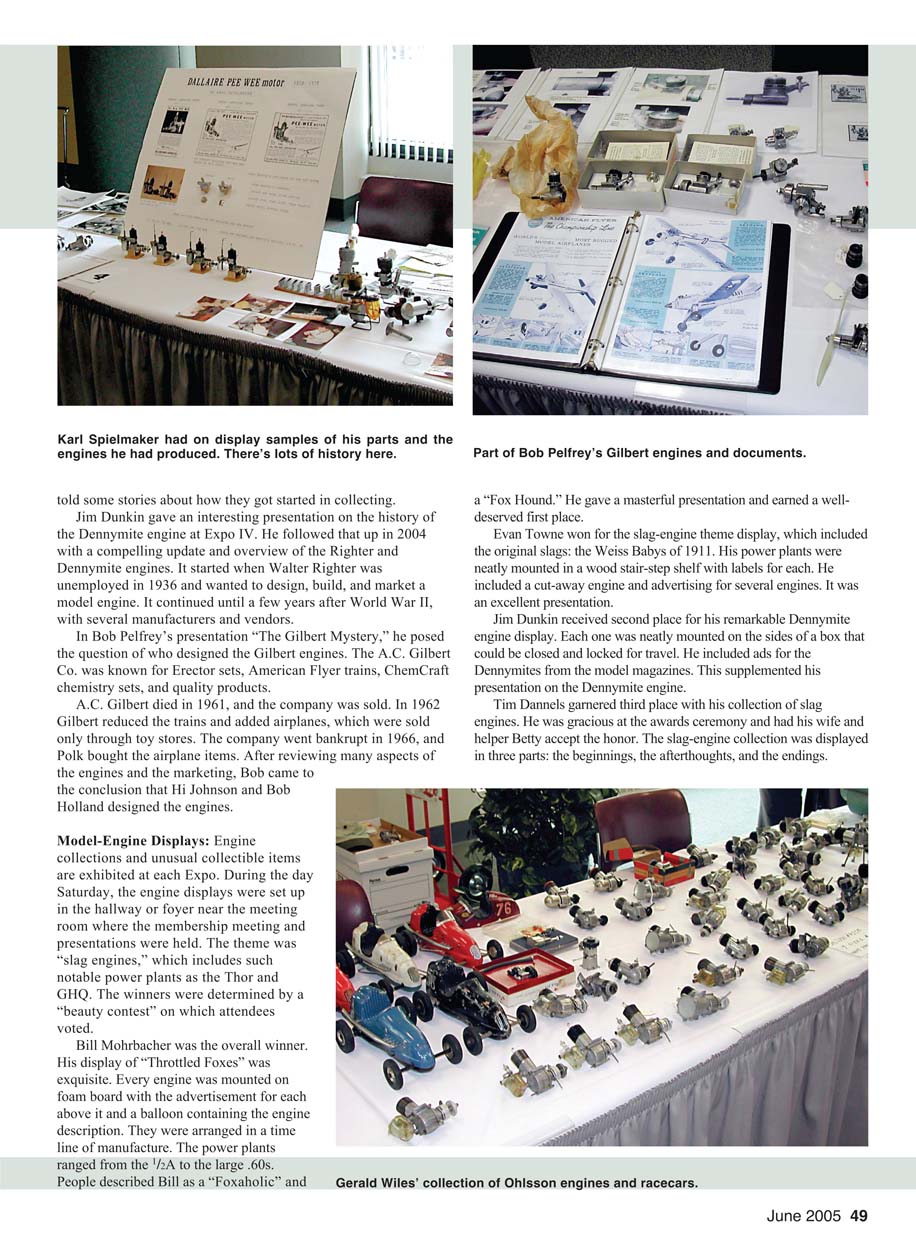
- Slag-engine theme winner: Evan Towne — featured the original slags, including the Weiss Babys of 1911. Engines were mounted on a wood stair-step shelf with labels, a cutaway engine, and period advertising.
- Second place: Jim Dunkin — remarkable Dennymite engine display, each engine mounted on the sides of a lockable travel box, supplemented by magazine ads.
- Third place: Tim Dannels — a slag-engine collection displayed in three parts: beginnings, afterthoughts, and endings. Tim’s wife and assistant Betty accepted the award on his behalf.
MECA Expo V Banquet
The banquet was held in one of the Horizon Convention Center’s ballrooms. The buffet-style meal was excellent, and the Magic City Music Men of Muncie provided entertainment. The Magic City Music Men is a barbershop-style a cappella group consisting of roughly 25 men and one woman. Their program featured a variety of group and quartet numbers. Because the performance was on September 11, the concluding number was “God Bless America,” in memory of the victims of the September 11, 2001, terrorist attacks.
Engine-Running Demonstrations
Each Expo features engine-running demonstrations. This year’s demonstration included many conventional and unusual engines, all exhibiting excellent craftsmanship and operation.
Collecto
MECA collectos are swap shops for model engines and related items, also including displays of interesting collectibles and socializing. The 2004 collecto was held in a Horizon Convention Center ballroom Sunday morning. Attendance was high, with many tables offering a large selection of items for sale, display, or discussion.
One main MECA benefit is the Swap Sheet, a roughly 40-page collection of member ads related to model engines; ads are free to members and the Swap Sheet is published six times per year. The MECA Bulletin—the membership publication—is included with the Swap Sheet.
Membership and subscription information:
- MECA membership: $30 per year (US); $40 per year (elsewhere).
- Pay to: MECA, Bob McClelland, Treasurer
- Address: 3007 Travis St., Westlake, LA 70669
- Engine Collectors’ Journal (ECJ): $15 for six issues (US); $17 (Canada); $20 (Europe); $24 (Asia–Australia).
- Pay to: Engine Collectors Journal
- Address: Box 243, Buena Vista, CO 81211
MA
Robert M. Bennett 40 Mohawk Rd. Hampton, VA 23669
Transcribed from original scans by AI. Minor OCR errors may remain.

