
Micro-Flying
How to build a wing with curved dihedral
Dave Robelen | [email protected]
GREETINGS, micro fans. I am writing this during the coldest spell in February, but chances are that by the time it reaches many of you, the weather will have warmed enough to get out and do some flying.
John Krouse: Curved-dihedral wing
I have several topics this time. The first material comes from one of my regular contributors: John Krouse, 1124 Pipestem Pl., Rockville MD 20854. I will let John describe his newest project.
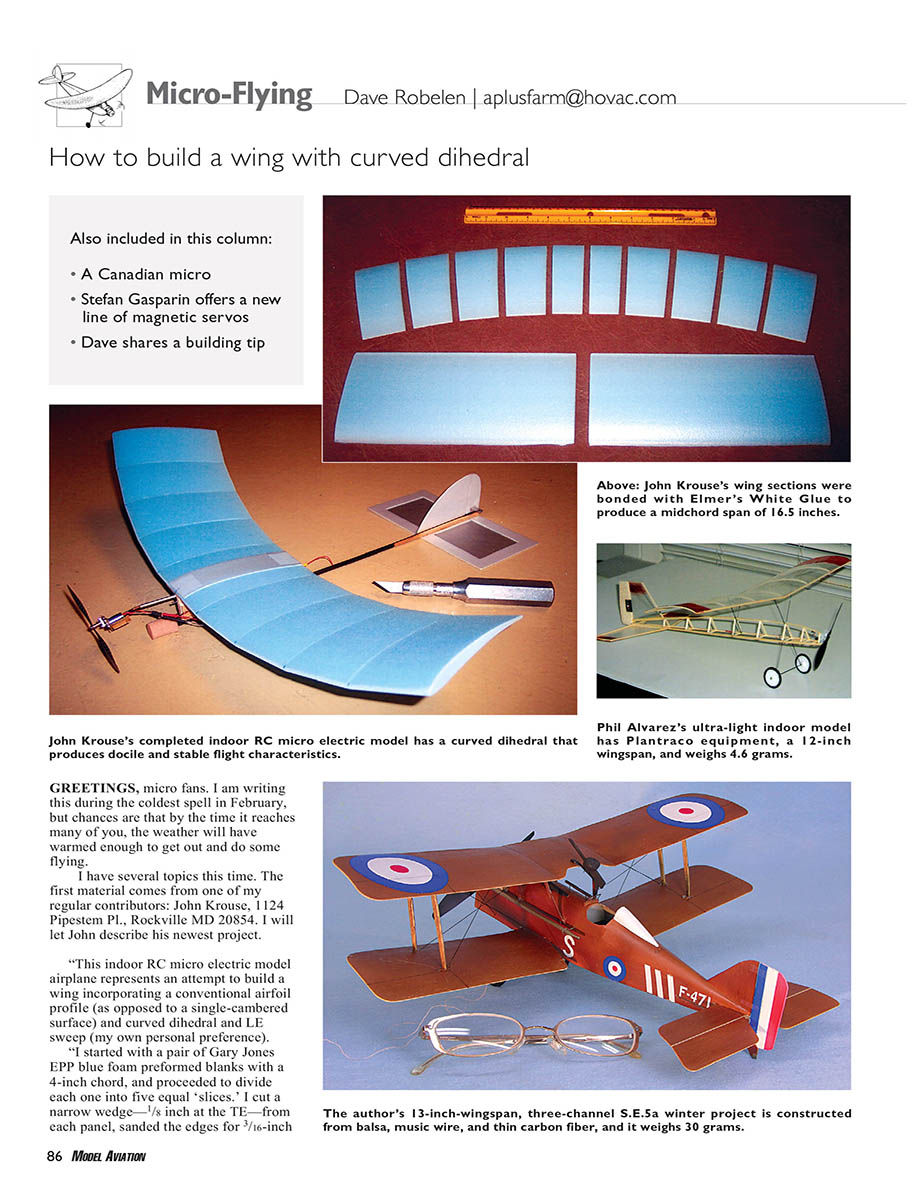
This indoor RC micro electric model airplane represents an attempt to build a wing incorporating a conventional airfoil profile (as opposed to a single-cambered surface) and curved dihedral and leading-edge sweep (my own personal preference).
I started with a pair of Gary Jones EPP blue foam preformed blanks with a 4-inch chord, and proceeded to divide each one into five equal "slices." I cut a narrow wedge—1/8 inch at the trailing edge—from each panel, sanded the edges for 3/16-inch dihedral, and bonded them together with Elmer’s White Glue. The result was a wing that has an overall midchord span of 16.5 inches, a nearly circular-arc dihedral, and a leading-edge sweep of 2.25 inches and 1.5 inches respectively.
The electronic components, available from BSDMicroRC.com and AirMidiMicros.com, consist of the following:
- 6 mm x 12 mm 4.5-ohm (green) pager motor
- Gasparin 4:1 reduction stainless-steel gearbox
- MCF 3222 carbon-fiber propeller
- MicroInvent Minor receiver
- MCS2 0.75-gram actuator
- single 90 mAh Li-Poly battery
With two-channel control (throttle and rudder) and a wing loading of 1.7 ounces per square foot, the flying qualities of this model can best be described as docile and stable.
Thanks, John, for sharing the information about this interesting project.
Phil Alvarez: Tiny blown-up Mini-Stik
Paul Bradley, a champion of tiny RC models, provided the information about this next project. It comes from Phil Alvarez in Canada and following is his description.
Enclosed is a picture of my micro RC based on a concept by Rob Romash. When I attended the Indoor Nats at Johnson City last year, I watched Rob flying his two micro RC models: a monoplane and a biplane. I knew I had to design one that size.
It’s some sort of blown-up Mini-Stik (12-inch wingspan), with Plantraco’s Butterfly gear. The components weigh 2.6 grams. They include:
- 0.38-gram receiver
- 0.23-gram actuator
- 0.9-gram 30 mAh cell
- 0.86-gram geared motor
- 0.2-gram propeller
- some nano connectors
The airframe is 2.0 grams for a total weight of 4.6 grams.
The wing and tail are built from 3/64 x 1/16 balsa, the fuselage structure is 1/16-inch-square balsa, and 0.6 mm (0.024 inch) carbon-fiber rods form the wing support and landing gear. The wheels are cut from picnic dish foam and the covering is HyperLite Mylar.
I flew it for the first time at the Heritage in Detroit, Michigan, and the guys went crazy about it. Everyone had to fly it and the most enthusiastic was Stu Weckerly. He kept asking questions and making notes from the instruction sheet that fortunately I brought with me.
The flight started with my releasing it on the floor from my chair by the wall and watching it take off. The flight is absolutely unbelievable—so slow and relaxed.
Perhaps you'll find it interesting enough for your readers to see. It's a new dimension in modeling. I have flown indoor rubber-powered airplanes for many years and there is nothing like that, but this is a new way that lets you control it. That's the big difference. There is room for both. It's a new category in modeling that is so much fun!
Thanks, Phil. I am glad you are enjoying this new dimension of our hobby.
Jim Walker 74 glider and light RC conversion
I received a nice letter from Doug Dahlke, 1393 BLK, Wolf Ave., Oshkosh WI 54902. He wants to remind us that the Jim Walker-designed 74 glider (now produced by Frank Macy in Oregon) would be an excellent candidate for light RC conversion.
It has been a long time since I tossed a 74 glider, but I have to agree that it would bear a close look. The Frank Macy replicas are made from some of the finest wood I have seen, and they faithfully follow the Jim Walker originals.
So many ways to have fun with the new gear are available! Who will be the first to try this concept and send me a picture for the column?
MicroInvent magnetic servos and tiny ARFs
A nice e-mail came in from Stefan Gasparin describing a new line of magnetic servos that he has developed. The pictures were too small to reproduce here, but there is plenty of information on the web site, www.microinvent.com.
It appears that the servo is a coil mounted on a section of printed circuit board (along with some electronics), with a magnet mounted so that it can rotate within the coil, and an output arm attached to the magnet.
There is an extensive line of these servos in different sizes and configurations, and the quality of Stefan's work is well known. He sent some pictures of models the company sells as ARFs. The tiny scale airplanes have wingspans between 8 and 13 inches.
Along with the servos and models, MicroInvent has a nice line of electronics and drive units. I suggest that you check them out.
My building season: S.E.5a micro
This is the building season and I have been at it myself. Three of the pictures show my micro S.E.5a with a 13-inch wingspan. The construction is almost all 1/32 sheet balsa with a couple of small blocks, a little music wire, and some thin carbon fiber. The 30-gram weight produces a lively flight performance.
The equipment includes:
- JMP combo receiver
- two 1-gram BSD actuators
- GWJ 4:1 ball-bearing drive with a 7 mm Super Slick motor (blue end)
- 170 mAh Li-Poly cell
- 4 x 4 GWS propeller
A 4 x 4 GWS propeller provides the S.E.5a with the right amount of thrust.
I have Scott Christensen to thank for some of the features in this little airplane. The primer under the color is Delta Stencil Magic Top Coat Satin Spray that works beautifully, and the rigging is 0.3 mm carbon-fiber rod. Scott introduced both of these products on his gorgeous little biplanes and they are ideal for the job.
The little S.E.5a is a sweet flier. Floor takeoffs are easy and it has a nice climb performance at full throttle. The only deviation from true scale is a slight increase in the dihedral to enhance the rudder turns. This is one of those "natural"-scale designs that tends to fly well when built with a modest wing loading and no extensive changes to the geometry.
One of the pictures shows the top of the S.E.5a being molded from 1/32 balsa over a foam form. This method of producing sections of a model shell can produce nice, uniform parts that fit in place with a minimum support structure and hold their shape well. The wings were formed to the airfoil shape using the same method, and it only took a couple ribs to stiffen things up nicely.
Why not try it? A variety of subjects could benefit from formed-shell construction.
You have read my modeling tip for the month. Please share your methods of producing model parts. We all have much to learn.
I enjoy information about those finished models, so keep in touch.
MA
Transcribed from original scans by AI. Minor OCR errors may remain.

