
Micro-Flying
Route 4, Box 369, Farmville VA 23901; E-mail: [email protected]
HELLO, SMALL-MODEL FANS. This is being written as the last of winter is moving through Central Virginia (I hope), and the Toledo show is only a few weeks away. I will be there soaking up material for us micro fans and getting in some flying at the indoor flying session.
In the last column I included some information about a new micro Radio Control (RC) system — the RFFS-100 — along with my first project to make use of it. Rather than let dust collect on my sanding block, I have built a second model for this system.
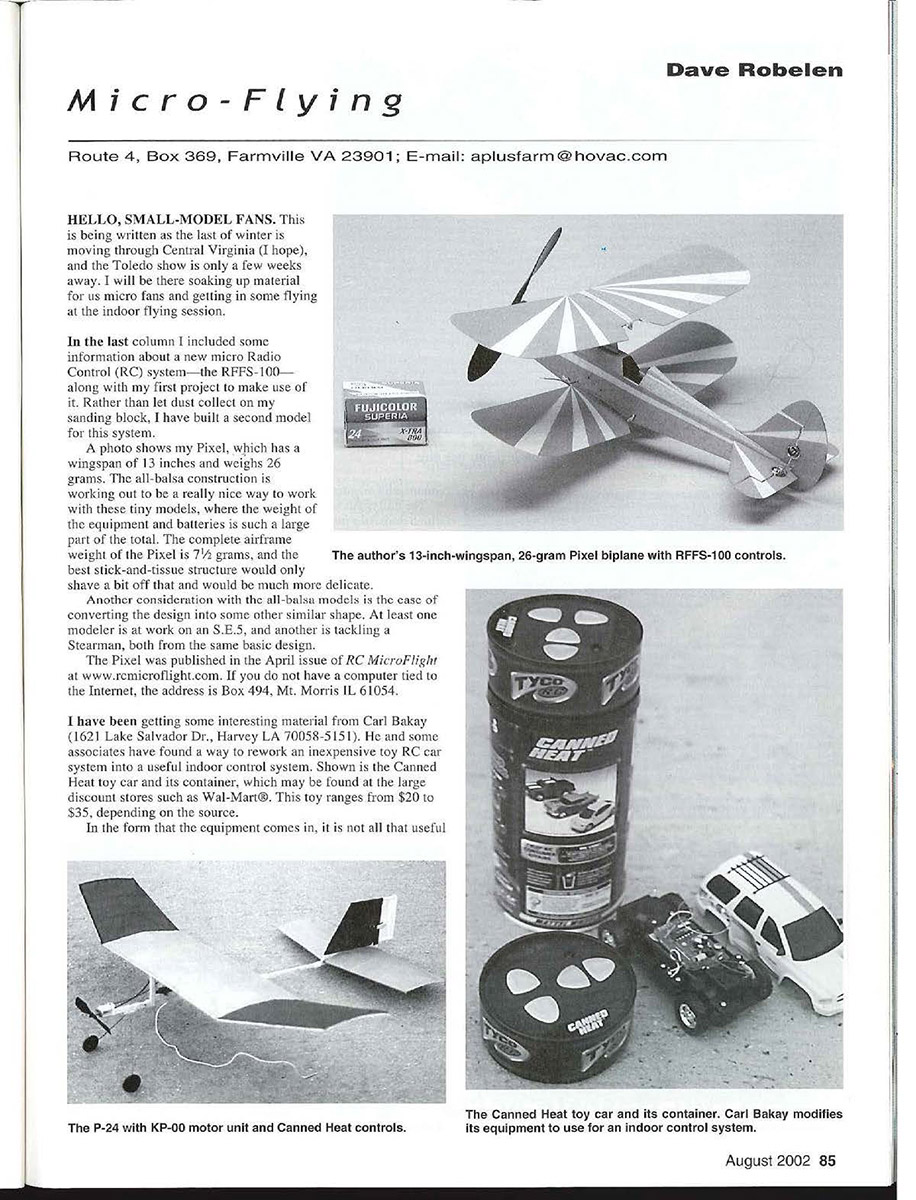
A photo shows my Pixel, which has a wingspan of 13 inches and weighs 26 grams. The all-balsa construction is working out to be a really nice way to work with these tiny models, where the weight of the equipment and batteries is such a large part of the total. The complete airframe weight of the Pixel is 7½ grams, and the best stick-and-tissue structure would only shave a bit off that and would be much more delicate.
Another consideration with the all-balsa models is the case of converting the design into some other similar shape. At least one modeler is at work on an S.E.5, and another is tackling a Stearman, both from the same basic design.
The Pixel was published in the April issue of RC MicroFlight at www.rcmicroflight.com. If you do not have a computer tied to the Internet, the address is Box 494, Mt. Morris IL 61054.
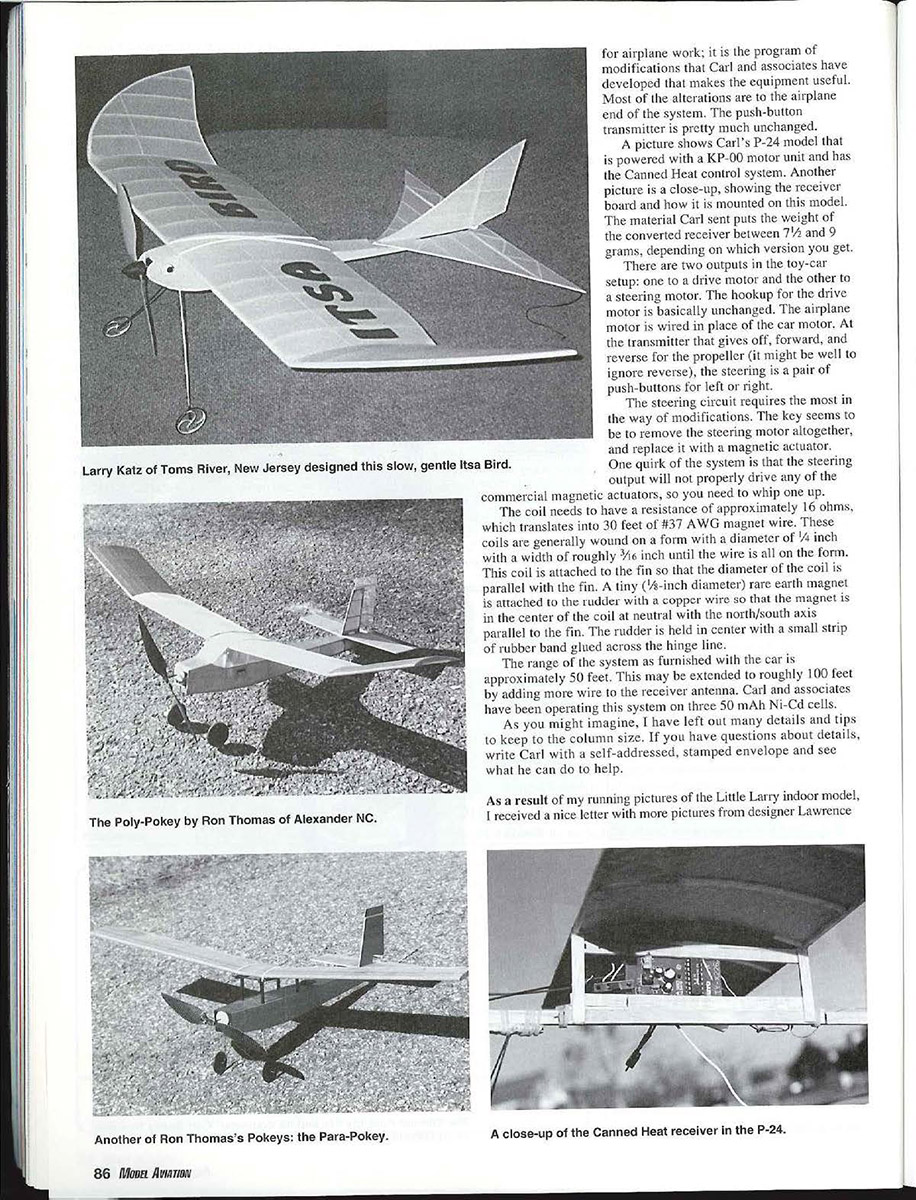
I have been getting some interesting material from Carl Bakay (1621 Lake Salvador Dr., Harvey LA 70058-5151). He and some associates have found a way to rework an inexpensive toy RC car system into a useful indoor control system. Shown is the Canned Heat toy car and its container, which may be found at the large discount stores such as Wal-Mart®. This toy ranges from $20 to $35, depending on the source.
In the form that the equipment comes in, it is not all that useful for airplane work; it is the program of modifications that Carl and associates have developed that makes the equipment useful. Most of the alterations are to the airplane end of the system. The push-button transmitter is pretty much unchanged.
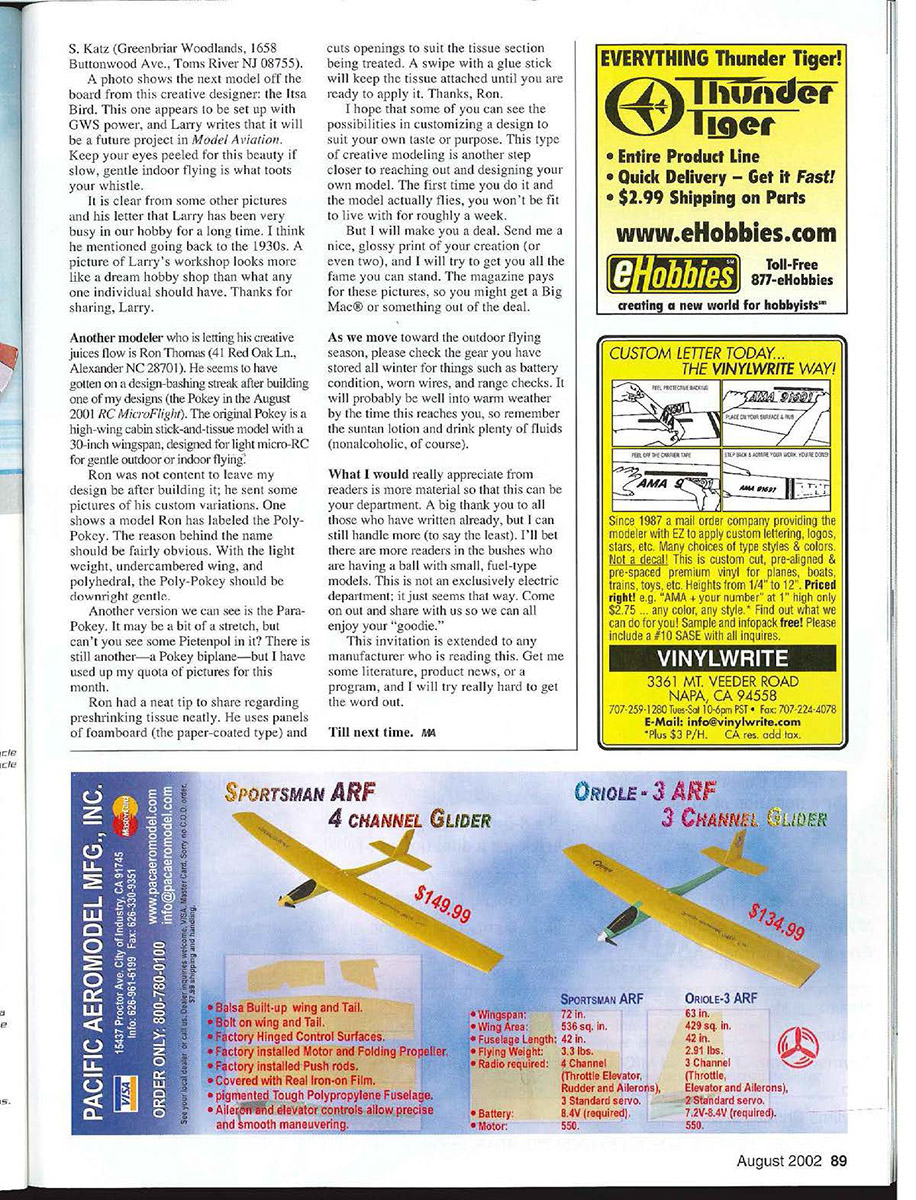
A picture shows Carl's P-24 model that is powered with a KP-00 motor unit and has the Canned Heat control system. Another picture is a close-up, showing the receiver board and how it is mounted on this model. The material Carl sent puts the weight of the converted receiver between 7½ and 9 grams, depending on which version you get.
There are two outputs in the toy-car setup: one to a drive motor and the other to a steering motor. The hookup for the drive motor is basically unchanged. The airplane motor is wired in place of the car motor. At the transmitter that gives off, forward, and reverse for the propeller (it might be well to ignore reverse), the steering is a pair of push-buttons for left or right.
The steering circuit requires the most in the way of modifications. The key seems to be to remove the steering motor altogether, and replace it with a magnetic actuator. One quirk of the system is that the steering output will not properly drive any of the commercial magnetic actuators, so you need to whip one up. The coil needs to have a resistance of approximately 16 ohms, which translates into 30 feet of #37 AWG magnet wire. These coils are generally wound on a form with a diameter of 1/4 inch with a width of roughly 3/16 inch until the wire is all on the form. This coil is attached to the fin so that the diameter of the coil is parallel with the fin. A tiny (1/8-inch diameter) rare earth magnet is attached to the rudder with a copper wire so that the magnet is in the center of the coil at neutral with the north/south axis parallel to the fin. The rudder is held in center with a small strip of rubber band glued across the hinge line.
The range of the system as furnished with the car is approximately 50 feet. This may be extended to roughly 100 feet by adding more wire to the receiver antenna. Carl and associates have been operating this system on three 50 mAh Ni-Cd cells.
As you might imagine, I have left out many details and tips to keep to the column size. If you have questions about details, write Carl with a self-addressed, stamped envelope and see what he can do to help.
As a result of my running pictures of the Little Larry indoor model, I received a nice letter with more pictures from designer Lawrence
Another modeler who is letting his creative juices flow is Ron Thomas (41 Red Oak Ln., Alexander NC 28701). He seems to have gotten on a design-bashing streak after building one of my designs (the Pokey in the August 2001 RC MicroFlight). The original Pokey is a high-wing cabin stick-and-tissue model with a 30-inch wingspan, designed for light micro-RC for gentle outdoor or indoor flying.
Ron was not content to leave my design be after building it; he sent some pictures of his custom variations. One shows a model Ron has labeled the Poly-Pokey. The reason behind the name should be fairly obvious. With the light weight, undercambered wing, and polyhedral, the Poly-Pokey should be downright gentle.
Another version we can see is the Para-Pokey. It may be a bit of a stretch, but can’t you see some Petipenol in it? There is still another—a Pokey biplane—but I have used up my quota of pictures for this month.
Ron had a neat tip to share regarding reshrinking tissue neatly. He uses panels of foamboard (the paper-coated type) and cuts openings to suit the tissue section being treated. A swipe with a glue stick will keep the tissue attached until you are ready to apply it. Thanks, Ron.
I hope that some of you can see the possibilities in customizing a design to suit your own taste or purpose. This type of creative modeling is another step closer to reaching out and designing your own model. The first time you do it and the model actually flies, you won’t be fit to live with for roughly a week.
But I will make you a deal. Send me a nice, glossy print of your creation (or even two), and I will try to get you all the fame you can stand. The magazine waits for these pictures, so you might get a Big Mac® or something out of the deal.
As we move toward the outdoor flying season, please check the gear you have stored all winter for things such as battery condition, worn wires, and range checks. It will probably be well into warm weather by the time this reaches you, so remember the suntan lotion and drink plenty of fluids (alcohol-free, of course).
What I would really appreciate from readers is more material so that this can be your department. A big thank you to all those who have written already, but I can still handle more (to say the least). I’ll bet there are more readers in the bushes who are having a ball with small, fuel-type models. This is not an exclusively electric department; it just seems that way. Come on out and share with us so we can all enjoy your "goodie."
This invitation is extended to any manufacturer who is reading this. Get me some literature, product news, or a program, and I will try really hard to get the word out.
Till next time. MA
Transcribed from original scans by AI. Minor OCR errors may remain.

