
Micro-Flying
Route 4, Box 369, Farmville VA 23901; E-mail: [email protected]
GREETINGS, MICRO FANS. Thank you to those who have written to express pleasure with this column. It has been a special treat to hear from old friends who are just recently finding my address. Several people have responded to my request for material, so I am going to get right to it.
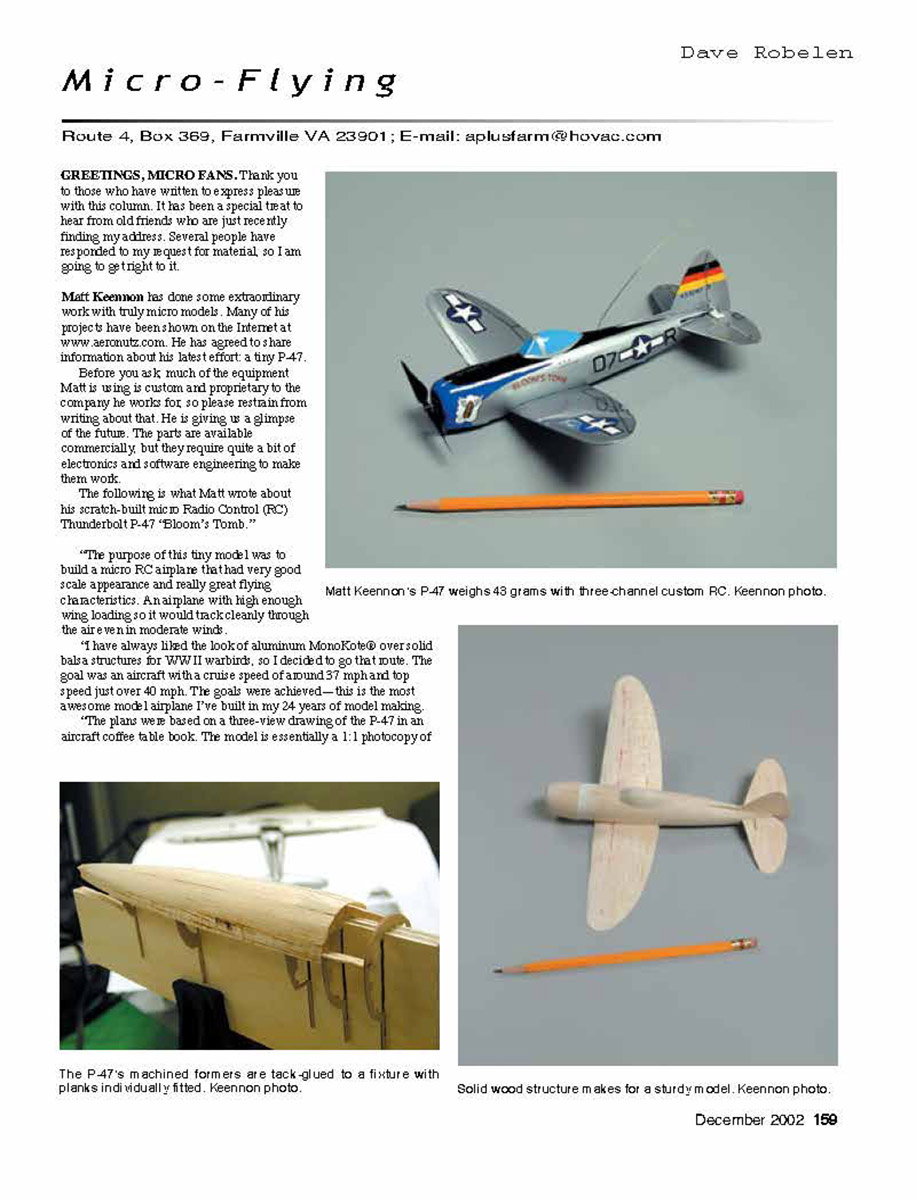
Matt Keennon has done some extraordinary work with truly micro models. Many of his projects have been shown on the Internet at www.aeronutz.com. He has agreed to share information about his latest effort: a tiny P-47.
Before you ask, much of the equipment Matt is using is custom and proprietary to the company he works for, so please refrain from writing about that. He is giving us a glimpse of the future. The parts are available commercially, but they require quite a bit of electronics and software engineering to make them work.
The following is what Matt wrote about his scratch-built micro Radio Control (RC) Thunderbolt P-47 "Bloom's Tomb."
“The purpose of this tiny model was to build a micro RC airplane that had very good scale appearance and really great flying characteristics. An airplane with high enough wing loading so it would track cleanly through the air even in moderate winds.
“I have always liked the look of aluminum MonoKote® over solid balsa structures for WWII warbirds, so I decided to go that route. The goal was an aircraft with a cruise speed of around 37 mph and top speed just over 40 mph. The goals were achieved—this is the most awesome model airplane I've built in my 24 years of model making.
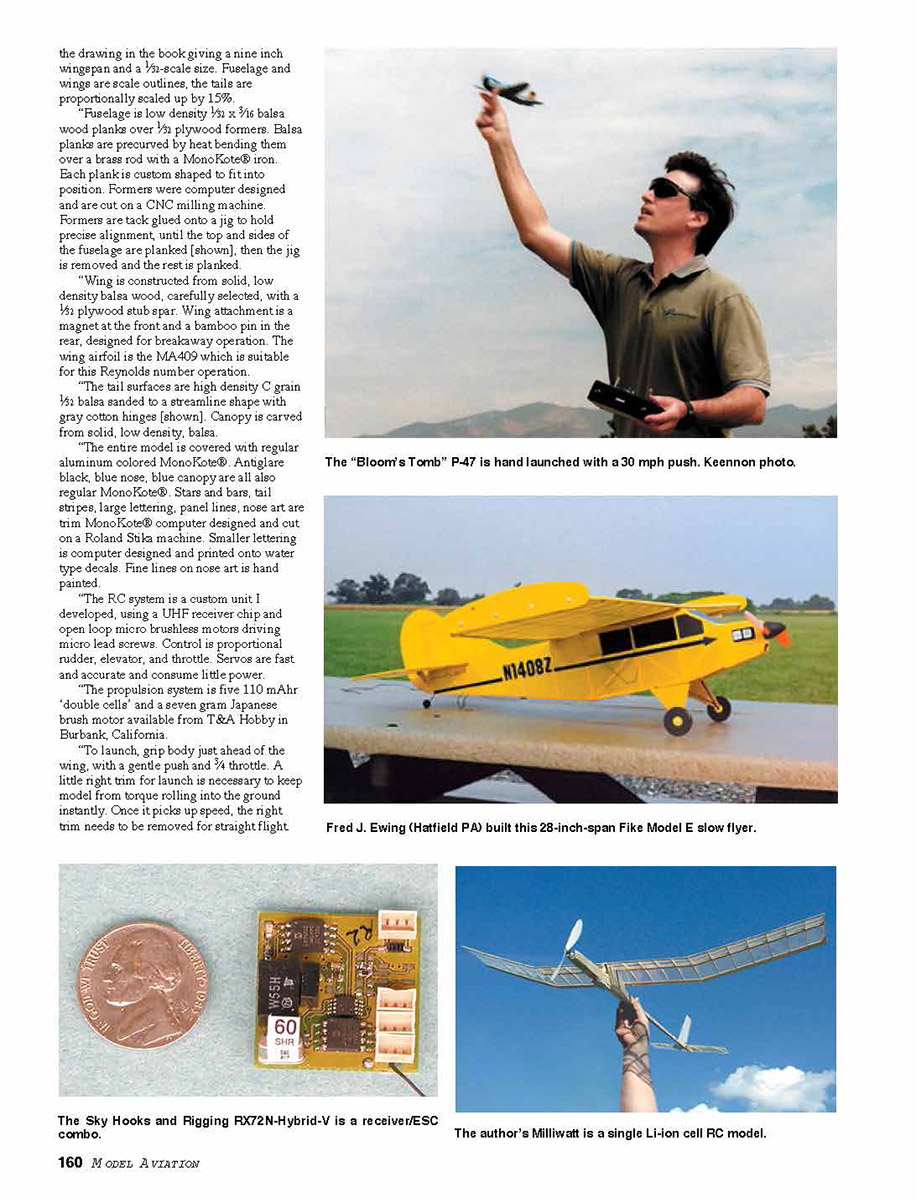
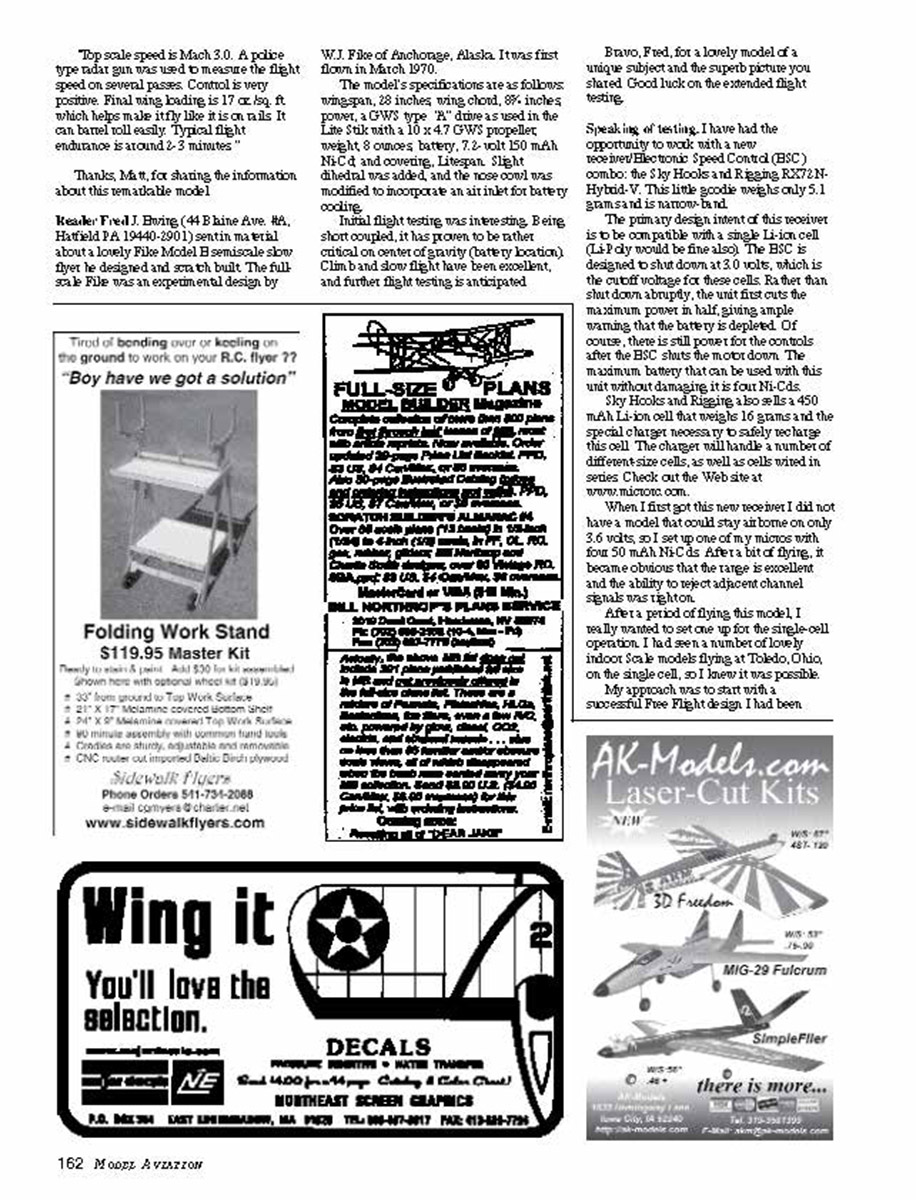
“The plans were based on a three-view drawing of the P-47 in an aircraft coffee table book. The model is essentially a 1:1 photocopy of the drawing in the book giving a nine inch wingspan and a 7/32-scale size. Fuselage and wings are scale outlines, the tails are proportionally scaled up by 15%.
"Fuselage is low density 1/32 x 3/16 balsa wood planks over 1/32 plywood formers. Balsa planks are precurved by heat bending them over a brass rod with a MonoKote® iron. Each plank is custom shaped to fit into position. Formers were computer designed and are cut on a CNC milling machine. Formers are tack glued onto a jig to hold precise alignment, until the top and sides of the fuselage are planked, then the jig is removed and the rest is planked.
"Wing is constructed from solid, low density balsa wood, carefully selected, with a 1/32 plywood stub spar. Wing attachment is a magnet at the front and a bamboo pin in the rear, designed for breakaway operation. The wing airfoil is the MA409 which is suitable for this Reynolds number operation.
"The tail surfaces are high density C grain 1/32 balsa sanded to a streamline shape with grey cotton hinges. Canopy is carved from solid, low density, balsa.
"The entire model is covered with regular aluminum colored MonoKote®. Antiglare black, blue nose, blue canopy are all also regular MonoKote®. Stars and bars, tail stripes, large lettering, panel lines, nose art are trim MonoKote® computer designed and cut on a Roland Stika machine. Smaller lettering is computer designed and printed onto water type decals. Fine lines on nose art is hand painted.
"The RC system is a custom unit I developed, using a UHF receiver chip and open loop micro brushless motors driving micro lead screws. Control is proportional rudder, elevator, and throttle. Servos are fast and accurate and consume little power.
"The propulsion system is five 110 mAhr 'double cells' and a seven gram Japanese brush motor available from T&A Hobby in Burbank, California.
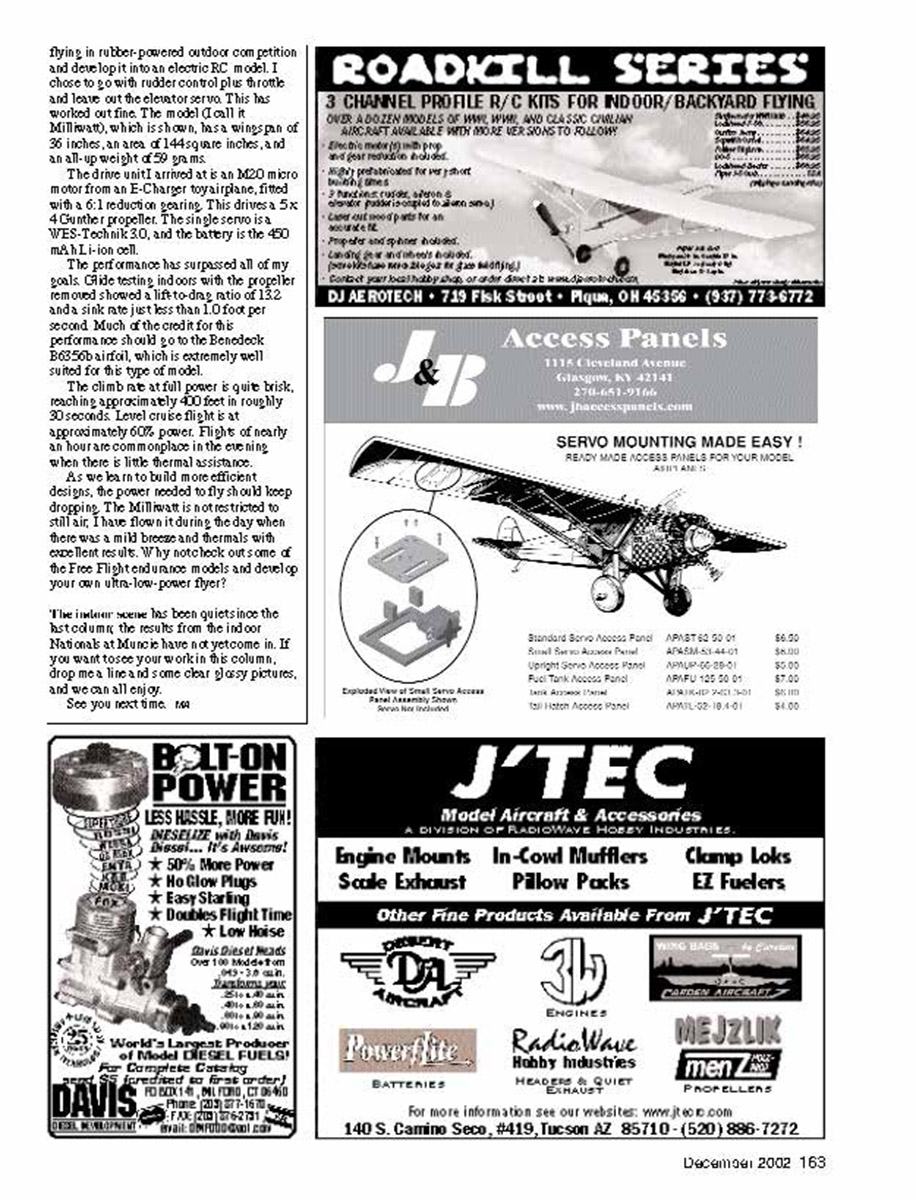
"To launch, grip body just ahead of the wing, with a gentle push and 3/4 throttle. A little right trim for launch is necessary to keep model from torque rolling into the ground instantly. Once it picks up speed, the right trim needs to be removed for straight flight.
W.J. Fike of Anchorage, Alaska. It was first flown in March 1970.
The model's specifications are as follows: wingspan, 28 inches; wing chord, 8½ inches; power, a GWS type "A" drive as used in the Little Stik with a 10 x 4.7 GWS propeller; weight, 8 ounces; battery, 7.2 volt 150 mAh NiCd and covering, LiteSpan. Slight dihedral was added, and the nose cowl was modified to incorporate an air inlet for battery cooling.
Initial flight testing was impressive. Being short coupled, it has proven to be rather critical on center of gravity (battery location). Climb and slow flight have been excellent, and further flight testing is anticipated.
Bravo, Fred, for a lovely model of a unique subject and the superb picture you shared. Good luck on the extended flight testing.
Speaking of testing, I have had the opportunity to work with a new receiver/ Electronic Speed Control (BSC) combo: the Sky Hooks and Rising RX72N-Hybrid V2. This little package weighs only 5.1 grams and is narrow-band.
The primary design intent of this receiver is to be compatible with a single Li-ion cell (Li-poly would be fine also). The BSC is designed to shut down at 3.0 volts, which is the cutoff voltage for these cells. Rather than shut down abruptly, the unit first cuts the maximum power in half, giving the user warning that the battery is depleted. Of course, there is still power for the controls after the BSC shuts the motor down. The maximum battery that can be used with this unit without damaging it is four Ni-Cads.
Sky Hooks and Rising also sells a 450 mAh Li-ion cell that weighs 16 grams and the special charger necessary to safely recharge this cell. The charger will handle a number of different size cells, as well as cells wired in series. Check out the Web site at www.micron.com.
When I first got this new receiver I did not have a model that could stay airborne on only 3.6 volts, so I set up one of my micros with four 50 mAh NiCds. After a bit of flying, it became obvious that the range was excellent and the ability to reject adjacent channel signals was tight.
After a period of flying this model I really wanted to set one up for the single-cell operation. I had seen a number of lovely indoor scale models flying at Toledo, Ohio, on the single cell, so I knew it was possible. My approach was to start with a successful Free Flight design I had been flying in rubber-powered outdoor competition and developing it into an electric RC model. I chose to go with rudder control plus throttle and leave out the elevator servo. This has worked out fine. The model (I call it the Milliwatt, which is shown) has a wingspan of 36 inches, an area of 144 square inches, and an all-up weight of 59 grams.
The drive unit I arrived at is an M20 micro motor from an E-Charger toy airplane fitted with a 6:1 reduction gearing. This drives a 5 x 4 Guilder propeller. The single servo is a WES-Technik 30, and the battery is the 450 mAh Li-ion cell.
The performance has surpassed all of my goals. Glide testing indoors with the propeller removed showed a lift-to-drag ratio of 13.2 and a sink rate just less than 1.0 foot per second. Much of the credit for this performance should go to the Benedek B6350 airfoil, which is extremely well suited for this type of model.
The climb rate at full power is quite brisk, reaching approximately 400 feet in roughly 30 seconds. Level cruise flight is at approximately 60% power. Flights of nearly an hour are commonplace in the evening when there is little thermal assistance.
As we learn to build more efficient designs, the power needed to fly should keep dropping. The Milliwatt is not restricted to still air; I have flown it during the day when there was a mild breeze and thermals with excellent results. Why not check out some of the Free Flight endurance models and develop your own ultra-low-power flyer?
The indoor scene has been quiet since the best column — the results from the Indoor Nationals at Muncie have not yet come in. If you want to see your work in this column, drop me a line and some clear glossy pictures, and we can all enjoy.
See you next time.
Transcribed from original scans by AI. Minor OCR errors may remain.

