
Arizona Model Aircrafters 1903 Wright Flyer ARF
Joe Malinchak
BEFORE I START building a new Scale project, I spend many hours researching the history of the airplane and collecting all the necessary documentation. This can be a fun part of the building process.
I always wanted to build a micro version of the Wright Flyer, so I started my quest for information. I contacted Arizona Model Aircrafters, because it advertised plans for several different Wright Flyer aircraft. Not only does the company have plans, but it also offers a park flyer ARF version of the world's first powered airplane.
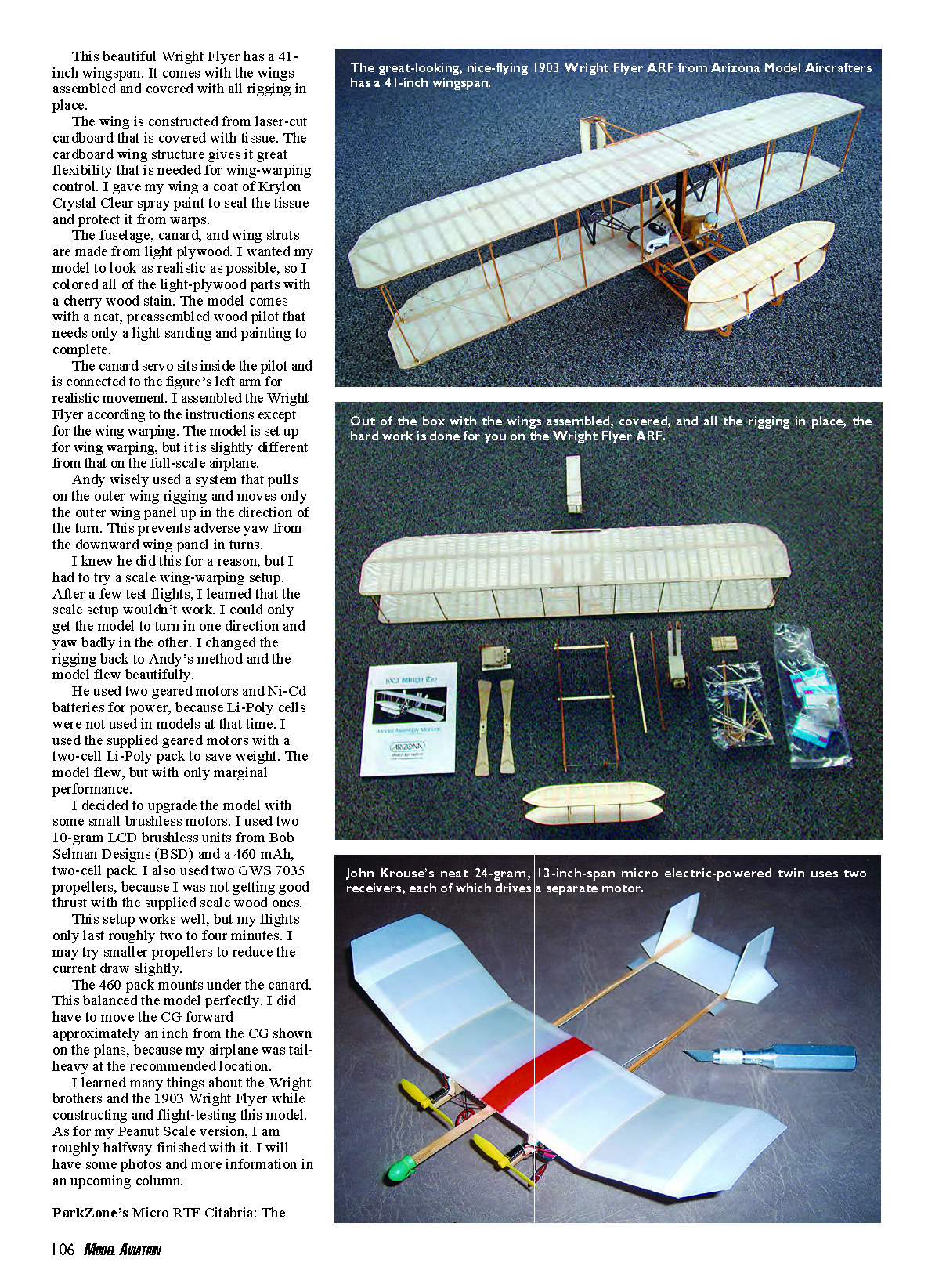
Andy Clancy designed the ARF for the Centennial of Flight in 2003. I thought it would be a good idea to build this airplane to gain some experience with the design and to test wing warping. This beautiful Wright Flyer has a 41-inch wingspan. It comes with the wings assembled and covered with all rigging in place.
The wing is constructed from laser-cut cardboard that is covered with tissue. The cardboard wing structure gives it great flexibility that is needed for wing-warping control. I gave my wing a coat of Krylon Crystal Clear spray paint to seal the tissue and protect it from warps.
The fuselage, canard, and wing struts are made from light plywood. I wanted my model to look as realistic as possible, so I colored all of the light-plywood parts with a cherry wood stain. The model comes with a neat, preassembled wood pilot that needs only a light sanding and painting to complete.
The canard servo sits inside the pilot and is connected to the figure’s left arm for realistic movement. I assembled the Wright Flyer according to the instructions except for the wing warping. The model is set up for wing warping, but it is slightly different from that on the full-scale airplane.
Andy wisely used a system that pulls on the outer wing rigging and moves only the outer wing panel up in the direction of the turn. This prevents adverse yaw from the downward wing panel in turns.
I knew he did this for a reason, but I had to try a scale wing-warping setup. After a few test flights, I learned that the scale setup wouldn’t work. I could only get the model to turn in one direction and yaw badly in the other. I changed the rigging back to Andy’s method and the model flew beautifully.
He used two geared motors and Ni-Cd batteries for power, because Li-Poly cells were not used in models at that time. I used the supplied geared motors with a two-cell Li-Poly pack to save weight. The model flew, but with only marginal performance.
I decided to upgrade the model with some small brushless motors. I used two 10-gram LCD brushless units from Bob Selman Designs (BSD) and a 460 mAh, two-cell pack. I also used two GWS 7035 propellers, because I was not getting good thrust with the supplied scale wood ones.
This setup works well, but my flights only last roughly two to four minutes. I may try smaller propellers to reduce the current draw slightly.
The 460 pack mounts under the canard. This balanced the model perfectly. I did have to move the CG forward approximately an inch from the CG shown on the plans, because my airplane was tail-heavy at the recommended location.
I learned many things about the Wright brothers and the 1903 Wright Flyer while constructing and flight-testing this model. As for my Peanut Scale version, I am roughly halfway finished with it. I will have some photos and more information in an upcoming column.
batteries, the stand can charge the 70 mAh Li-Poly cell in roughly 15–20 minutes.
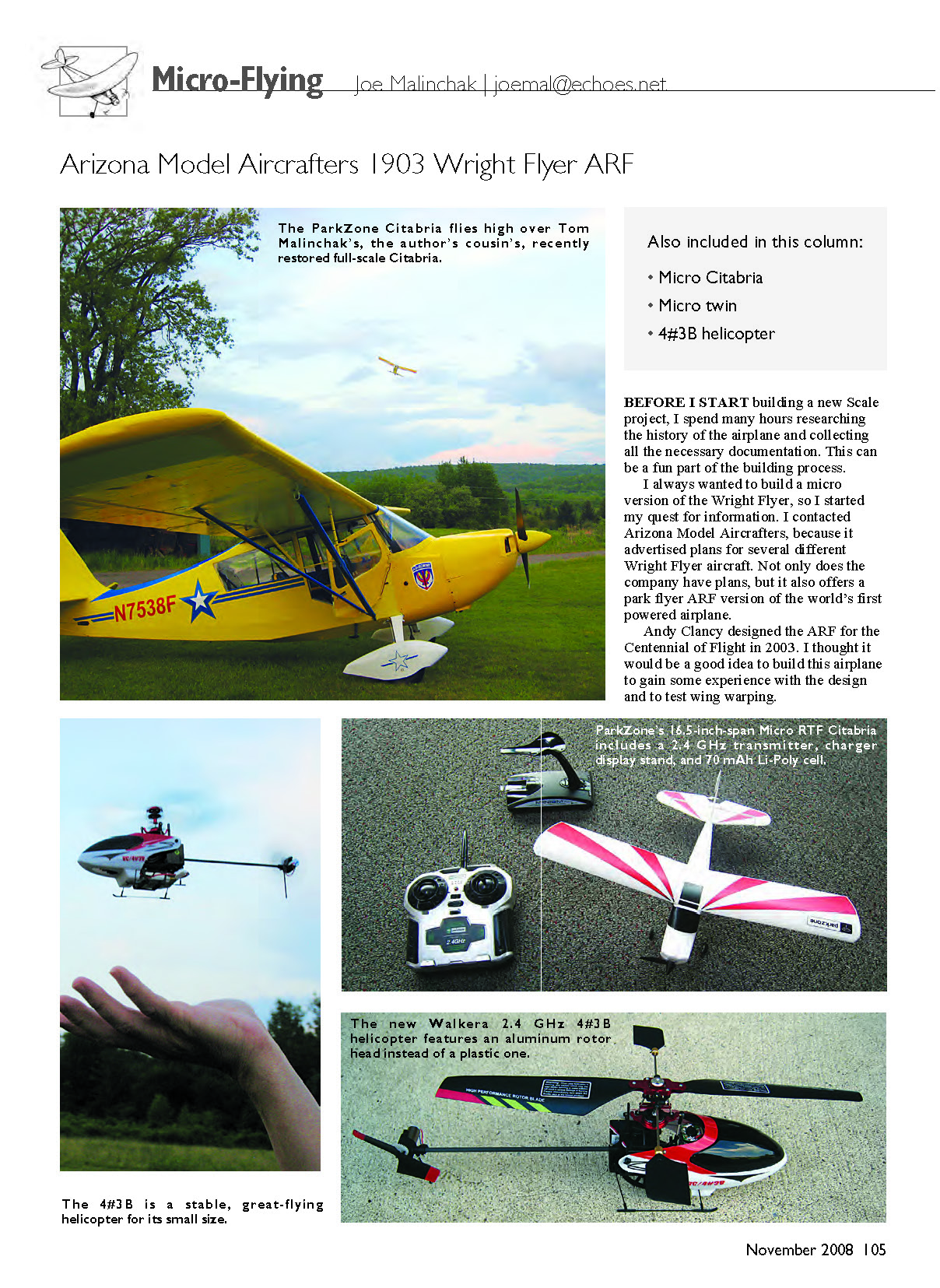
The Citabria really shines in the air. At 21 grams, it has a wing loading of only 1 ounce per square foot. This gives the airplane excellent slow-speed capabilities and makes it easy to fly. It can be flown indoors or outdoors in light winds. Takeoffs and landings are easy and predictable from a hard-surface runway.
The model is capable of some basic aerobatic maneuvers, such as loops, with a little dive for the entry speed. Ironically, I have to do this to loop my cousin’s full-scale airplane.
The Citabria is available from Horizon Hobby and is street priced at approximately $120. I purchased mine from my friend, David Lewis. His company is called Homefly and is an excellent source for micro RC supplies.
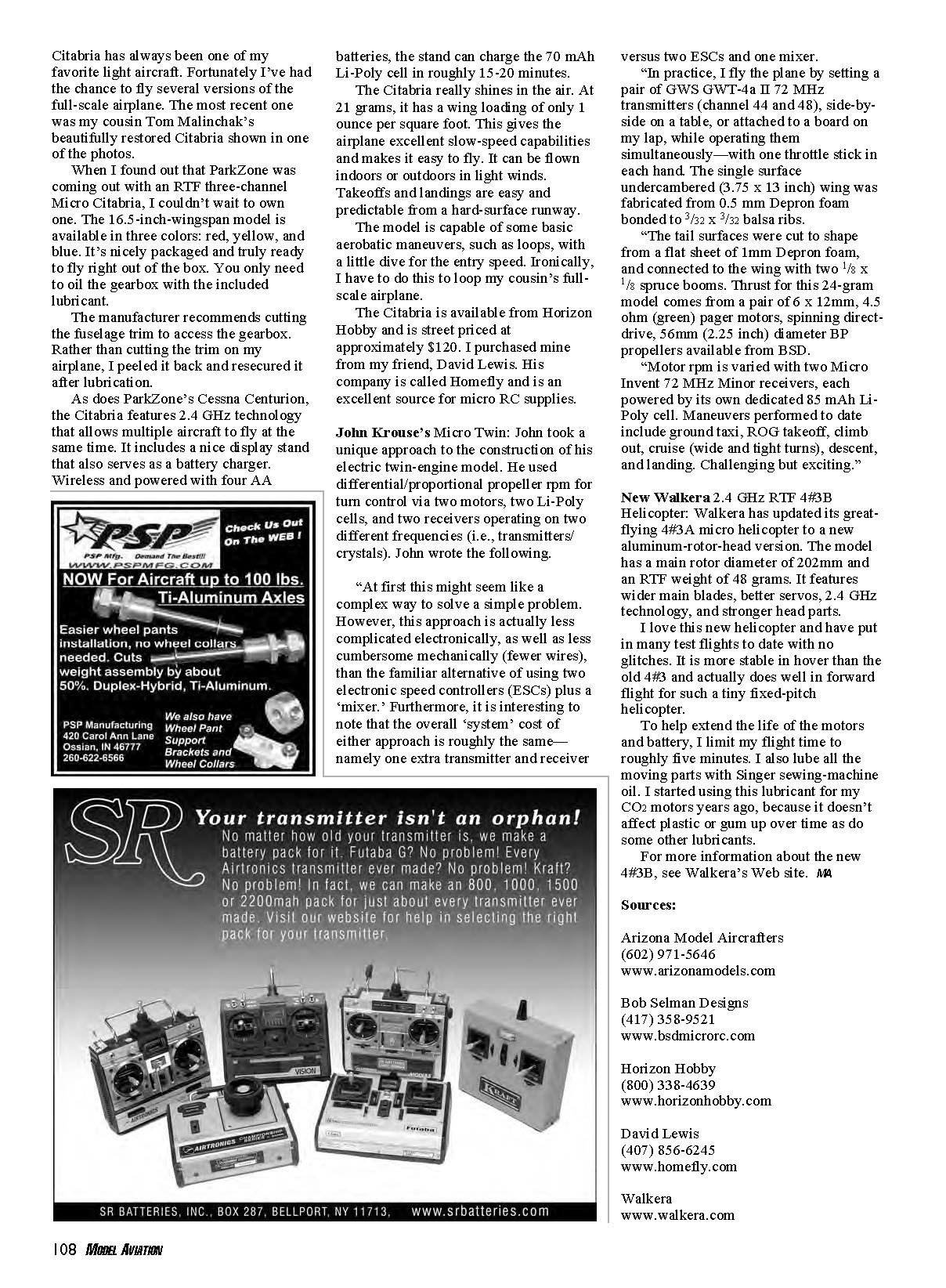
John Krouse’s Micro Twin: John took a unique approach to the construction of his electric twin-engine model. He used differential/proportional propeller rpm for turn control via two motors, two Li-Poly cells, and two receivers operating on two different frequencies (i.e., transmitters/crystals). John wrote the following.
“At first this might seem like a complex way to solve a simple problem. However, this approach is actually less complicated electronically, as well as less cumbersome mechanically (fewer wires), than the familiar alternative of using two electronic speed controllers (ESCs) plus a ‘mixer.’ Furthermore, it is interesting to note that the overall ‘system’ cost of either approach is roughly the same—namely one extra transmitter and receiver versus two ESCs and one mixer.
“In practice, I fly the plane by setting a pair of GWS GWT-4A II 72 MHz transmitters (channel 44 and 48), side-by-side on a table, or attached to a board on my lap, while operating them simultaneously—with one throttle stick in each hand. The single surface undercambered (3.75 x 13 inch) wing was fabricated from 0.5 mm Depron foam bonded to 3/32 x 3/32 x 3/32 balsa ribs.
“The tail surfaces were cut to shape from a flat sheet of 1 mm Depron foam, and connected to the wing with two 1/8 x 1/8 spruce booms. Thrust for this 24-gram model comes from a pair of 6 x 12 mm, 4.5 ohm (green) pager motors, spinning direct-drive, 56 mm (2.25 inch) diameter BP propellers available from BSD.
“Motor rpm is varied with two Micro Invent 72 MHz Minor receivers, each powered by its own dedicated 85 mAh Li-Poly cell. Maneuvers performed to date include ground taxi, ROG takeoff, climb out, cruise (wide and tight turns), descent, and landing. Challenging but exciting.”
New Walkera 2.4 GHz RTF 4#3B Helicopter: Walkera has updated its great-flying 4#3A micro helicopter to a new aluminum-rotor-head version. The model has a main rotor diameter of 202 mm and an RTF weight of 48 grams. It features wider main blades, better servos, 2.4 GHz technology, and stronger head parts.
I love this new helicopter and have put in many test flights to date with no glitches. It is more stable in hover than the old 4#3 and actually does well in forward flight for such a tiny fixed-pitch helicopter.
To help extend the life of the motors and battery, I limit my flight time to roughly five minutes. I also lube all the moving parts with Singer sewing-machine oil. I started using this lubricant for my CO2 motors years ago, because it doesn’t affect plastic or gum up over time as do some other lubricants.
For more information about the new 4#3B, see Walkera’s Web site. MA
Sources:
- Arizona Model Aerocrafters
(602) 971-5646 www.arizonamodels.com
- Bob Selman Designs
(417) 358-9521 www.bsdmicrorc.com
- Horizon Hobby
(800) 338-4639 www.horizonhobby.com
- David Lewis
(407) 856-6245 www.homefly.com
- Walkera
Transcribed from original scans by AI. Minor OCR errors may remain.

