
It was another great NEAT Fair
Every year, I look forward to the Northeast Electric Aircraft Technology (NEAT) Fair and the indoor flying session at the Downsville (New York) Central School. The 2012 NEAT Fair was held September 14 to 16 and for me, it was a special one. It brought together many of my friends who were unable to attend the last few years, and a few who attended the event for the first time.
Most people arrive on Wednesday or Thursday before the event officially starts. The Thursday before NEAT is usually the best day to fly!
Good weather and calm winds prevailed this year. Unfortunately, I had to work on Thursday so I later heard about how nice the day was! The good news was that when I finished work that day, I was on vacation and in NEAT Fair event mode!
I worked a 12-hour day and drove 2-1/2 hours to get home. I was tired, but I still had enough energy to complete a new project that I wanted to fly at the event! "It will only take me a half-hour," I said to my friends who were staying at my house for the weekend. They laughed; they know me better. The half-hour turned into two, but I got the model ready to fly the next day.
Friday was too windy to fly our micro models, so Matt Keenan and Petter Muren decided to design and build an aircraft to fly at the event! They purchased wood, a motor, a receiver, and all of the necessary parts to complete the model from the NEAT Fair vendors, and went to work. Before long, they had everyone sitting under my pop-up canopy, swapping ideas and working on some part of the project!
The model was complete by Saturday afternoon, and Matt and Petter successfully test-flew it for the first time off-site. This was an interesting way to spend a windy day at NEAT. However, it may have started a friendly, small building competition at next year's event!
Indoor Night at NEAT
Saturday was our big day of indoor flying. My wife and I went from home to the Downsville school to set up and get things started. The theme of this year's event was flying Cartoon Scale airplanes. There were many great Cartoon Scale models at the event.
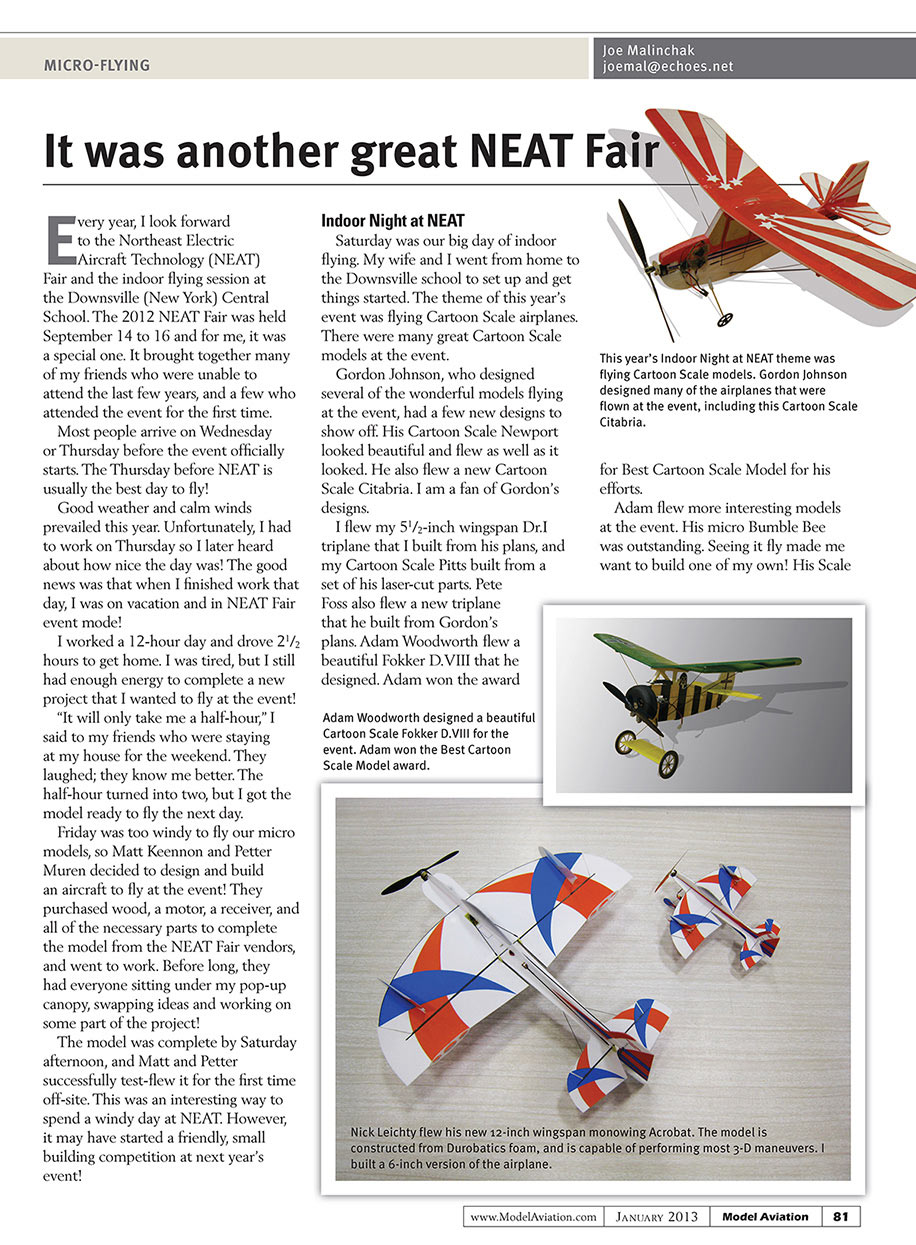
Gordon Johnson, who designed several of the wonderful models flying at the event, had a few new designs to show off. His Cartoon Scale Newport looked beautiful and flew as well as it looked. He also flew a new Cartoon Scale Citabria. I am a fan of Gordon's designs.
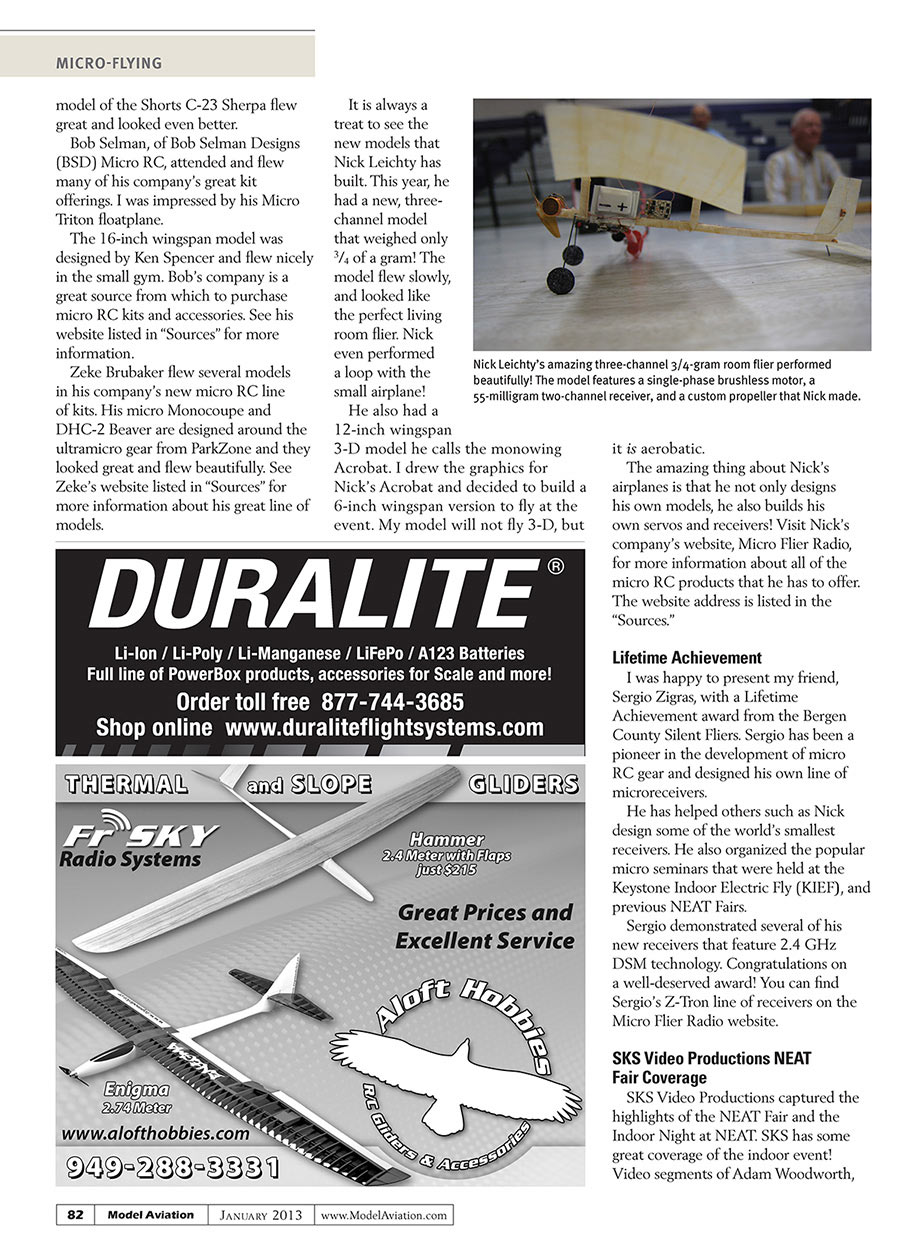
I flew my 5-1/2-inch wingspan Dr.I triplane that I built from his plans, and my Cartoon Scale Pitts built from a set of his laser-cut parts. Pete Foss also flew a new triplane that he built from Gordon's plans. Adam Woodworth flew a beautiful Fokker D.VII that he designed. Adam won the award for Best Cartoon Scale Model for his efforts.
Adam flew more interesting models at the event. His micro Bumble Bee was outstanding. Seeing it fly made me want to build one of my own! His Scale model of the Shorts C-23 Sherpa flew great and looked even better.
Bob Selman, of Bob Selman Designs (BSD) Micro RC, attended and flew many of his company’s great kit offerings. I was impressed by his Micro Triton floatplane.
The 16-inch wingspan model was designed by Ken Spencer and flew nicely in the small gym. Bob’s company is a great source from which to purchase micro RC kits and accessories. See his website listed in “Sources” for more information.
Zeke Brubaker flew several models in his company’s new micro RC line of kits. His micro Monocoupe and DHC-2 Beaver are designed around the ultramicro gear from ParkZone and they looked great and flew beautifully. See Zeke’s website listed in “Sources” for more information about his great line of models.
It is always a treat to see the new models that Nick Leichty has built. This year, he had a new, three-channel model that weighed only 3/4 of a gram! The model flew slowly, and looked like the perfect living room flier. Nick even performed a loop with the small airplane!
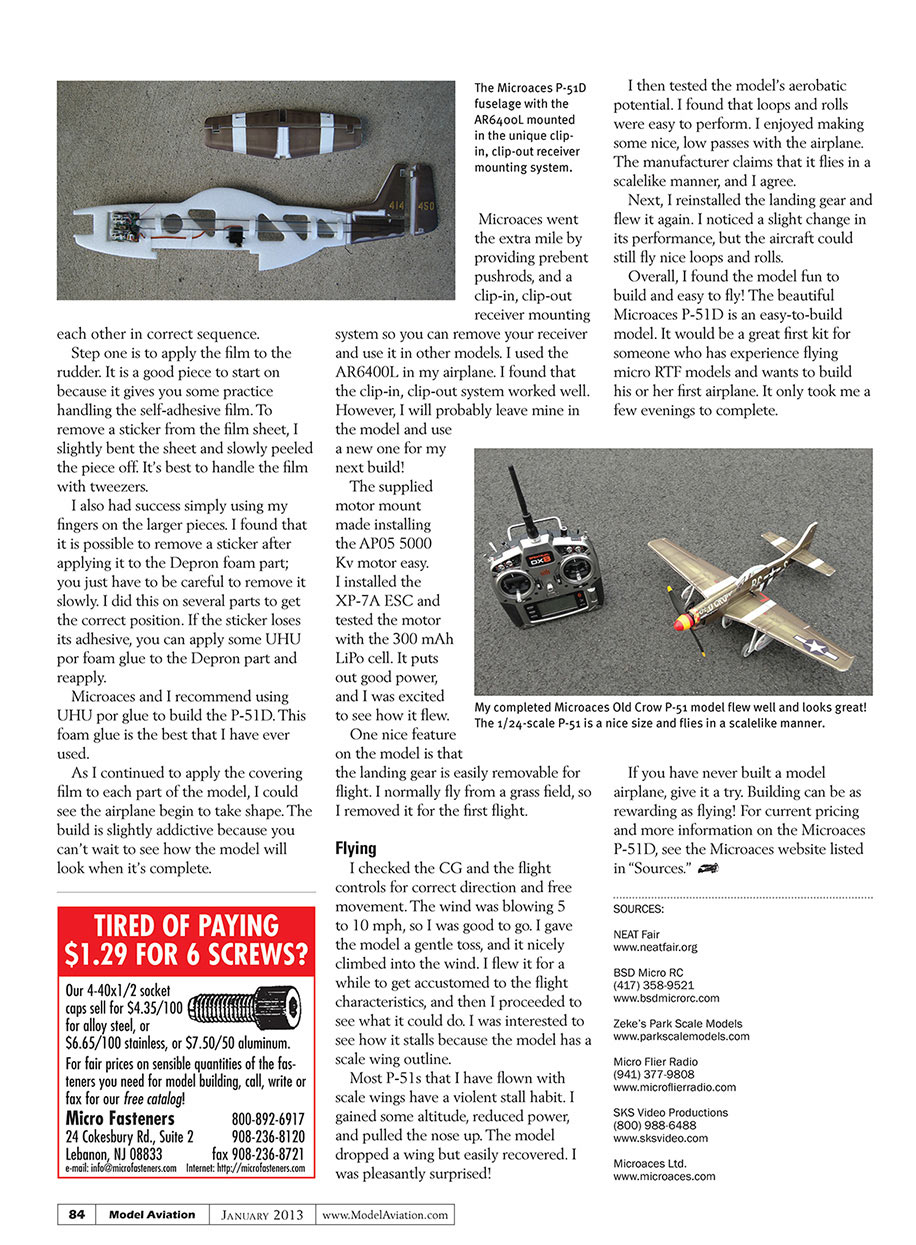
He also had a 12-inch wingspan 3-D model he calls the monowing Acrobat. I drew the graphics for Nick’s Acrobat and decided to build a 6-inch wingspan version to fly at the event. My model will not fly 3-D, but it is aerobatic.
The amazing thing about Nick’s airplanes is that he not only designs his own models, he also builds his own servos and receivers! Visit Nick’s company’s website, Micro Flier Radio, for more information about all of the micro RC products that he has to offer. The website address is listed in the “Sources.”
Lifetime Achievement
I was happy to present my friend, Sergio Zigras, with a Lifetime Achievement award from the Bergen County Silent Fliers. Sergio has been a pioneer in the development of micro RC gear and designed his own line of microreceivers.
He has helped others such as Nick design some of the world’s smallest receivers. He also organized the popular micro seminars that were held at the Keystone Indoor Electric Fly (KIEF), and previous NEAT Fairs.
Sergio demonstrated several of his new receivers that feature 2.4 GHz DSM technology. Congratulations on a well-deserved award! You can find Sergio’s Z-Tron line of receivers on the Micro Flier Radio website.
SKS Video Productions NEAT Fair Coverage
SKS Video Productions captured the highlights of the NEAT Fair and the Indoor Night at NEAT. SKS has some great coverage of the indoor event! Video segments of Adam Woodworth, each other in correct sequence.
Micro-Flying
Joe Malinchak
Step one is to apply the film to the rudder. It is a good piece to start on because it gives you some practice handling the self-adhesive film. To remove a sticker from the film sheet, I slightly bent the sheet and slowly peeled the piece off. It’s best to handle the film with tweezers.
I also had success simply using my fingers on the larger pieces. I found that it is possible to remove a sticker after applying it to the Depron foam part; you just have to be careful to remove it slowly. I did this on several parts to get the correct position. If the sticker loses its adhesive, you can apply some UHU por foam glue to the Depron part and reapply.
Microaces and I recommend using UHU por glue to build the P-51D. This foam glue is the best that I have ever used.
As I continued to apply the covering film to each part of the model, I could see the airplane begin to take shape. The build is slightly addictive because you can’t wait to see how the model will look when it’s complete.
The Microaces P-51D fuselage with the AR6400L mounted in the unique clipin, clip-out receiver mounting system.
Microaces went the extra mile by providing preborn pushrods, and a clip-in, clip-out receiver mounting system so you can remove your receiver and use it in other models. I used the AR6400L in my airplane. I found that the clip-in, clip-out system worked well. However, I will probably leave mine in the model and use a new one for my next build!
The supplied motor mount made installing the AP05 5000 Kv motor easy. I installed the XP-7A ESC and tested the motor with the 300 mAh LiPo cell. It puts out good power, and I was excited to see how it flew.
One nice feature on the model is that the landing gear is easily removable for flight. I normally fly from a grass field, so I removed it for the first flight.
Flying
I checked the CG and the flight controls for correct direction and free movement. The wind was blowing 5 to 10 mph, so I was good to go. I gave the model a gentle toss, and it nicely climbed into the wind. I flew it for a while to get accustomed to the flight characteristics, and then I proceeded to see what it could do. I was interested to see how it stalls because the model has a scale wing outline.
Most P-51s that I have flown with scale wings have a violent stall habit. I gained some altitude, reduced power, and pulled the nose up. The model dropped a wing but easily recovered. I was pleasantly surprised!
I then tested the model’s aerobatic potential. I found that loops and rolls were easy to perform. I enjoyed making some nice, low passes with the airplane. The manufacturer claims that it flies in a scalelike manner, and I agree.
Next, I reinstalled the landing gear and flew it again. I noticed a slight change in its performance, but the aircraft could still fly nice loops and rolls.
Overall, I found the model fun to build and easy to fly! The beautiful Microaces P-51D is an easy-to-build model. It would be a great first kit for someone who has experience flying micro RTF models and wants to build his or her first airplane. It only took me a few evenings to complete.
If you have never built a model airplane, give it a try. Building can be as rewarding as flying! For current pricing and more information on the Microaces P-51D, see the Microaces website listed in “Sources.”
SOURCES:
NEAT Fair www.neatfair.org
BSD Micro RC (417) 358-9521 www.bsdmicro.com
Zeke’s Park Scale Models www.parkscalemodels.com
Micro Flier Radio (941) 377-9808 www.microflieradio.com
SKS Video Productions (800) 988-6488 www.sksvideo.com
Microaces Ltd. www.microaces.com
Transcribed from original scans by AI. Minor OCR errors may remain.

