
Building another 1/72-scale model
Joe Malinchak
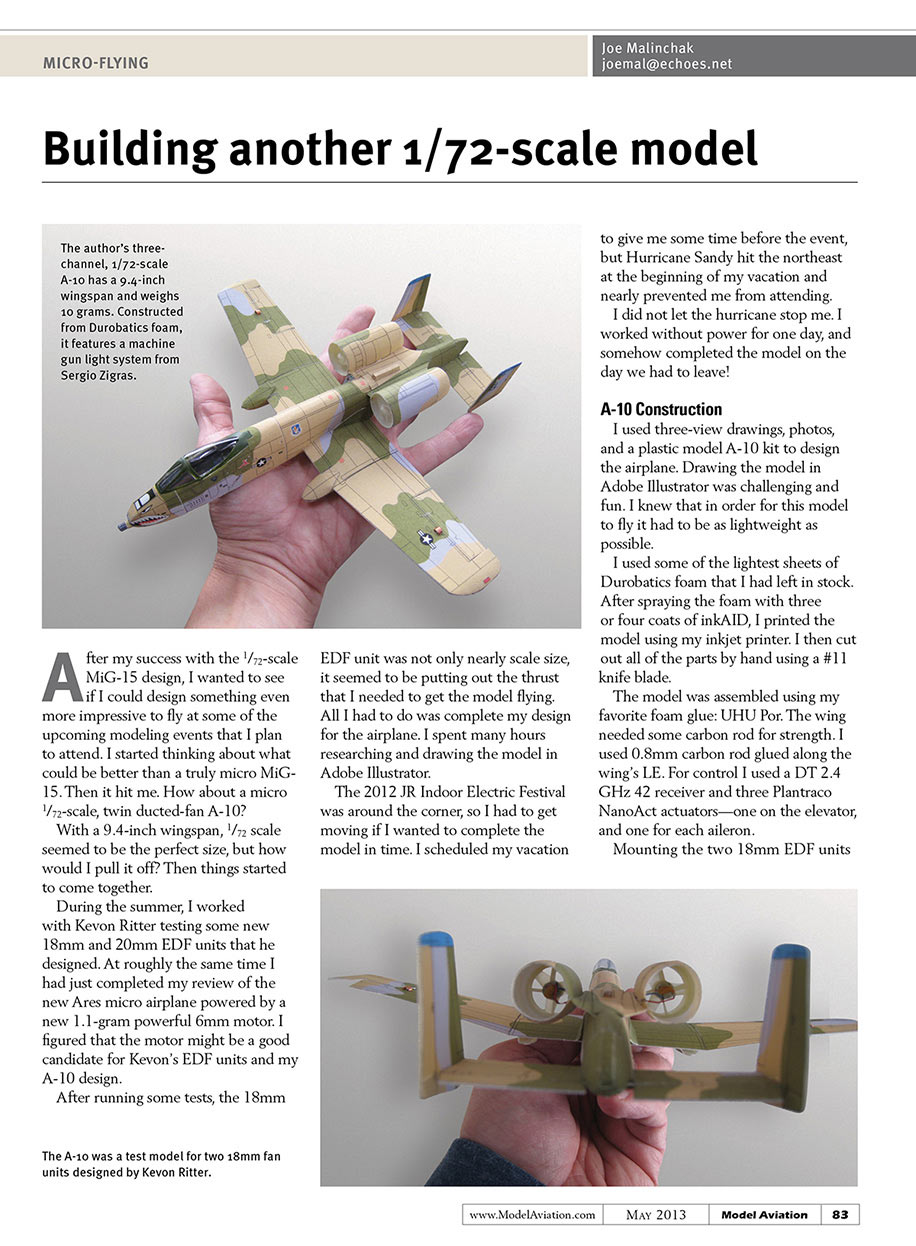
After my success with the 1/72-scale MiG-15 design, I wanted to see if I could design something even more impressive to fly at some of the upcoming modeling events that I plan to attend. I started thinking about what could be better than a truly micro MiG-15. Then it hit me. How about a micro 1/72-scale, twin ducted-fan A-10?
With a 9.4-inch wingspan, 1/72 scale seemed to be the perfect size, but how would I pull it off? Then things started to come together.
During the summer, I worked with Kevon Ritter testing some new 18mm and 20mm EDF units that he designed. At roughly the same time I had just completed my review of the new Ares micro airplane powered by a new 1.1-gram powerful 6mm motor. I figured that the motor might be a good candidate for Kevon's EDF units and my A-10 design.
After running some tests, the 18mm EDF unit was not only nearly scale size, it seemed to be putting out the thrust that I needed to get the model flying. All I had to do was complete my design for the airplane. I spent many hours researching and drawing the model in Adobe Illustrator.
The 2012 JR Indoor Electric Festival was around the corner, so I had to get moving if I wanted to complete the model in time. I scheduled my vacation to give me some time before the event, but Hurricane Sandy hit the northeast at the beginning of my vacation and nearly prevented me from attending.
I did not let the hurricane stop me. I worked without power for one day, and somehow completed the model on the day we had to leave!
A-10 Construction
I used three-view drawings, photos, and a plastic model A-10 kit to design the airplane. Drawing the model in Adobe Illustrator was challenging and fun. I knew that in order for this model to fly it had to be as lightweight as possible.
I used some of the lightest sheets of Durobatics foam that I had left in stock. After spraying the foam with three or four coats of inkAID, I printed the model using my inkjet printer. I then cut out all of the parts by hand using a #11 knife blade.
The model was assembled using my favorite foam glue: UHU Por. The wing needed some carbon rod for strength. I used 0.8mm carbon rod glued along the wing's LE. For control I used a DT 2.4 GHz 4E receiver and three Plantraco NanoAct actuators—one on the elevator, and one for each aileron.
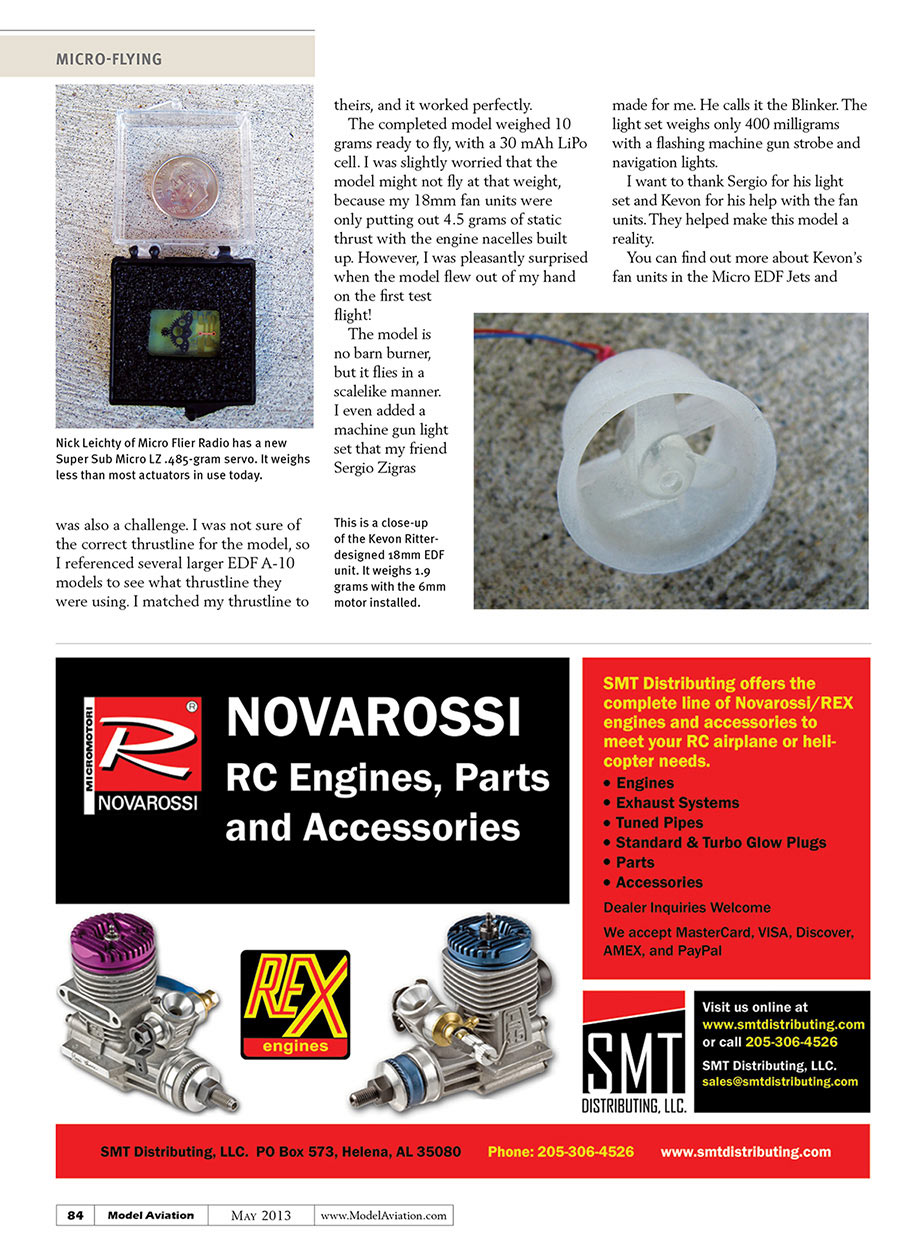
Mounting the two 18mm EDF units was also a challenge. I was not sure of the correct thrustline for the model, so I referenced several larger EDF A-10 models to see what thrustline they were using. I matched my thrustline to theirs, and it worked perfectly.
The completed model weighed 10 grams ready to fly, with a 30 mAh LiPo cell. I was slightly worried that the model might not fly at that weight, because my 18mm fan units were only putting out 4.5 grams of static thrust with the engine nacelles built up. However, I was pleasantly surprised when the model flew out of my hand on the first test flight!
The model is no barn burner, but it flies in a scalelike manner. I even added a machine gun light set that my friend Sergio Zigras made for me. He calls it the Blinker. The light set weighs only 400 milligrams with a flashing machine gun strobe and navigation lights.
I want to thank Sergio for his light set and Kevon for his help with the fan units. They helped make the model a reality.
You can find out more about Kevon’s fan units in the Micro EDF Jets and Power System section at RCGroups.com, under the topic "bimRC Ducted Fan Line." You can also find more information about my 1/72-scale A-10 and a few flight videos in a thread that I started about the model.
Twin CO2-Powered Vickers
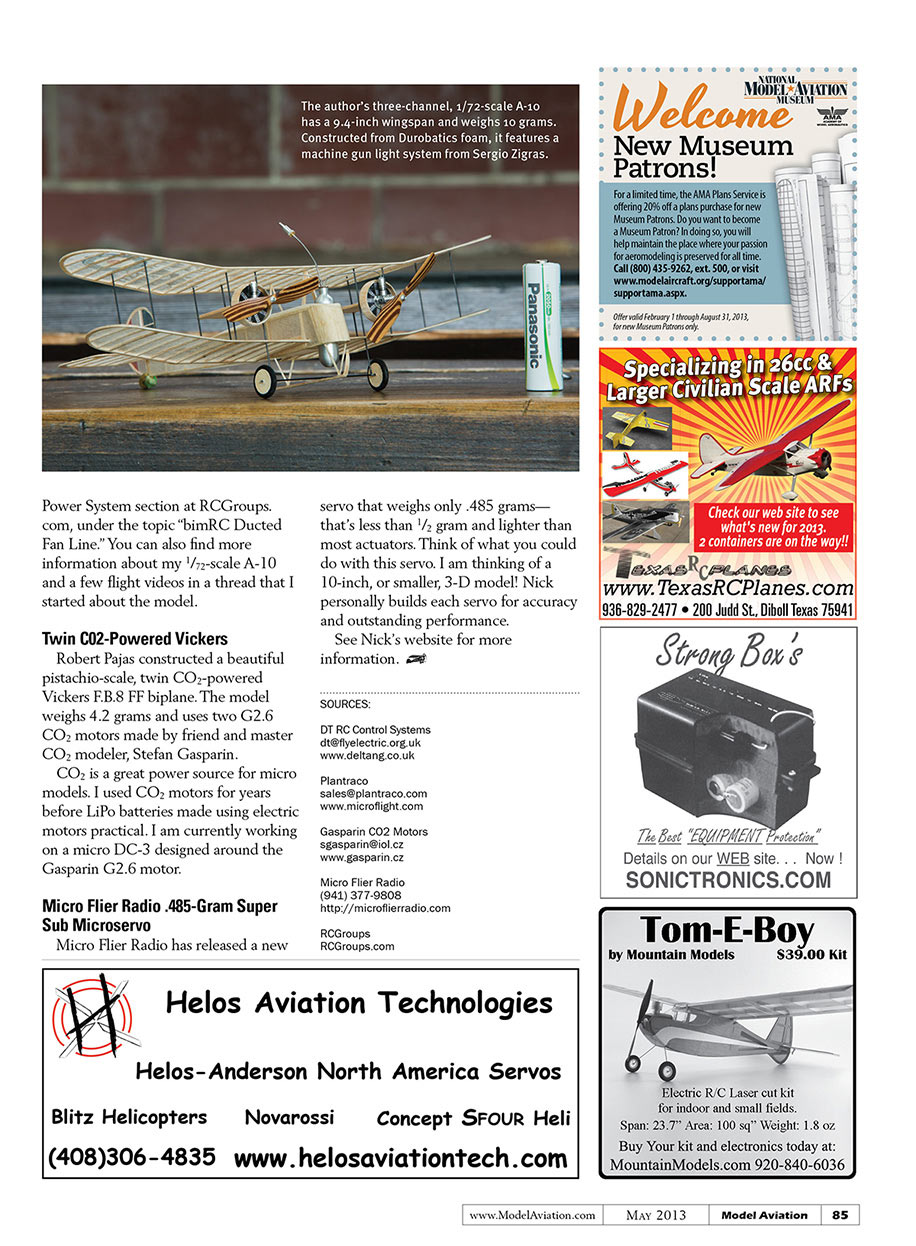
Robert Pajas constructed a beautiful pistachio-scale, twin CO2-powered Vickers F.B.8 FF biplane. The model weighs 4.2 grams and uses two G2.6 CO2 motors made by friend and master CO2 modeler, Stefan Gasparin.
CO2 is a great power source for micro models. I used CO2 motors for years before LiPo batteries made using electric motors practical. I am currently working on a micro DC-3 designed around the Gasparin G2.6 motor.
Micro Flier Radio .485-Gram Super Sub Microservo
Micro Flier Radio has released a new servo that weighs only .485 grams—that's less than 1/2 gram and lighter than most actuators. Think of what you could do with this servo. I am thinking of a 10-inch, or smaller, 3-D model! Nick personally builds each servo for accuracy and outstanding performance.
See Nick's website for more information.
SOURCES:
- DT RC Control Systems
dtfyelectric.org.uk www.deltang.co.uk
- Plantraco
[email protected] www.microflight.com
- Gasparin CO2 Motors
[email protected] www.gasparin.cz
- Micro Flier Radio
(941) 377-9808 http://microflieradio.com
- RCGroups
RCGroups.com
Transcribed from original scans by AI. Minor OCR errors may remain.

