
Two nice micro models
I love to build model airplanes, but I am also a big fan of the RTF aircraft that were released during the last few years. They have introduced the joy of flying micro RC airplanes to many who otherwise might not have shown an interest.
It has also been amazing to see how much the RTF aircraft have improved in appearance and performance compared with previous versions. The manufacturers are doing a great job of updating older models and introducing new ones.
The only drawback to all of the newly released airplanes is that some of the old favorites are being retired and becoming difficult to find. My suggestion is that if you see a new micro aircraft you want, buy it before it is gone!
As I write this column, the price on the amazing E-flite UMX MiG 15 has dropped dramatically. I hope this does not mean the end of the production run of this great model airplane.
E-flite UMX MiG 15
The MiG-15 was the first great Soviet interceptor aircraft. It was designed as a bomber hunter to target the B-29 and B-52 bomber. The aircraft, however, is best remembered as a formidable foe against the F-86 Sabre during the Korean War conflict.
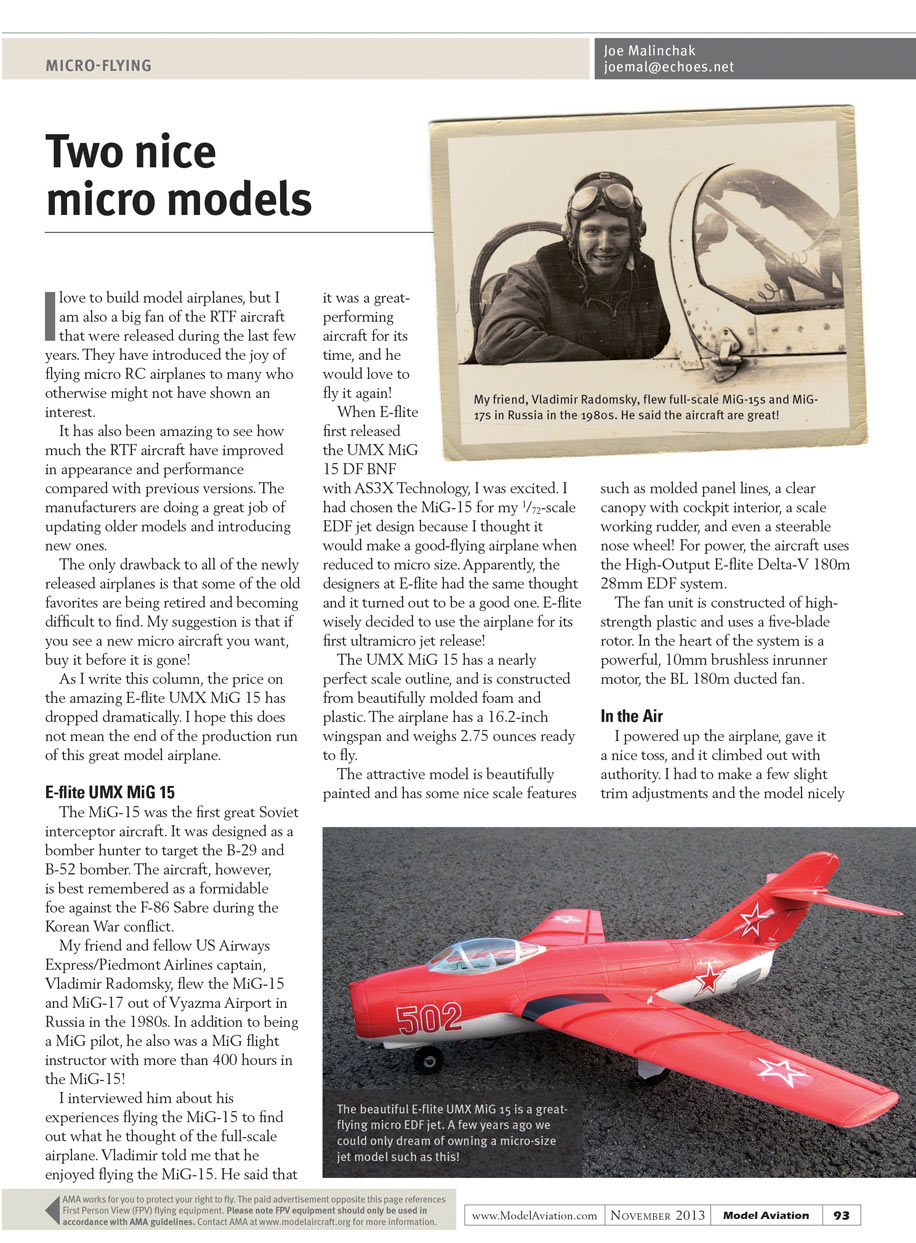
My friend and fellow US Airways Express/Piedmont Airlines captain, Vladimir Radomsky, flew the MiG-15 and MiG-17 out of Vyazma Airport in Russia in the 1980s. In addition to being a MiG pilot, he also was a MiG flight instructor with more than 400 hours in the MiG-15!
I interviewed him about his experiences flying the MiG-15 to find out what he thought of the full-scale airplane. Vladimir told me that he enjoyed flying the MiG-15. He said that it was a great-performing aircraft for its time, and he would love to fly it again!
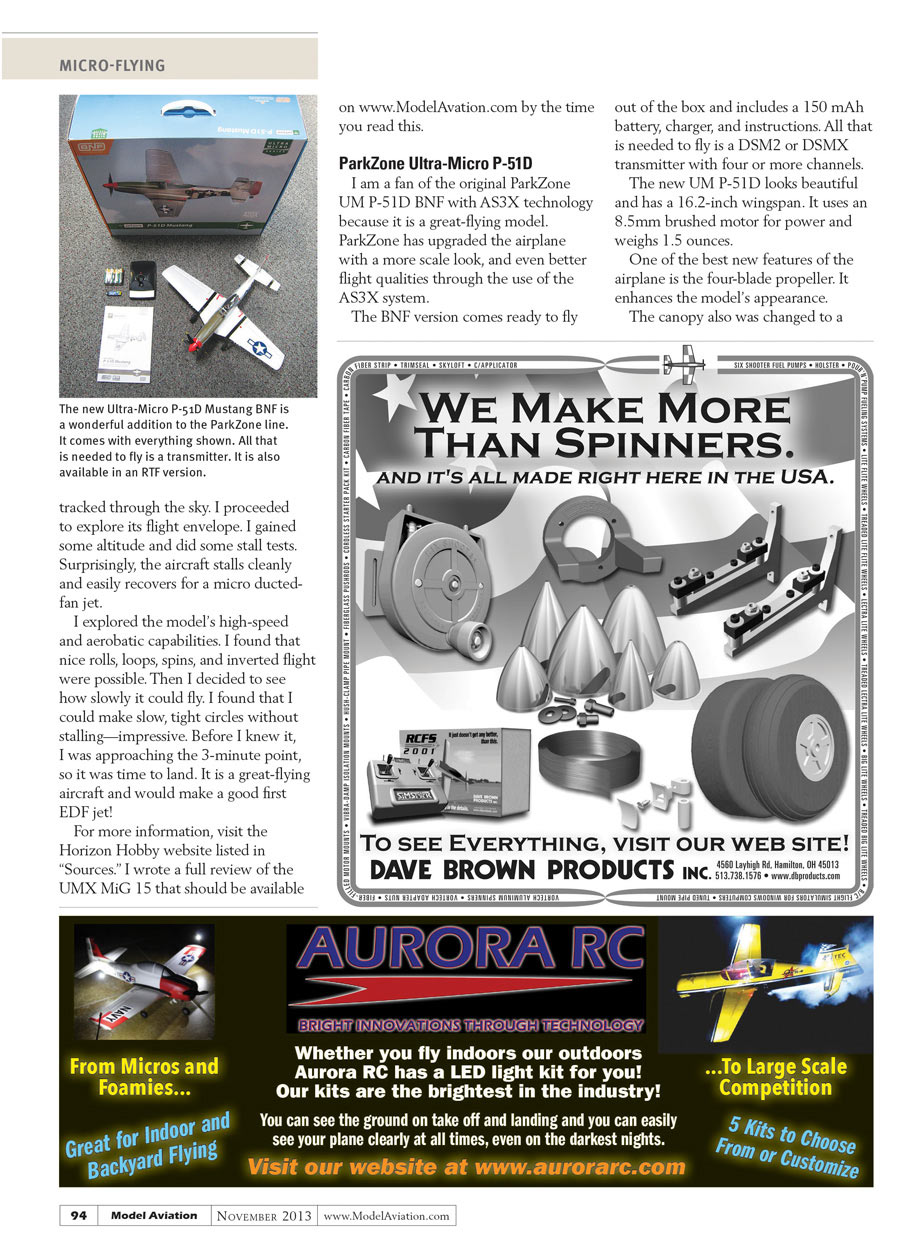
When E-flite first released the UMX MiG 15 DF BNF with AS3X Technology, I was excited. I had chosen the MiG-15 for my 1/72-scale EDF jet design because I thought it would make a good-flying airplane when reduced to micro size. Apparently, the designers at E-flite had the same thought and it turned out to be a good one. E-flite wisely decided to use the airplane for its first ultramicro jet release!
The UMX MiG 15 has a nearly perfect scale outline, and is constructed from beautifully molded foam and plastic. The airplane has a 16.2-inch wingspan and weighs 2.75 ounces ready to fly.
The attractive model is beautifully painted and has some nice scale features such as molded panel lines, a clear canopy with cockpit interior, a scale working rudder, and even a steerable nose wheel! For power, the aircraft uses the High-Output E-flite Delta-V 180m 28mm EDF system.
The fan unit is constructed of high-strength plastic and uses a five-blade rotor. In the heart of the system is a powerful, 10mm brushless inrunner motor, the BL 180m ducted fan.
In the Air
I powered up the airplane, gave it a nice toss, and it climbed out with authority. I had to make a few slight trim adjustments and the model nicely tracked through the sky. I proceeded to explore its flight envelope. I gained some altitude and did some stall tests. Surprisingly, the aircraft stalls cleanly and easily recovers for a micro ducted-fan jet.
I explored the model's high-speed and aerobatic capabilities. I found that nice rolls, loops, spins, and inverted flight were possible. Then I decided to see how slowly it could fly. I found that I could make slow, tight circles without stalling—impressive. Before I knew it, I was approaching the 3-minute point, so it was time to land. It is a great-flying aircraft and would make a good first EDF jet!
For more information, visit the Horizon Hobby website listed in "Sources." I wrote a full review of the UMX MiG 15 that should be available on www.ModelAviation.com by the time you read this.
ParkZone Ultra-Micro P-51D
I am a fan of the original ParkZone UM P-51D BNF with AS3X technology because it is a great-flying model. ParkZone has upgraded the airplane with a more scale look, and even better flight qualities through the use of the AS3X system.
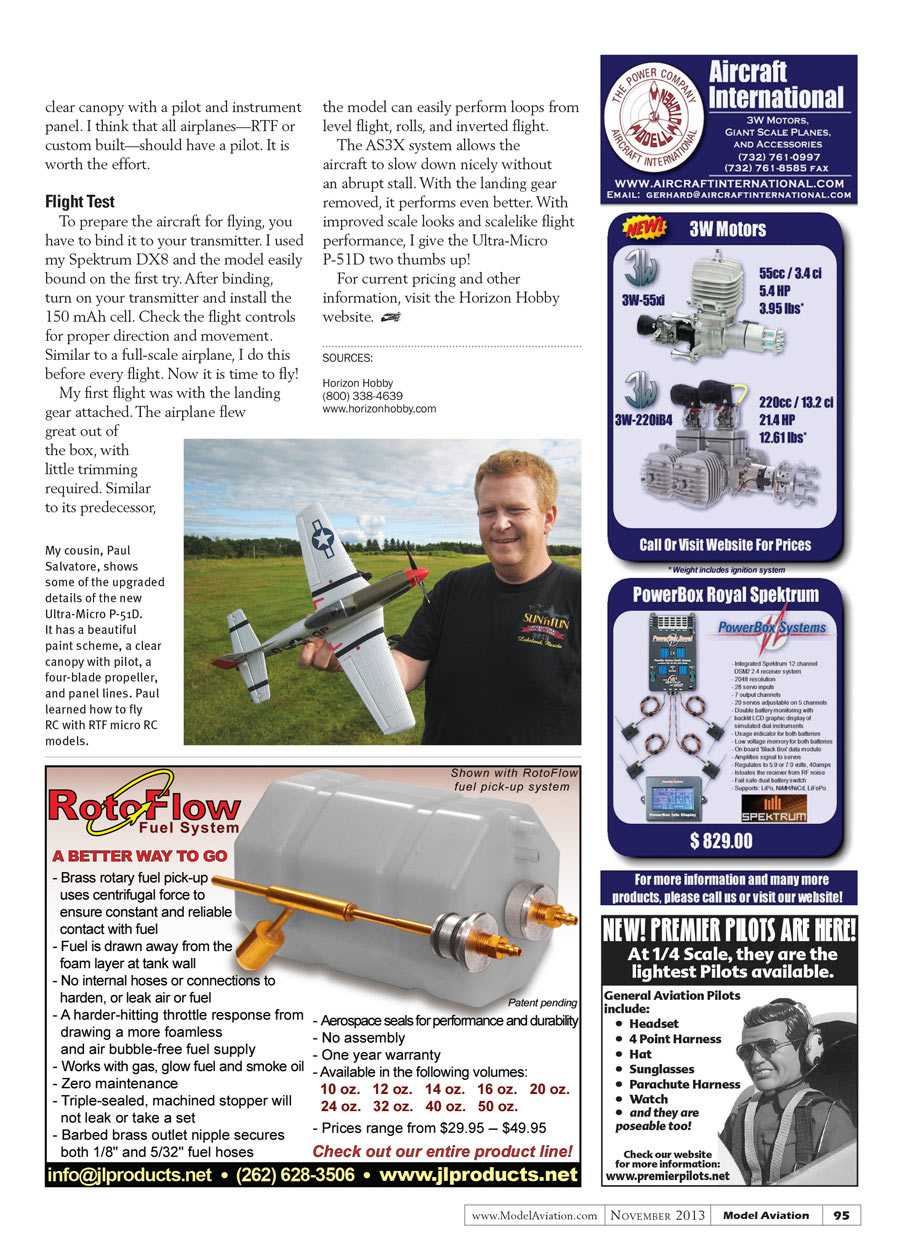
The BNF version comes ready to fly out of the box and includes a 150 mAh battery, charger, and instructions. All that is needed to fly is a DSM2 or DSMX transmitter with four or more channels.
The new UM P-51D looks beautiful and has a 16.2-inch wingspan. It uses an 8.5mm brushed motor for power and weighs 1.5 ounces.
One of the best new features of the airplane is the four-blade propeller. It enhances the model's appearance.
The canopy also was changed to a
Flight Test
To prepare the aircraft for flying, you have to bind it to your transmitter. I used my Spektrum DX8 and the model easily bound on the first try. After binding, turn on your transmitter and install the 150 mAh cell. Check the flight controls for proper direction and movement. Similar to a full-scale airplane, I do this before every flight. Now it is time to fly!
My first flight was with the landing gear attached. The airplane flew great out of the box, with little trimming required. Similar to its predecessor, the model can easily perform loops from level flight, rolls, and inverted flight.
The AS3X system allows the aircraft to slow down nicely without an abrupt stall. With the landing gear removed, it performs even better. With improved scale looks and scalelike flight performance, I give the Ultra-Micro P-51D two thumbs up!
For current pricing and other information, visit the Horizon Hobby website.
SOURCES:
Horizon Hobby (800) 338-4639 www.horizonhobby.com
Transcribed from original scans by AI. Minor OCR errors may remain.

