
Micro-Flying
HERE IT GOES — a new department and a new writer. Since very few of you know me, I will toss out some of the basics.
I am 61 years old, retired from NASA (the National Aeronautics and Space Administration), married with six children and three grandchildren, and have had a lifelong passion for model airplanes.
I have been attracted to the miniature since the earliest point I can remember, which is apparent in my choice of projects.
Early micro-RC and indoor activity
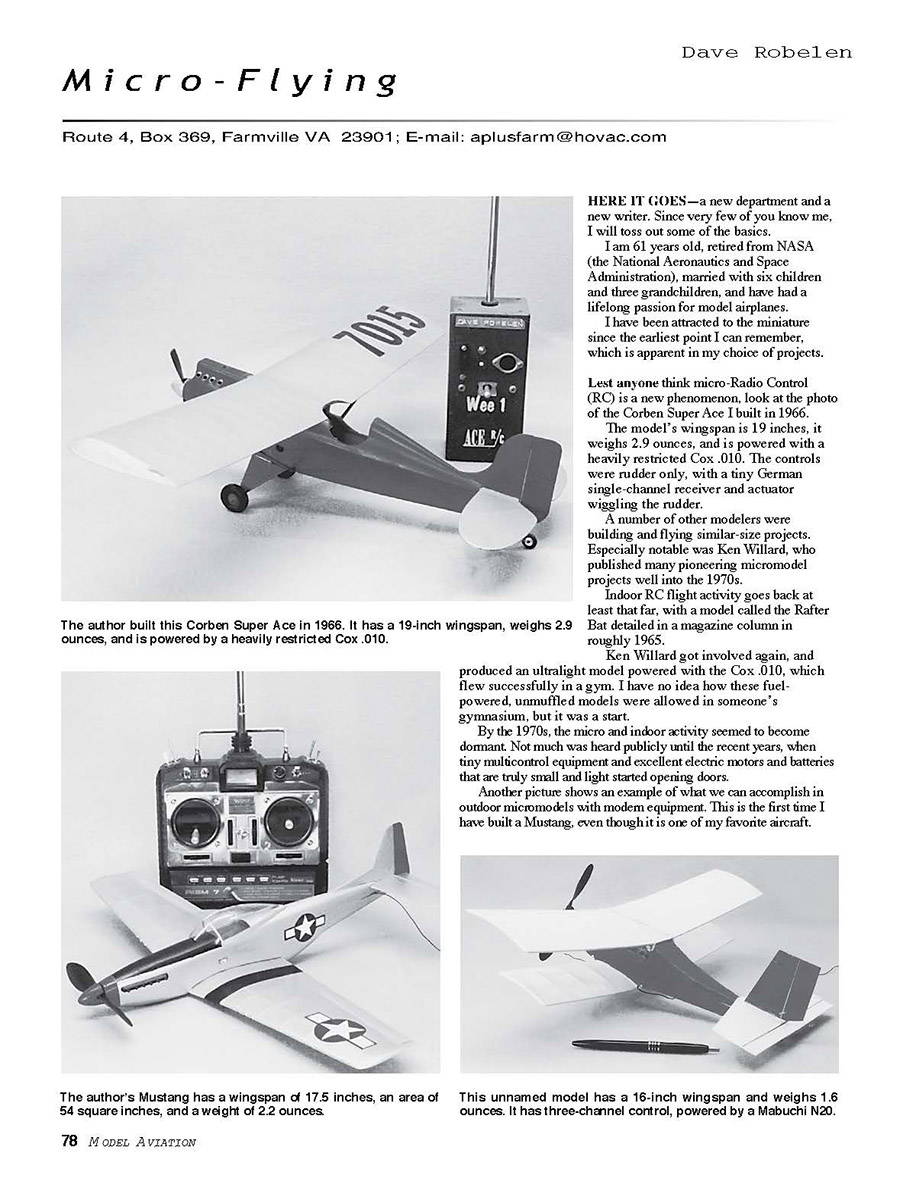
Lest anyone think micro-Radio Control (RC) is a new phenomenon, look at the photo of the Corben Super Ace I built in 1966.
The model's wingspan is 19 inches, it weighs 2.9 ounces, and is powered with a heavily restricted Cox .010. The controls were rudder only, with a tiny German single-channel receiver and actuator wiggling the rudder.
A number of other modelers were building and flying similar-size projects. Especially notable was Ken Willard, who published many pioneering micromodel projects well into the 1970s.
Indoor RC flight activity goes back at least that far, with a model called the Rafter Bat detailed in a magazine column in roughly 1965.
Ken Willard got involved again and produced an ultralight model powered with the Cox .010, which flew successfully in a gym. I have no idea how these fuel-powered, un-muffled models were allowed in someone's gymnasium, but it was a start.
By the 1970s, the micro and indoor activity seemed to become dormant. Not much was heard publicly until recent years, when tiny multicontrol equipment and excellent electric motors and batteries that are truly small and light started opening doors.
Recent outdoor micromodels
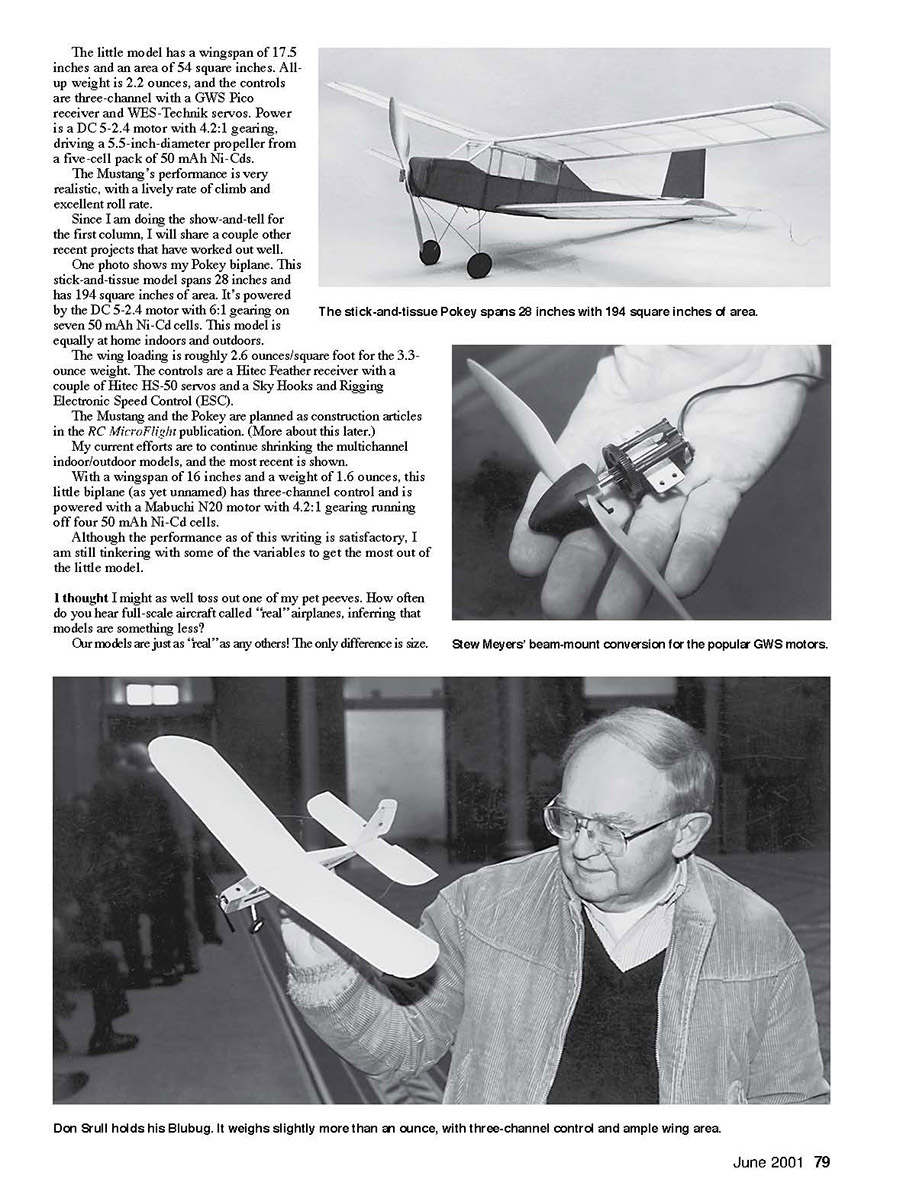
Another picture shows an example of what we can accomplish in outdoor micromodels with modern equipment. This is the first time I have built a Mustang, even though it is one of my favorite aircraft.
The little model has a wingspan of 17.5 inches and an area of 54 square inches. All-up weight is 2.2 ounces, and the controls are three-channel with a GWS Pico receiver and WES-Technik servos. Power is a DC 5-2.4 motor with 4.2:1 gearing, driving a 5.5-inch-diameter propeller from a five-cell pack of 50 mAh Ni-Cds.
The Mustang's performance is very realistic, with a lively rate of climb and excellent roll rate.
Since I am doing the show-and-tell for the first column, I will share a couple other recent projects that have worked out well.
One photo shows my Pokey biplane. This stick-and-tissue model spans 28 inches and has 194 square inches of area. It's powered by the DC 5-2.4 motor with 6:1 gearing on seven 50 mAh Ni-Cd cells. This model is equally at home indoors and outdoors.
The wing loading is roughly 2.6 ounces per square foot for the 3.3-ounce weight. The controls are a Hitec Feather receiver with a couple of Hitec HS-50 servos and a Sky Hooks and Rigging Electronic Speed Control (ESC).
The Mustang and the Pokey are planned as construction articles in the RC MicroFlight publication. (More about this later.)
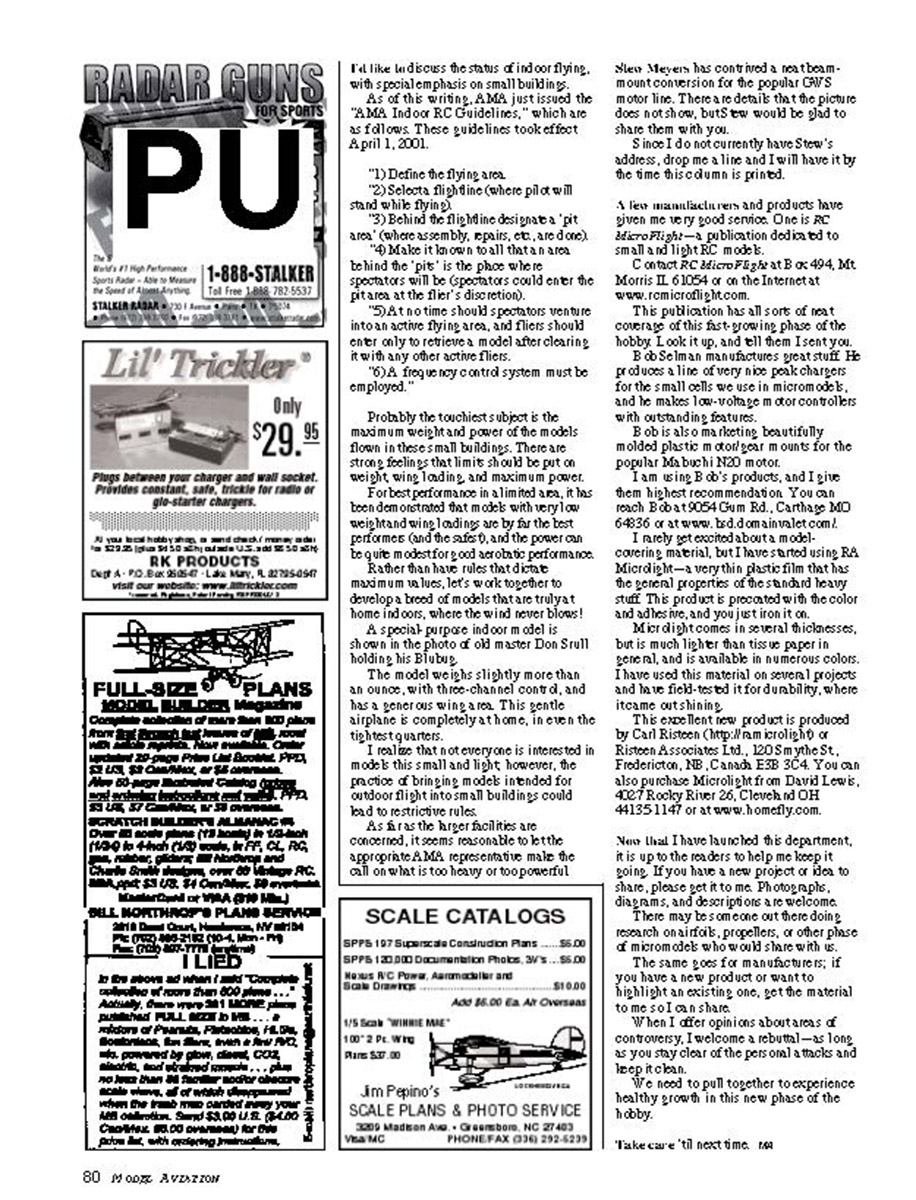
My current efforts are to continue shrinking the multichannel indoor/outdoor models, and the most recent is shown.
With a wingspan of 16 inches and a weight of 1.6 ounces, this little biplane (as yet unnamed) has three-channel control and is powered with a Mabuchi N20 motor with 4.2:1 gearing running off four 50 mAh Ni-Cd cells.
Although the performance as of this writing is satisfactory, I am still tinkering with some of the variables to get the most out of the little model.
A note on "real" airplanes
I thought I might as well toss out one of my pet peeves. How often do you hear full-scale aircraft called "real" airplanes, inferring that models are something less?
Our models are just as "real" as any others! The only difference is size.
Indoor flying and guidelines
I'd like to discuss the status of indoor flying, with special emphasis on small buildings.
As of this writing, AMA just issued the "AMA Indoor RC Guidelines," which are as follows. These guidelines took effect April 1, 2001.
- Define the flying area.
- Select a flight line (where pilot will stand while flying).
- Behind the flight line designate a "pit area" (where assembly, repairs, etc., are done).
- Make it known to all that an area behind the "pits" is the place where spectators will be (spectators could enter the pits at the flier's discretion).
- At no time should spectators venture into an active flying area, and fliers should center only to retrieve a model after clearing it with any other active fliers.
- Frequency control system must be employed.
Probably the touchiest subject is the maximum weight and power of the models flown in these small buildings. There are strong feelings that limits should be put on weight, wing loading, and maximum power.
For best performance in a limited area, it has been demonstrated that models with very low weight and wing loading are by far the best performers (and the safest), and the power needs to be modest for good aerobatic performance.
Rather than have rules that dictate maximum values, let's work together to develop a broad set of models that are truly at home indoors, where the wind never blows!
A special-purpose indoor model is shown in the photo of old master Don Srull holding his Bibber.
The model weighs slightly more than an ounce, with three-channel control, and has a generous wing area. This gentle airplane is completely at home, even in the tightest quarters.
I realize that not everyone is interested in models this small and light; however, the practice of bringing models intended for outdoor flight into small buildings could lead to restrictive rules.
As far as the larger facilities are concerned, it seems reasonable to let the appropriate AMA representative make the call on what is too heavy or too powerful.
Conversions, products, and materials
Steve Meyers has converted a neat beam-mount conversion for the popular GWS motor line. There are details that the picture does not show, but Steve would be glad to share them with you.
Since I do not currently have Steve's address, drop me a line and I will have it by the time this column is printed.
A few manufacturers and products have given me very good service.
- RC MicroFlight — a publication dedicated to small and light RC models. Contact RC MicroFlight at Box 494, Mt. Morris IL 61054 or on the Internet at www.rcmicroflight.com. This publication has all sorts of neat coverage of this fast-growing phase of the hobby.
- Bob Selman — manufactures peak chargers for the small cells used in micromodels and low-voltage motor controllers with outstanding features. Bob also markets molded plastic control horns and mounts for the popular Mabuchi N20 motor. I am using Bob's products and give them my highest recommendation. You can reach Bob at 9054 Gum Rd., Carthage MO 64836 or at www.bobsdomain.net.
I recently discovered a new material for covering small models: Microfilm — a very thin plastic film that has the general properties of the standard heat-shrink covering. This product is impervious to the colored pigments and adhesives, and you just iron it on.
Microfilm comes in several thicknesses, but is much lighter than tissue paper in general, and is available in numerous colors. I've used this material on several projects and have found it to be durable, where it came out shining.
This product is produced by Carl Ritson (Ritson Associates Ltd., 120 Smythe St., Fredericton, NB, Canada, E3B 3C4). You can also purchase Microfilm from David Lewis, 4027 Rocky River Dr., Cleveland OH 44135-1147 or at www.homefly.com.
Contributions and closing
Now that I have launched this department, it is up to the readers to help me keep it going. If you have a new project or idea to share, please get it to me. Photographs, diagrams, and descriptions are welcome. There may be some copyright issues, so please send material you own or have permission to use.
If you have commercial products you'd like me to mention, send details and samples and I will check them out. If you have an item to highlight in an upcoming issue, send the material to me so I can share it.
When I offer opinions about areas of controversy, I welcome a rebuttal — as long as you stay clear of the personal attacks and keep it clean.
We need to pull together to experience healthy growth in this new phase of the hobby.
Take care 'til next time.
Transcribed from original scans by AI. Minor OCR errors may remain.

