
Micro-Flying
Dave Robelen
Route 4, Box 369, Farmville, VA 23901 E-mail: [email protected]
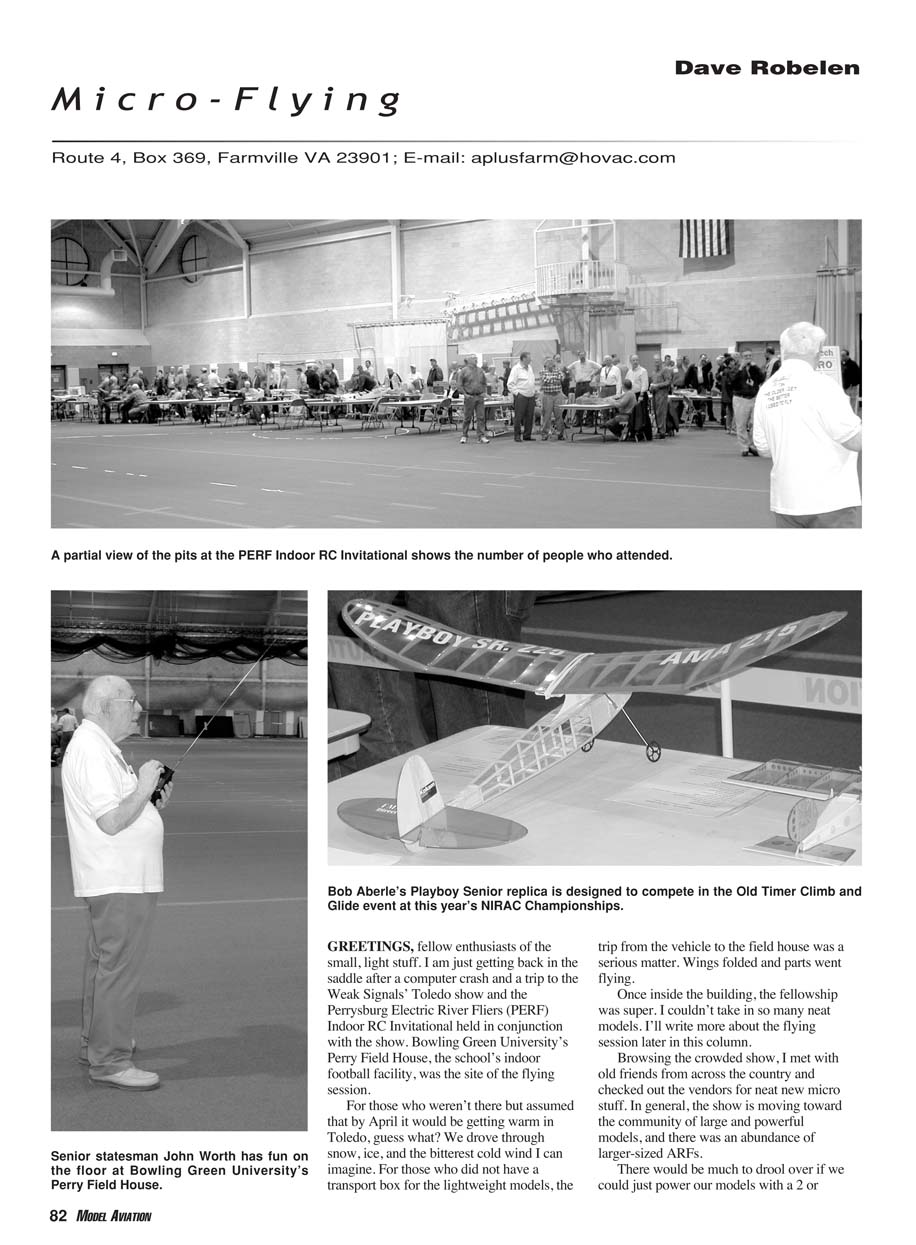
GREETINGS, fellow enthusiasts of the small, light stuff. I am just getting back in the saddle after a computer crash and a trip to the Weak Signals Toledo show and the Perrysburg Electric River Fliers (PERF) Indoor RC Invitational held in conjunction with the show. Bowling Green University's Perry Field House, the school's indoor football facility, was the site of the flying session.
For those who weren't there but assumed that by April it would be getting warm in Toledo, guess what? We drove through snow, ice, and the bitterest cold wind I can imagine. For those who did not have a transport box for the lightweight models, the trip from the vehicle to the field house was a serious matter. Wings folded and parts went flying.
Once inside the building, the fellowship was super. I couldn't take in so many neat models. I'll write more about the flying session later in this column.
Browsing the crowded show, I met old friends from across the country and checked out the vendors for neat new micro stuff. In general, the show is moving toward the community of large and powerful models, and there was an abundance of larger-sized ARFs. There would be much to drool over if we could just power our models with a 2-horsepower—or more—gas engine. There were certainly vendors with offerings that targeted the modelers who follow this column, but they were in the minority.
FMA Direct showed a nifty package system that included a five-channel micro receiver, two PS-20 servos, a special low-voltage ESC, and a Li-Poly battery cell. The whole package weighed approximately 1 ounce. By my standards, that is progress. I saw at least one of these systems flying a 6-ounce model with a GWS power unit, and it was very peppy. Check FMA's advertisements or visit its Web site at www.fmadirect.com for more specifics and current pricing.
Dynamic Web Enterprises (DWE) at www.smallrc.com was busy showing its growing line of equipment and model products. I noted ARF models as well as laser-cut balsa kits. The selection of power units was on the increase, with several Gary Jones high-ratio drive units that appeared nicely made. One model in the DWE booth that caught my eye was the DWEb. Built by Scott Christensen of Sig Manufacturing, the model was especially cute and nicely made. The photo will give you an idea of the general size and shape of this exquisite little pusher. Scott would not comment on whether Sig or DWE would be producing a kit. He's a bit of a politician.
Incredible projects that could have been borrowed from a museum for the occasion filled the display tables. If there was one common characteristic, it was the size of the aircraft. Nearly all of those beauties were huge. There were no indoor or micro models in evidence. I suggest we get busy and correct that situation for 2005. I will build something if you will, and we can have better representation.
The absence of micro aircraft at the show didn't take away from the quality of models Saturday night at Bowling Green. There were some truly neat projects on tables and in the air, including the Taube by master builder Dave Platt. One picture doesn't do it justice, but check out the detailed structure and rigging. The miniature engine looks ready to crank up and run. The Taube was a smooth and graceful flier; it was lovely as it lapped the building at a leisurely pace.
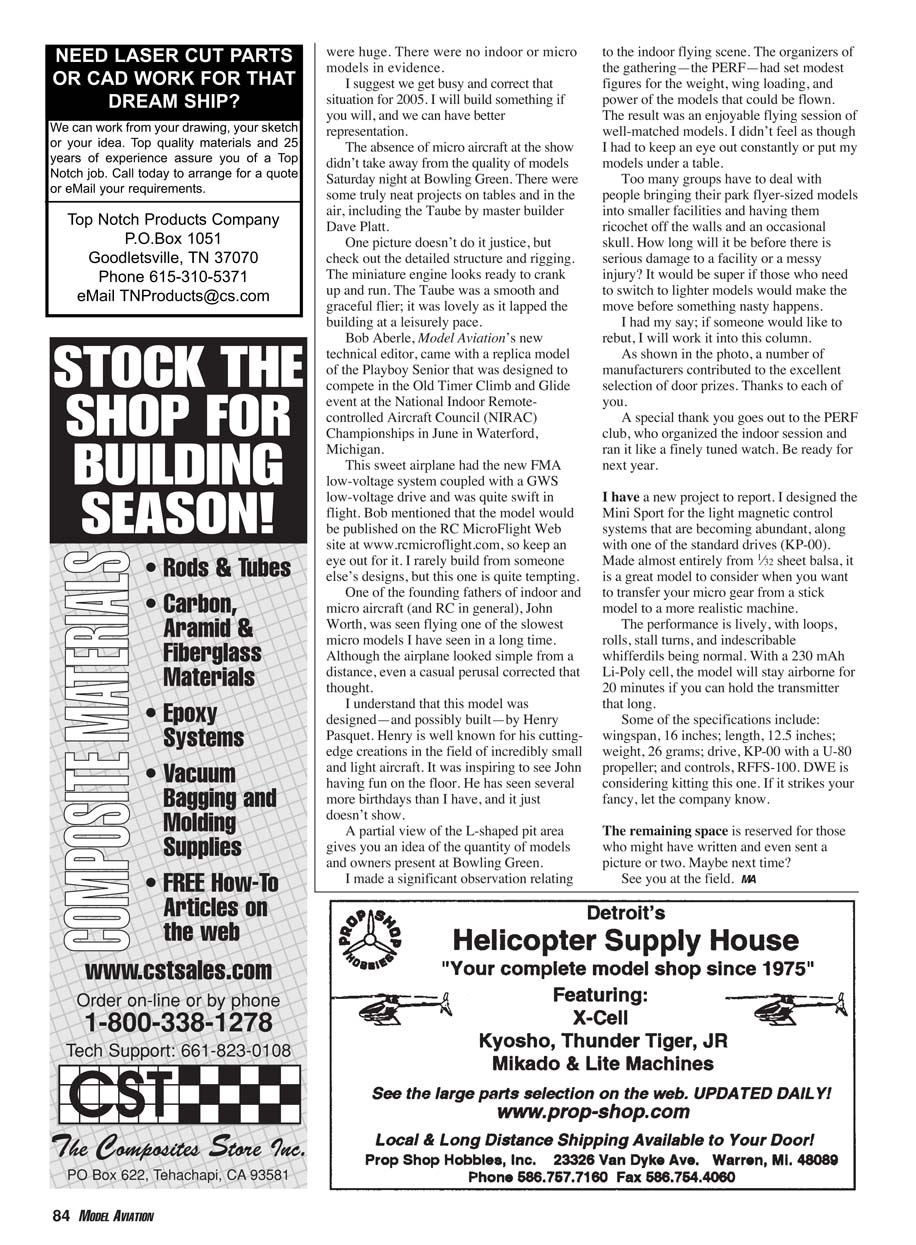
Bob Aberle, Model Aviation's new technical editor, came with a replica model of the Playboy Senior that was designed to compete in the Old Timer Climb and Glide event at the National Indoor Remote-controlled Aircraft Council (NIRAC) Championships in June in Waterford, Michigan. This sweet airplane had the new FMA low-voltage system coupled with a GWS low-voltage drive and was quite swift in flight. Bob mentioned that the model would be published on the RC MicroFlight Web site at www.rcmicroflight.com, so keep an eye out for it. I rarely build from someone else's designs, but this one is quite tempting.
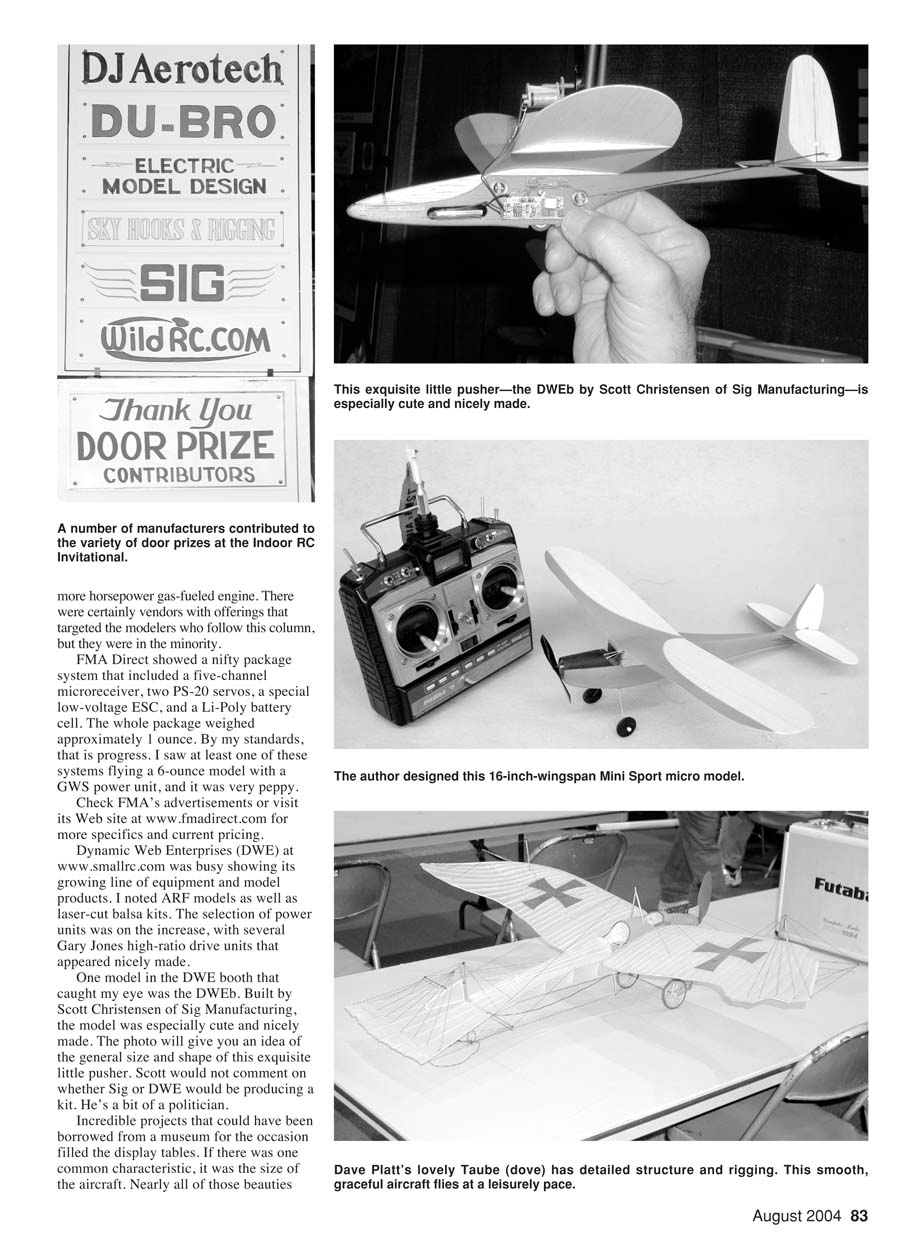
One of the founding fathers of indoor and micro aircraft (and RC in general), John Worth, was seen flying one of the slowest micro models I have seen in a long time. Although the airplane looked simple from a distance, even a casual perusal corrected that thought. I understand that this model was designed—and possibly built—by Henry Pasquet. Henry is well known for his cutting-edge creations in the field of incredibly small and light aircraft. It was inspiring to see John having fun on the floor. He has seen several more birthdays than I have, and it just doesn't show.
I made a significant observation relating to the indoor flying scene. The organizers of the gathering—the PERF—had set modest figures for the weight, wing loading, and power of the models that could be flown. The result was an enjoyable flying session of well-matched models. I didn't feel as though I had to keep an eye out constantly or put my models under a table.
Too many groups have to deal with people bringing their park-flyer–sized models into smaller facilities and having them ricochet off the walls and an occasional skull. How long will it be before there is serious damage to a facility or a messy injury? It would be super if those who need to switch to lighter models would make the move before something nasty happens. I had my say; if someone would like to rebut, I will work it into this column.
As shown in the photo, a number of manufacturers contributed to the excellent selection of door prizes. Thanks to each of you.
A special thank you goes out to the PERF club, who organized the indoor session and ran it like a finely tuned watch. Be ready for next year.
New project: Mini Sport
I have a new project to report. I designed the Mini Sport for the light magnetic control systems that are becoming abundant, along with one of the standard drives (KP-00). Made almost entirely from 1/32" sheet balsa, it is a great model to consider when you want to transfer your micro gear from a stick model to a more realistic machine.
The performance is lively, with loops, rolls, stall turns, and indescribable whifflers being normal. With a 230 mAh Li-Poly cell, the model will stay airborne for 20 minutes if you can hold the transmitter that long.
Some of the specifications include:
- Wingspan: 16 inches
- Length: 12.5 inches
- Weight: 26 grams
- Drive: KP-00 with a U-80 propeller
- Controls: RFFS-100
DWE is considering kitting this one. If it strikes your fancy, let the company know.
The remaining space is reserved for those who might have written and even sent a picture or two. Maybe next time? See you at the field.
MA
Transcribed from original scans by AI. Minor OCR errors may remain.

