
Micro precision Pattern is on the way!
Dave Robelen | [email protected]
GREETINGS, FELLOW micro fans! I hope you found the right stuff under the Christmas tree. This promises to be an exciting season for our interests, with quite a bit of new equipment coming along. I will kick things off with a project I have been working on that uses some of this neat new gear.
My interest in flying RC aerobatics (Pattern) goes back to the 1960s. I have made several micro-size electric-powered models that have approached the ability to fly true aerobatics, but each time there were significant limits. This is changing.
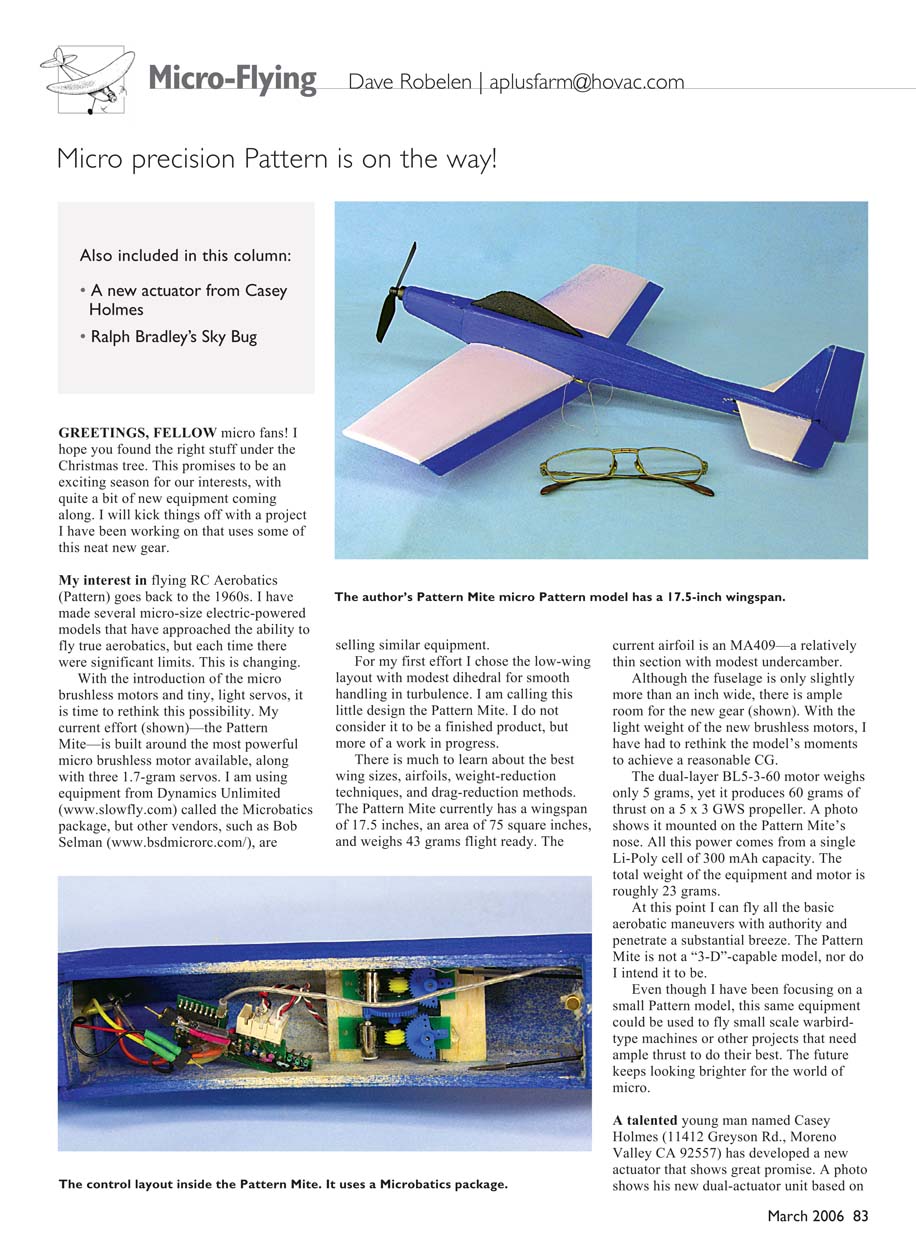
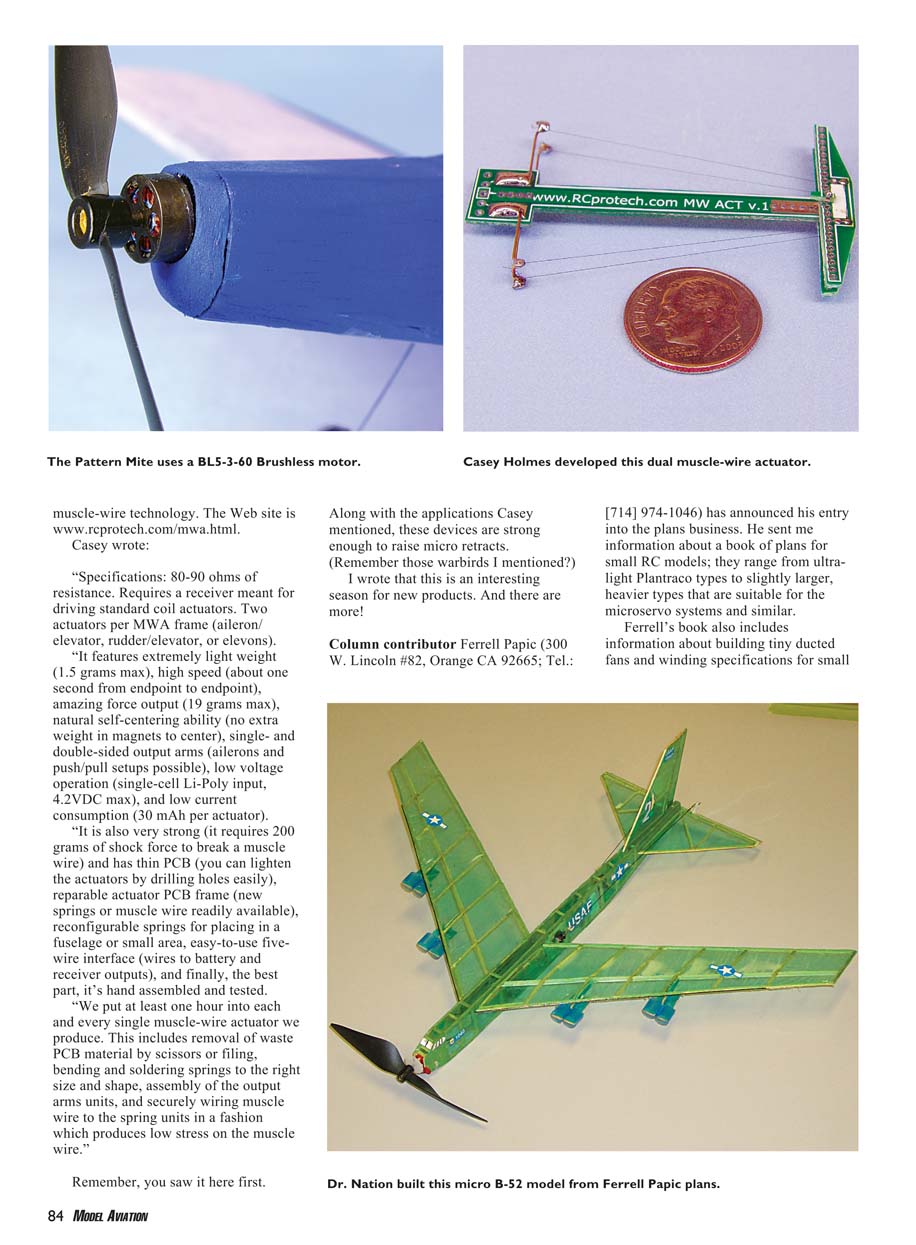
With the introduction of micro brushless motors and tiny, light servos, it is time to rethink this possibility. My current effort—the Pattern Mite—is built around the most powerful micro brushless motor available, along with three 1.7-gram servos. I am using equipment from Dynamics Unlimited (www.slowfly.com) called the Microbatics package, but other vendors, such as Bob Selman (www.bsdmicrorc.com), are selling similar equipment.
For my first effort I chose a low-wing layout with modest dihedral for smooth handling in turbulence. I am calling this little design the Pattern Mite. I do not consider it to be a finished product, but more of a work in progress.
There is much to learn about the best wing sizes, airfoils, weight-reduction techniques, and drag-reduction methods. The Pattern Mite currently has a wingspan of 17.5 inches, an area of 75 square inches, and weighs 43 grams flight ready. The current airfoil is an MA409—a relatively thin section with modest undercamber.
Although the fuselage is only slightly more than an inch wide, there is ample room for the new gear. With the light weight of the new brushless motors, I have had to rethink the model’s moments to achieve a reasonable CG.
The dual-layer BL5-3-60 motor weighs only 5 grams, yet it produces 60 grams of thrust on a 5 x 3 GWS propeller. All this power comes from a single Li-Poly cell of 300 mAh capacity. The total weight of the equipment and motor is roughly 23 grams.
At this point I can fly all the basic aerobatic maneuvers with authority and penetrate a substantial breeze. The Pattern Mite is not a “3-D”-capable model, nor do I intend it to be.
Even though I have been focusing on a small Pattern model, this same equipment could be used to fly small scale warbird-type machines or other projects that need ample thrust. The future keeps looking brighter for the world of micro.
New actuator from Casey Holmes
A talented young man named Casey Holmes (11412 Greyson Rd., Moreno Valley CA 92557) has developed a new actuator that shows great promise. The web site is www.rcprotech.com/mwa.html. Casey wrote:
Specifications and features:
- Resistance: 80–90 ohms.
- Requires a receiver meant for driving standard coil actuators.
- Two actuators per MWA frame (aileron/elevator, rudder/elevator, or elevons).
- Extremely light weight: 1.5 grams max.
- High speed: about one second from endpoint to endpoint.
- Strong force output: 19 grams max.
- Natural self-centering ability (no extra weight in magnets to center).
- Single- and double-sided output arms (ailerons and push/pull setups possible).
- Low voltage operation: single-cell Li-Poly input, 4.2 VDC max.
- Low current consumption: 30 mAh per actuator.
- Very strong: requires about 200 grams of shock force to break a muscle wire.
- Thin PCB that can be lightened by drilling holes.
- Reparable actuator PCB frame (new springs or muscle wire readily available).
- Reconfigurable springs for placing in a fuselage or small area.
- Easy-to-use five-wire interface (wires to battery and receiver outputs).
- Hand assembled and tested: at least one hour spent on each actuator (removal of waste PCB material, bending and soldering springs, assembly of output arm units, and secure wiring of muscle wire to minimize stress).
Remember—you saw it here first.
Along with the applications Casey mentioned, these devices are strong enough to raise micro retracts.
Plans and products from Ferrell Papic
Column contributor Ferrell Papic (300 W. Lincoln #82, Orange CA 92665; Tel.: [714] 974-1046) has announced his entry into the plans business. He sent information about a book of plans for small RC models; they range from ultra-light Plantraco types to slightly larger, heavier types suitable for the microservo systems and similar equipment.
Ferrell’s book also includes information about building tiny ducted fans and winding specifications for small brushless motors. The list price is $37 with $3 shipping and handling. Dealers can take a 30% discount.
Ferrell also has a line of plans for larger electric-powered RC models. A couple of photos show a B-52 with a 14-inch wingspan built by Dr. Nation from these plans. The equipment is a Plantraco system. It is refreshing to see more modelers getting involved and sharing their talents.
Sky Bug: a submicro model
A few issues ago Paul Bradley (Model Aviation’s “Small-Field Flying” columnist) included a picture of a submicro model his brother Ralph built. I was intrigued enough to contact Ralph for more details on this fascinating little airplane he calls the Sky Bug.
Ralph was kind enough to share his design with me, which sort of pushed me over the edge. I had to have one too! My version includes a few small changes to suit my flying style.
Sky Bug specifications and equipment:
- Wingspan: 6 inches.
- Weight: 5 grams total.
- Receiver: Plantraco Butterfly-style unit (no connectors).
- Motor: 6 mm, 4.5-ohm direct drive with a 1-inch carved propeller.
- Actuator: 0.6-gram unit from Balsa Products (www.balsaprc.com).
- Battery: 30 mAh Li-Poly cell from Bob Selman (www.bsdmicrorc.com).
The 6 mm motor would normally be too much of a load for the 30 mAh cell, but by using a tiny direct-drive propeller the current is low enough for safety. My version of the Sky Bug cruises at approximately half to two-thirds throttle for nearly eight minutes if I avoid excess use of higher power settings.
This type of model has worked out extremely well for me as an alternative to the Plantraco Butterfly since I do not have an indoor space large enough to fly RC models. Of course, with progress the way it is, that may change!
My Sky Bug has moderate wing loading and is not especially slow, so it can handle a bit of breeze outdoors. It is really hard to damage flying over grass, so I have gotten away with several misjudged turns and such.
Such small models may not be for everyone, but they get attention at a regular RC field where their wingspans are maybe a quarter of the length of the propellers on many popular airplanes.
Happy micro-flying, and send all the pictures of and information about those new projects to me to share with fellow modelers. It is always good to hear from manufacturers as well.
MA
Transcribed from original scans by AI. Minor OCR errors may remain.

