
Micro-Flying
Dave Robelen | [email protected]
Greetings
I am writing this in January, which in Virginia spells winter. Not having access to a regular indoor site, my flying days are limited. Naturally, I am jealous of those who have moderate weather or indoor facilities.
I have also learned that some of our equipment—especially Li-Poly cells—do not like cold weather and rapidly lose capacity under these conditions. After putting up with short, low-powered flights, I began to ponder options. Enclosing the cell in insulating material such as beaded foam helps keep the warmth (and pep) in. In some cases I gained nearly double the flight time when temperatures were in the 40s.
On March 18–19, 2006, the Kansas City Flying Circuits club in Kansas City, Missouri, is holding a two-day indoor fly-in that shows a lot of promise. More information is on the club's Web site at http://www.kcflyingcircuits.com/miff. I am making plans to go. Perhaps I will see some of you there. Good indoor flying meets are scarce and this one has potential.
Contents
- Keeping those Li-Poly batteries warm
- The Flying Circuits' two-day indoor fly-in
- Gordon Johnson's battery capacity and performance test results
- Dave reports on his Legal Eagle micro project
I mentioned the temperature issue with Li-Polys, but there is more to deal with when matching a cell to your system. Several times, in my zeal to save weight, I have chosen a cell that was too small for the job at hand.
Gordon Johnson, an established expert in the micro field, has run a series of tests on various cells to establish their capacity and performance. You can find this information at http://home.comcast.net/~gordon-johnson. These charts have been a big help to me and I thank Gordon for this effort.
Contributors
I have established several regular contributors who generously share information about their projects.
John Krouse 1124 Pipestem Pl., Rockville, MD 20854 E-mail: [email protected]
John has been developing indoor models for the 900 MHz Plantraco system. One of the photos shows John's latest design, which he describes below.
"Having built several model airplanes based on the Plantraco HFX-900 system, I decided to explore its full potential by 'going small.' I chose a wingspan of 10 inches as a practical lower limit. To reduce weight, I used the Plantraco 0.25-gram hinge actuator.
"Likewise, a direct-drive motor eliminated the weight of a gearbox and a big propeller. A 6 x 12 mm, 4.5-ohm pager motor spinning a 56 mm diameter Balsa Products yellow propeller seemed to be a good combination. Placing the motor over the wing improves crash-worthiness while incorporating manually adjustable pitch/yaw thrust angles.
"Carbon-fiber (CF) tubes are used for the LE (leading edge) and TE (trailing edge) of the center section of the wing. CF rods are inserted into the tubes to form the tips. After covering the framework with grocery-store Reynolds Wrap, the model weighed roughly 1/3 ounce. It flies on throttle and rudder controls."
Thanks for sharing, John. The innovations possible with the current equipment seem endless.
Ferrell Papic 300 W. Lincoln #82, Orange, CA 92865
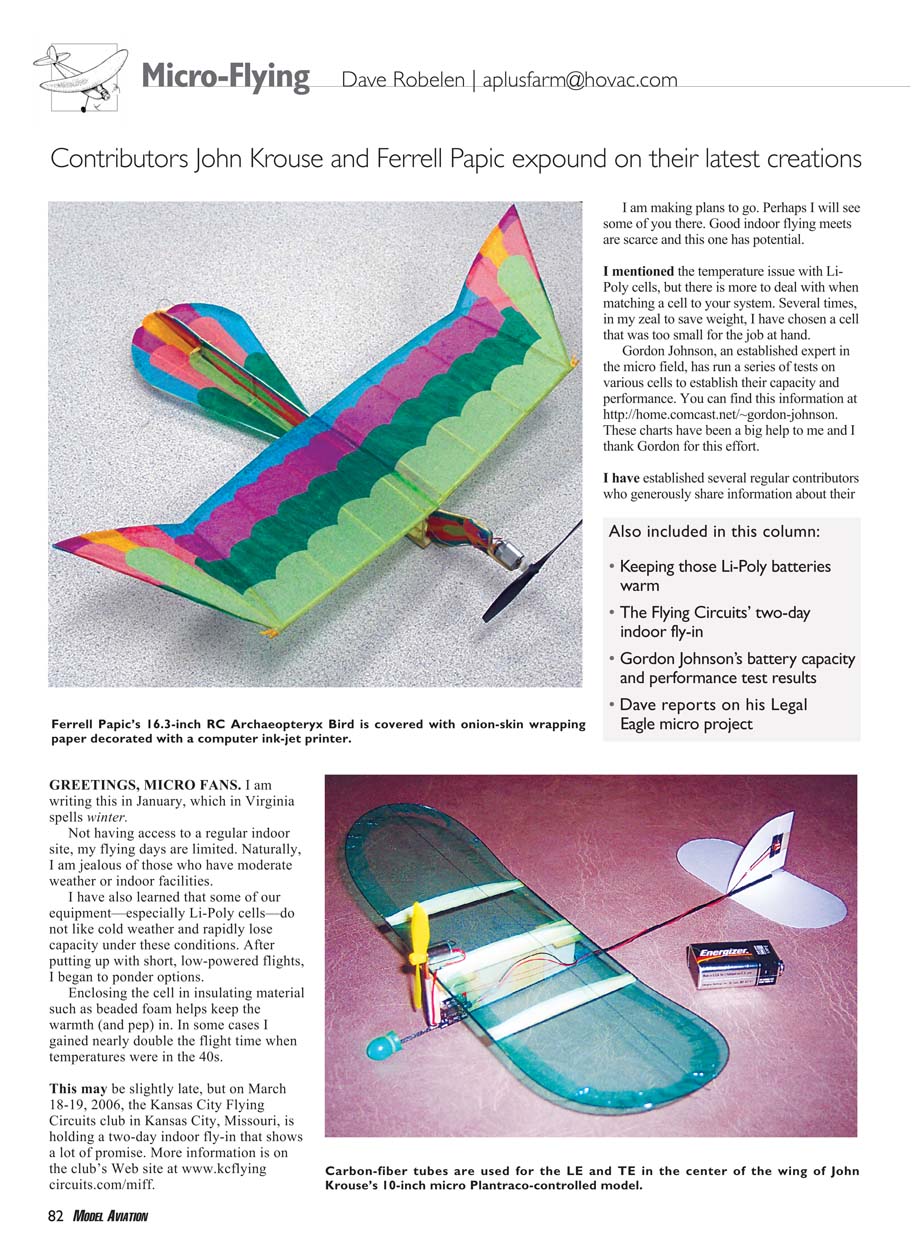
Ferrell sent information about a neat project he calls the RC Archaeopteryx Bird:
"The RC Archaeopteryx Bird was created with 1/32-inch balsa and .03-inch and .04-inch-diameter bamboo sticks made with a steel drawplate, which is used to fabricate model ship parts.
"The aircraft is covered with onion-skin wrapping paper that is decorated with a computer ink-jet printer. The water-based ink is secured with spray fix. The covering is attached to the frame with a mix of 50% clear-drying 560 latex glue and 50% water.
"Power is a KP-00 or geared N-20 motor. The radio control system is a two- or three-channel Micro-Joule. The battery is a one- or two-cell 170 mAh Li-Poly. The 16.3-inch-wingspan model could be controlled with a small Plantraco RC system. I have flown the airplane in a gymnasium and outdoors on calm mornings with success."
Ferrell is offering full-size building plans for a 23-inch-wingspan version and the 16.3-inch-wingspan model on one D-sized plans sheet for $13 in the United States. For a catalog of other plans and a plans book, send him an SASE.
Micro-Flying - 2006/05
I have been building my own micro projects, one of which is a model of an ultralight aircraft called the Legal Eagle, designed and built by Leonard Millholland. Leonard developed the two-cylinder engine from Volkswagen parts. He calls this the Better Half. To follow up on the full-scale projects, check the Web site http://www.usastores.com/betterhalf/.
My model was developed from small rubber-powered free-flight plans included in the Central New York Indoor Flying Society Thermals newsletter published by Hal Stewart. The outlines are the same, but I went with a different size and altered the structure for RC.
My version uses the Plantraco HFX-900 system, has a 15.5-inch wingspan, and weighs 0.5 ounce. The framework is all balsa and the wing and tail are covered with Risteen Associates Microlite (available from http://www.homefly.com).
The little Legal Eagle certainly has established the ability of the Plantraco equipment to fly scale models. It is peppy enough to rise off the ground, climb at a brisk rate, and cruise at 60% power. The flight characteristics are similar to those of a trainer with a circle diameter of approximately 10 feet.
It is great fun on those pretty evenings when the winds are light—or for you lucky modelers with an indoor site. Look for this design to be published in Model Airplane News.
Dynamics Unlimited microreceiver
I have been working with a piece of equipment that impresses me: the microreceiver from Dynamics Unlimited (http://www.smallrc.com). The current version has been upgraded to narrow band while retaining extremely light weight and small size.
The neat thing about this receiver is its flexibility. You can purchase the basic receiver and decoder, and it will drive a brushed motor and operate magnetic actuators. It is compatible with the micro brushless-motor controller shown in the picture, and with the installation of a plug-in board it will drive servos as well. All this on a single Li-Poly cell!
My experience with this equipment has been extremely positive, and the people at Dynamics Unlimited stand behind their products.
Big P-Nut
My final offering for this month is not exactly a micro-size model, but it has its roots in one. It's a direct enlargement of an earlier micro design. The picture shows the Big P-Nut: a project developed to make the most of a GWS LPS DXA drive. The wing is cut from pink insulation foam to an MA409 airfoil, while the rest of the model is built from 1/16-inch balsa.
With a couple of standard microservos; a 40 mAh, 7.2-volt Li-Poly pack; and a small Berg receiver, the final weight is 4.3 ounces. Just for kicks I carved a propeller to try to bump the top speed up slightly—and it worked!
This baby is almost scary fast, and it will perform any maneuver in the basic aerobatic pattern with a nice, clean roll motion.
Now that I have seen the potential, it is time to go back and fit the original micro with one of the miniature brushless motors. When it comes to the ability of a model to perform clean rolling maneuvers without ailerons, try to keep an open mind—because it really can be done.
As always, I enjoy your sharing pictures and information about your projects, and manufacturers are welcome to share information about new products.
Transcribed from original scans by AI. Minor OCR errors may remain.

