
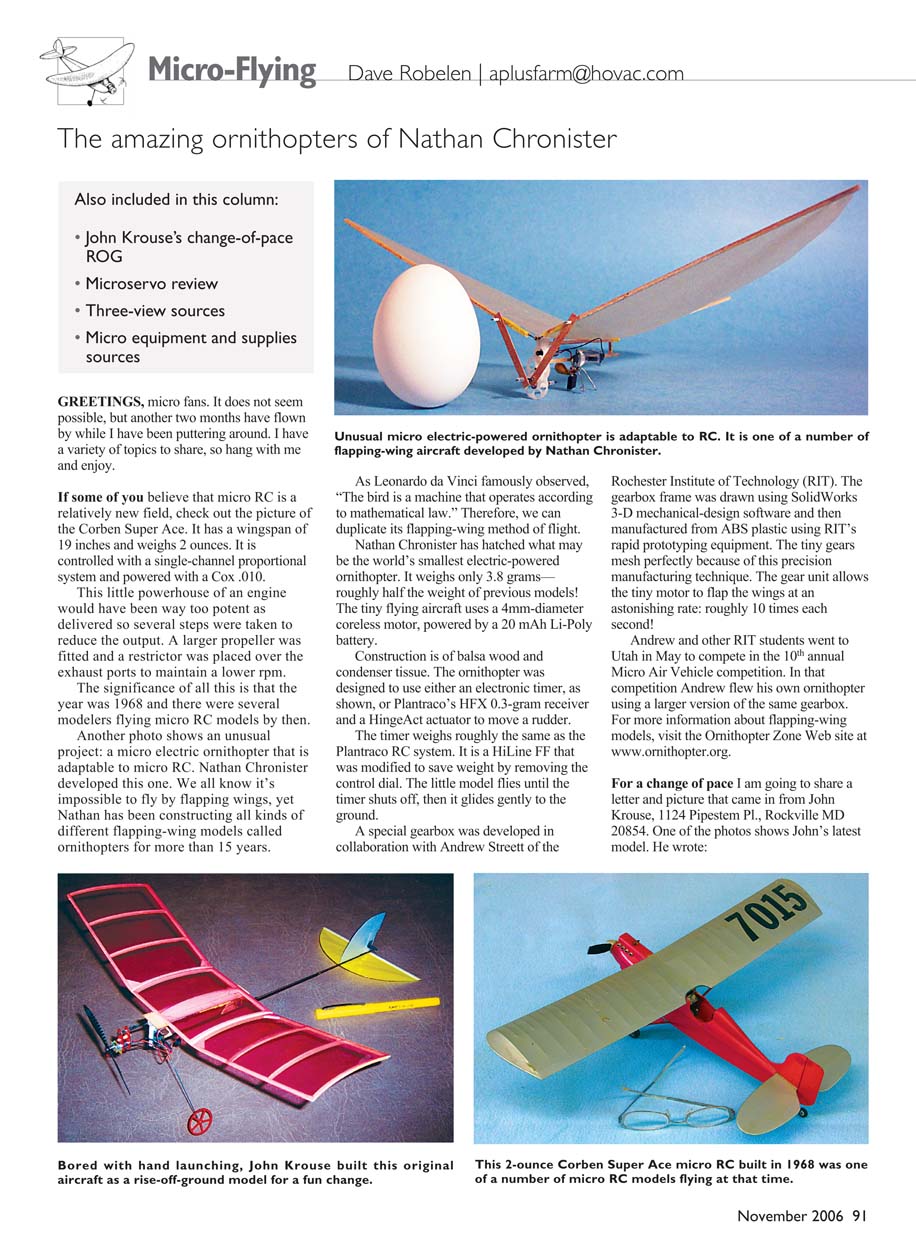
The amazing ornithopters of Nathan Chronister
Dave Robelen | [email protected]
Introduction
Greetings, micro fans. It does not seem possible, but another two months have flown by while I have been puttering around. I have a variety of topics to share, so hang with me and enjoy.
A brief history: Corben Super Ace (1968)
If some of you believe that micro RC is a relatively new field, check out the picture of the Corben Super Ace. It has a wingspan of 19 inches and weighs 2 ounces. It is controlled with a single-channel proportional system and powered with a Cox .010.
This little powerhouse of an engine would have been way too potent as delivered, so several steps were taken to reduce the output. A larger propeller was fitted and a restrictor was placed over the exhaust ports to maintain a lower rpm.
The significance of all this is that the year was 1968 and there were several modelers flying micro RC models by then.
Nathan Chronister's micro electric ornithopter
Background
Another photo shows an unusual project: a micro electric ornithopter that is adaptable to micro RC. Nathan Chronister developed this one. We all know it's challenging to fly by flapping wings, yet Nathan has been constructing all kinds of different flapping-wing models called ornithopters for more than 15 years.
As Leonardo da Vinci famously observed, "The bird is a machine that operates according to mathematical law." Therefore, we can duplicate its flapping-wing method of flight.
Design and construction
Nathan Chronister has hatched what may be the world's smallest electric-powered ornithopter. It weighs only 3.8 grams—roughly half the weight of previous models. The tiny flying aircraft uses a 4 mm-diameter coreless motor, powered by a 20 mAh Li-Poly battery.
Construction is of balsa wood and condenser tissue. The ornithopter was designed to use either an electronic timer or Plantraco's HFX 0.3-gram receiver and a HingeAct actuator to move a rudder. The timer weighs roughly the same as the Plantraco RC system. It is a HiLine FF that was modified to save weight by removing the control dial. The little model flies until the timer shuts off, then it glides gently to the ground.
Powertrain and gearbox
A special gearbox was developed in collaboration with Andrew Streett of the Rochester Institute of Technology (RIT). The gearbox frame was drawn using SolidWorks 3-D mechanical-design software and then manufactured from ABS plastic using RIT's rapid prototyping equipment. The tiny gears mesh perfectly because of this precision manufacturing technique. The gear unit allows the tiny motor to flap the wings at an astonishing rate: roughly 10 times each second.
RIT competition and further information
Andrew and other RIT students went to Utah in May to compete in the 10th annual Micro Air Vehicle competition. In that competition Andrew flew his own ornithopter using a larger version of the same gearbox.
For more information about flapping-wing models, visit the Ornithopter Zone website at www.ornithopter.org.
John Krouse: indoor ultralight ROG model
For a change of pace I am going to share a letter and picture that came in from John Krouse, 1124 Pipestem Pl., Rockville MD 20854. One of the photos shows John's latest model. He wrote:
"I thought you might be interested in my indoor ultralight RC model controlled by the latest Micro Invent Minor receiver, available from Bob Selman at BSD Micro RC (www.bsdmicrorc.com) or www.airmidmicros.com. I was becoming bored with hand launching, so I thought an ROG (rise-off-ground) design would be a fun change. Larry Park makes the carbon-fiber landing gear and laser-cut plywood wheels available through www.roomflight.com."
Construction
The wing construction is fairly conventional: 3/32 square balsa leading edge, trailing edge, and ribs, held together with Titebond glue, and Reynolds Wrap for covering. The horizontal tail is formed by bending a piece of 0.3 mm carbon-fiber rod into a semicircular shape and secured at the tips with a 1/8-inch-wide strip of stiff 1/32 balsa bonded with cyanoacrylate. The covering is 5-micron RA Microlite.
The drive train consists of a 6 x 12 mm, 4.5-ohm (green) pager motor coupled to a Gasparin 3.2:1 reduction gearbox, spinning a 3.2-inch carbon-fiber propeller (Microinvent MCF 3222)—all powered by a single 60 mAh Li-Poly cell. The components are from BSD Micro RC. Lift for the 16-gram model comes from a 3.75 x 12.5-inch, single-surface, cambered wing.
Based on the successful flying characteristics (and experience with previous models), the throttle and rudder controls (no elevator/ailerons) seemed adequate for all but 3-D aerobatic maneuvers, minus the additional weight."
Thanks for sharing, John. There is plenty of original activity in the micro field.
Microservos: a brief review
I thought it might be a good idea to review some of the microservos available to us that are truly micro in their weights. One of the pictures shows three that I have had experience with and can recommend.
- Falcon servo — 1.6 grams. Available from BSD Micro RC. The unit in the picture is an earlier model; check the company's website for the most current one.
- Gasparin GD — 1.3 grams, the lightest of the group. It has no cable or plug. It can be found at the Didel website (www.didel.com).
- Lightning servo — sold by Dynamics Unlimited. Slightly more rugged and furnished with a cable and JST connector to mate with current narrow-band receivers.
Another possibility for this group is the Breeze: a modular unit made by Falcon that contains two servos and a microreceiver in one case. It is available from BSD Micro RC.
Scratch-building challenge: Quaker FF replica
It is time to toss out a challenge for more of you to get involved in scratch building a micro RC model. Check out the photo that shows the beginnings of my latest project—a miniature replica of the Quaker FF model from the 1930s.
There is a limit to the number of micro designs currently available, but you can do something about that! In my case, the Quaker was enlarged from a small three-view in a Frank Zaic Year Book from the 1930s. These books are a treasure trove of designs and can be purchased from the AMA. Go to www.modelaircraft.org and click on the Webstore tab.
If scale models are your thing, there is a website that compiles a vast quantity of model plans and three-views: www.simaviation.com/designresources.htm.
Nearly all the three-views and drawings you come across will be a different size from what you want to build. The solution is the modern copy shop (Kinko's in my area), where drawings may be enlarged or reduced to the desired size.
As for structure, many of my small-scale models are all balsa—generally 1/32 sheet. If a full-bodied project seems too much at first, why not build it as a profile? That has worked well for others.
There are probably some of you holding back because of a lack of information or intimidation by the process. Go ahead and take the plunge! The materials are certainly cheap and the models are damage resistant. Meanwhile, remember to send me a picture of your new creation.
Acknowledgements — dealers and suppliers
I want to acknowledge some of the dealers in micro equipment and supplies that have served me well through the years. Many of these are family businesses and the service is excellent. There is no significance to the order of listing.
- Bob Selman Designs — www.bsdmicrorc.com
An extensive line of equipment, accessories, and models.
- Sky Hooks and Rigging — http://skyhooks.ca
A full line of equipment, accessories, and models.
- Plantraco — www.plantraco.com
Home of the 900 MHz micro equipment, the Butterfly ARF living-room flyer, and much more.
- BP Hobbies LLC — www.bphobbies.com
Micro RC equipment, accessories, and models.
- Dave Lewis — www.homefly.com
An extensive line of supplies, materials, and some equipment.
Til next time. MA
Transcribed from original scans by AI. Minor OCR errors may remain.

