
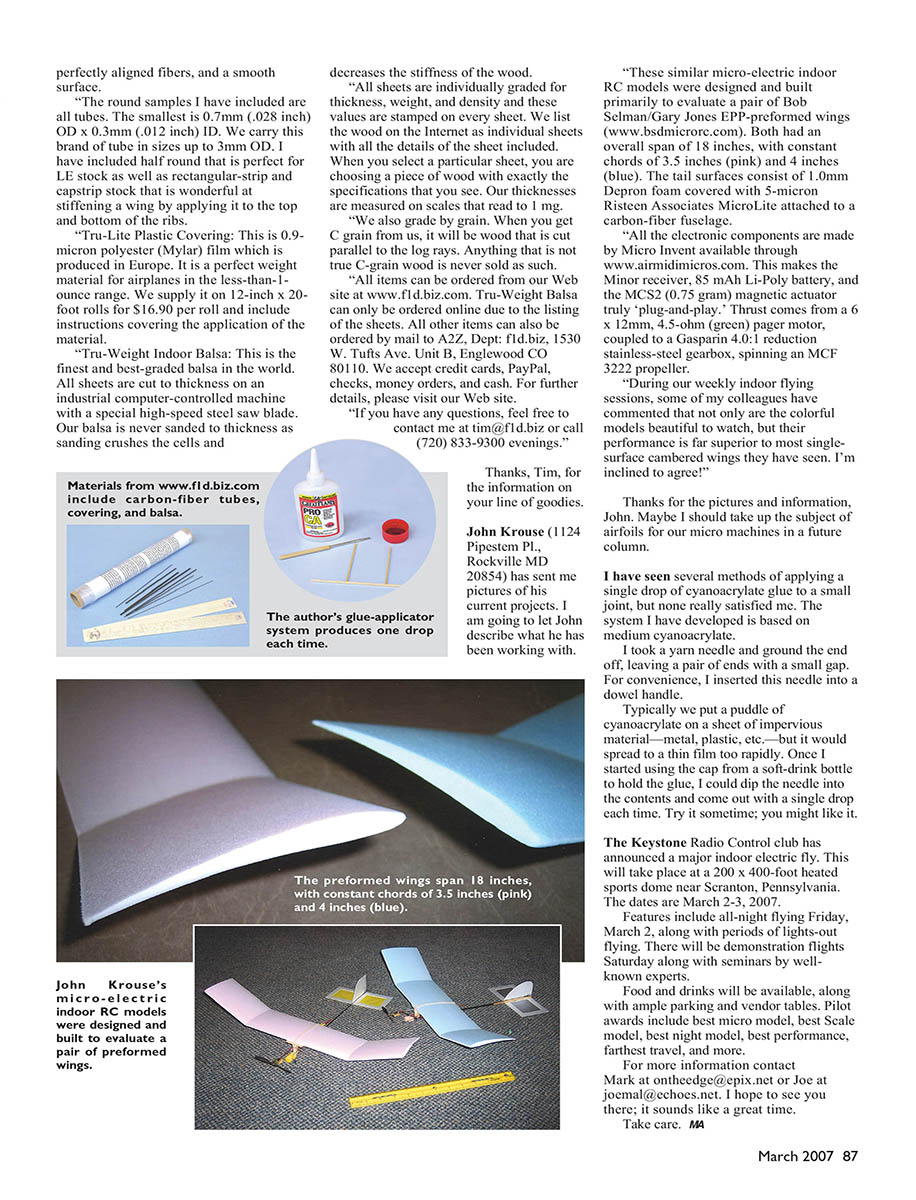
A look at Plantraco's Carbon Butterfly
My first encounter with the new Plantraco (www.plantraco.com) Carbon Butterfly began when I opened a hefty package and found a handsome piece of aluminum luggage. A tooled finish, reinforced corners, and locks all spoke of quality. Inside the case the items were well organized and protected.
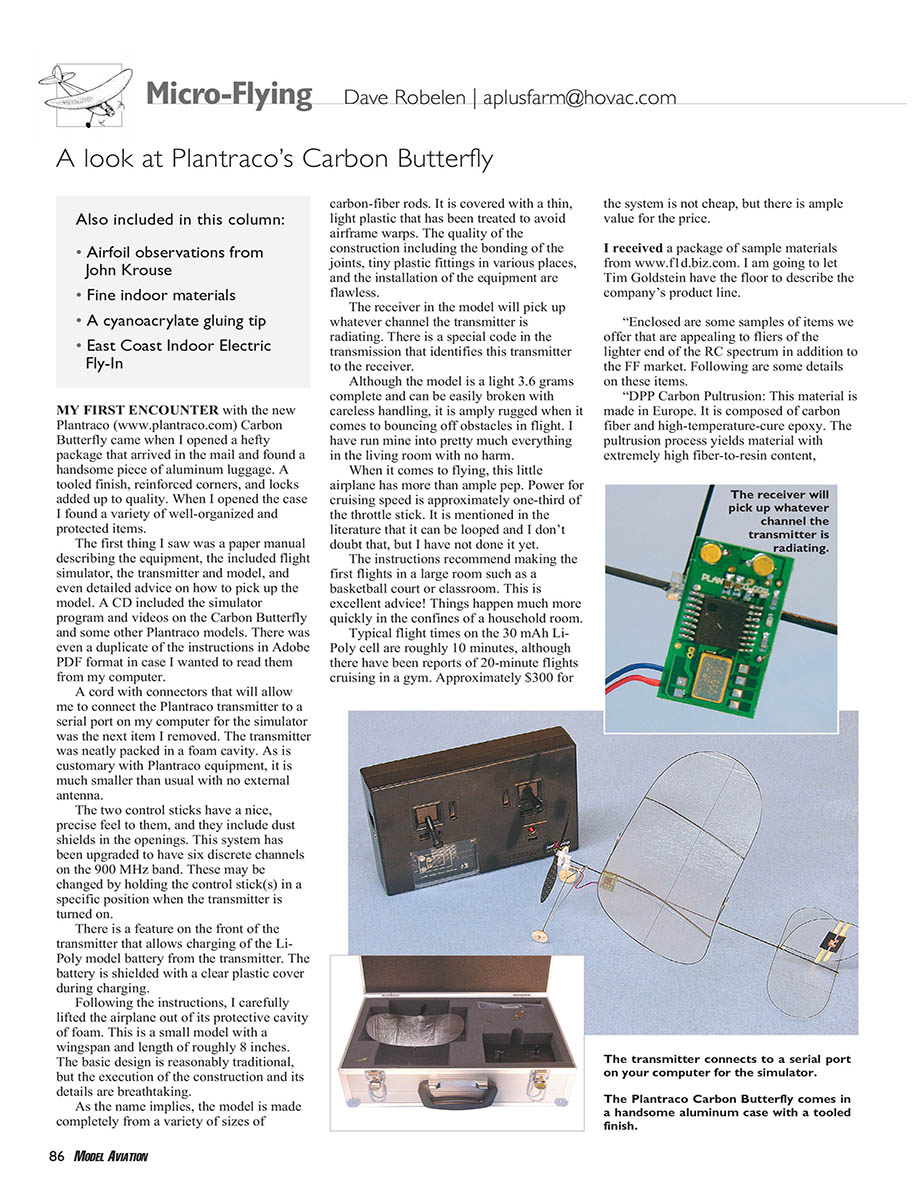
The first thing I saw was a paper manual describing the equipment, the included flight simulator, the transmitter and model, and even detailed advice on how to pick up the model. A CD included the simulator program and videos on the Carbon Butterfly and some other Plantraco models. There was also a duplicate of the instructions in Adobe PDF format for reading on a computer. A cord with connectors to allow connection of the Plantraco transmitter to a serial port on a computer for the simulator was next. The transmitter was neatly packed in a foam cavity. As is customary with Plantraco equipment, it is smaller than usual and has no external antenna.
The two control sticks have a nice, precise feel and include dust shields in the openings. This system has been upgraded to six discrete channels on the 900 MHz band. Channels may be changed by holding the control stick(s) in a specific position when the transmitter is turned on. A front-panel feature allows charging of the Li-Poly model battery from the transmitter; the battery is shielded with a clear plastic cover during charging.
Following the instructions, I carefully lifted the airplane out of its foam cavity. This is a small model with a wingspan and length of roughly 8 inches. The basic design is reasonably traditional, but the execution and detailing are breathtaking. As the name implies, the model is made completely from a variety of sizes of carbon-fiber rods and is covered with a thin, light plastic treated to avoid airframe warps. The construction quality — bonding of joints, tiny plastic fittings, and equipment installation — is flawless.
The receiver in the model picks up whatever channel the transmitter is radiating and recognizes the transmitter by a special identification code in the transmission. Although the model is a light 3.6 grams complete and can be easily broken with careless handling, it is amply rugged for bouncing off obstacles in flight. I have run mine into pretty much everything in the living room with no harm.
When it comes to flying, this little airplane has more than ample pep. Power for cruising speed is approximately one-third throttle. The literature mentions it can be looped — I don't doubt that, though I have not tried it yet. The instructions recommend making the first flights in a large room such as a basketball court or classroom. This is excellent advice — things happen much more quickly in the confines of a household room. Typical flight times on the 30 mAh Li-Poly cell are roughly 10 minutes, although there have been reports of 20-minute flights when cruising in a gym. The system is approximately $300 — not cheap, but there is ample value for the price.
F1D product samples
I received a package of sample materials from www.f1d.biz. Below is Tim Goldstein's description of the company's product line.
DPP Carbon Pultrusion
- Made in Europe from carbon fiber and high-temperature-cure epoxy.
- The pultrusion process yields material with extremely high fiber-to-resin content, perfectly aligned fibers, and a smooth surface.
- Round tube samples included range from 0.7 mm (0.028 inch) OD x 0.3 mm (0.012 inch) ID up to sizes as large as 3 mm OD.
- Half-round pieces are perfect for leading-edge stock; rectangular strip and capstrip stock are excellent for stiffening wings when applied to the top and bottom of ribs.
Tru-Lite Plastic Covering
- 0.9-micron polyester (Mylar) film produced in Europe.
- A perfect-weight material for airplanes in the less-than-1-ounce range.
- Supplied on 12-inch x 20-foot rolls for $16.90 per roll; instructions for application are included.
Tru-Weight Indoor Balsa
- Described as the finest and best-graded balsa in the world.
- Sheets are cut to thickness on an industrial computer-controlled machine with a special high-speed steel saw blade; wood is never sanded to thickness, as sanding crushes the cells and decreases stiffness.
- All sheets are individually graded for thickness, weight, and density; these values are stamped on every sheet.
- Sheets are listed on the Internet with full details so you choose the exact piece you want. Thicknesses are measured on scales reading to 1 mg.
- Grain is also graded; true C-grain wood (cut parallel to the log rays) is sold only as C-grain.
Ordering and contact
- All items can be ordered from the website: www.f1d.biz.
- Tru-Weight Balsa can only be ordered online due to the individual-sheet listings.
- Other items can also be ordered by mail to: A2Z, Dept: f1d.biz, 1530 W. Tufts Ave., Unit B, Englewood, CO 80110.
- Payment accepted: credit cards, PayPal, checks, money orders, and cash.
- For further details or questions contact Tim at [email protected] or call (720) 833-9300 (evenings).
Thanks, Tim, for the information on your line of goodies.
Reader projects: John Krouse
John Krouse (1124 Pipestem Pl., Rockville MD 20854) sent pictures of his current projects. He describes them as follows.
These similar micro-electric indoor RC models were designed and built primarily to evaluate a pair of Bob Selman/Gary Jones EPF-preformed wings (www.bsdmicrorc.com). Both models had an overall span of 18 inches, with constant chords of 3.5 inches (pink) and 4 inches (blue). Tail surfaces consist of 1.0 mm Depron foam covered with 5-micron Ristean Associates MicroLicro, attached to a carbon-fiber fuselage.
All electronic components are made by Micro Invent and available through www.airmidimicros.com. This makes the Minor receiver, 85 mAh Li-Poly battery, and the MCS2 (0.75 gram) magnetic actuator truly "plug-and-play." Thrust comes from a 6 x 12 mm, 4.5-ohm (green) pager motor, coupled to a Gasparin 4.0:1 reduction stainless-steel gearbox, spinning an MCF 3222 propeller.
During weekly indoor flying sessions, colleagues commented that not only are the colorful models beautiful to watch, but their performance is far superior to most single-surface cambered wings they have seen. I’m inclined to agree!
Thanks for the pictures and information, John. Maybe I should take up the subject of airfoils for our micro machines in a future column.
DIY tip: single-drop CA applicator
I have seen several methods of applying a single drop of cyanoacrylate (CA) glue to a small joint, but none really satisfied me. The system I developed is based on medium CA.
- Take a yarn needle and grind the end off, leaving a pair of prongs with a small gap.
- Insert the needle into a dowel handle for convenience.
- Instead of putting a puddle of CA on a sheet of impervious material (where it can spread to a thin film), use the cap from a soft-drink bottle to hold the glue.
- Dip the needle prongs into the cap and come out with a single drop each time.
Try it sometime; you might like it.
Keystone Radio Control Club — indoor electric fly
The Keystone Radio Control Club has announced a major indoor electric fly taking place at a 200 x 400-foot heated sports dome near Scranton, Pennsylvania. Dates: March 2–3, 2007.
Features include:
- All-night flying Friday, March 2, including periods of lights-out flying.
- Demonstration flights Saturday and seminars by well-known experts.
- Food and drinks, ample parking, and vendor tables.
- Pilot awards: best micro model, best scale model, best night model, best performance, farthest travel, and more.
For more information contact:
- Mark: [email protected]
- Joe: [email protected]
I hope to see you there; it sounds like a great time.
Take care.
MA
Transcribed from original scans by AI. Minor OCR errors may remain.

