
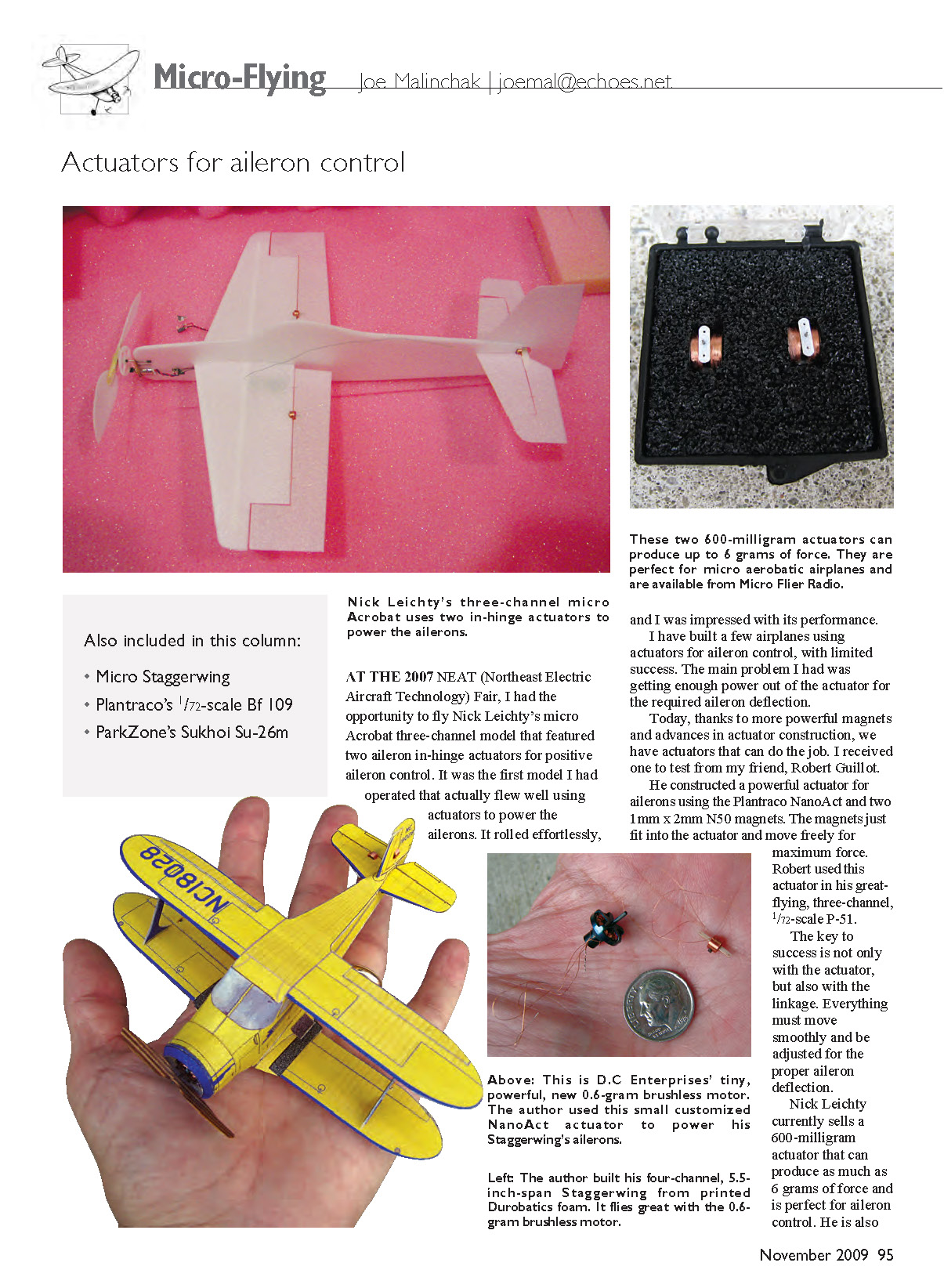
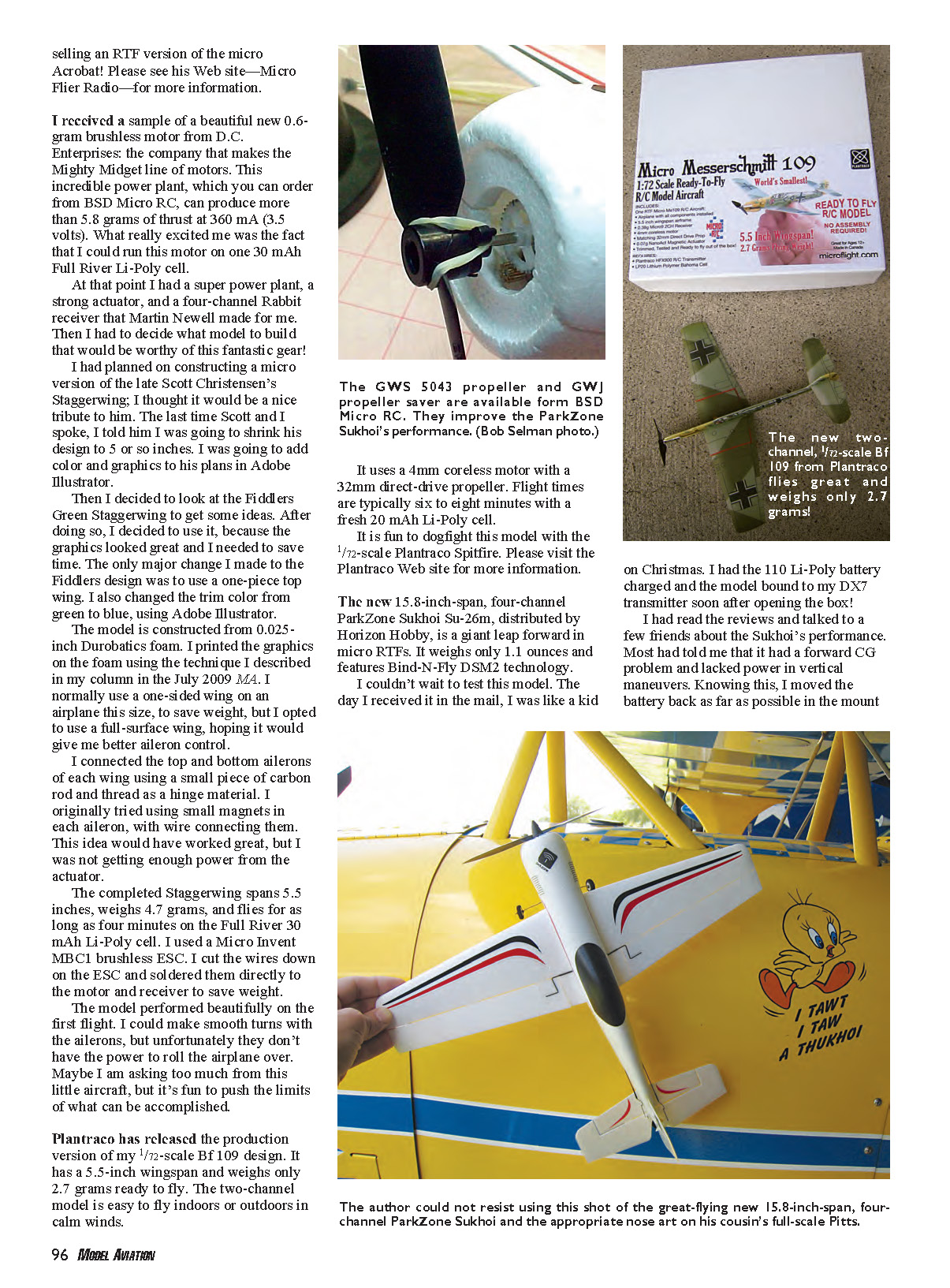
Actuators for aileron control
I was impressed with its performance.
I have built a few airplanes using actuators for aileron control, with limited success. The main problem I had was getting enough power out of the actuator for the required aileron deflection. Today, thanks to more powerful magnets and advances in actuator construction, we have actuators that can do the job.
Actuator development and testing
I received an actuator to test from my friend Robert Guillot. He constructed a powerful actuator for ailerons using the Plantraco NanoAct and two 1 mm × 2 mm N50 magnets. The magnets just fit into the actuator and move freely for maximum force. Robert used this actuator in his great-flying, three-channel, 1/72-scale P-51.
The key to success is not only the actuator but also the linkage. Everything must move smoothly and be adjusted for the proper aileron deflection.
Nick Leichty currently sells a 600-milligram actuator that can produce as much as 6 grams of force and is perfect for aileron control. He is also selling an RTF version of the micro Acrobat. Please see his website—Micro Flier Radio—for more information.
I also received a sample of a beautiful new 0.6-gram brushless motor from D.C. Enterprises, the company that makes the Mighty Midget line of motors. This power plant, which you can order from BSD Micro RC, can produce more than 5.8 grams of thrust at 360 mA (3.5 volts). What excited me was that I could run this motor on one 30 mAh Full River Li-Poly cell. At that point I had a super power plant, a strong actuator, and a four-channel Rabbit receiver that Martin Newell made for me.
Building the micro Staggerwing
I had planned to construct a micro version of the late Scott Christensen’s Staggerwing as a tribute. I intended to shrink his design to about 5 inches and add color and graphics in Adobe Illustrator. After looking at the Fiddlers Green Staggerwing for ideas, I decided to use its graphics and save time. The only major change I made to the Fiddlers design was to use a one-piece top wing. I also changed the trim color from green to blue in Adobe Illustrator.
The model is constructed from 0.025-inch Durobatics foam. I printed the graphics on the foam using the technique I described in my July 2009 column. I normally use a one-sided wing on an airplane this size to save weight, but I opted for a full-surface wing, hoping it would give better aileron control. I connected the top and bottom ailerons of each wing using a small piece of carbon rod and thread as hinge material. I originally tried using small magnets in each aileron, with wire connecting them. This idea would have worked great, but I was not getting enough power from the actuator.
The completed Staggerwing spans 5.5 inches, weighs 4.7 grams, and flies for as long as four minutes on the Full River 30 mAh Li-Poly cell. I used a Micro Invent MBC1 brushless ESC. I cut the wires down on the ESC and soldered them directly to the motor and receiver to save weight.
- Key components:
- 0.6 g brushless motor (Mighty Midget line)
- 30 mAh Full River Li-Poly cell
- Plantraco NanoAct-based actuator with N50 magnets
- Micro Invent MBC1 brushless ESC
- Four-channel Rabbit receiver
The model performed beautifully on the first flight. I could make smooth turns with the ailerons, but they didn't have the power to roll the airplane over. Maybe I was asking too much of this little aircraft, but it's fun to push the limits of what can be accomplished.
Plantraco 1/72-scale Bf 109
Plantraco has released the production version of my 1/72-scale Bf 109 design. It has a 5.5-inch wingspan and weighs only 2.7 grams ready to fly. The two-channel model is easy to fly indoors or outdoors in calm winds.
- Features:
- 4 mm coreless motor with a 32 mm direct-drive propeller
- Flight times typically six to eight minutes with a fresh 20 mAh Li-Poly cell
It is fun to dogfight this model with the 1/72-scale Plantraco Spitfire. Please visit the Plantraco website for more information.
ParkZone Sukhoi Su-26m
The new 15.8-inch-span, four-channel ParkZone Sukhoi Su-26m, distributed by Horizon Hobby, is a giant leap forward in micro RTFs. It weighs only 1.1 ounces and features Bind-N-Fly DSM2 technology.
I couldn't wait to test this model. The day I received it I was like a kid on Christmas. I had the 110 mAh Li-Poly battery charged and the model bound to my DX7 transmitter soon after opening the box.
I had read reviews and talked to a few friends about the Sukhoi's performance. Most had told me it had a forward CG problem and lacked power in vertical maneuvers. Knowing this, I moved the battery back as far as possible in the mount and test flew the model. After moving the battery back, it flew fantastic. The plane has plenty of vertical performance and will do aggressive 3D maneuvers. It tracks very accurately and is extremely stable. It also lands very well.
I found the model's recommended control throws to be a bit too much, but a small amount of exponential made it very enjoyable to fly. The power system is efficient and gave me about seven to nine minutes of flight time.
The ParkZone Sukhoi is a great micro RTF. It is ready to fly and has excellent construction and finish. If you want a fun, high-performance micro that works right out of the box, this is it.
Transcribed from original scans by AI. Minor OCR errors may remain.

