
Cartoon-scale Sopwith Camel
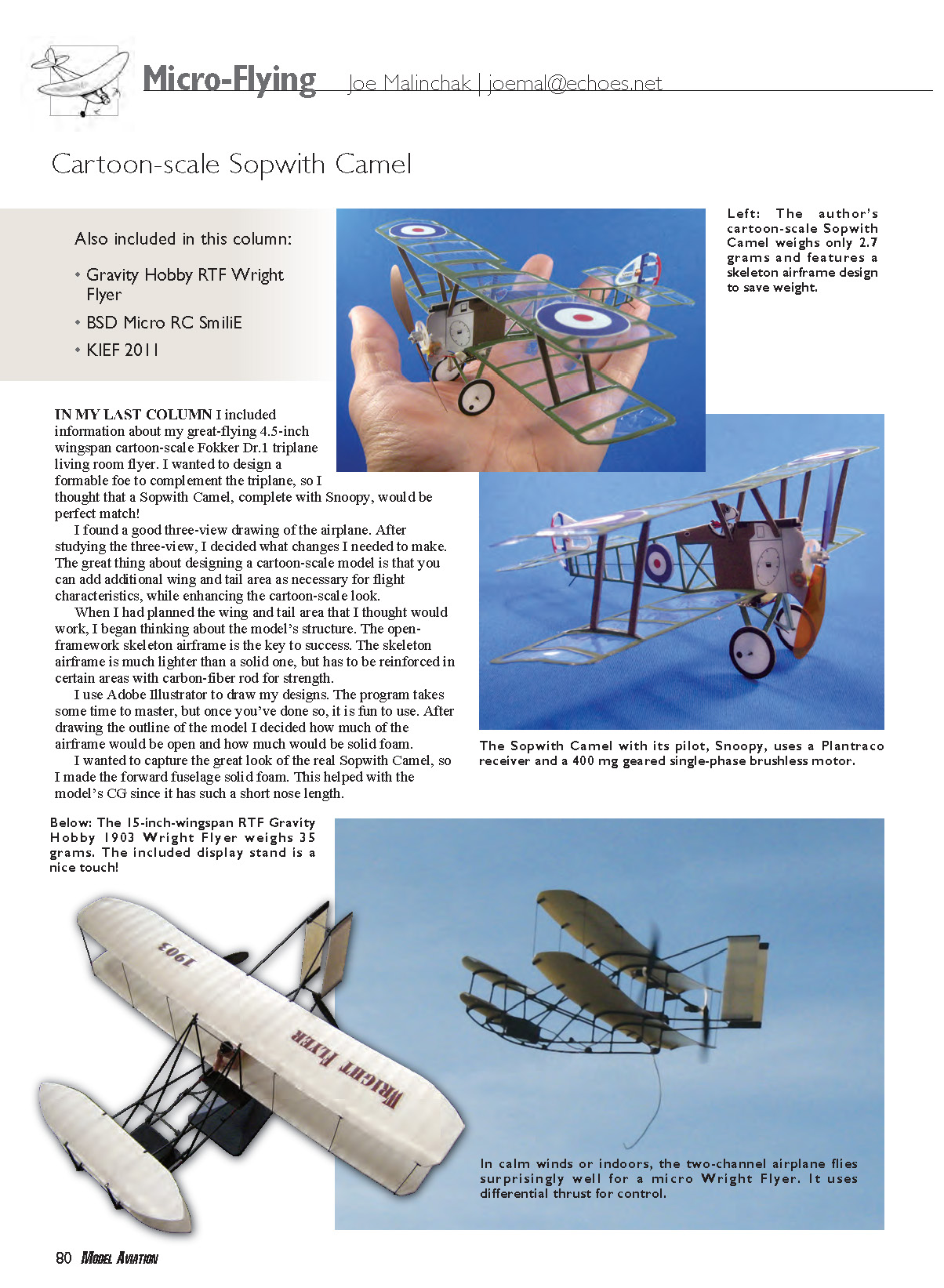
In my last column I included information about my great-flying 4.5-inch wingspan cartoon-scale Fokker Dr.1 triplane living-room flyer. I wanted to design a formidable foe to complement the triplane, so I thought that a Sopwith Camel, complete with Snoopy, would be a perfect match!
Design and structure
I found a good three-view drawing of the airplane. After studying the three-view, I decided what changes I needed to make. The great thing about designing a cartoon-scale model is that you can add additional wing and tail area as necessary for flight characteristics while enhancing the cartoon-scale look.
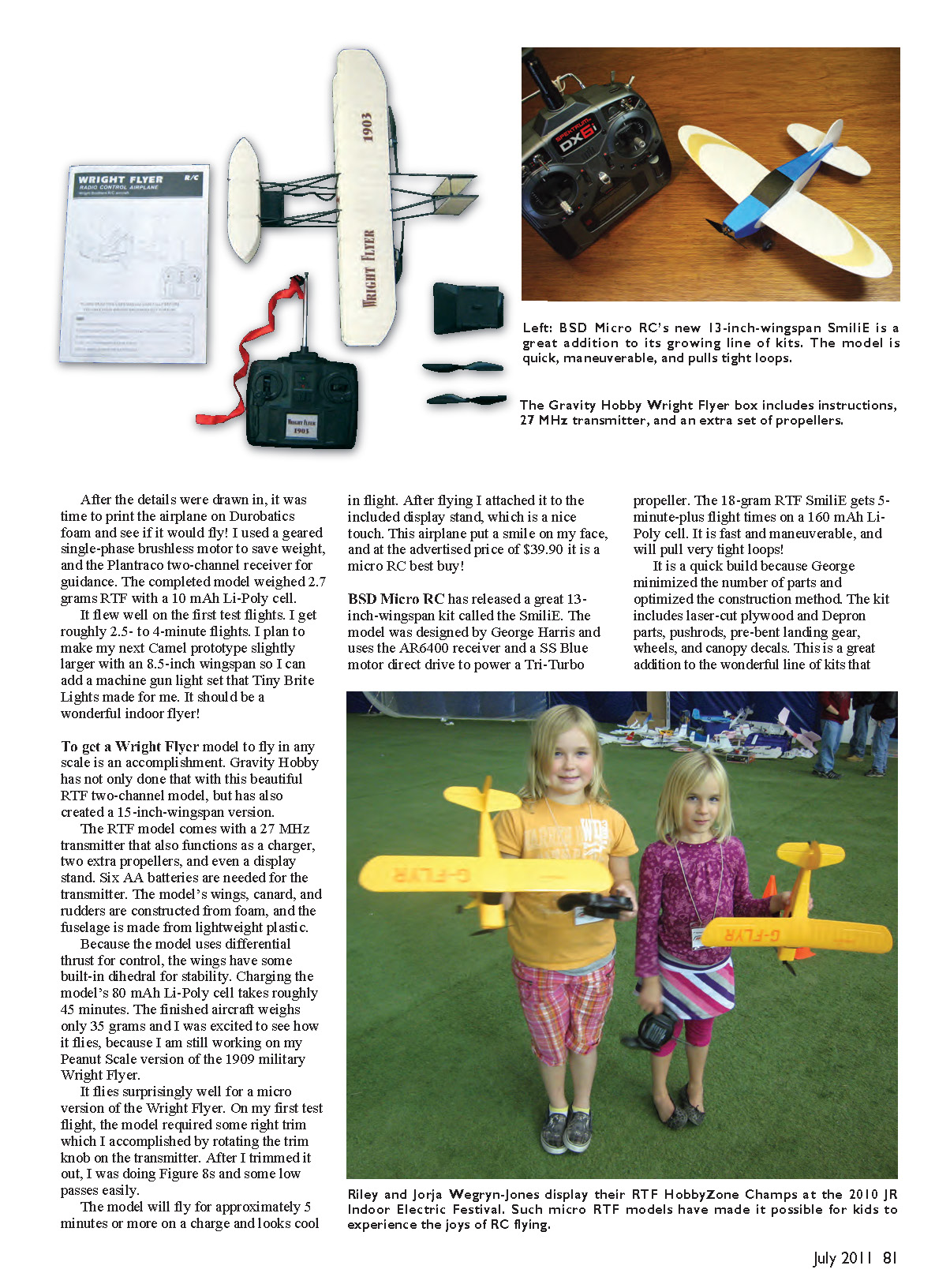
When I had planned the wing and tail area that I thought would work, I began thinking about the model’s structure. The open-framework skeleton airframe is the key to success. The skeleton airframe is much lighter than a solid one but has to be reinforced in certain areas with carbon-fiber rod for strength.
I use Adobe Illustrator to draw my designs. The program takes some time to master, but once you’ve done so, it is fun to use. After drawing the outline of the model I decided how much of the airframe would be open and how much would be solid foam.
I wanted to capture the great look of the real Sopwith Camel, so I made the forward fuselage solid foam. This helped with the model’s center of gravity since it has such a short nose length.
Power and flight
After the details were drawn in, it was time to print the airplane on Durobatics foam and see if it would fly! I used a geared single-phase brushless motor to save weight, and the Plantraco two-channel receiver for guidance. The completed model weighed 2.7 grams RTF with a 10 mAh Li-Poly cell.
It flew well on the first test flights. I get roughly 2.5- to 4-minute flights. I plan to make my next Camel prototype slightly larger with an 8.5-inch wingspan so I can add a machine-gun light set that Tiny Brite Lights made for me. It should be a wonderful indoor flyer!
Wright Flyer (micro RTF model)
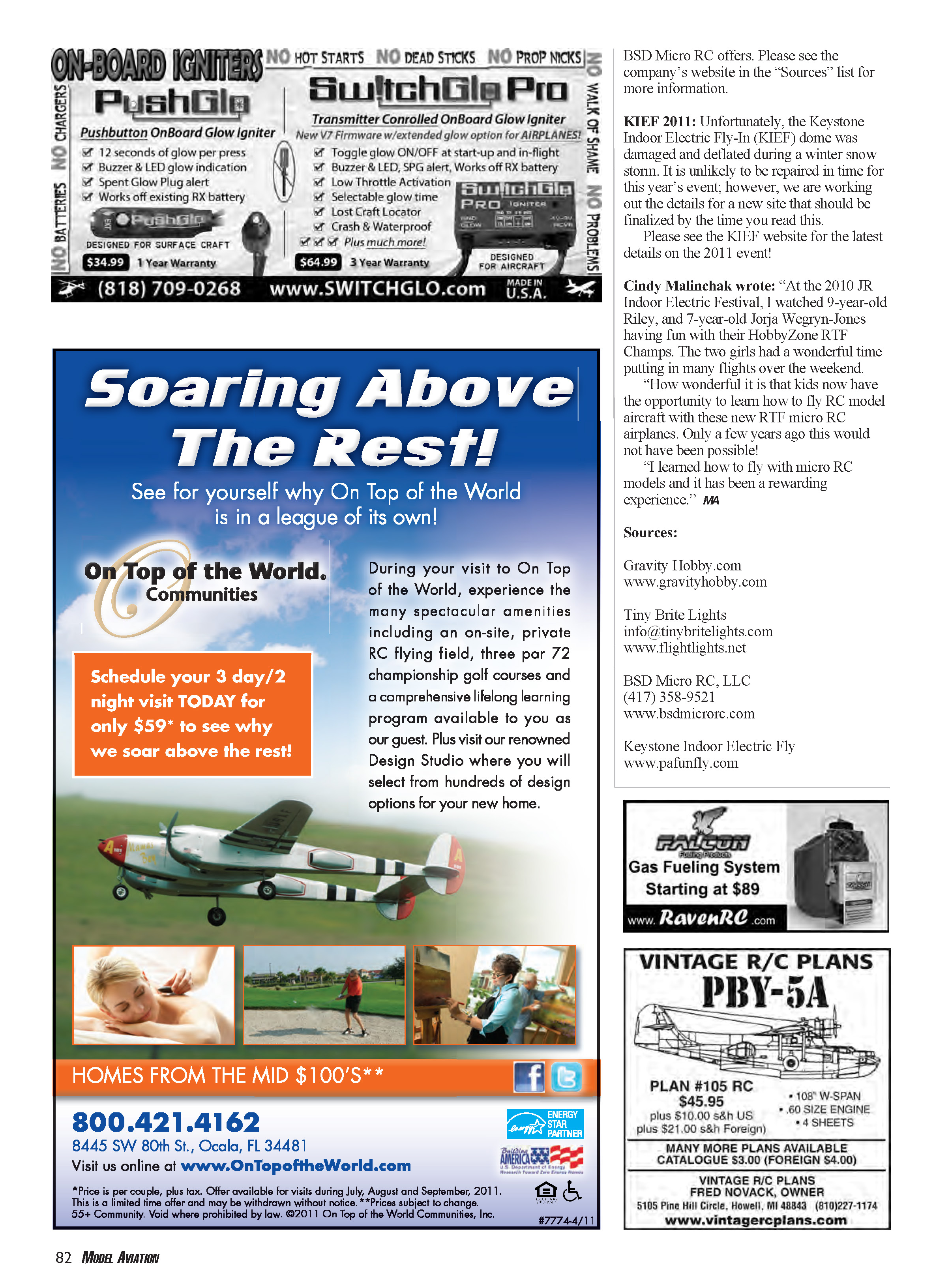
To get a Wright Flyer model to fly in any scale is an accomplishment. Gravity Hobby has not only done that with this beautiful RTF two-channel model, but has also created a 15-inch-wingspan version.
The RTF model comes with a 27 MHz transmitter that also functions as a charger, two extra propellers, and even a display stand. Six AA batteries are needed for the transmitter. The model's wings, canard, and rudders are constructed from foam, and the fuselage is made from lightweight plastic.
Because the model uses differential thrust for control, the wings have some built-in dihedral for stability. Charging the model's 80 mAh Li-Poly cell takes roughly 45 minutes. The finished aircraft weighs only 35 grams, and I was excited to see how it flies because I am still working on my Peanut Scale version of the 1909 military Wright Flyer.
It flies surprisingly well for a micro version of the Wright Flyer. On my first test flight the model required some right trim, which I accomplished by rotating the trim knob on the transmitter. After I trimmed it out, I was doing figure 8s and some low passes easily.
The model will fly for approximately 5 minutes or more on a charge and looks cool in flight. After flying I attached it to the included display stand, which is a nice touch. This airplane put a smile on my face, and at the advertised price of $39.90 it is a micro RC best buy!
BSD Micro RC — SmilE (13-inch wingspan kit)
BSD Micro RC has released a great 13-inch-wingspan kit called the SmilE. The model was designed by George Harris and uses the AR6400 receiver and an SS Blue motor direct drive to power a Tri-Turbo propeller. The 18-gram RTF SmilE gets 5-minute-plus flight times on a 160 mAh Li-Poly cell. It is fast and maneuverable and will pull very tight loops.
It is a quick build because George minimized the number of parts and optimized the construction method. The kit includes laser-cut plywood and Depron parts, pushrods, pre-bent landing gear, wheels, and canopy decals. This is a great addition to the wonderful line of kits that BSD Micro RC offers.
KIEF 2011
Unfortunately, the Keystone Indoor Electric Fly-In (KIEF) dome was damaged and deflated during a winter snow storm. It is unlikely to be repaired in time for this year’s event; however, we are working out the details for a new site that should be finalized by the time you read this.
Please see the KIEF website for the latest details on the 2011 event.
Kids and RTF micro RC
Cindy Malinchak wrote: “At the 2010 JR Indoor Electric Festival, I watched 9-year-old Riley and 7-year-old Jorja Wegryn-Jones having fun with their HobbyZone RTF Champs. The two girls had a wonderful time putting in many flights over the weekend.
“How wonderful it is that kids now have the opportunity to learn how to fly RC model aircraft with these new RTF micro RC airplanes. Only a few years ago this would not have been possible!
“I learned how to fly with micro RC models and it has been a rewarding experience.” — MA
Sources
- Gravity Hobby: www.gravityhobby.com
- Tiny Brite Lights: [email protected], www.flightlights.net
- BSD Micro RC, LLC: (417) 358-9521, www.bsdmicrorc.com
- Keystone Indoor Electric Fly-In: www.pafunfly.com
Transcribed from original scans by AI. Minor OCR errors may remain.

