
Micro-Flying
Dave Robelen
Route 4, Box 369, Farmville VA 23901; E-mail: [email protected]
Introduction
Here we are again. Time sure flies. I am going to mention a few of the things that I have been up to, touch on a flying session at the National Building Museum in Washington, D.C., go over some concerns about site separation, share a bit of reader feedback, and take a look at a couple products of interest.
Miniature RC Sailplanes
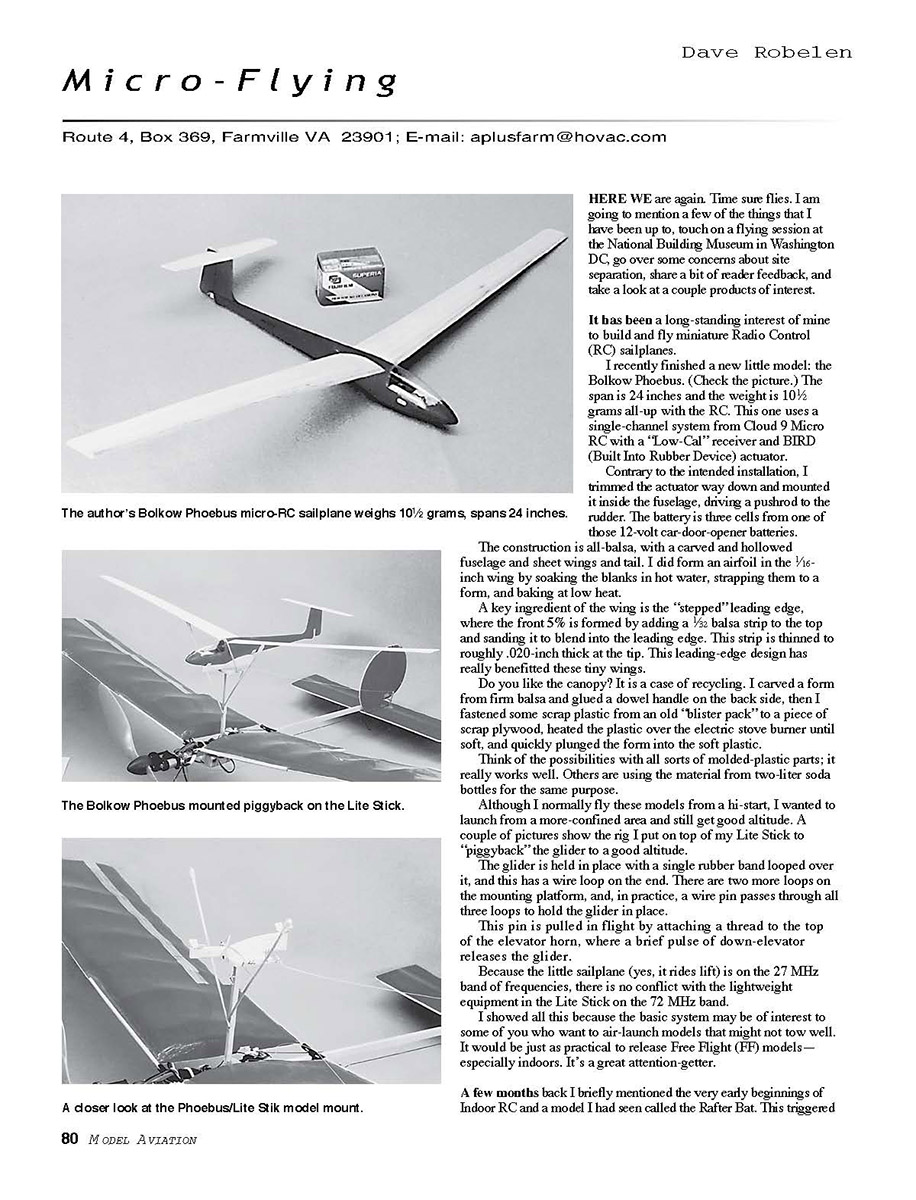
It has been a long-standing interest of mine to build and fly miniature radio-control (RC) sailplanes. I recently finished a new little model: the Bolkow Phoebus (check the picture). The span is 24 inches and the weight is 10½ grams all-up with the RC. This one uses a single-channel system from Cloud 9 Micro RC with a "Low-Cal" receiver and BIRD (Built Into Rubber Device) actuator.
Contrary to the intended installation, I trimmed the actuator way down and mounted it inside the fuselage, driving a pushrod to the rudder. The battery is three cells from one of those 12-volt car-door-opener batteries.
The construction is all balsa, with a carved and hollowed fuselage and sheet wings and tail. I did form an airfoil in the 1/16-inch wing by soaking the blanks in hot water, strapping them to a form, and baking at low heat.
A key ingredient of the wing is the "stepped" leading edge, where the front 5% is formed by adding a 1/32 balsa strip to the top and sanding it to blend into the leading edge. This strip is thinned to roughly .020-inch thick at the tip. This leading-edge design has really benefitted these tiny wings.
Canopy and Molding
Do you like the canopy? It is a case of recycling. I carved a form from firm balsa and glued a dowel handle on the back side, then I fastened some scrap plastic from an old blister pack to a piece of scrap plywood, heated the plastic over the electric stove burner until soft, and quickly plunged the form into the soft plastic.
Think of the possibilities with all sorts of molded-plastic parts; it really works well. Others are using the material from two-liter soda bottles for the same purpose.
Piggyback Launch Rig
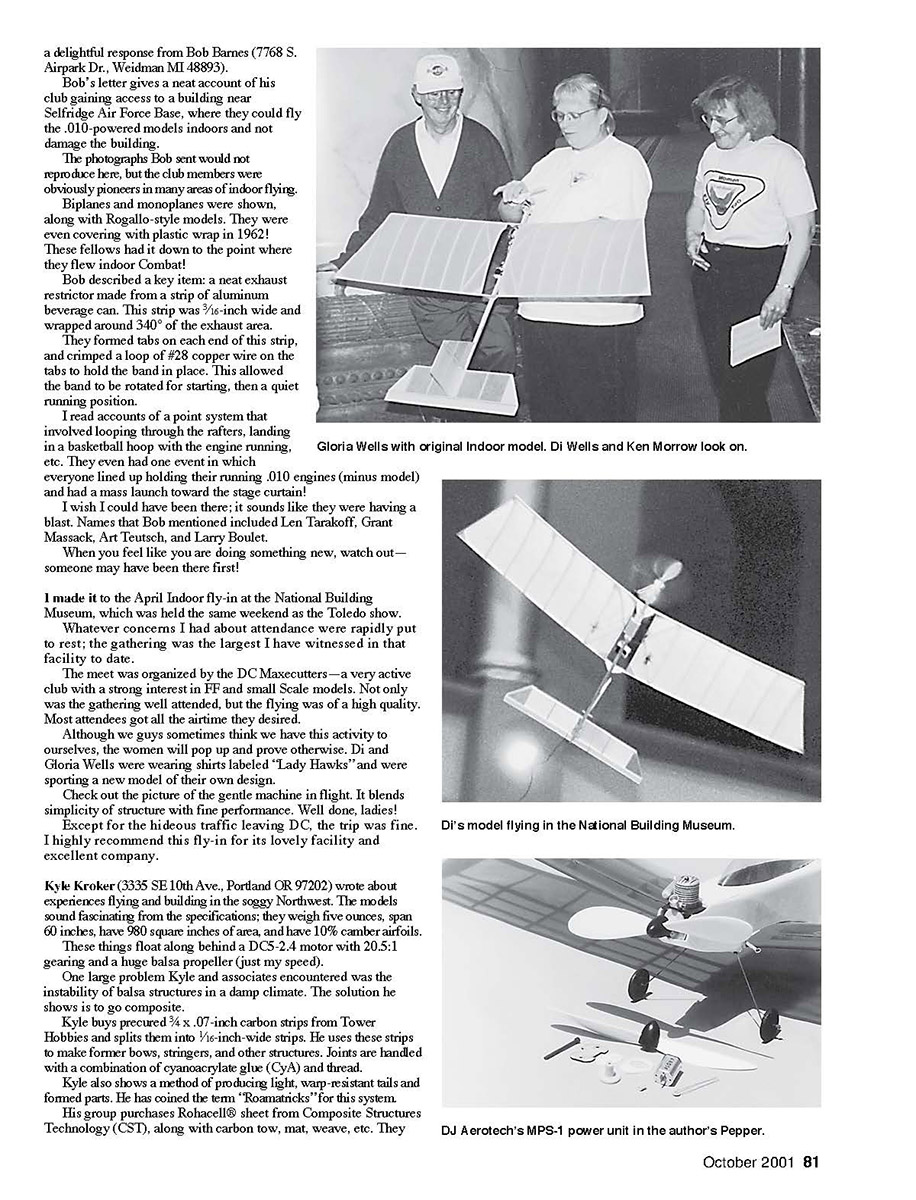
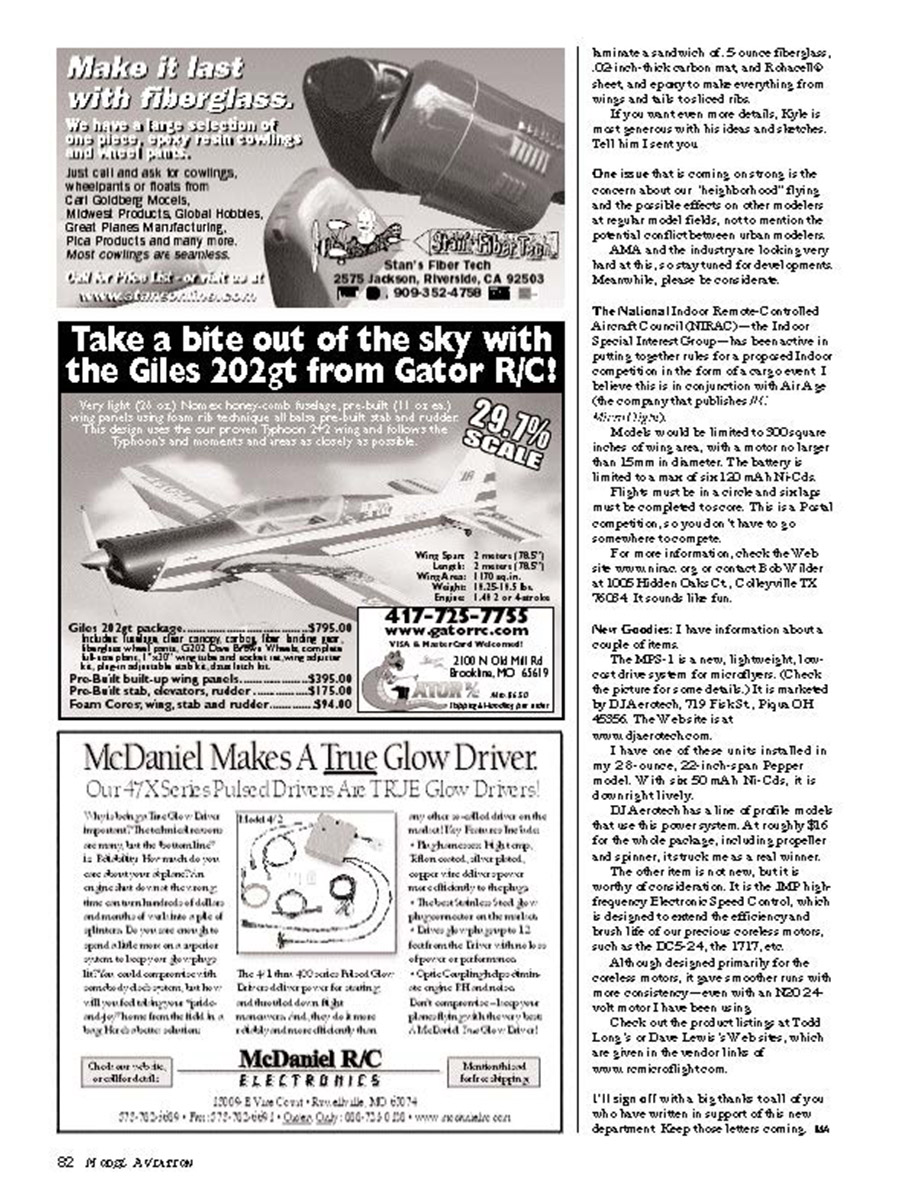
Although I normally fly these models from a hi-start, I wanted to launch from a more-confined area and still get good altitude. A couple of pictures show the rig I put on top of my Lite Stick to "piggyback" the glider to a good altitude.
- The glider is held in place with a single rubber band looped over it, and this has a wire loop on the end.
- There are two more loops on the mounting platform, and, in practice, a wire pin passes through all three loops to hold the glider in place.
- This pin is pulled in flight by attaching a thread to the top of the elevator horn, where a brief pulse of down-elevator releases the glider.
Because the little sailplane (yes, it rides lift) is on the 27 MHz band of frequencies, there is no conflict with the lightweight equipment in the Lite Stick on the 72 MHz band.
I showed all this because the basic system may be of interest to some of you who want to air-launch models that might not tow well. It would be just as practical to release free-flight (FF) models—especially indoors. It's a great attention-getter.
Reader Feedback: Early Indoor RC
A few months back I briefly mentioned the very early beginnings of indoor RC and a model I had seen called the Rafter Bat. This triggered a delightful response from Bob Barnes (7768 S. Airpark Dr., Weidman MI 48893).
Bob's letter gives a neat account of his club gaining access to a building near Selfridge Air Force Base, where they could fly the .010-powered models indoors and not damage the building. The photographs Bob sent would not reproduce here, but the club members were obviously pioneers in many areas of indoor flying.
Biplanes and monoplanes were shown, along with Rogallo-style models. They were even covering with plastic wrap in 1962! These fellows had it down to the point where they flew indoor combat!
Bob described a key item: a neat exhaust restrictor made from a strip of aluminum beverage can. This strip was 3/16-inch wide and wrapped around 340° of the exhaust area. They formed tabs on each end of this strip, and crimped a loop of #28 copper wire on the tabs to hold the band in place. This allowed the band to be rotated for starting, then a quiet running position.
I read accounts of a point system that involved looping through the rafters, landing in a basketball hoop with the engine running, etc. They even had one event in which everyone lined up holding their running .010 engines (minus model) and had a mass launch toward the stage curtain!
I wish I could have been there; it sounds like they were having a blast. Names that Bob mentioned included Len Trakoff, Grant Massack, Art Teutsch, and Larry Boulet.
When you feel like you are doing something new, watch out—someone may have been there first!
National Building Museum Fly-in
I made it to the April indoor fly-in at the National Building Museum, which was held the same weekend as the Toledo show. Whatever concerns I had about attendance were rapidly put to rest; the gathering was the largest I have witnessed in that facility to date.
The meet was organized by the DC Maxecutters—a very active club with a strong interest in FF and small-scale models. Not only was the gathering well attended, but the flying was of a high quality. Most attendees got all the airtime they desired.
Although we guys sometimes think we have this activity to ourselves, the women will pop up and prove otherwise. Di and Gloria Wells were wearing shirts labeled "Lady Hawks" and were sporting a new model of their own design. Check out the picture of the gentle machine in flight. It blends simplicity of structure with fine performance. Well done, ladies!
Except for the hideous traffic leaving D.C., the trip was fine. I highly recommend this fly-in for its lovely facility and excellent company.
Transcribed from original scans by AI. Minor OCR errors may remain.

