
Micro-Flying
Dave Robelen
<REDACTED>
I am going to use most of this month's department to cover a flying session that took place November 10, 2001 inside the National Building Museum located in Washington DC. I will comment on the facility a bit, introduce a few of the fliers, and discuss the various models that were flown that day.
The National Building Museum (NBM) is a beautiful site for indoor flying. There is a center hall with a lovely fountain and columns and two atriums located on either end of the main hall. These atriums are separated from the main hall by rows of large columns, but are otherwise open to the hall.
Each atrium has a usable floor space approximately 1.5 times larger than a double-court gymnasium, but the unique feature is the ceiling height of roughly 80 feet. This yields a lot of flying space compared to most local sites.
The flying sessions are organized by the D.C. Maxecuters club, and they include a Free Flight session in one atrium while the Radio Control (RC) models are flown in the other.
Since this building is a public museum, it is typical to have a sizable group of people in the facility, most of whom have never seen a model fly (or have never even seen a model). This has opened some real opportunities for public relations and model aviation, considering the clean, quiet nature of the models flying.
This takes me to one of the photos—of Dereck Woodward flying his Mouse in front of a very appreciative audience. This scene is typical of the public's self-control and their level of appreciation of the models. Although the Mouse does not particularly resemble a typical aircraft, it has unique qualities in that it can perform complex maneuvers in a confined space.
Another vehicle along these lines is the IFO series, which looks even less like an aircraft but is exceptionally well-suited for flying incredible maneuvers in a closed space.
A different photo shows John Worth servicing his Jack Dobbins-built original model between flights.
For those of you who may be relative newcomers, John has been one of the most influential people in the sport of model aviation in recent times. Among his many accomplishments, John was the executive director of AMA for a number of years, and he has managed to maintain a number of small supply-business enterprises through the years.
As early as 1953, when I first met John, he was working at the Langley Research Center and organizing annual RC fly-ins at Langley Air Force Base in VA. His small business at that time was Control Research, which kept many of us supplied with the bits and pieces needed to build the early RC gear.
In more recent times, John is operating Cloud 9 Micro RC and still meeting unique needs of the indoor and micro modeler. The newsletter John started has become RC MicroFlight, published by Air Age, and it keeps many of us informed of activities in the world of micro RC.
I wrote all that because John has many qualities that include modesty, and he probably would not reveal all of these details.
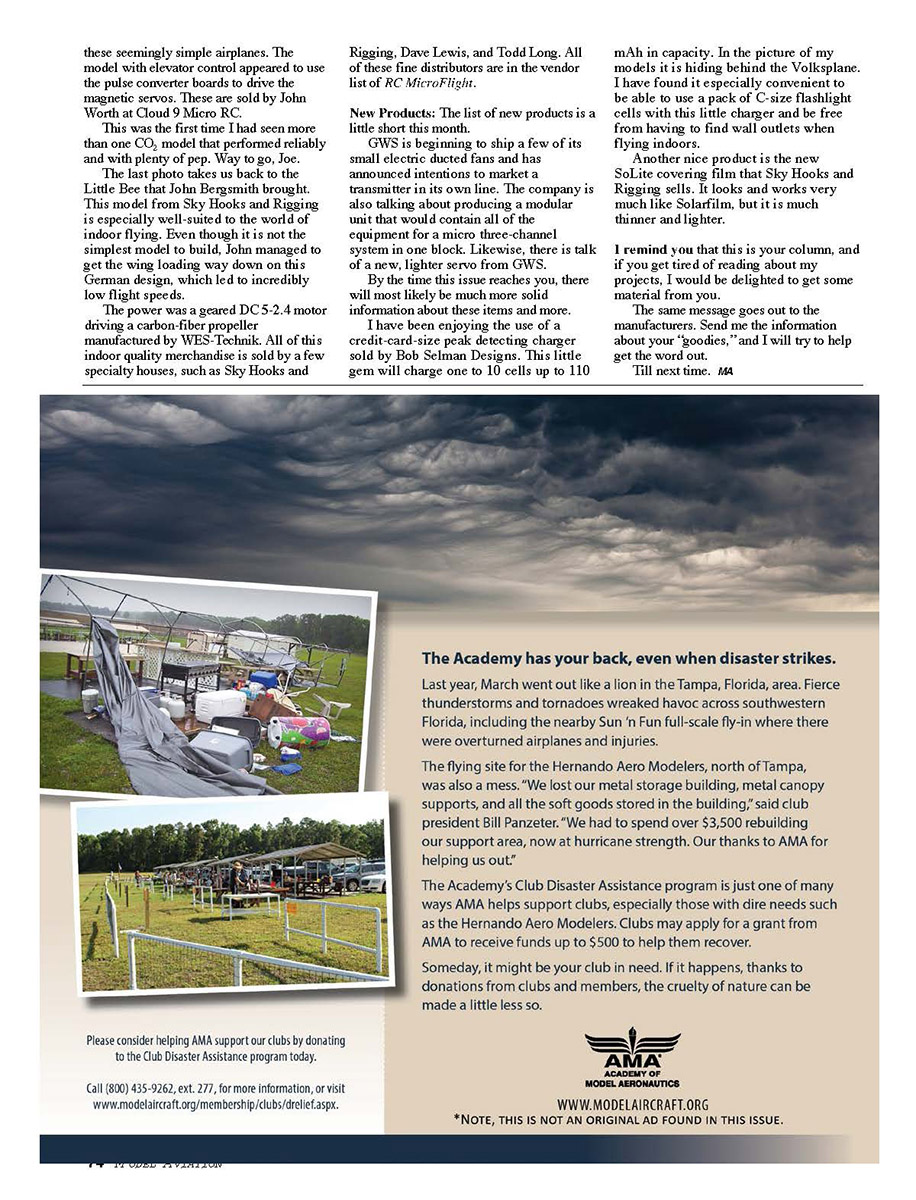
Another photo is a typical pit scene at the NBM flying sessions. These models came with Dereck Woodward and John Bergsmith, and they show some of the variety likely to be seen at a session.
The model in the foreground is John's Little Bee built from a Sky Hooks and Rigging kit, and it must be the slowest-flying model to be seen at many sites. It's an outstanding choice for indoor.
The next two models are John and Dereck's Dusksticks, which appear to be built around the popular GWS Pico Stik drive unit. The multicolored version is covered with Litespan, and the other is covered with the popular Reynolds Crystal Wrap. These models are the sort that are equally at home indoors or outside in quiet weather.
As do many of us, John and Dereck chose to use the popular GWS R4P Pico receiver in these models. This little gem manages to blend an excellent combination of tiny size, low cost, and reasonable operation around other active transmitters.
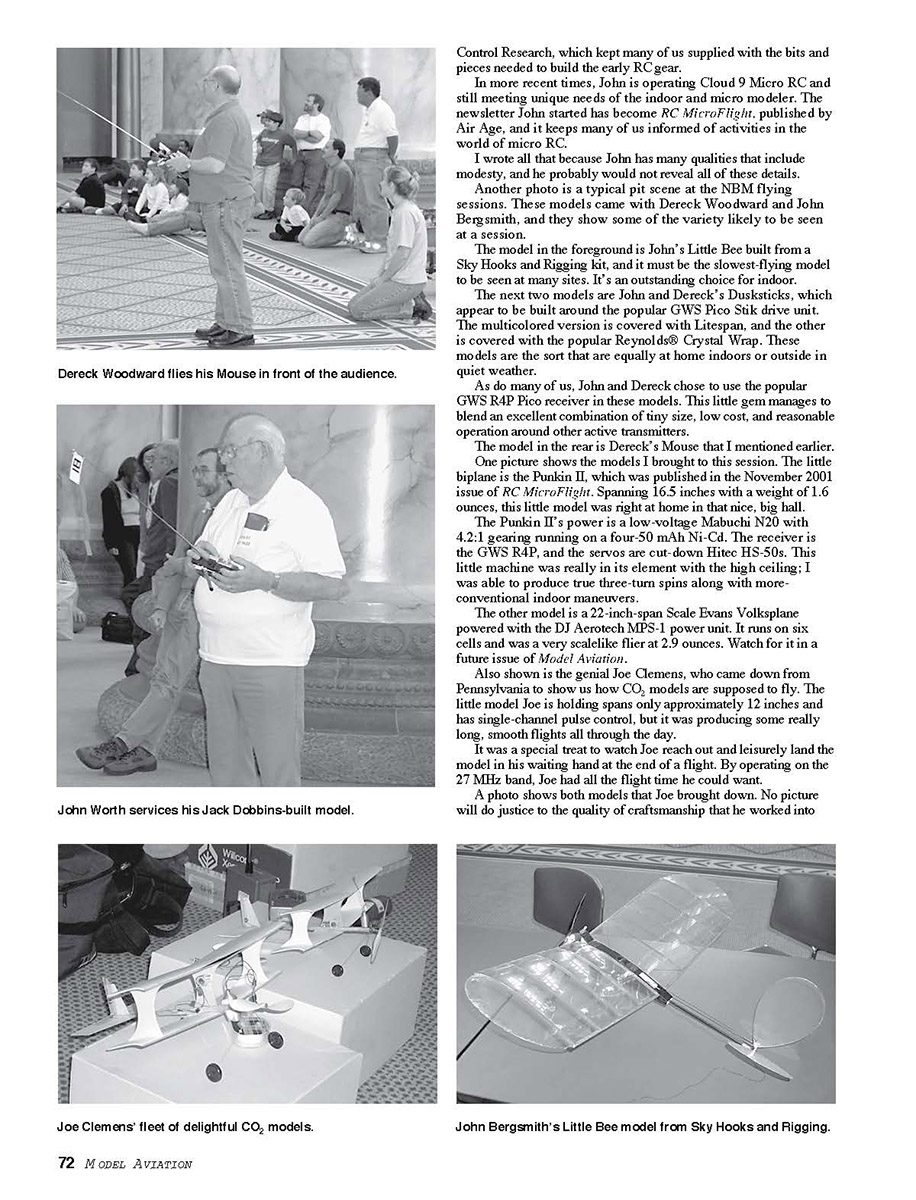
The model in the rear is Dereck's Mouse that I mentioned earlier. One picture shows the models I brought to this session. The little biplane is the Punkin II, which was published in the November 2001 issue of RC MicroFlight. Spanning 16.5 inches with a weight of 1.6 ounces, this little model was right at home in that nice, big hall.
The Punkin II's power is a low-voltage Mabuchi N20 with 4.2:1 gearing running on a four-50 mAh Ni-Cd. The receiver is the GWS R4P, and the servos are cut-down Hitec HS-50s. This little machine was really in its element with the high ceiling; I was able to produce true three-turn spins along with more-conventional indoor maneuvers.
The other model is a 22-inch-span Scale Evans Volksplane powered with the DJ Aerotech MPS-1 power unit. It runs on six cells and was a very scale-like flier at 2.9 ounces. Watch for it in a future issue of Model Aviation.
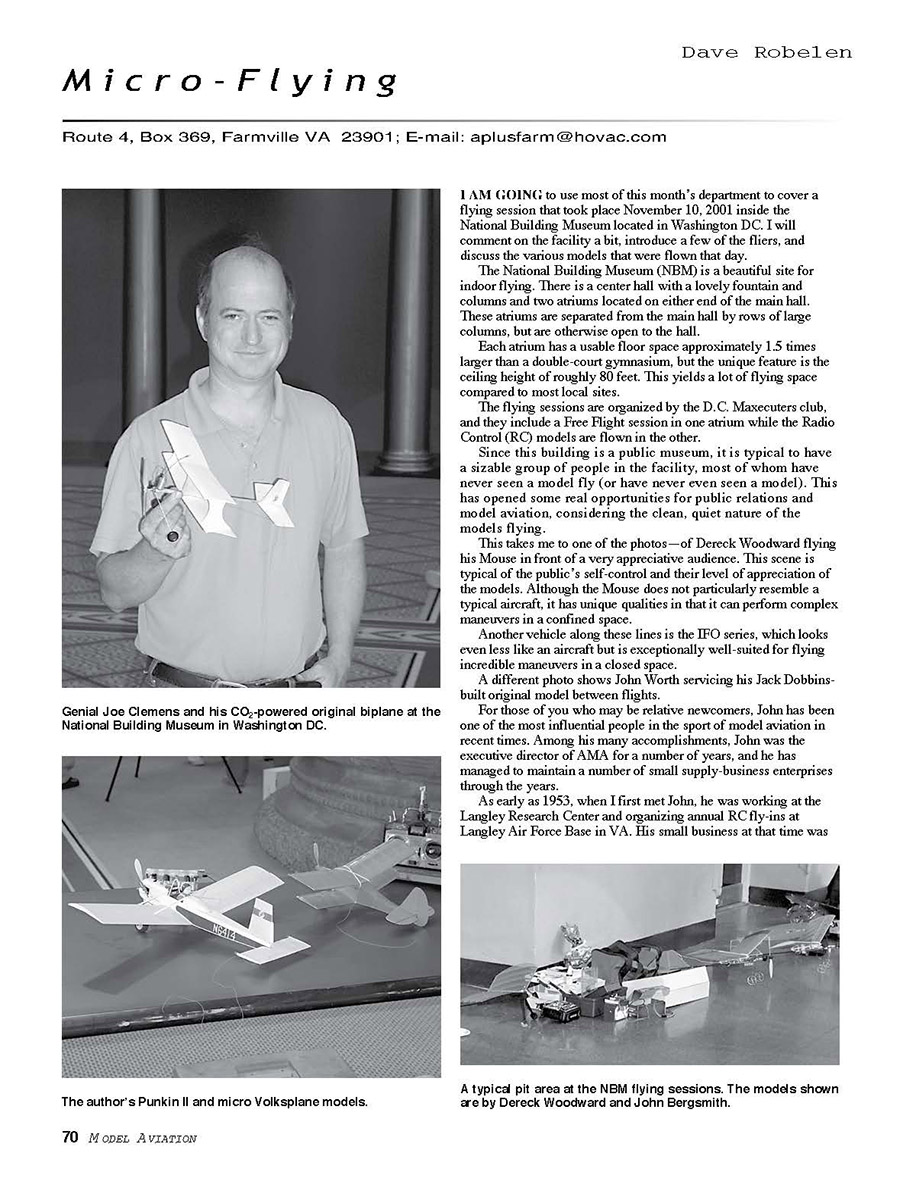
Also shown is the genial Joe Clemens, who came down from Pennsylvania to show us how CO2 models are supposed to fly. The little model Joe is holding spans only approximately 12 inches and has single-channel pulse control, but it was producing some really long, smooth flights all through the day.
It was a special treat to watch Joe reach out and leisurely land the model in his waiting hand at the end of a flight. By operating on the 27 MHz band, Joe had all the flight time he could want.
A photo shows both models that Joe brought down. No picture will do justice to the quality of craftsmanship that he worked into these seemingly simple airplanes. The model with elevator control appeared to use the pulse converter boards to drive the magnetic servos. These are sold by John Worth at Cloud 9 Micro RC.
This was the first time I had seen more than one CO2 model that performed reliably and with plenty of pep. Way to go, Joe.
The last photo takes us back to the Little Bee that John Bergsma brought. This model from Sky Hooks and Rigging is especially well-suited to the world of indoor flying. Even though it is not the simplest model to build, John managed to get the wing loading way down on this German design, which led to incredibly low flight speeds.
The power was a geared DC5-2.4 motor driving a carbon-fiber propeller, manufactured by WES-Technik. All of this indoor quality merchandise is sold by a few specialty houses, such as Sky Hooks and Rigging, Dave Lewis, and Todd Long. All of these fine distributors are in the vendor list of RC MicroFlight.
New Products: The list of new products is a little short this month.
GWS is beginning to ship a few of its small electric ducted fans and has announced intentions to market a transmitter in its own line. The company is also talking about producing a modular unit that would contain all of the equipment for a micro three-channel system in one block. Likewise, there is talk of a new, lighter servo from GWS.
By the time this issue reaches you, there will most likely be much more solid information about these items and more.
I have been enjoying the use of a credit-card-size peak detecting charger sold by Bob Selman Designs. This little gem will charge one to 10 cells up to 110 mAh in capacity. In the picture of my models it is hiding behind the Volksplane. I have found it especially convenient to be able to use a pack of C-size flashlight cells with this little charger and be free from having to find wall outlets when flying indoors.
Another nice product is the new SoLite covering film that Sky Hooks and Rigging sells. It looks and works very much like Solarfilm, but it is much thinner and lighter.
I remind you that this is your column, and if you get tired of reading about my projects, I would be delighted to get some material from you.
The same message goes out to the manufacturers. Send me the information about your "goodies," and I will try to help get the word out.
Till next time. MA
Transcribed from original scans by AI. Minor OCR errors may remain.

