
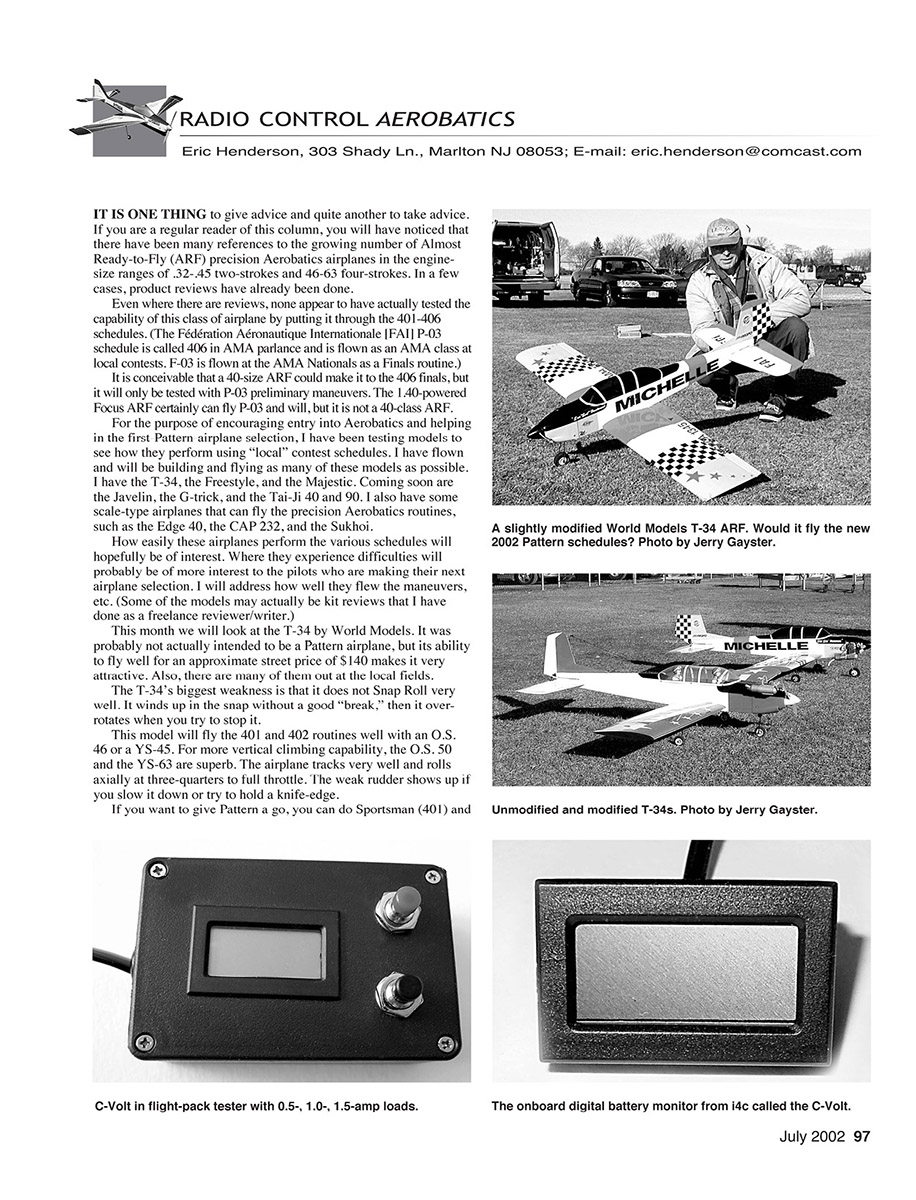
Micro-Flying
IT IS ONE THING to give advice and quite another to take advice. If you are a regular reader of this column, you will have noticed that there have been many references to the growing number of Almost Ready-to-Fly (ARF) precision Aerobatics airplanes in the engine-size ranges of .32-.45 two-strokes and 46-63 four-strokes. In a few cases, product reviews have already been done.
Even where there are reviews, none appear to have actually tested the capability of this class of airplane by putting it through the 401-406 schedules. (The Fédération Aéronautique Internationale (FAI) P-03 schedule is called 406 in AMA parlance and is flown as an AMA class at local contests. P-03 is flown at the AMA Nationals as a Finals routine.)
It is conceivable that a 40-size ARF could make it to the 406 finals, but it will only be tested with P-03 preliminary maneuvers. The 1.40-powered Focus ARF certainly can fly P-03 and will, but it is not a 40-class ARF.
For the purpose of encouraging entry into Aerobatics and helping in the first Pattern airplane selection, I have been testing models to see how they perform using "local" contest schedules. I have flown and will be building and flying as many of these models as possible. I have the T-34, the Freestyle, and the Majestic. Coming soon are the Javelin, the G-trick, and the Tai-Ji 40 and 90. I also have some scale-type airplanes that can fly the precision Aerobatics routines, such as the Edge 40, the CAP 232, and the Sukhoi.
How easily these airplanes perform the various schedules will hopefully be of interest. Where they experience difficulties will probably be of more interest to the pilots who are making their next airplane selection. I will address how well they flew the maneuvers, etc. (Some of the models may actually be kit reviews that I have done as a freelance reviewer/writer.)
This month we will look at the T-34 by World Models. It was probably not actually intended to be a Pattern airplane, but its ability to fly well for an approximate street price of $140 makes it very attractive. Also, there are many of them out at the local fields.
The T-34's biggest weakness is that it does not Snap Roll very well. It winds up in the snap without a good "break," then it over-rotates when you try to stop it.
This model will fly the 401 and 402 routines well with an O.S. 46 or a YS-45. For more vertical climbing capability, the O.S. 50 and the YS-63 are superb. The airplane tracks very well and rolls axially at three-quarters to full throttle. The weak rudder shows up if you slow it down or try to hold a knife-edge.
If you want to give Pattern a go, you can do Sportsman (401) and Intermediate (402) with the T-34. It has tricycle undercarriage and is very solid in takeoff and landing maneuvers.
You are probably wondering why an airplane with these limitations has gone this far in the report. That's because it flew so well in less-experienced hands, the decision was made to do a little bit of "kit-bashing." It is relatively easy to buy an extra set of wings and stabilizer and fin for this model or just go ahead and modify the one you already have. It can grow with you!
The ailerons were increased in area because the originals used too much throw to get a quick enough roll rate. The rudder and elevator areas were approximately doubled. The ailerons employed two servos instead of one. This can be accomplished by adding an extra servo to the central torque rods or putting the servos out in the wings. (Both methods worked very well.) It is not very hard to do and well worth the mixing options that two servos provide.
The result is an airplane that, for a few dollars of modifications, will snap and stop rotating on command. It will spin with rudder and elevator-only input. It is now even better at Four and Eight Point Rolls. The Avalanche in Advanced (403) became readily achievable.
Most interesting of all was that it became regular practice to keep the T-34 in the car at all times. Any proximity to the flying field for lunch or a slight deviation in the journey home allows practice. This smaller airplane helps the limbering up of hands and memory-building of the new Masters (404) schedule.
Admittedly, you needed the new O.S. 50 or the YS-63 for the Masters routine. If you only use this airplane up to the Advanced (403) schedule, the 46s would do the job.
The FAI P-03 routine was tried and could be done respectably, but not at a competitive level. Trying the FAI P-03 preliminary schedule was a bit redundant because the main idea here is to show affordable, entry-type airplanes. Most people would not begin flying Pattern in 404 or 406 classes.
However, it would be presumptuous on my part not to assume that no one would try it, so it was tested just in case . . .
The weather in the Northeast has been a bit strange this year. "Winter" (often called spring in Massachusetts) has held off, and some of us have been flying all year. (My goal is to fly at least once every month, no matter what! The current total is 147 consecutive months.)
The reason I bring it up is that with really cold weather, I have learned that you need a different airplane from what you would fly in summer contests. The relatively inexpensive T-34 fits that bill—modified or unmodified.
If you are already a regular Pattern flier, you can "build" one of these "winter" airplanes each year. Fly it, have fun, then sell it to potential Pattern pilots. This way you have moved a viable Pattern airplane into the club population—a model that is already trimmed and tested that would spare the novice much of the learning curve and get him or her hooked on our sport early.
Product News: For you Focus fans, a new batch of ARF and ARC (Almost Ready to Cover) kits from Piedmont Models is in the country. I am told that there are a few tweaks here and there to make the airplane go together better and that the original flying properties have been retained.
The National Society of Radio Controlled Aerobatics (NSRCA) had a booth at the 2002 WRAM (Westchester Radio Aero Modelers) Show in White Plains NY. Lou Scarlino, the WRAM Show manager, did the NSRCA, AMA, and many Special Interest Groups proud with booth space and prominent program-material mentions. Thank you, Lou!
The question most frequently asked at the NSRCA WRAM Show booth was, "Why do we not see more Pattern-specialized products at trade shows?" There is more than one answer to that question.
It is well known that Pattern pilots and builders source multiple and often very unlikely sources for their parts and materials. They tend to bring initially disparate items together to achieve the results they want.
Another big factor is that the producers of Aerobatics products tend to be smaller companies. Specialty mail order is dominant in Pattern. Some exceptions are the engines and radios we use; these items are there, but they are not usually billed as "Pattern" engines or radios. Pattern-usable products are all around us at trade shows, but we have to really look for them.
It was not until the third day of the WRAM Show that I came across a company called i4c. I already had one of its products without knowing it.
In my unfortunate journey with early Lithium batteries, I had purchased a Duratrax digital battery tester. This unit had a C-Volt unit embedded in it. This tester gave you the capability of putting the battery pack under a one-amp load—very useful for Radio Control (RC)-equipment operators who worry about potential battery weakness detection. The C-Volt device is probably better known as a lightweight, onboard visual battery-monitoring system.
Also produced by i4c is a new plug-in battery monitor that has two loads. Half an amp is available from one push button; one amp is available from a second button. Press both buttons, and you have a 1½-amp load you can put on your Lithium, Ni-Cd, or NiMH battery. The digital readout is there for you to see in a clever reuse of the onboard C-Volt unit. Four-or five-cell would be the norm use. However, the unit is rated from +4.00 to +18.00 Vdc (0.01V resolution).
The C-Volt has very low current drain on any onboard system and is an excellent visual check for the RC pilot. This device is different from the load tester in that it only operates when the receiver is turned on. It does track the voltage closely parallel to the current being drawn by the onboard system. Do not fly if you see low readings.
Setting there on the table at the i4c booth was another pleasant surprise: a six-piece set of popular metric and inch Allen bits for your drill/drivers and torque wrenches. These have proven especially useful in taking the heads off YS engines, etc., where you need the right length of tool to reach the bolts deep inside of the head.
For now, it's back to the workshop to build the next 40-size ARF. Until then, center your maneuvers and be smooth. MA
Transcribed from original scans by AI. Minor OCR errors may remain.

