
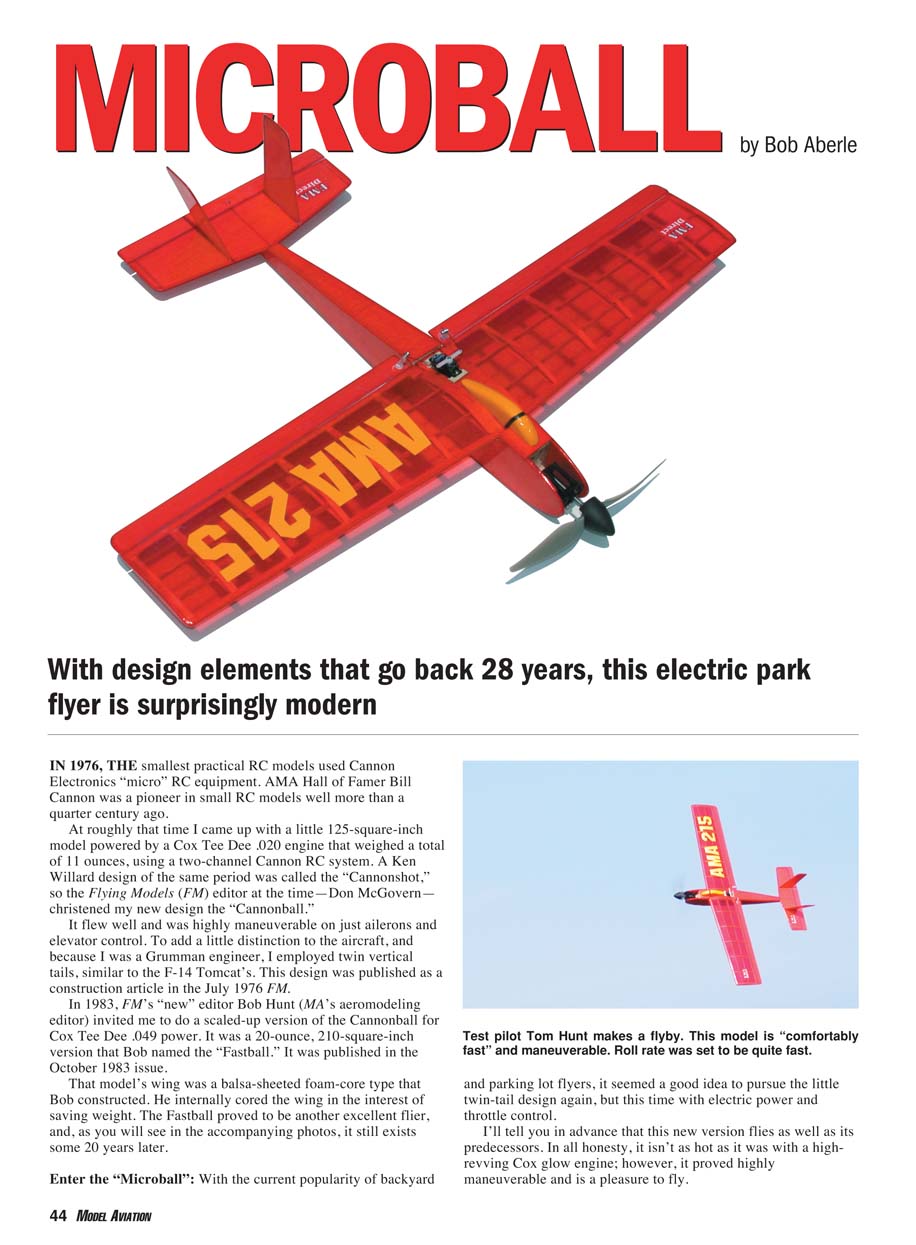
MICROBALL
by Bob Aberle [email protected]
With design elements that go back 28 years, this electric park flyer is surprisingly modern.
In 1976 the smallest practical RC models used Cannon Electronics "micro" RC equipment. AMA Hall of Famer Bill Cannon was a pioneer in small RC models well more than a quarter century ago. At roughly that time I came up with a little 125-square-inch model powered by a Cox Tee Dee .020 engine that weighed a total of 11 ounces, using a two-channel Cannon RC system. A Ken Willard design of the same period was called the "Cannonshot," so the Flying Models editor at the time—Don McGovern—christened my new design the "Cannonball."
It flew well and was highly maneuverable on just ailerons and elevator control. To add a little distinction to the aircraft, and because I was a Grumman engineer, I employed twin vertical tails, similar to the F-14 Tomcat's. This design was published as a construction article in the July 1976 Flying Models.
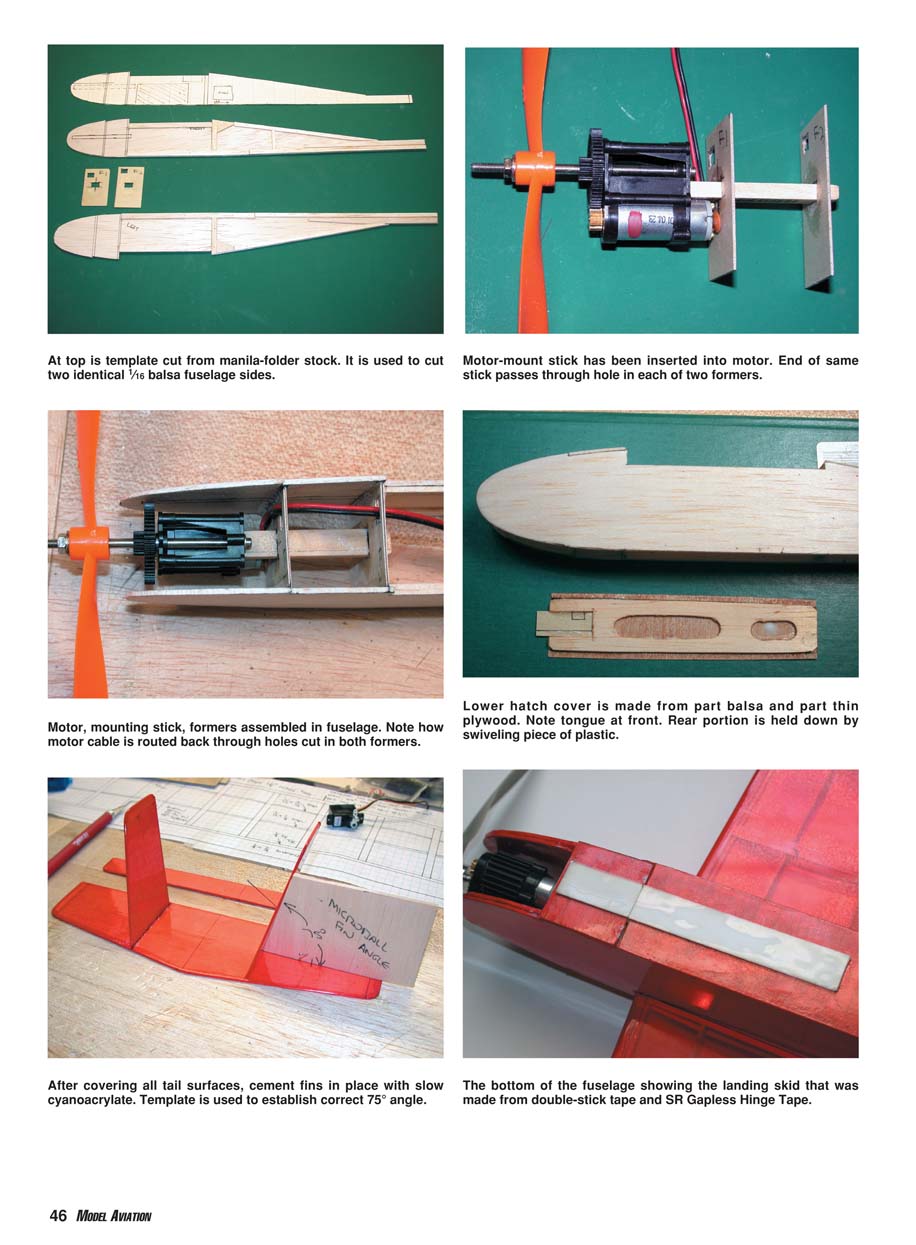
In 1983 FM's "new" editor Bob Hunt (MA's aeromodeling editor) invited me to do a scaled-up version of the Cannonball for Cox Tee Dee .049 power. It was a 20-ounce, 210-square-inch version that Bob named the "Fastball." It was published in the October 1983 issue. That model's wing was a balsa-sheeted foam-core type that Bob constructed. He internally cored the wing in the interest of saving weight. The Fastball proved to be another excellent flier, and it still exists some 20 years later.
Enter the Microball: with the current popularity of backyard and parking-lot flyers, it seemed a good idea to pursue the little twin-tail design again, but this time with electric power and throttle control. This new version flies as well as its predecessors. It isn't as hot as it was with a high-revving Cox glow engine; however, it proved highly maneuverable and is a pleasure to fly.
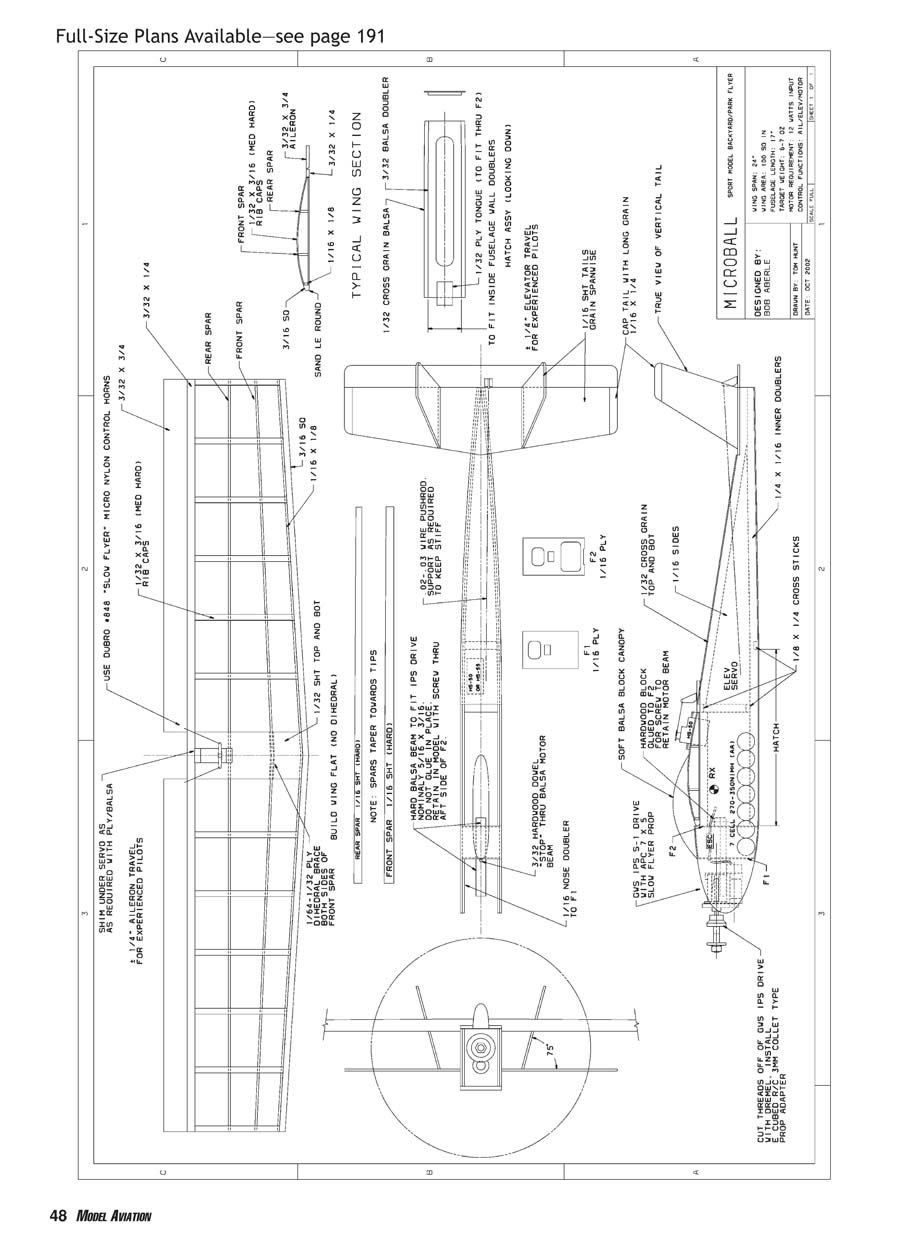
I settled on 100 square inches of wing area, slightly smaller than the Cannonball’s. The target weight was approximately 7 ounces complete because I intended to use an inexpensive GWS geared IPS motor, similar to the type supplied with GWS’s Lite Stik ARF. To provide better performance at somewhat slower flight speeds, I increased the wing aspect ratio from 3.9 to 5.6:1—making the wing longer in span and narrower in chord.
The original wing used a semisymmetrical NACA 2412 airfoil. I wanted some extra lift and chose a simple, slightly modified Clark Y flat-bottom airfoil as an alternative. To maintain the same appearance, I kept the twin vertical (F-14) fins.
As on the Cannonball and Fastball designs, the wing is permanently affixed to the fuselage, with a removable bottom hatch that allows access to the RC equipment and the battery for charging. To keep things simple I installed the aileron servo on top of the wing, out in the open. A balsa-block simulated canopy provides some streamlining of the airflow directly in front of that externally mounted servo.
Motor system / Battery
The motor I chose was the GWS IPS S-1 model, which has a lower-than-average gear-reduction ratio of 4.14:1. The lower ratio allows use of a smaller-diameter propeller—an APC 7 x 5 Slow Flyer for this model.
Rule of thumb for this GWS motor series: keep motor current under 2.0 amps and around 15 watts. I found it possible to use a seven-cell NiMH pack of 280 mAh capacity. With that pack my start-up current measured 2.1 amps at 16.9 watts; this quickly diminishes as charge wears off. To be safe I added a GWS motor heat sink to help dissipate heat. With this arrangement the propeller speed is roughly 5,100 rpm and motor runs of 8–10 minutes are possible—longer if you throttle back during flight.
RC system and radio gear
- Receiver: FMA Direct Extreme dual-conversion receiver (4 oz).
(Editor’s note: FMA Direct discontinued the Extreme and replaced it with the M5 micro-size dual-conversion receiver weighing just over 0.3 oz; Bob reports success with the M5.)
- Servos: Hitec RCD HS-50 submicro servos (two).
- ESC: Castle Creations Pixie-7P (programmable cutoff voltage).
- Antenna: E-Cubed R/C short antenna stick (model M-72-U). The antenna wire is wrapped around a 1-1/2" rod; cut off the existing receiver antenna about 1" from the case and solder the E-Cubed lead wire to it. Initially I located the antenna stub inside the RC compartment and noted interference; moving the stub several inches behind the wing trailing edge (inside the fuselage) eliminated range problems. Always range-check before the first flight.
- Connectors: JST polarized connectors (motor-to-ESC and battery-to-ESC) — wires come pre-crimped and use red/black for polarity.
Construction hints
The Microball’s basic construction is all balsa. It uses little material and can be built in a matter of days—one advantage of parking-lot/backyard flyers.
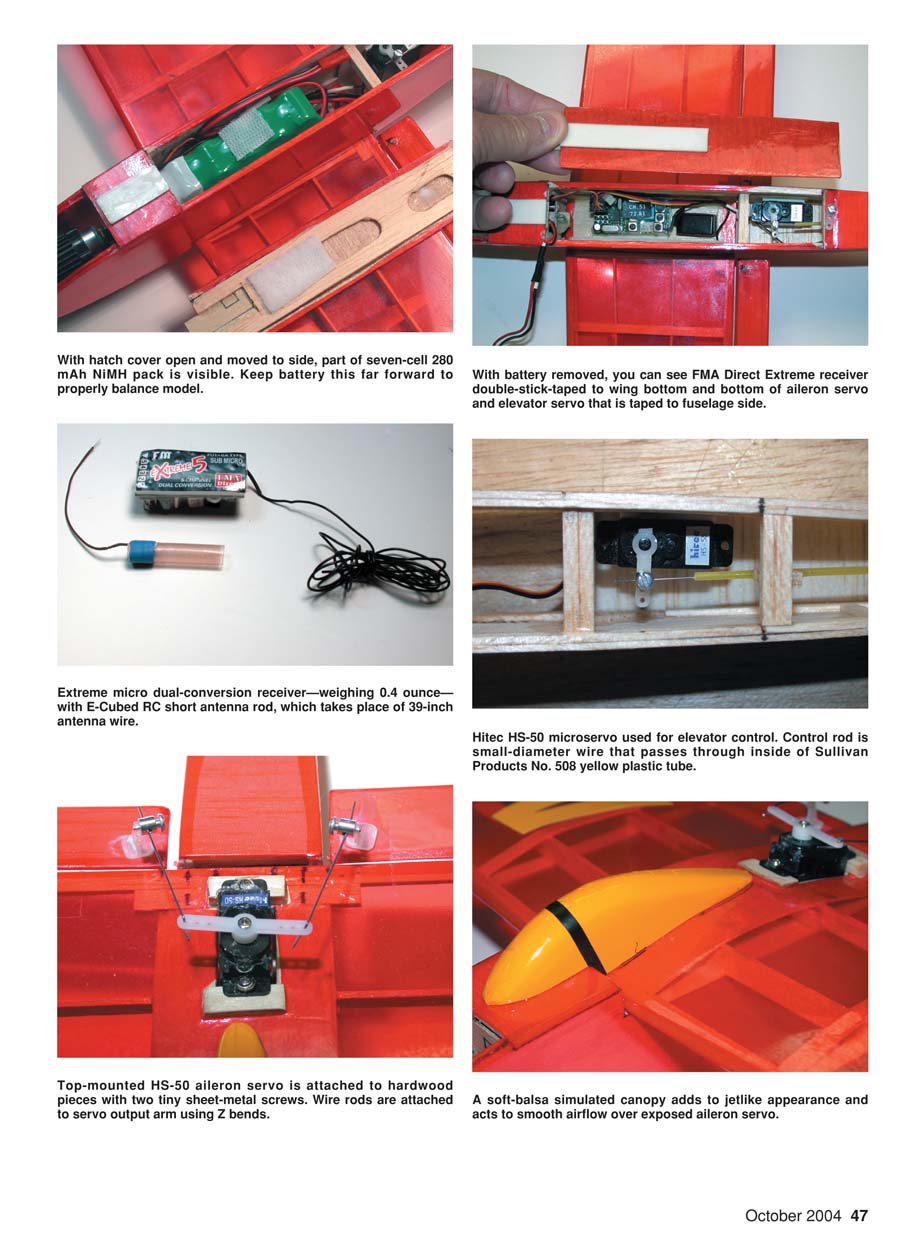
Wing construction: instead of cutting traditional ribs, use Tom Hunt’s Modelair-Tech "Stik"-type wing. Substitute 1/32" x 3/16" balsa strips for ribs. Lay one set flat on the building board with leading and trailing edges pinned, add two spars cut from 1/16" balsa (taper spar height toward the tips), then bend a second set of 1/32" strips over both spars from LE to TE to form a neat airfoil without full ribs.
Ailerons, stabilizer, elevator, and twin fins are cut from sheet balsa. Fuselage sides are 1/16" balsa with several stiffeners and a doubler added to each side—make one right and one left.
Motor mount: adapted from Larry Sribnick's SR Bantam kit. Prepare two plywood formers, each with a square hole to accept a motor-mount stick made from two pieces of spruce or basswood so it press-fits into the square hole molded into the GWS/IPS motor casing. Place the motor on the stick and pin it with a small sheet-metal screw. Leave enough stick projecting to pass through holes in both formers. Insert a small dowel in front of the first former and add a small sheet-metal screw behind the second former to lock the motor. In a hard landing the stick will break before the motor shaft bends. With the connector set described earlier you can change motors easily at the field.
Make a lower hatch from balsa and 1/32" plywood with a front tongue and a swiveling plastic retainer for the rear. Keep it simple for battery access and charging.
Adhere the wing to the fuselage with five-minute epoxy—no wing dowels or rubber bands required. Precover the stabilizer, elevator, and fins before final assembly. Cement the fins with slow (thick) cyanoacrylate and attach the stabilizer to the fuselage with five-minute epoxy. Leave the top fuselage sheeting off until after hooking up the elevator control rod.
Covering and final assembly
- Covering: Hangar 9 UltraCote Lite Transparent iron-on material. Use one iron set low to tack and a second at moderately high temperature for final shrinking. The thin balsa tail surfaces cover easily without undue warping.
- Hinges: SR Gapless Hinge Tape (from Larry Sribnick’s SR Bantam series) works well.
- Control hardware: Du-Bro micro-size control horns and EZ connectors for ailerons and elevator.
- Elevator control rod: Sullivan Products No. 508 yellow plastic tubing with a length of .020" wire inside.
- Final control travel: 1/4" each side from neutral on both ailerons and elevator.
- Balance (CG): approximately at the front wing spar. Achieve this by placing the seven-cell 280 mAh NiMH battery pack in-line as far forward against the front fuselage former (F-1) as possible; anything less makes the model tail-heavy.
Final top sheeting and covering are completed after control linkage checks.
Flying
- Final weight: 6.7 ounces (slightly lighter than target).
- Wing loading: 9.6 oz/ft².
- Power: with the seven-cell 280 mAh NiMH the watts-per-ounce is 2.52; a six-cell NiMH pack yields about 2.00 W/oz. Anything heavier than ~2.00 W/oz gives medium to aggressive aerobatic performance—consistent with flight observations.
- Launches: hand-launched only (no landing gear). I added double-stick tape plus SR Gapless Hinge Tape as a lower skid to protect the fuselage on landings.
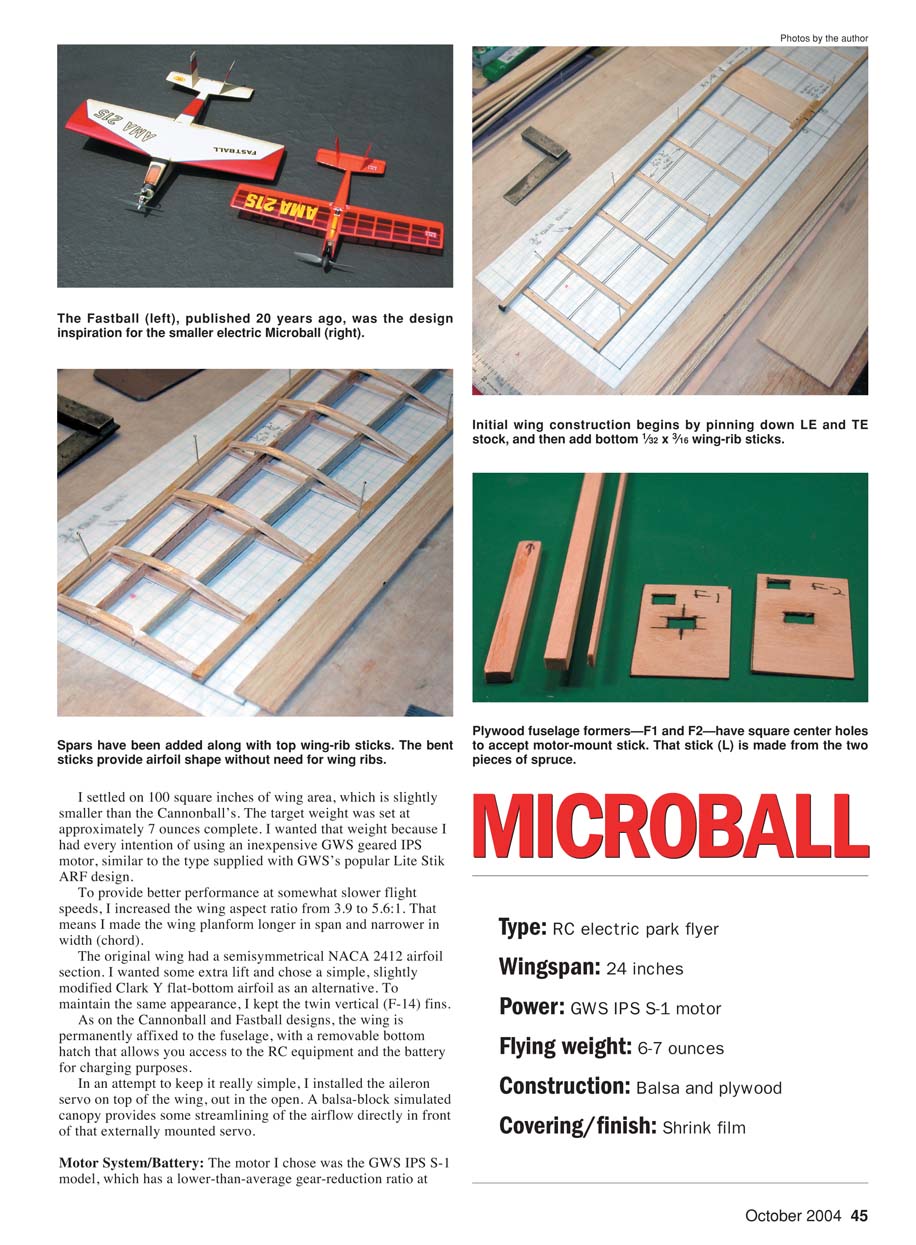
- Handling: roll rate is quite fast—consider starting with dual-rate cutback until familiar with the model. Aileron-equipped parking-lot flyers open many doors to advanced maneuvers. Landings can be made slowly with a nose-high attitude and no tendency to stall or drop a wing.
Li-Poly notes: I didn’t design the Microball around Li-Poly cells because their lighter weight would upset the CG. If you use Li-Poly, add ~1-1/2" to nose length (move the motor forward). I did try two FMA Direct/Kokam 540 mAh Li-Poly cells in series; current, voltage, wattage, and rpm were nearly identical to the six-cell 280 mAh NiMH, but the Li-Poly pack weighed half as much, reducing overall model weight by about 0.9 oz. That produced ~2.34 W/oz and suggested slightly better performance and much longer motor run times—potentially 18 minutes versus 8–10 with NiMH. If you try Li-Poly, please share your experiences.
Specifications
- Wing area: 100 sq in
- Wing loading: 9.6 oz/ft²
- Length: 18 in
- Wingspan: 24 in
- Propeller: APC 7 x 5 Slow Flyer
- Motor: GWS IPS S-1 (gear reduction 4.14:1)
- Motor current: 2.1 A at start on a full charge (1.78 A on six cells)
- Motor power: 16.9 W (13.1 W on six cells)
- rpm: 5,100 (4,700 on six cells)
- Watts per ounce: 2.52 (2.04 on six cells)
- Battery: seven-cell 280 mAh NiMH pack (six-cell pack option)
- Radio: FMA Direct Extreme micro dual-conversion receiver (note: replaced by FMA M5), Hitec HS-50 microservos, Castle Creations Pixie-7P ESC with BEC, E-Cubed R/C short (1-1/2") antenna, Hitec Eclipse transmitter with Spectra module
- Flight duration: 8–10 minutes with seven-cell 280 mAh NiMH (longer with throttle management or Li-Poly)
Manufacturers / Suppliers
- Balsa Products (motor and NiMH batteries)
122 Jansen Ave., Iselin, NJ 08830 (732) 634-6131 www.balsapr.com
- Castle Creations (Pixie-7P ESC)
18773 W. 117th St., Olathe, KS 66061 (913) 438-6325 Fax: (913) 438-1394 www.castlecreations.com
- Du-Bro RC (micro control horns and EZ connectors)
Box 815, Wauconda, IL 60084 (800) 848-9411 Fax: (847) 526-1604 [email protected] www.dubro.com
- E-Cubed R/C (short antenna rod)
1750 Lundgren Rd., New Carlisle, OH 45344 (937) 849-0418 Fax: (937) 849-0431 [email protected] www.ecubedrc.com
- FMA Direct (receiver and Li-Poly batteries)
5716A Industry Ln., Frederick, MD 21704 (800) 343-2934 Fax: (301) 668-7619 [email protected] www.fmadirect.com
- Hitec RCD (transmitter and servos)
12115 Paine St., Poway, CA 92064 (858) 748-6948 www.hitecrc.com
- Radical R/C (JST connectors and NiMH batteries)
7046 Harshmanville Rd., Huber Heights, OH 45424 (937) 237-7889 [email protected] www.radicalrc.com
Transcribed from original scans by AI. Minor OCR errors may remain.

