

The Microhenrys by Ed Henry
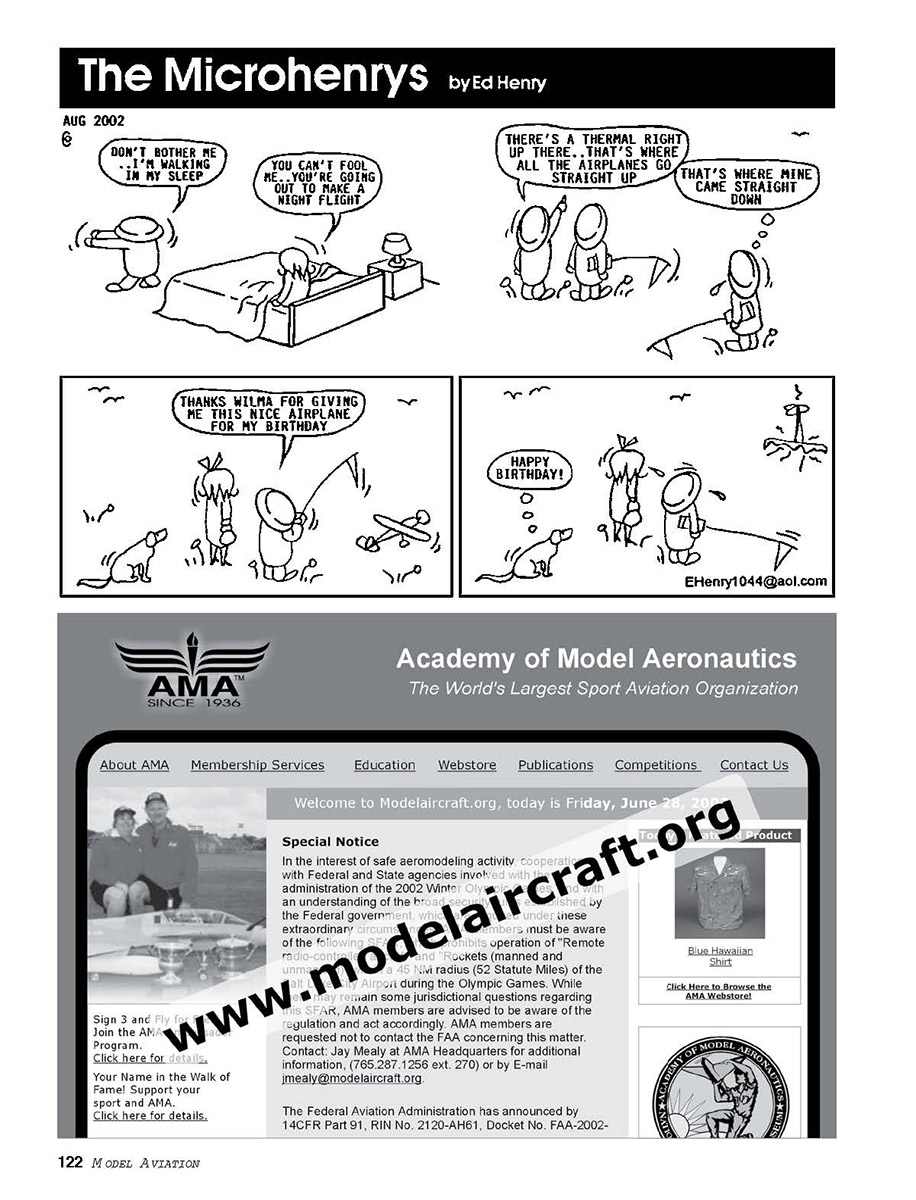
"Don't bother me — I'm walking in my sleep."
"You can't fool me... you're going out to make a night flight."
"There's a thermal right up there... that's where all the airplanes go straight up."
"That's where mine came straight down."
"Thanks Wilma for giving me this nice airplane for my birthday."
"Happy Birthday!"
<REDACTED>
the mild flybar setup, it is a stable machine. Any beginner will be happy with the feel. Because of the JR trademark large fuel tank mounted far forward of the main mast the fore-and-aft trim will change during the flights as the fuel burns. (Much more so than with the Raptor.)
The mild setup is somewhat cleaner than the stock Raptor 30. With the Venture's hot flybar selection it is easily as good as a Raptor, although it's definitely suffering from pitch sensitivity in forward flight. During the leading edge of the paddles normally helps this problem. I haven't done that yet because I expect to have some V-Paddles soon, and they are also without being "gimby." The cyclic is plenty hot enough for 3-D flying. There is also more than enough pitch range available; I have 23° on mine with no binding.
I did have two problems with my Venture. First, the plastic mounting tab for the servo screws refused to slide inside the brass servosavers on my JR servos. I stripped three of them trying before I gave up and took the eyebolts out. This allowed the servos to seat in their mounts, but you have to use larger washers under the screws and be careful to tighten them evenly and not to overtighten.
The second problem took me by surprise and made me think for a moment that I had a Raptor under the Venture canopy. My model had an extremely pronounced version of the "wah-wahs" — a moan/ry that is normally associated only with the Raptor 30 and 50. It is caused by slop in the auto hub/main gear system.
Horizon's helicopter guru assured me that none of the other machines had exhibited this problem, so hopefully that is the case. I fixed the issue, and the helicopter behaved fine from then on.
Overall, I think the Venture CP will be a popular helicopter. It's probably more of an under control, make one more approach, lower the collective sticks smoothly, and engage the hold function at the spot where your practice has shown you is the proper location for your arriving point.
If all is looking good at this point, keep the helicopter level and descending until you get down to approximately 10 feet high, then smoothly pull the cyclic back to arrest the forward speed. As soon as forward speed is halted, re-level the disk with cyclic and slowly start adding collective. You want the stick to reach a point at or above hover pitch just as the helicopter reaches roughly two feet of altitude.
Depending on the size of the blades, the weight of the helicopter, and the general energy retention during the approach, you will have between a half second and a couple seconds at this point until there is not enough left to keep the helicopter off the ground. Smoothly add pitch to keep the last bit of descent slow and smooth, and you should land it soft and straight like a pro!
If you add too much pitch, the model will jump skyward and bleed energy rapidly. You never want to see the helicopter climbing during the flare and landing! If you did add too much pitch, quickly pull the stick down a bit and be ready to add pitch again as soon as the helicopter starts to settle.
The one thing to avoid here is letting the head speed be brought to a low level, then panicking and switching the hold function off. You're better off letting the machine settle down a bit harder than desired than to switch the power back on when you are freaked out and in a very low-energy state.
Again, I've overused my space allotment. Until next time, fly safely and happy rotoring! tgl
Transcribed from original scans by AI. Minor OCR errors may remain.

