
Midnight Combat
by John Kilsdonk
It's near midnight on a snowy January evening in Michigan. The temperature is 10 degrees Fahrenheit and falling, with the wind blowing a steady 25 mph. There is already more than a foot of snow on the ground.
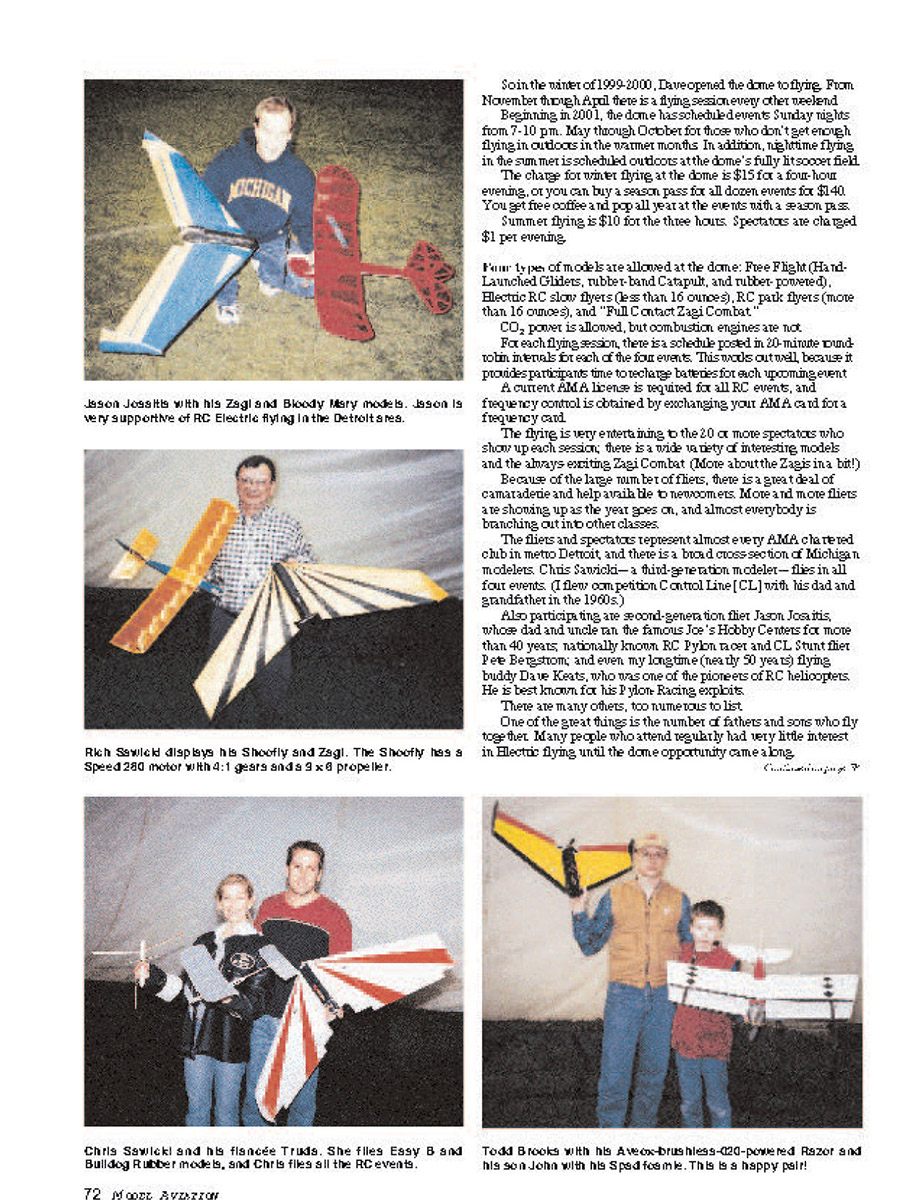
Despite the weather and the bewitching hour, there are more than 50 people at the Radio Control (RC) flying site. The flightline is jammed, with no less than 15 models in the air.
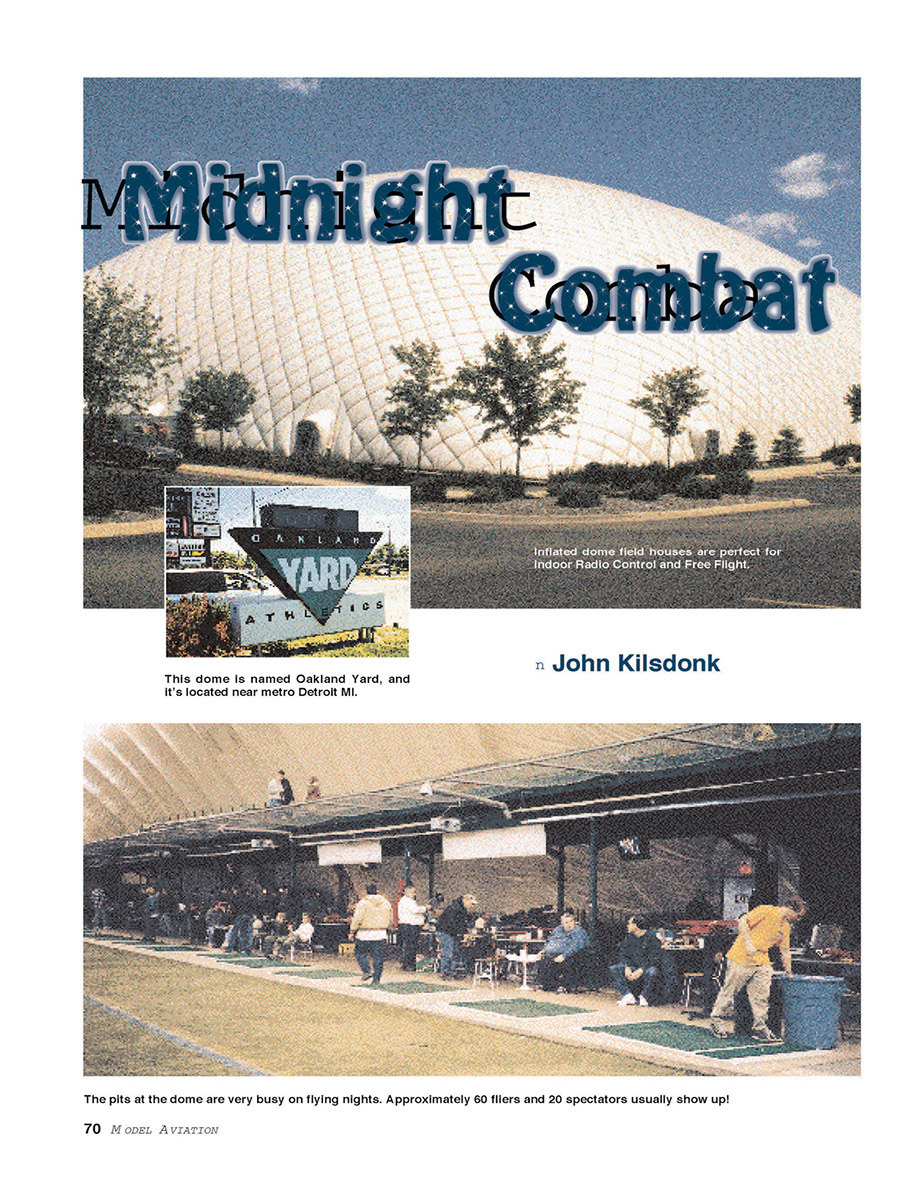
This is not all fake, and Michigan's winters aren't any harsher than the rest of the country (well, that point may be arguable!). We are inside the Oakland Yard—an inflated dome that is used as an athletic facility.
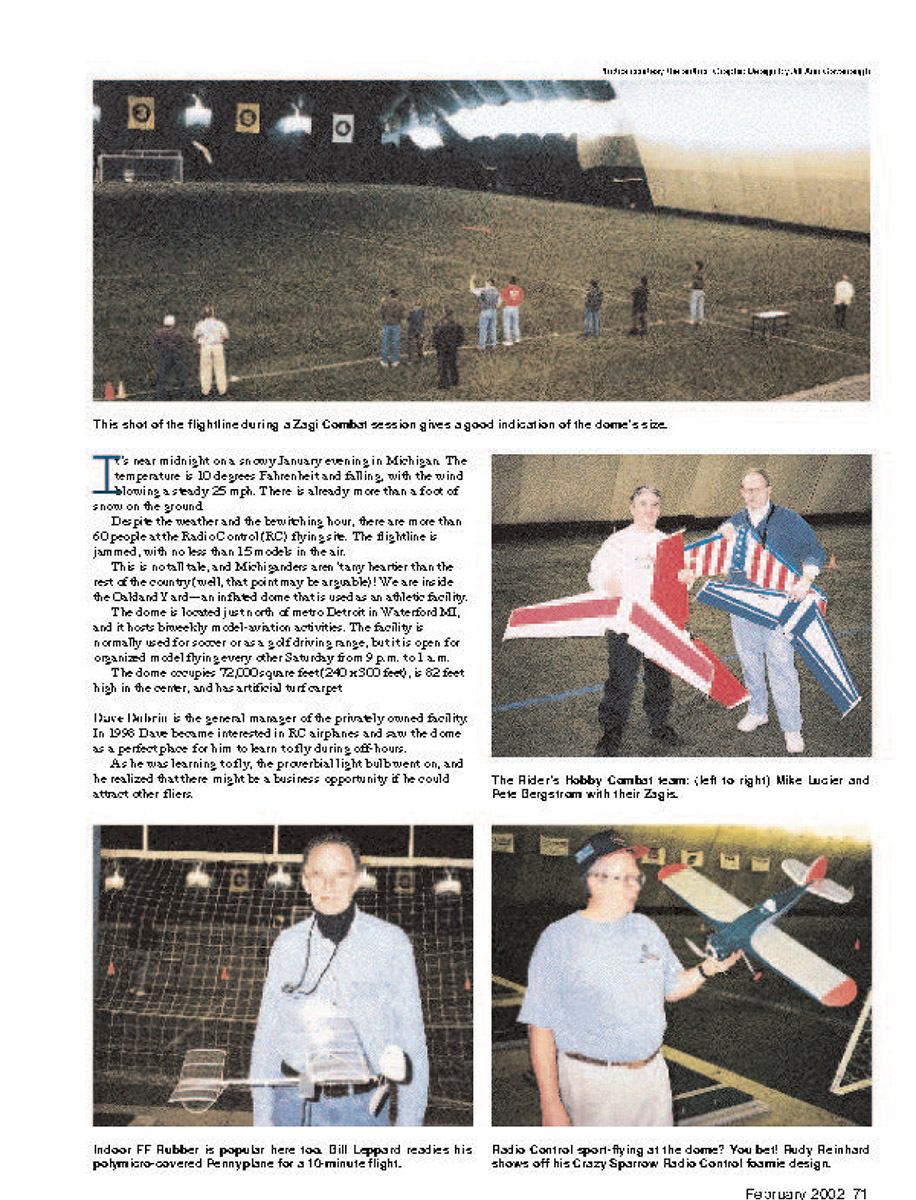
The dome is located just north of metro Detroit in Waterford MI, and it hosts biweekly model aviation activities. The facility is normally used for soccer or as a golf driving range, but it is open for organized modeling every other Saturday from 9 p.m. to 1 a.m.
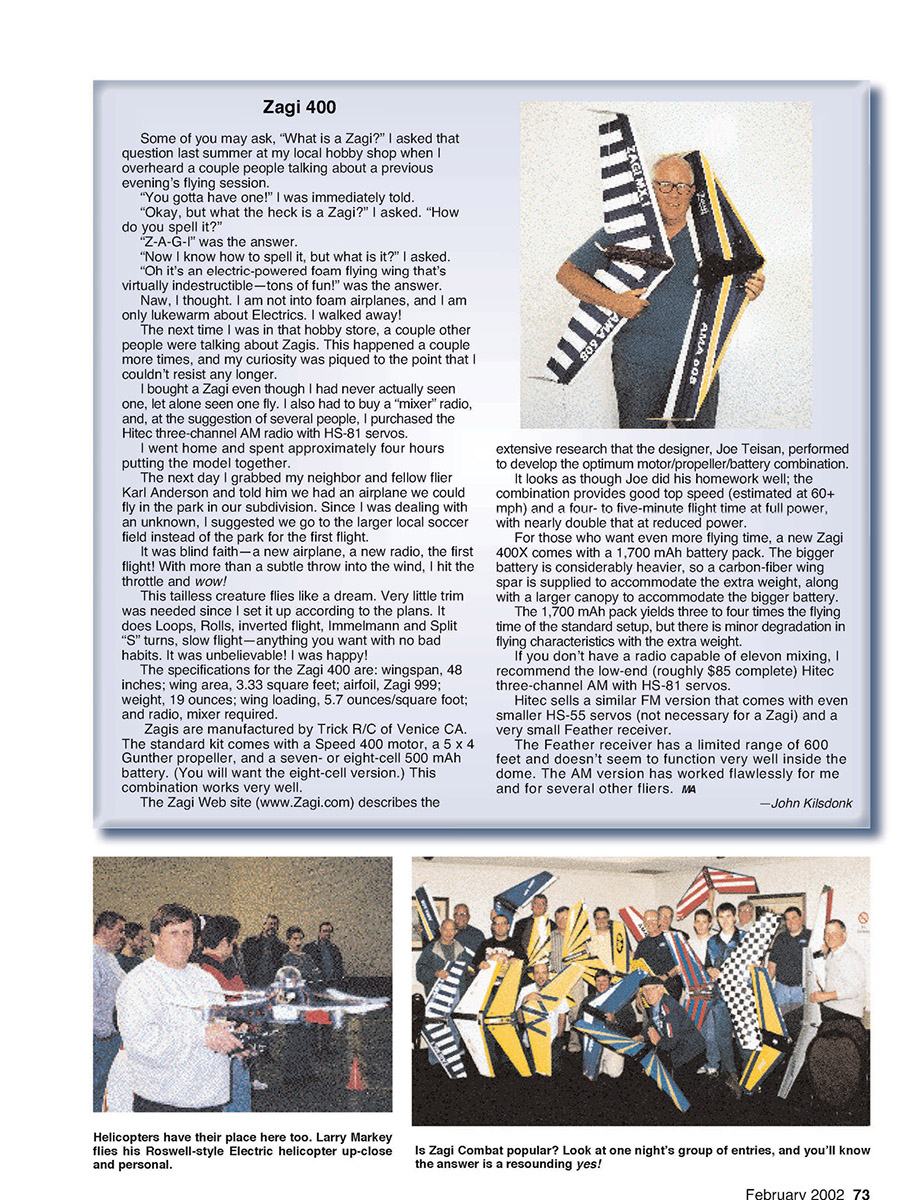
The dome occupies 72,000 square feet (240 x 300 feet), is 82 feet high in the center, and has artificial turf carpet.
Dave Halpin is the general manager of the privately owned facility. In 1998 Dave became interested in RC airplanes and saw the dome as a perfect place for him to learn to fly during off-hours.
As he was learning to fly, the proverbial light bulb went on, and he realized that there might be a business opportunity if he could attract other fliers. So in the winter of 1999-2000, Dave opened the dome to fly. From November through April there is a flying session every other weekend. Beginning in 2001, the dome has scheduled events Sunday nights from 7-10 p.m. May through October for those who don't get enough flying outdoors in the warmer months. In addition, nighttime flying in the summer is scheduled outdoors at the dome's fully lit soccer field. The charge for winter flying at the dome is $15 for a four-hour evening, or you can buy a season pass for all dome events for $140. You get free coffee and pop all year at the events with a season pass. Summer flying is $10 for the three hours. Spectators are charged $1 per evening.
Four types of models are allowed at the dome: Free Flight (Hand-Launched Gliders, rubber-band Catapult, and rubber-powered), Electric RC slow flyers (less than 16 ounces), RC park flyers (more than 16 ounces), and "Full Contact Zagi Combat."
CO2 power is allowed, but combustion engines are not.
For each flying session, there is a schedule posted in 20-minute round-robin intervals for each of the four events. This works out well, because it provides participants time to recharge batteries for each upcoming event. A current AMA license is required for all RC events, and frequency control is obtained by exchanging your AMA card for a frequency card.
The flying is very entertaining to the 20 or more spectators who show up each session; there is a wide variety of interesting models and the always exciting Zagi Combat (more about the Zagis in a bit).
Because of the large number of fliers, there is a great deal of camaraderie and help available to newcomers. More and more fliers are showing up as the year goes on, and almost everybody is branching out into other classes.
The fliers and spectators represent almost every AMA chartered club in metro Detroit, and there is a broad cross-section of Michigan modelers. Chris Savicki — a third-generation modeler — flies in all four events (I flew competition Control Line [CL] with his dad and grandfather in the 1960s).
Also participating are second-generation flier Jason Josaitis, whose dad and uncle ran the famous Joe's Hobby Center for more than 40 years, nationally known RC pilot and CL stunt flier Pete Bergstrom, and even my longtime (nearly 50 years) flying buddy Dave Keats, who was one of the pioneers of RC helicopters. He is best known for his Pylon Racing exploits.
There are many others, too numerous to list.
One of the great things is the number of fathers and sons who fly together. Many people who attend regularly had very little interest in Electric flying until the dome opportunity came along.
Zagi 400
Some of you may ask, "What is a Zagi?" I asked that question last summer at my local hobby shop when I overheard a couple people talking about a previous evening's flying session.
"You gotta have one!" I was immediately told.
"Okay, but what the heck is a Zagi?" I asked. "How do you spell it?"
"Z-A-G-I" was the answer.
"Now I know how to spell it, but what is it?" I asked.
"Oh it's an electric-powered foam flying wing that's virtually indestructible—tons of fun!" was the answer.
Now, I thought, I am not into foam airplanes, and I am only lukewarm about Electrics. I walked away!
The next time I was in that hobby store, a couple other people were talking about Zagis. This happened a couple more times, and my curiosity was piqued to the point that I couldn't resist any longer.
I bought a Zagi even though I had never actually seen one, let alone seen one fly. I also had to buy a "mixer" radio, and, at the suggestion of several people, I purchased the Hitec three-channel AM radio with HS-81 servos.
I went home and spent approximately four hours putting the model together.
The next day I grabbed my neighbor and fellow flier Karl Anderson and told him we had an airplane we could fly in the park in our subdivision. Since I was dealing with an unknown, I suggested we go to the larger local soccer field instead of the park for the first flight.
It was blind faith—a new airplane, a new radio, the first flight! With more than a subtle throw into the wind, I hit the throttle and wow!
This tailless creature flies like a dream. Very little trim was needed since I set it up according to the plans. It does Loops, Rolls, Inverted flight, Immelmann and Split "S" turns, slow flight—anything you want with no bad habits. It was unbelievable! I was happy!
The specifications for the Zagi 400 are: wingspan, 48 inches; wing area, 3.33 square feet; airfoil, Zagi 999; weight, 19 ounces; wing loading, 5.7 ounces/square foot; and radio, mixer required.
Zagis are manufactured by Trick R/C of Venice CA. The standard kit comes with a Speed 400 motor, a 5 x 4 Gunther propeller, and a seven- or eight-cell 500 mAh battery. (You will want the eight-cell version.) This combination works very well.
The Zagi Web site (www.Zagi.com) describes the extensive research that the designer, Joe Teisan, performed to develop the optimum motor/propeller/battery combination.
It looks as though Joe did his homework well; the combination provides good top speed (estimated at 60+ mph) and a four- to five-minute flight time at full power, with nearly double that at reduced power.
For those who want even more flying time, a new Zagi 400X comes with a 1,700 mAh battery pack. The bigger battery is considerably heavier, so a carbon-fiber wing spar is supplied to accommodate the extra weight, along with a larger canopy to accommodate the bigger battery.
The 1,700 mAh pack yields three to four times the flying time of the standard setup, but there is some minor degradation in flying characteristics with the extra weight.
If you don't have a radio capable of elevon mixing, I recommend the low-end (roughly $85 complete) Hitec three-channel AM with HS-81 servos.
Hitec sells a similar FM version that comes with even smaller HS-55 servos (not necessary for a Zagi) and a very small Feather receiver.
The Feather receiver has a limited range of 600 feet and doesn't seem to function very well inside the dome. The AM version has worked flawlessly for me and for several other fliers.
—John Kilsdonk
Midnight Combat
Continued from page 72
This article's purpose is to report on the local winter modeling activities and to encourage fliers in other parts of the country to explore the possibility of using similar facilities in their areas to expand the hobby.
Let's go through a typical series of 20-minute flying rotations.
Free Flight (FF): Indoor FF is usually the first event. There are roughly a half dozen Hand-Launch Gliders, a few of the old Jim Walker rubber catapult-launch-type clones, a half dozen paper/stick rubber-powered models, and even a couple microfilm models.
Bill Leppard, who is there almost every week with a Pennyplane, regularly posts 10+-minute flights.
Chris Sawicki's fiancée Truda flies a paper-and-stick Easy B and a Bulldog. Her models obtain flights exceeding five minutes and are getting better each week.
Despite the regularly good turnout for this event, I am surprised that even more of the local indoor fliers don't take advantage of the facility.
RC Slow Flyers: This is the less-than-16-ounce class of RC Electrics. The only distinction between slow and park flyers is the weight; the former are only marginally slower than the latter.
Some slow flyers weigh as little as 10 ounces, but most are closer to the 16-ounce limit, making the crossover to park flyers somewhat blurry.
Several of the slow flyers are very aerobatic. Models such as U.F.O.s are capable of what appear to be 18-inch loops, very quick rolls, and even an occasional flat spin.
Lite Stiks, Johnny Bees, and Fundagons are also very popular in this class.
RC Park Flyers: This is really a mixed bag of Almost Ready to Flys (ARFs), kits, and scratch-builts. Many of the ARFs are complete packages that include the airplane, motor, gear drive, ESC (Electronic Speed Control), battery, and propeller.
Some ARFs are all-balsa, precovered with heat-shrinkable film, and others are the "foamies." The vast majority of the models are distributed through Hobby Lobby and Great Planes outlets. They offer quality construction and materials, and they are remarkably good fliers.
Very popular rudder-elevator balsa models are the Bloody Mary and the Miss Bohemia. The more-popular foamie ARFs seem to be the Crazy Sparrow, the Wingo, and the Chubby Lady.
The foamies are certainly more durable and they fly decent enough, but not nearly as well as the balsa-and-film airplanes.
Other very popular models are the Triangle V and the Gnat 280—both with ailerons and V-tails—the radical Elipstik, and the Breezy Jr. designed by local flier Dave George.
It is common to even see some "buddy box" action; the slow airplanes in the windless facility provide an excellent venue for new-pilot training.
Electric-helicopter flying is permitted during the slow- or park-flying rotations. I have seen at least 10 people fly them. The very small Piccolos, the bigger ECOS, and the four-motor Roswells are the current gamut. These little eggbeaters fly remarkably well.
Larry Markey and Howard Kendall—two of the helicopter gurus in the area—have put on some remarkable synthesized demonstrations with the Roswells. They look like creatures from out in space dancing around.
Zagi Combat: The last event flown at the dome is Full Contact Zagi Combat. It is far and away the most popular event from the perspective of fliers and spectators.
The Detroit metro area enjoys a solid case of Zaginmania. I would venture to guess that more than 500 Zagis are flying in Michigan. Practically every RC flier I know has at least one. They're so indestructible that once you have one, you will probably always have one!
There are typically 30 or more Zagis present for each biweekly gathering at the dome. A few of Zagi's smaller siblings, the Razors, are also common. A normal 20-minute flying session will feature a solid flightline with as many as 15 Zagis in the air at any one time.
Some fliers have multiple battery packs charged to enable them to get two or more flights in a 20-minute session. They make a quick pit stop to change batteries, and their models are back in the air. Other fliers can be stacked three-deep waiting for a frequency card to clear.
The word “combat” is somewhat misleading. There’s a great deal of contact—and I mean full-bloom midairs. However, the contact is virtually inadvertent; imagine 15 fairly quick airplanes trying to occupy the same confined airspace. Stuff happens!
Zagi midairs are characterized by a loud “thump” as the foam wings slap together. It is common to hear several midairs in a 20-minute session.
Roughly half of the midairs result in only a momentary nibble for both airplanes. The small-number propellers are well-protected, so the airplanes just keep flying.
The midairs that do result in crashes usually happen at low altitude, with little chance to recover, or are caused by damage to the control linkage or the battery dislodging.
Even the models involved in the worst accidents are usually fixed by the next session. Some repairs are made so fast that the airplanes are back in the air in the same session.
The dome management has tried some more-organized events for the Zagis. Balloon-busting didn’t work because the pusher-propeller configuration was well-shielded, and balloons bounced off the wings, or the strings got tangled on airplanes.
Flight and Nylon Pro Racing was nothing short of controlled mayhem and ended up being more inadvertent combat.
An abundance of repair supplies are available from other fliers, and the dome maintains a full supply of propellers, canopies, tape, etc. It is extremely rare that a Zagi has to go home to the basement workshop for extensive repair.
It is almost impossible to watch all of the airplanes and neat misses, but the ever-present music and a solid midair keeps everyone entertained and enthused.
Remember that these flying sessions are going on Saturday at midnight. It’s much more fun than watching late television, and how many people can go to work Monday and tell their coworkers about flying model airplanes at midnight?
The stock Zagi setup provides plenty of performance for indoor flying. However, several fliers have been “hopping up” their Zagis particularly for outdoor flying, but they also fly them in the dome.
Some are using the new expensive brushless motors (roughly $200), and others are using Cobalt 6-speed 400s ($55) or Graupner Speed 480s ($84).
All of the hop-up motor packages require high-discharge (A) Ni-Cd batteries of at least 800 mAh capacity and higher-current speed controllers.
Todd Brooks was one of the first to use a brushless (CD) motor, turning some exotic little props on a three-blade Cox pusher propeller.
Larry Markey had been using a Speed 480 motor with a 6 x 3 Tornado pusher propeller, but he switched to the even faster Cobalt 400 with an APC 6 x 4 tractor propeller. Airspeeds are equal or better than the Avocet setup.
I am certainly no electric-motor expert, but I have learned that the brushless motors—although considerably more expensive—are more efficient and yield longer flight times than brushed-type motors.
It is quite obvious that optimum propeller selection is vital when changing motors. Some of the higher-output motors are timed to run only in one direction; therefore, they require pusher propellers, which are somewhat scarce in the smaller sizes.
If you are interested in hopping up your Zagi, New Creations R/C in Willis, TX has a very knowledgeable technical staff and a good supply of almost everything for electric models. Give the company a call if you have questions about electrics.
A quick look through any model magazine will reveal an ever-increasing supply of electric-powered RTFs (Ready to Fly), ARFs, and simple kits. Most of those don’t fly very well outdoors in any kind of wind. They were once shunned by most avid modelers as junk toys.
However, now, with the possibility of using a good indoor facility where there is an abundance of repairable, these models have become an integral part of our hobby.
As for the old-time modelers like me, who didn’t believe there was a place for foam airplanes, just grab hold of the sticks on a Zagi one time, and you will be a believer!
Now is the time to look for a suitable facility and organize some events for the winter—particularly for those who live in the colder climates.
Once you get into it, I am sure the indoor flying will snowball (pun intended) as it has here in Michigan.
—Ken Kozakievicz
Sources:
- Oakland Yard
5328 Highland Rd Waterford MI 48327 (248)673-0100
- Trick R/C
236 Ventura Ave. Venice CA 90291 (310)301-1614 Zagi.com www.zagi.com
- New Creations R/C
Box 496 Willis TX 77378 (936)856-4630 www.newcreations-rc.com
Transcribed from original scans by AI. Minor OCR errors may remain.

