
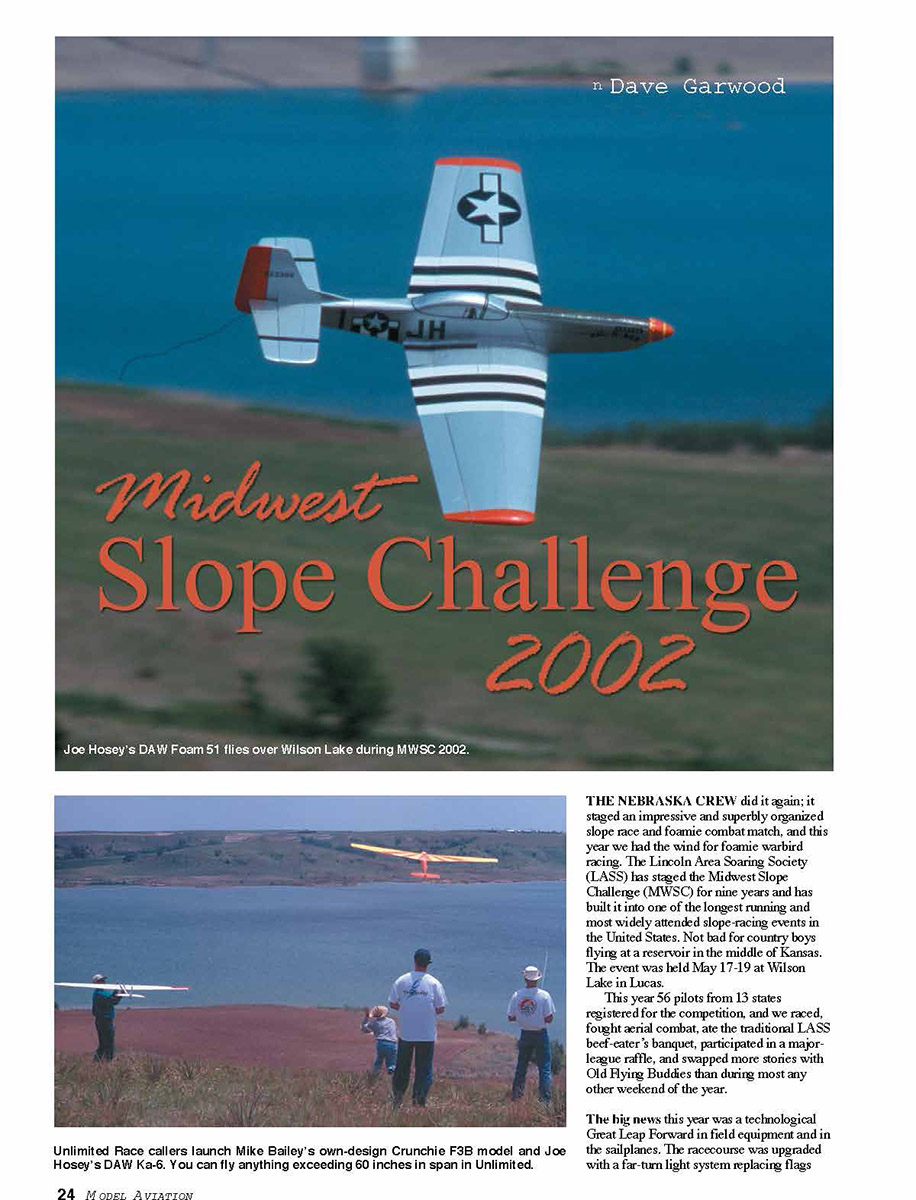
Midwest Slope Challenge 2002
THE NEBRASKA CREW did it again; it staged an impressive and superbly organized slope race and foamie combat match, and this year we had the wind for foamie warbird racing. The Lincoln Area Soaring Society (LASS) has staged the Midwest Slope Challenge (MWSC) for nine years and has built it into one of the longest running and most widely attended slope-racing events in the United States. Not bad for country boys flying at a reservoir in the middle of Kansas. The event was held May 17-19 at Wilson Lake in Lucas.
This year 56 pilots from 13 states registered for the competition, and we raced, fought aerial combat, ate the traditional LASS beef-eater's banquet, participated in a major-league raffle, and swapped more stories with Old Flying Buddies than during most any other weekend of the year.
The big news this year was a technological Great Leap Forward in field equipment and in the sailplanes. The racecourse was upgraded with a far-turn light system replacing flags and a CD-based audio countdown replacing the old, weird clock formerly used to start the races. I think these LASS guys work on planning this event all winter.
We saw four new eagerly anticipated One-Design Racing (ODR) designs. Although we saw replacements for the venerable CR Aircraft Fun-1 last year, they didn't place in the final standings. This year the Magnum Models expanded-polypropylene (EPP)-foam Cobra Racer finished in the money.
The ODR specification is designed to produce hot 60-inch racing sailplanes, yet not break your budget, and the advent of competitive, bounceable ODR models will be welcome to those contemplating slope racing for the first time. There is more about the four new ODR airplanes in an accompanying sidebar.
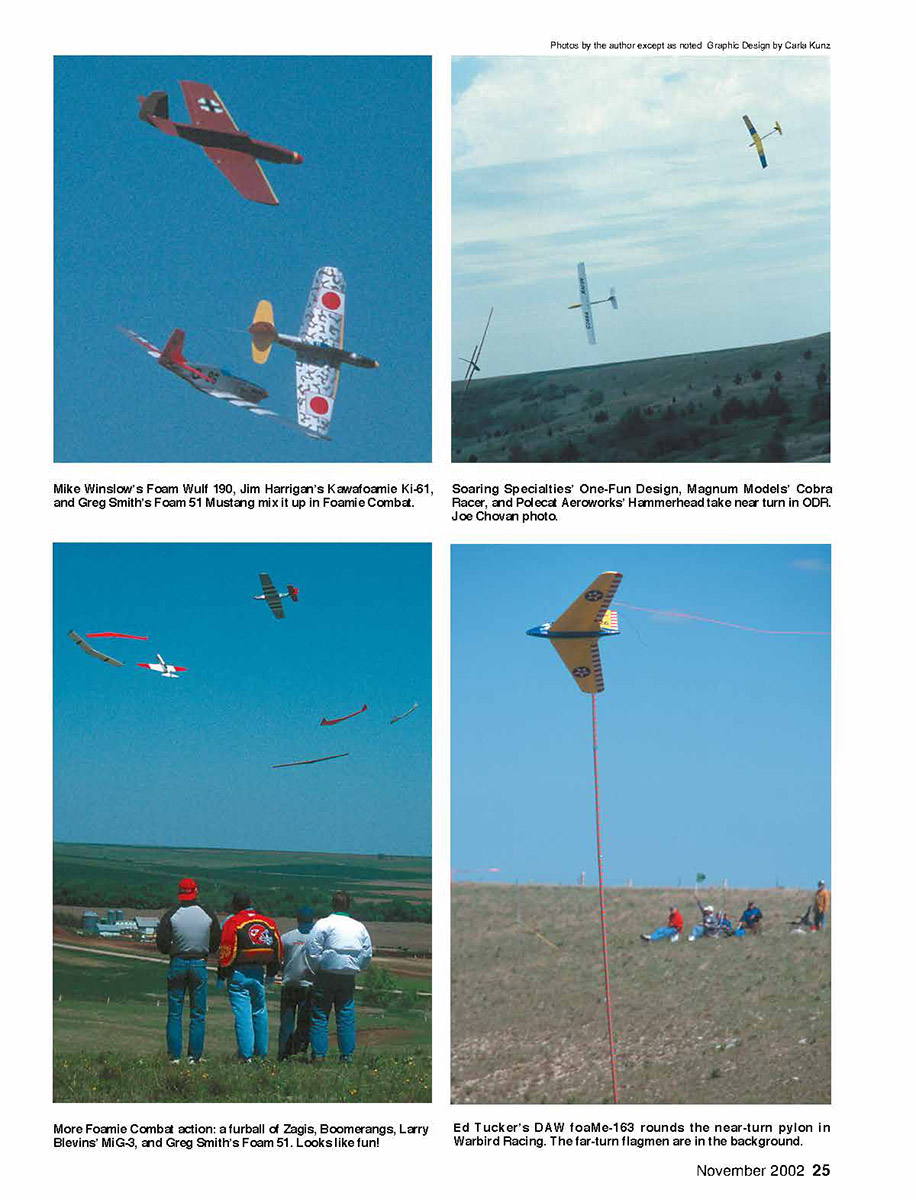
Friday, May 17, brought us sunny skies and a fresh breeze from the north—perfect for the foamie combat event in Kent Palmer's pasture. Foamie combat involves flying several rounds with 15-20 models in the air, and attacking airplanes hit other airplanes with enough force to upset their flight paths and hopefully drive them into the ground.
After each encounter, the victorious pilot must perform a roll or loop verification maneuver to demonstrate that he's in control of his airplane to score a point.
Sounds destructive? In practice it's not, because these airplanes are specifically designed and built from tough and resilient EPP foam to withstand the collisions and crashes, and they are generally immediately picked up and relaunched into the battle.
Approximately 45 pilots registered for the combat event, and multiple heats were run in three rounds. The lift was strong enough that many airplanes recovered after collisions and did not go down.
The lighter Boomerang and Zagi flying‑wing designs definitely had the edge in quick recovery and handily took all five top‑finishing places. The heavier Patton and Sanders World War II fighters look better to many, but their higher weight made them harder to fly out of an encounter. There was discussion of separating the two types of airplanes in future events.
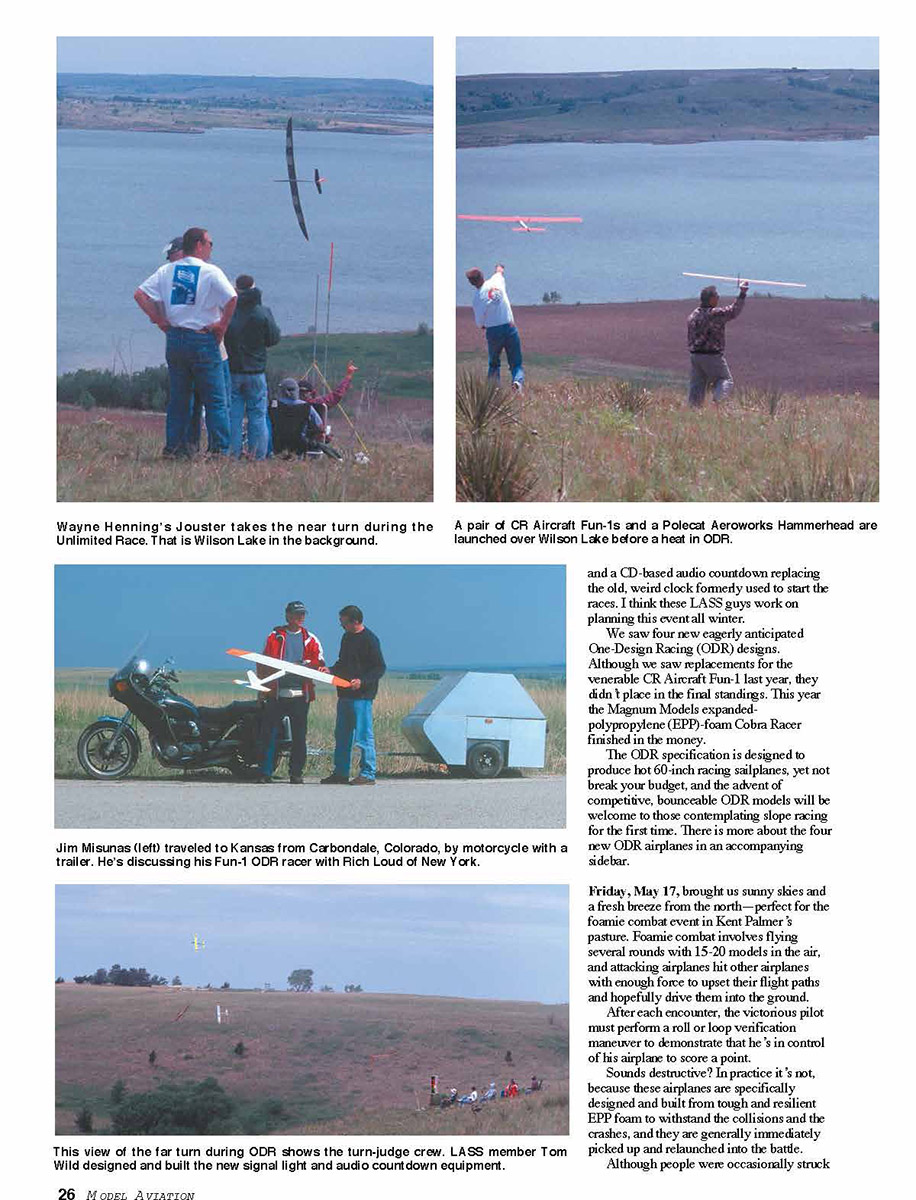
Friday afternoon we flew the Foamie Combat Warbird event in challenging gusty conditions. Contest Director Loren Blinde called for flying around the 30‑foot‑tall near‑turn pole under the top streamer, and an amazing number of pilots hit the pole, simulating great mirth among the audience.
Ed Tucker hit the pole and continued flying to finish the heat, with cheers from the onlookers. It's a good thing these are "rubber airplanes."
Saturday was the scheduled race day, and we had sun but insufficient wind. Fliers entertained themselves with hand launch, winch launch, rocket launch, and electric flying.
Fred Stillman and his nephew Rick Stillman of Colorado demonstrated a special net designed to recover slope airplanes at flying sites that have poor or nonexistent landing areas. The 12 x 20‑foot hockey‑arena net worked fine for stopping sailplanes, but it was more of a challenge to hit than might be expected. Many pilots spent many hours making bungee launches and shooting landing approaches into the net.
The wind forecast looked better Sunday, so the actual race day started with a pilots' meeting at 9:00. ODR began at 10:30, and it was plenty exciting with four airplanes in each heat. With the double‑elimination scoring, a racer could make up for a bad run and still stay in the game to win the match. The top three places went to well‑flown CR Fun‑1s, and an EPP‑foam Cobra Racer from Magnum Models took fourth place.
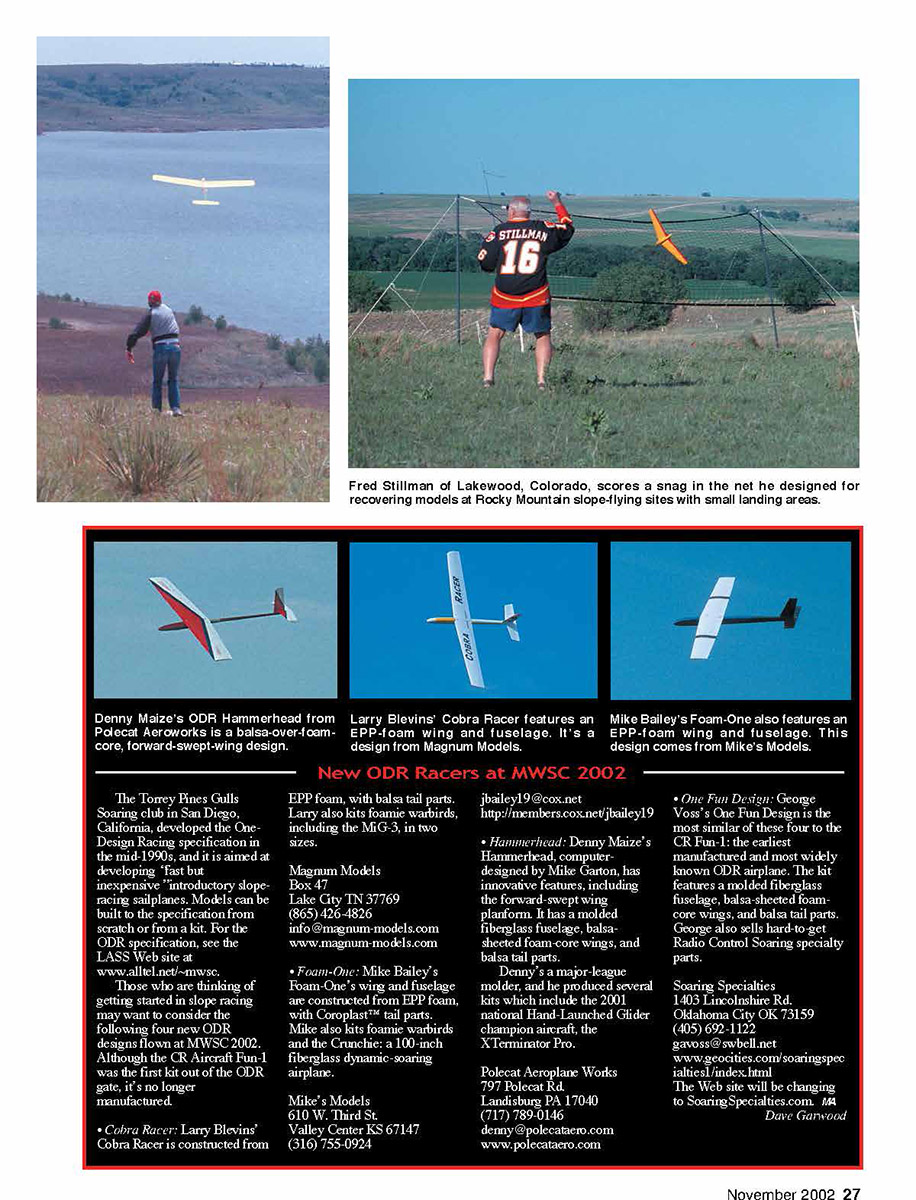
Finally the big guns took to the air for the Unlimited race, which was flown with two models in each heat at some impressive speeds. While the wind velocity was still good, the wind direction turned to give one upwind leg and one downwind leg, so pilot experience with a sailplane paid off.
The specification for airplanes in this race is fairly loose: "60 inch span and larger; Can't fly your ODR plane."
We saw an entertaining variety of aircraft, from typical odd new F3B‑type machines to purpose‑designed dynamic soaring airplanes, a Scale Dave's Aircraft Works (DAW) Schweizer Ka‑6 foamie aerotow trainer, and a venerable Harley Michaels Jouster which came within 15 feet in the final heat of winning the match.
We owe a big thanks to CD Loren Blinde; ace administrative guy Mark Blinde; racing air boss Alden Shipp; Kent Palmer of Lucas for the free and open use of his working pasture for flying; Jim Baker and Steve Davis for running the far‑turn crew; Steve Dvorsky for generating raffle prize donations; Tom and Kelly Neill for a way cool T‑shirt; and Tom Wild for engineering and building the new electronic race equipment.
Many thanks to the major commercial sponsors of this year's MWSC, including Dave's Aircraft Works, Composite Specialties (F3X), HobbyTown USA, J&C Hobbies, Magnum Models (Larry Devins), Midwest Balsa Cutter, Mike's Models (Mike Bailey), North Country Flying Machines, Polecat Aeroworks (Denny Matko), Radio Carbon Art, Reese Productions, ShredAir, SlopFlyer.com (Greg Smith), Soaring Specialties (George Voss), Trick R/C, Tom Hoopes Connectors, and Windrider Aviation.
These country boys plan to do it all again next year, and the 10‑year anniversary MWSC could be a big one. For more photos and detailed information about MWSC 2002, the class rules, and the schedule of next year's event, see the LASS Web site at www.alltel.net/~mwsc or contact Loren Blinde by E‑mail at [email protected].
At the time of this writing, the Academy of Model Aeronautics Executive Council (EC) is poised to consider a proposed rule banning "intentional collision" flying, which could affect foamie combat. By the time you read this, we will know the result of the EC vote. If it did not turn out the way you want AMA to run, contact the EC through your district vice president. We are AMA.
(Editor's note: At its meeting on July 15, 2002, the AMA EC decided to temporarily exclude the prohibition on intentional collisions of model aircraft.)
Dave Garwood 5 Birch Ln. Scotia NY 12302
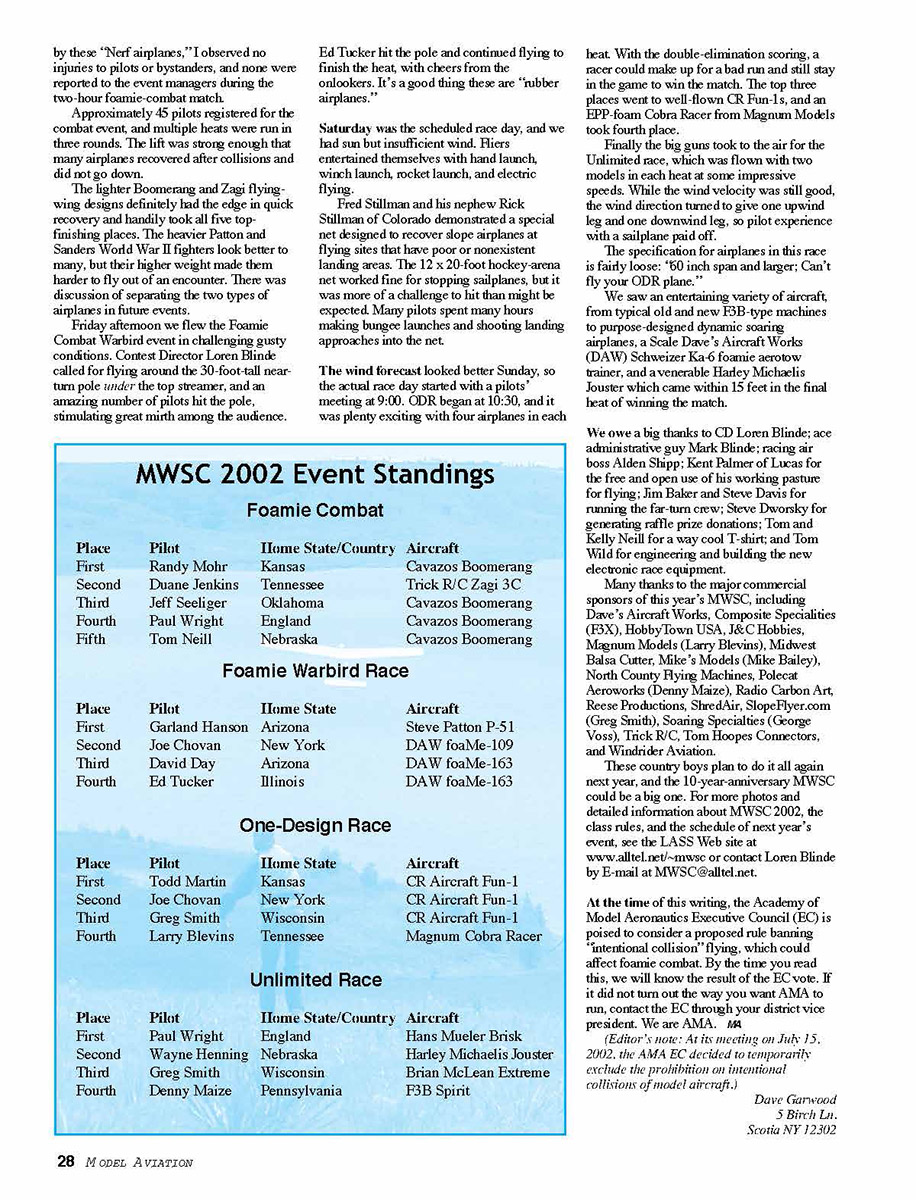
MWSC 2002 Event Standings
Foamie Combat
Place Pilot Home State/Country Aircraft First Randy Mohr Kansas Cavazos Boomerang Second Duane Jenkins Tennessee Trick R/C Zagi 3C Third Jeff Seeliger Oklahoma Cavazos Boomerang Fourth Paul Wright England Cavazos Boomerang Fifth Tom Neill Nebraska Cavazos Boomerang
Foamie Warbird Race
Place Pilot Home State Aircraft First Garland Hanson Arizona Steve Patton P‑51 Second Joe Chovan New York DAW foaMe‑109 Third David Day Arizona DAW foaMe‑163 Fourth Ed Tucker Illinois DAW foaMe‑163
One‑Design Race
Place Pilot Home State Aircraft First Todd Martin Kansas CR Aircraft Fun‑1 Second Joe Chovan New York CR Aircraft Fun‑1 Third Greg Smith Wisconsin CR Aircraft Fun‑1 Fourth Larry Blevins Tennessee Magnum Cobra Racer
Unlimited Race
Place Pilot Home State/Country Aircraft First Paul Wright England Hans Mueller Brisk Second Wayne Henning Nebraska Harley Michaelis Jouster Third Greg Smith Wisconsin Brian McLean Extreme Fourth Denny Maize Pennsylvania F3B Spirit
Transcribed from original scans by AI. Minor OCR errors may remain.

