
Midwest Slope Challenge 2005
By Dave Garwood
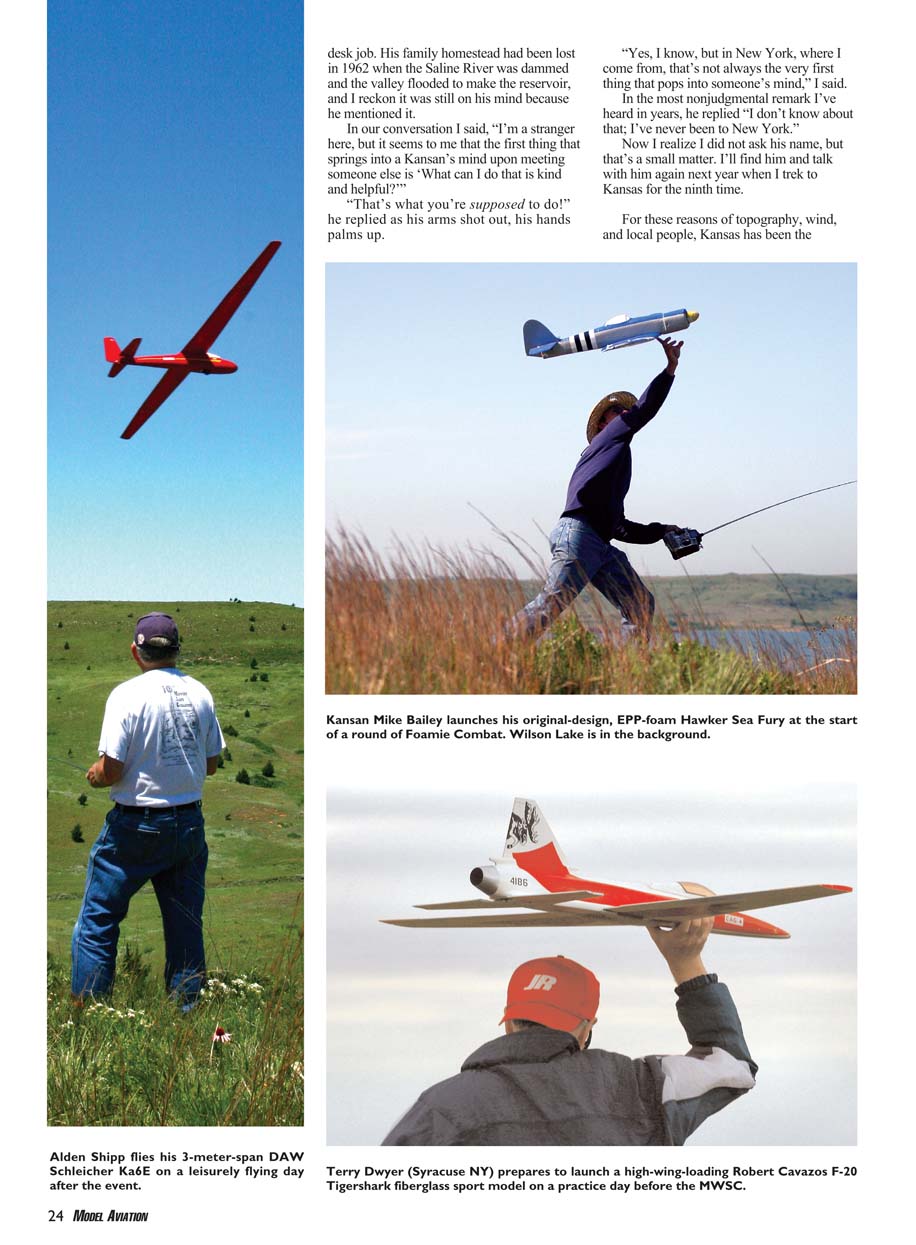
SLOPE SOARING in Kansas? Yes — particularly at Wilson Lake Reservoir, which is about 100 miles from the geographic center of the continental U.S. There are three reasons why Wilson is one of the top-10 slope-flying sites in the country and why it makes such a memorable slope-trip destination.
- The topography around Wilson Lake gives us five or more primo flying sites overlooking water, supporting ridge lift in five wind directions. Flying sites on public land are accessible, thanks to the U.S. Army Corps of Engineers' support. Beyond this, local ranchers generously allow the use of their land, including working pastures, for more flying sites away from the lake itself. Kansas Soaring pilots report that there are four flyable reservoirs in the Sunflower State.
- It's windy on the prairie, and there are few days when you can't fly at least something on the slope. Depending on the weather it may be light hand-launch and discus-launch gliders, long-wing scale models, heavy-wing-loading Power Scale Soaring (PSS) screamers, Foamie Combat models, or several classes of Slope Racing aircraft.
- The people we meet in rural Kansas. Lucas is a town of about 450, and they give visiting slope fliers a warm welcome when we swarm into town. They have even opened the movie theater and run a special matinee for us when we have had to wait out a rainy day in years past.
I've flown in Kansas at the Midwest Slope Challenge (MWSC) eight times in the last decade, and I never fail to meet memorable people who help me understand what life is, or should be.
This year a group of fliers walked into Linda's Café, the sole bar and grill in town, and found it unusually crowded; nearly all the seats were taken. Across the room was a man who looked for all the world like an aging Montana cowboy, sitting at a booth by himself. After one glance across the room and without a word, he got up and took a seat at the bar, giving up his booth for a group of visitors he had never met.
I sat with him at the bar and bought our next round as a way to say thanks. He was a 74-year-old retired farmer, lean as a pole, who looked like he could certainly run faster and jump higher than I could, with my desk job. His family homestead had been lost in 1962 when the Saline River was dammed and the valley flooded to make the reservoir, and I reckon it was still on his mind because he mentioned it.
In our conversation I said, "I'm a stranger here, but it seems to me that the first thing that springs into a Kansan's mind upon meeting someone else is 'What can I do that is kind and helpful?'"
"That's what you're supposed to do!" he replied as his arms shot out, his hands palms up.
"Yes, I know, but in New York, where I come from, that's not always the very first thing that pops into someone's mind," I said.
In the most nonjudgmental remark I've heard in years, he replied, "I don't know about that; I've never been to New York."
I realized I did not ask his name, but that's a small matter. I'll find him and talk with him again next year when I trek to Kansas for the ninth time.
For these reasons of topography, wind, and local people, Kansas has been the location of the Lincoln Area Soaring Society's (LASS, of Nebraska) MWSC for 11 years, making it the longest continuously running Slope Racing event in the U.S. The 12th MWSC, held June 10–12, 2005, had a new host: the Wings Over Wilson (WOW) Soaring club based in Lucas, Kansas. The event had 51 registered pilots who traveled from 11 states—as far north as Minnesota, as far south as Texas, as far west as Colorado, and as far east as New York. One noncompetition flier came from Nassau, Bahamas, technically making it an international event.
Those who arrived on-site early were fed and entertained Wednesday evening, June 7, by Leading Edge Gliders honcho Jack Cooper. He offered much informal instructional time covering designing, building, and finishing EPP-foam warbirds. Jack's airplanes look so good and fly so well that some have a hard time believing they aren't fiberglass molded models. Old flying buddy and overland driving companion Alex Paul and I arrived at the lake Tuesday and had flown three days straight.
Event activities and contest descriptions
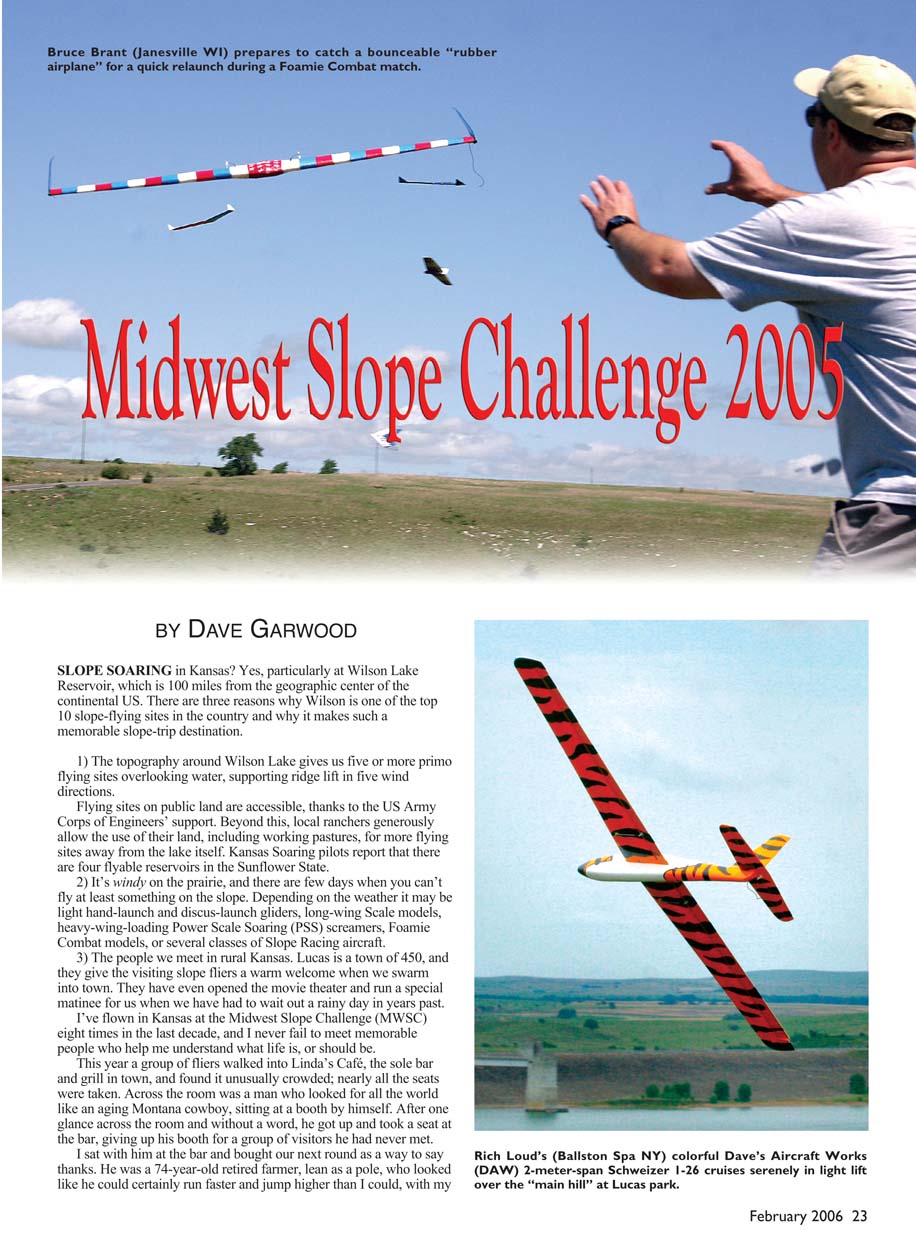
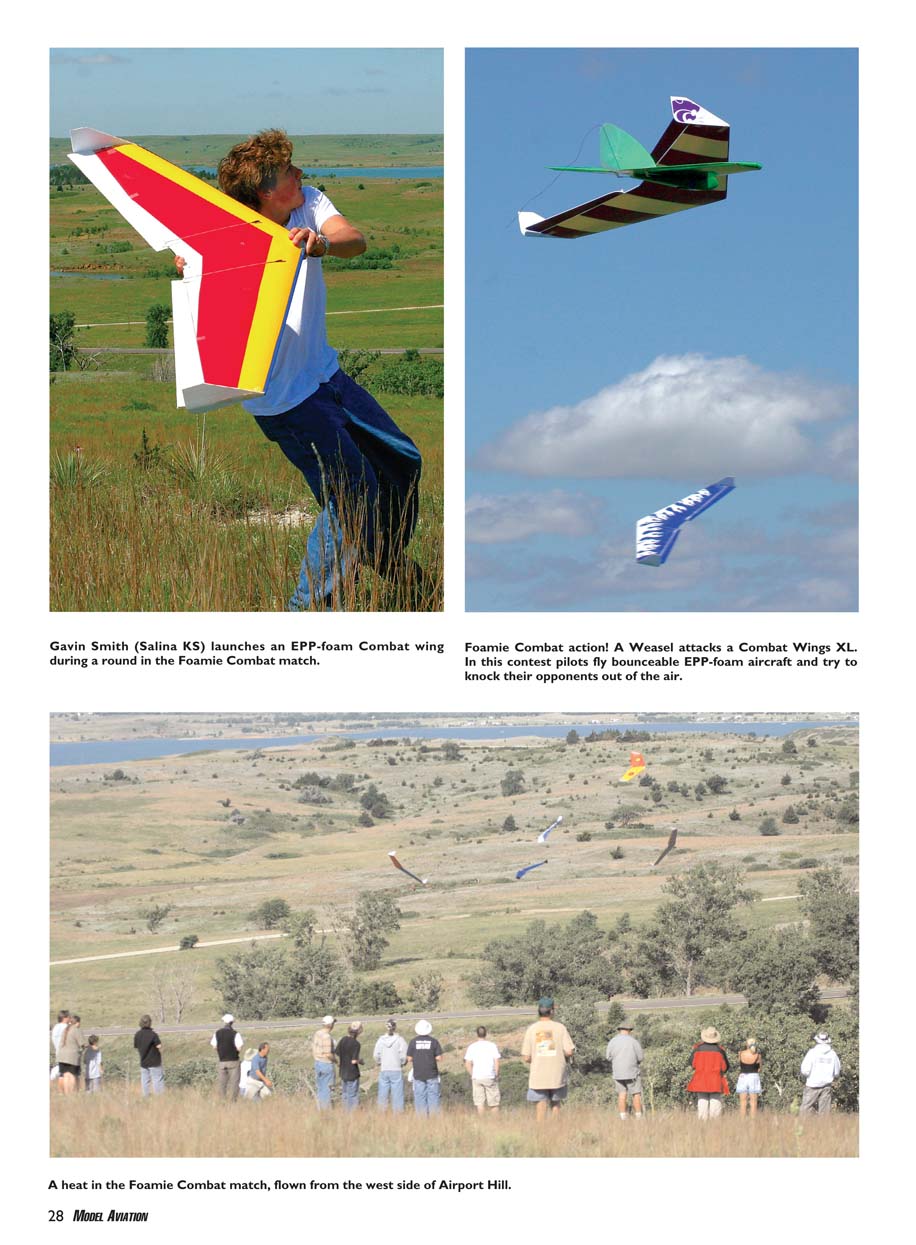
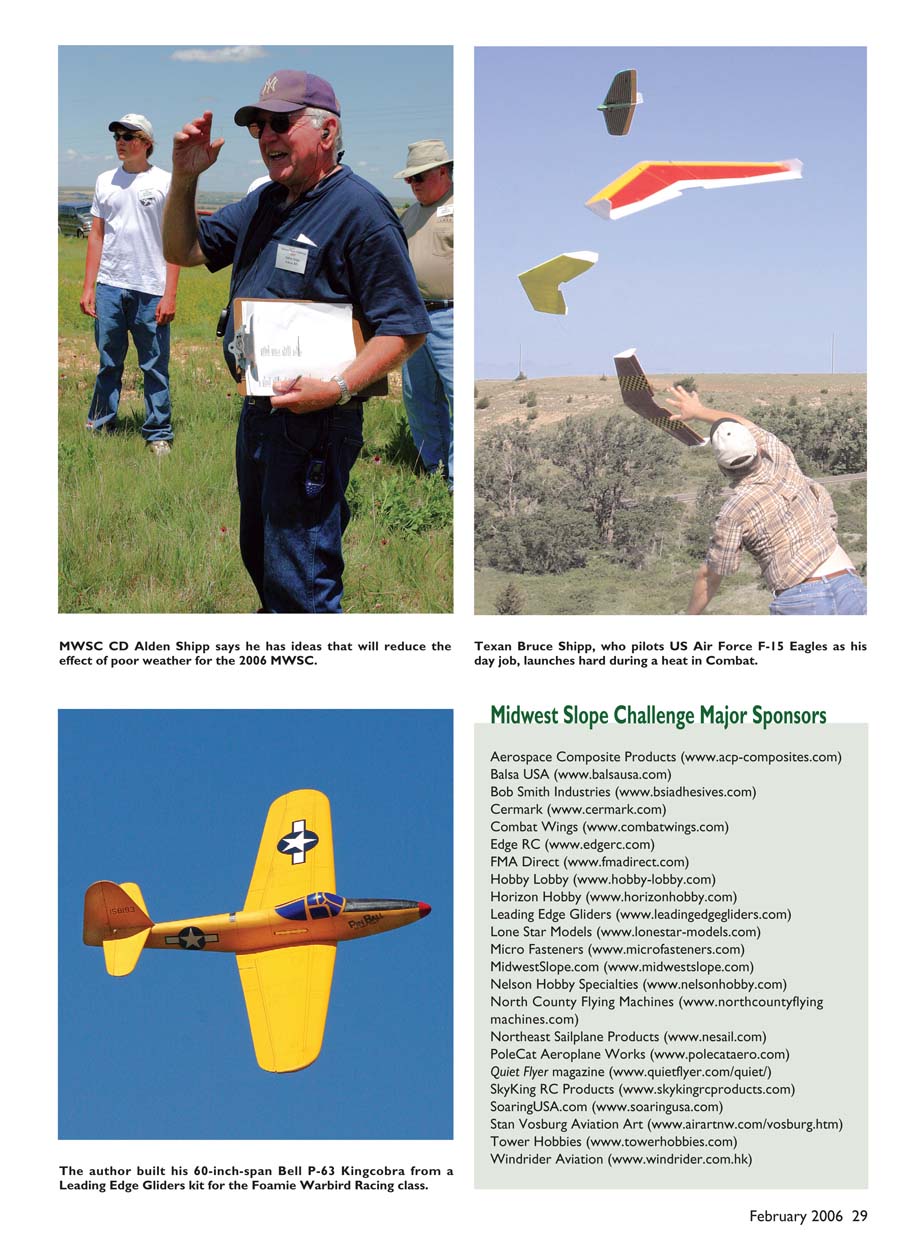
Specialized "bounceable" sailplanes are made from tough EPP foam, which quickly returns to its original size and shape after it's struck or crushed. Most times you can crash a Combat Foamie, pick it up, launch it, and it will fly fine.
Combatants score on opponents by striking their aircraft hard enough to cause them to "depart from controlled flight." The attacker must then fly a loop or a roll to demonstrate that he or she is still in control before the next encounter. Sometimes two or more airplanes get entangled and go down, but generally no serious damage results and the models are launched again to rejoin the fray. The pilot with the most "kills" wins the heat.
Several 10-minute heats of 12–15 airplanes are flown, and kill points are accumulated across heats to determine who will fly in the final heat. Scores are restarted in the final round.
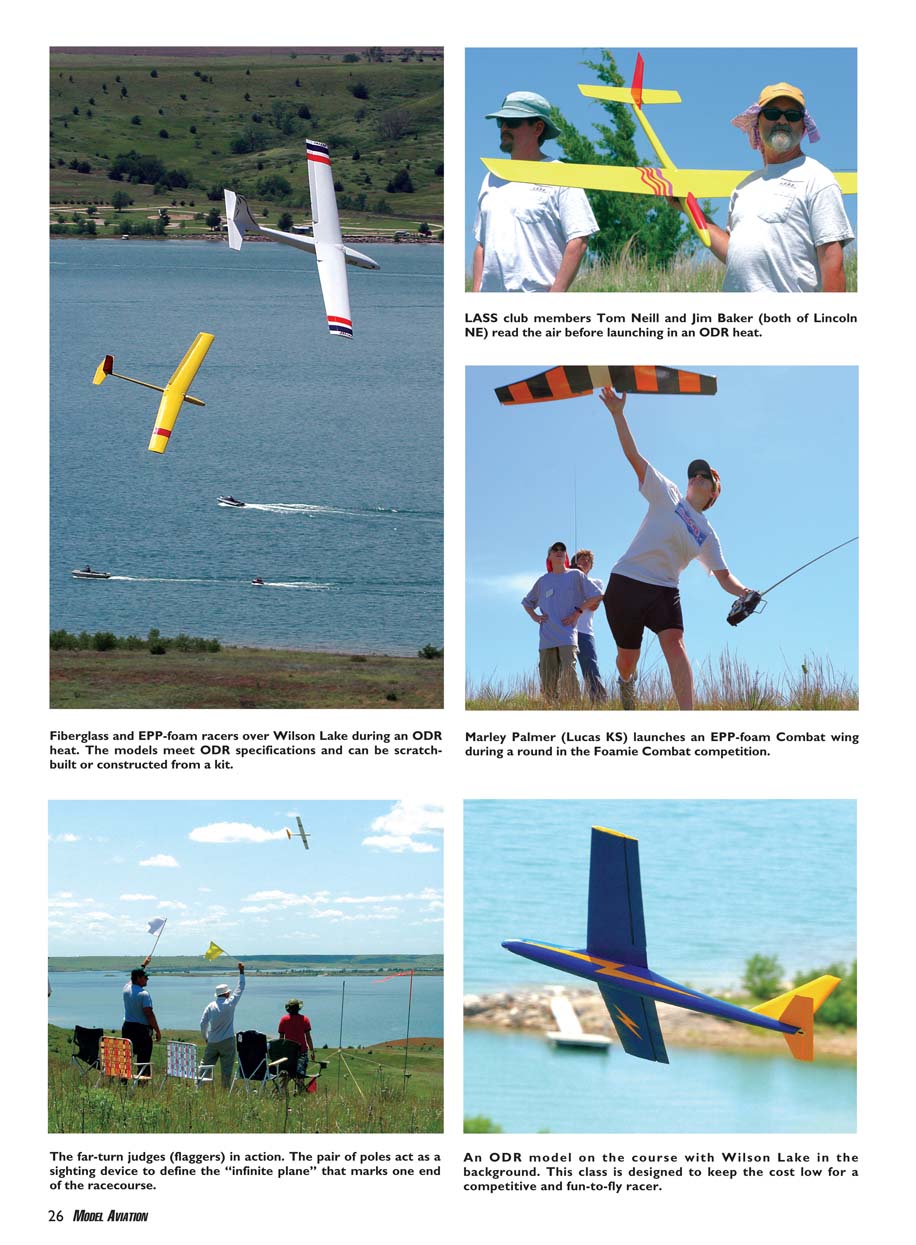
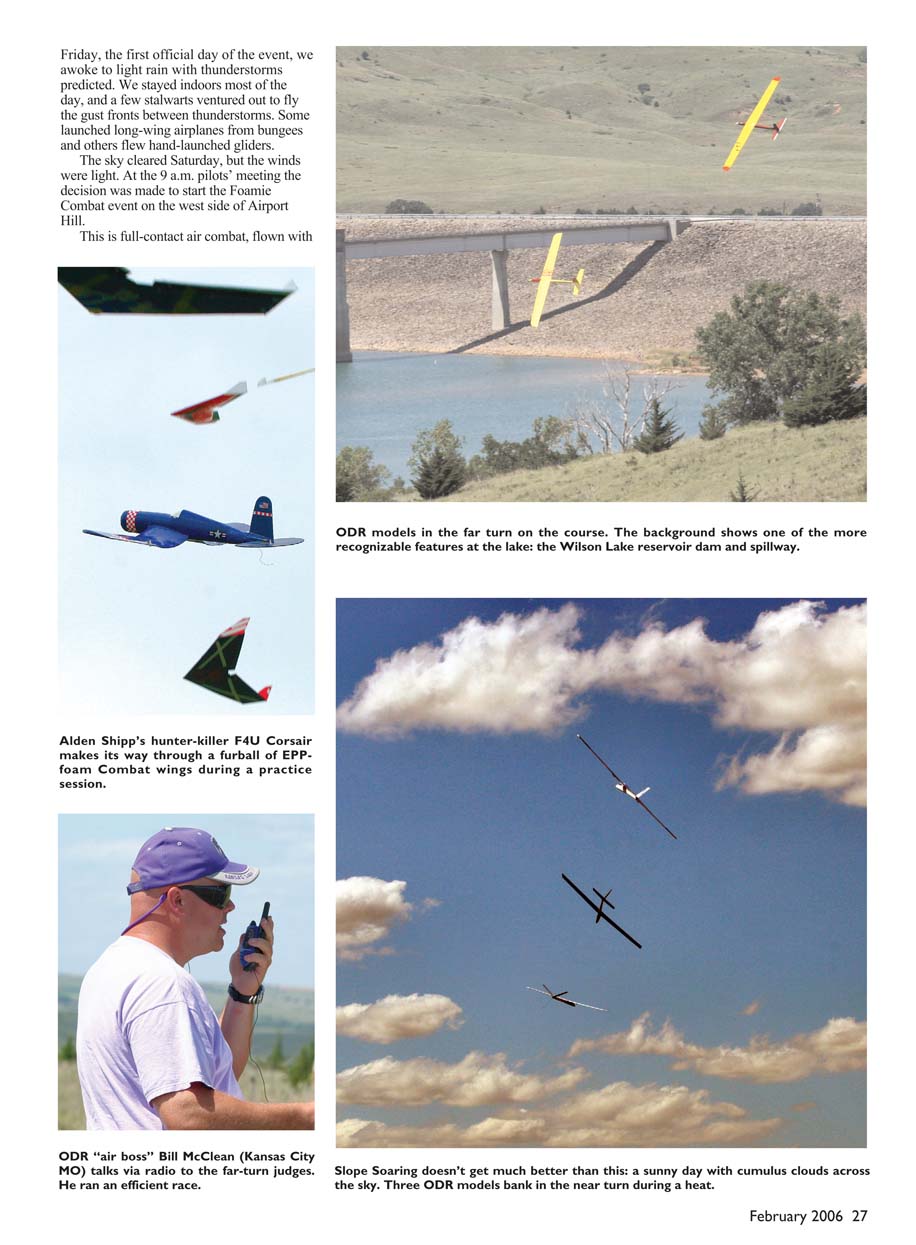
One-Design Racing (ODR) was contested Saturday afternoon at a new site: a tall ridge along the south side of the lake. The ODR specification was developed by the Torrey Pines Gulls and was designed to lower the cost of a racing sailplane. Kits for this class are available in fiberglass and EPP foam.
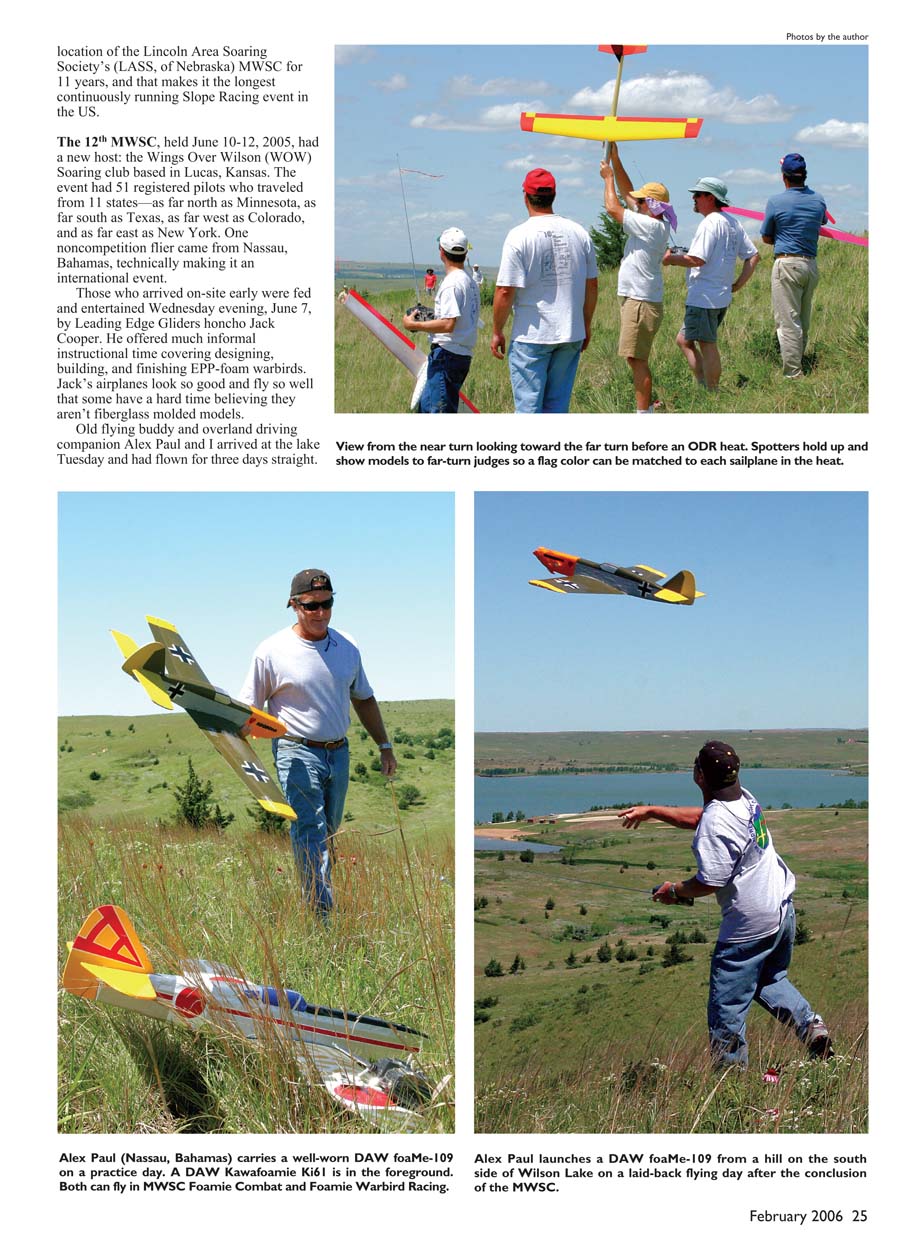
A course is set up along the ridge, with turn points at each end. Turn markers are sighting devices that "define a plane" perpendicular to the length of the racecourse. To complete a lap the aircraft's nose must "cross the plane" at both ends of the racecourse.
Far turns are called by a group of four turn judges, or "flaggers." Near turns are self-called and verified by near-turn judges, who also keep the official lap count.
Each pilot has a caller who launches the model, watches for traffic in the air, and notifies the flier of the far-turn flag signal. At the start of a race, callers hold up the sailplanes one at a time to identify them to the far-turn judges.
Models are launched and given roughly 20 seconds to gain altitude. At an audible signal four airplanes dive onto the course and start the race. Five laps are flown, and points in each heat are awarded according to the finishing order. Race winners are determined by finishing order in the final round.
Lift conditions started light and got lighter throughout the afternoon. A premium was placed on flying smoothly and efficiently, and later rounds amounted to an "all-up/last-down" type of contest.
Foamie Warbird Racing and Unlimited Class Racing were not flown because of light winds Saturday and rain Sunday.
Banquet, awards, and industry presence
Saturday evening the anticipated "Beef-Eaters Banquet" served massive quantities of prime rib. Afterward the WOW club gave awards for the two events completed and held an extensive raffle. We had generous prize support from our contest sponsors. Please patronize them when you can.
During the banquet a lifetime achievement award was presented to Loren Blinde, who was MWSC CD from 1999 to 2004. In attendance were two AMA representatives: District IX Vice President Mark T. Smith and District IX Associate Vice President Jerry Tuttle.
We also rubbed elbows and chatted with six model manufacturers and importers:
- Justin Ammon of Edge RC
- Mike Bailey of MidwestSlope.com
- Ed Berris of Sky King RC Products
- Jack Cooper of Leading Edge Gliders
- Andreas Mergner of Plane Insane Models (www.planeinsanemodels.com)
- Greg Smith of SlopeFlyer.com
The WOW club held the traditional brief annual MWSC suggestion meeting. Notable ideas included:
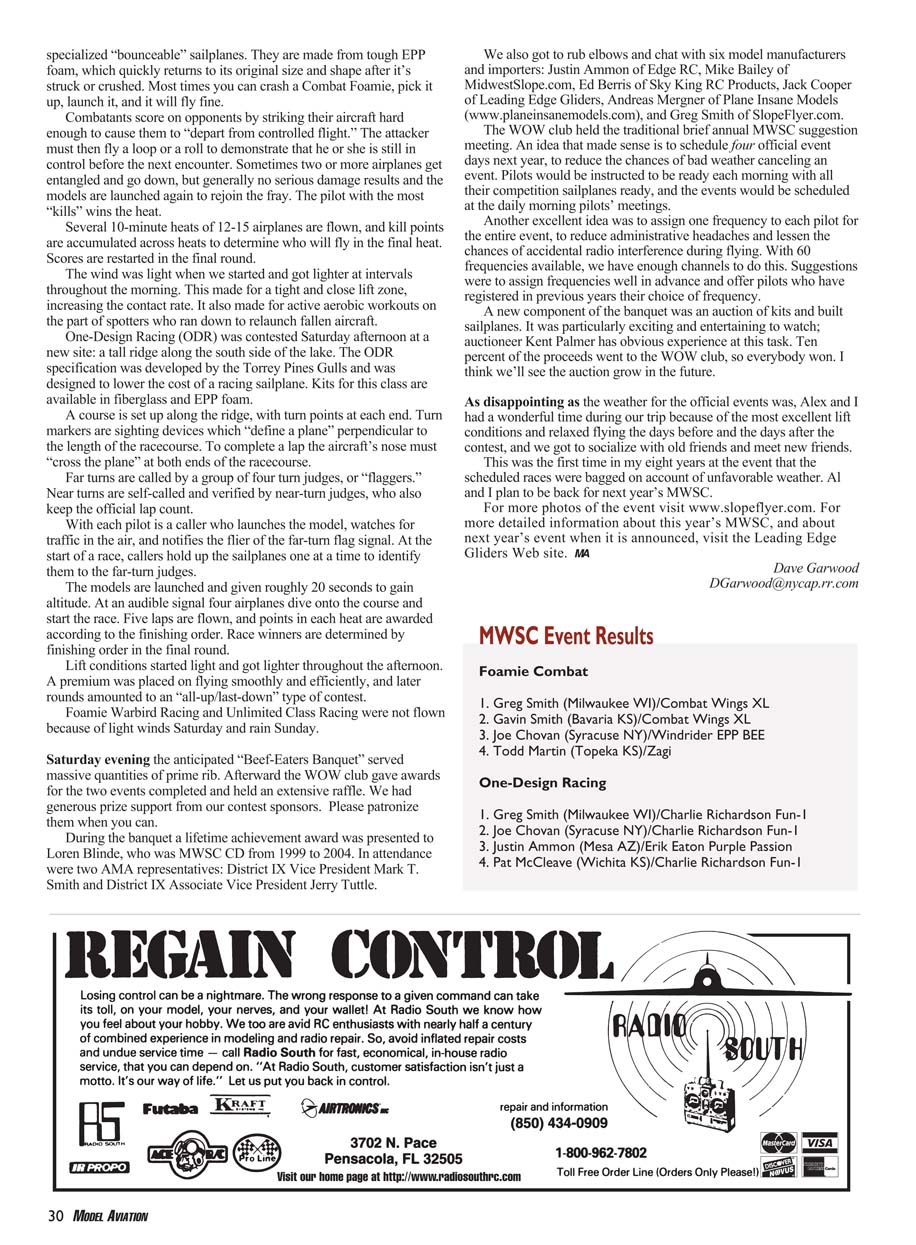
- Schedule four official event days next year to reduce the chances of bad weather canceling an event. Pilots would be instructed to be ready each morning with their competition sailplanes, and events would be scheduled at the daily morning pilots' meetings.
- Assign one frequency to each pilot for the entire event to reduce administrative headaches and lessen the chances of accidental radio interference. With 60 frequencies available, we have enough channels to do this. Suggestions included assigning frequencies well in advance and offering pilots who have registered in previous years their choice of frequency.
A new component of the banquet was an auction of kits and built sailplanes. It was particularly exciting and entertaining to watch; auctioneer Kent Palmer showed obvious experience at this task. Ten percent of the proceeds went to the WOW club, so everybody won. I think we'll see the auction grow in the future.
Closing notes
As disappointing as the weather was for the official events, Alex and I had a wonderful time during our trip because of the excellent lift conditions and relaxed flying on the days before and after the contest, and we got to socialize with old friends and meet new ones.
This was the first time in my eight years at the event that the scheduled races were bagged on account of unfavorable weather. Alex and I plan to be back for next year's MWSC.
For more photos of the event visit www.slopeflyer.com. For more detailed information about this year's MWSC, and about next year's event when it is announced, visit the Leading Edge Gliders web site.
Dave Garwood [email protected]
MWSC Event Results
Foamie Combat
- Greg Smith (Milwaukee, WI) / Combat Wings XL
- Gavin Smith (Bavaria, KS) / Combat Wings XL
- Joe Chovan (Syracuse, NY) / Windrider EPP BEE
- Todd Martin (Topeka, KS) / Zagi
One-Design Racing
- Greg Smith (Milwaukee, WI) / Charlie Richardson Fun-1
- Joe Chovan (Syracuse, NY) / Charlie Richardson Fun-1
- Justin Ammon (Mesa, AZ) / Erik Eaton Purple Passion
- Pat McCleave (Wichita, KS) / Charlie Richardson Fun-1
Transcribed from original scans by AI. Minor OCR errors may remain.

