
Model Aero Polaris
Terry Dunn
Great designs never die; they evolve with the times. Such is the case with Laddie Mikulasko's North Star.
Originally a .40-size balsa/plywood amphibian from the 1980s, North Star was reincarnated a few years ago by Steve Shumate as a sheet-foam park flyer called the Polaris. Model Aero began offering kits of the Polaris in three sizes. The popularity of those kits has spawned the latest derivative of the series: the Polaris Ultra.
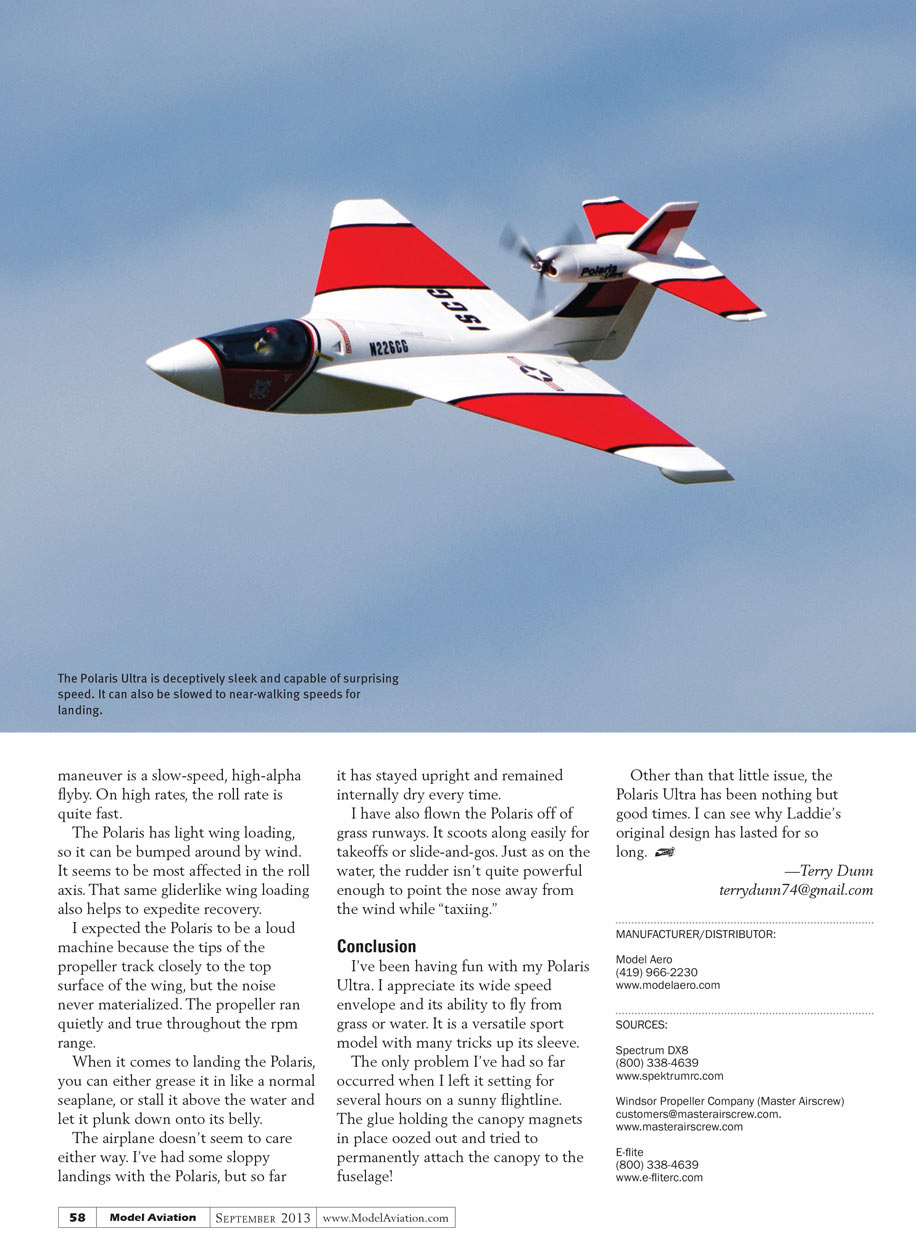
The Ultra has something that has eluded all other Polaris versions, as well as the North Star: curves! Thanks to an injection-molded foam airframe, the Polaris Ultra is not constrained to the slab-sided aesthetics of its predecessors. The result is a sleek, attractive flying machine.
Building Tips
The Polaris Ultra arrived as a kit with a few airframe parts and all of the necessary hardware. The main airframe components are nicely molded and are prepainted in a U.S. Coast Guard scheme. Self-adhesive decals are included to complete the look. On my kit, there were some areas where the painted stripes had bled under the masking tape. Other than that, the color scheme is well executed.
Although I like the look of the painted parts, I would have preferred to have the white sections left unpainted. The foam underneath is also white, so the paint's aesthetic value is questionable. Additionally, the white paint is present at all of the glue joints, and must be removed to guarantee the best glue adhesion between the parts.
The instruction manual is on a CD. The directions are short on details, but the kit is so simple that experienced modelers for whom this airplane is intended should have no problem sorting it all out.
One of the first steps in the assembly process is to bond the wing panels to the spars and fuselage. The Polaris Ultra is a sizeable model and I found it easier to hold off on joining these parts together until the rest of the assembly steps were complete. When the time came, I found that all of the wing parts fit together well and required no trimming.
I used E-flite S-75 microservos on every control surface. The elevator servo shares the motor's foam pod. An internal bracing structure for this pod is preinstalled, as are extension wires for the motor and servo.
There isn't much room for the motor connectors or the servo. The space is adequate, but it is a tight fit. I trimmed out some foam inside the pod to make things easier. The manual shows an alternate, external servo mounting option for those with limited patience.
The elevator servo isn't overly difficult to install, but the level of effort required for the task is inconsistent with the ease of assembling the rest of the model. When I installed the rudder servo and single aileron servo, they fit precisely into their molded pockets within the roomy fuselage. I simply trimmed off the servos' mounting ears and pushed them into place.
Other items within the fuselage are a Spektrum AR500 receiver and an E-flite 60-amp Pro ESC. This ESC is overkill (and weighty) for the Polaris, but I had one available. The huge battery-mounting area has built-in Velcro straps, but I added a strip of self-adhesive Velcro to the floor for additional holding power.
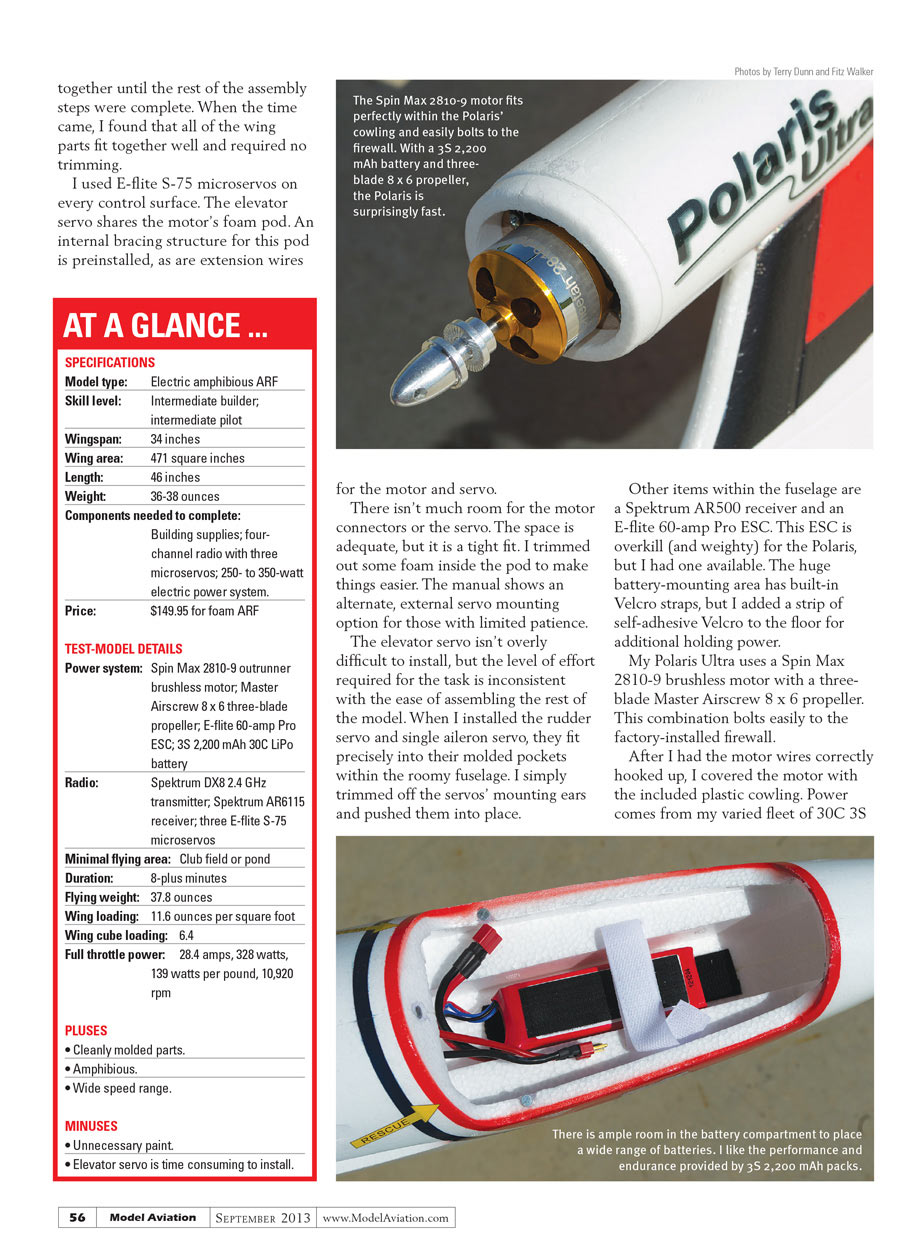
My Polaris Ultra uses a Spin Max 2810-9 brushless motor with a three-blade Master Airscrew 8 x 6 propeller. This combination bolts easily to the factory-installed firewall.
After I had the motor wires correctly hooked up, I covered the motor with the included plastic cowling. Power comes from my varied fleet of 30C 3S 2,200 mAh packs.
AT A GLANCE ...
SPECIFICATIONS Model type: Electric amphibious ARF Skill level: Intermediate builder; intermediate pilot Wingspan: 34 inches Wing area: 471 square inches Length: 46 inches Weight: 36-38 ounces Components needed to complete: Building supplies; four-channel radio with three microservos; 250- to 350-watt electric power system. Price: $149.95 for foam ARF
TEST-MODEL DETAILS Power system: Spin Max 2810-9 outrunner brushless motor; Master Airscrew 8 x 6 three-blade propeller; E-flite 60-amp Pro ESC; 3S 2,200 mAh 30C LiPo battery
Radio: Spektrum DX8 2.4 GHz transmitter; Spektrum AR6115 receiver; three E-flite S-75 microservos
Minimal flying area: Club field or pond Duration: 8-plus minutes Flying weight: 37.8 ounces Wing loading: 11.6 ounces per square foot Wing cube loading: 6.4 Full throttle power: 28.4 amps, 328 watts, 139 watts per pound, 10,920 rpm
PLUSES
- Cleanly molded parts.
- Amphibious.
- Wide speed range.
MINUSES
- Unnecessary paint.
- Elevator servo is time consuming to install.
2,200 mAh LiPo batteries.
After attaching the prepainted pilot bust and instrument panel, I glued the canopy to the battery hatch using Zap’s Formula 560 Canopy Glue. The glue dried clear and bonded well to the foam and plastic parts. A molded tongue in front, along with three rear magnets, keep the hatch in place. I attached the plastic belly skid with 3M Super 77 spray adhesive.
Excluding overnight drying time for the canopy glue, I had my Polaris Ultra ready to fly after only one evening in the shop. I set it up with the recommended control throws and exponential on my Spektrum DX8 transmitter. To attain the suggested CG, the flight battery was placed near the rear of its compartment.
Flying
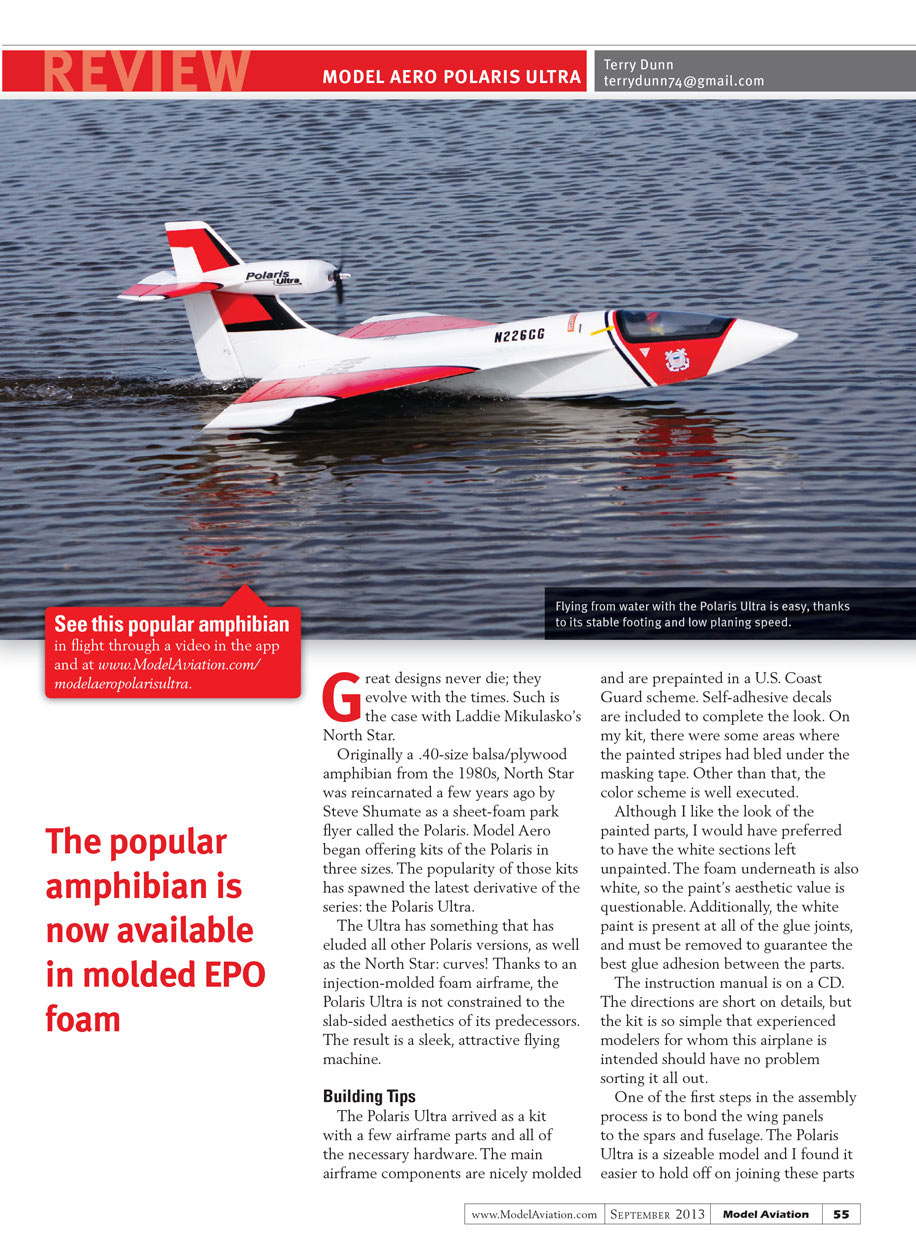
Heavy rains forced my first outing with the Polaris Ultra to take place at an unusual body of water: a chain of large puddles on my club’s paved runway. The Ultra has a shallow draft and had no trouble floating in the ankle-deep, temporary ponds.
The rudder extends slightly into the water and provides a measure of taxiing capability; however, it lacked sufficient authority to turn perpendicular to the prevailing wind.
The Polaris seemed to jump as soon as I added throttle. A little up-elevator broke it free of the water and initiated a climbout. When in the sky, the Ultra accelerated quickly.
Even with the 3S battery, the airplane is surprisingly fast. With a propeller swap, 4S power is also an option. Although I may exercise that option later, I’m happy with the current climb rate and level flight speed.
On its maiden flight, I thought that the Polaris felt nose-heavy. I eased the CG back on subsequent flights until I found the location that I liked—roughly 3/16 inch behind the step in the hull. In this location, the elevator and ailerons have good control authority, and the airplane must be forced into a stall. The only downside is a slight tail wag in the turns.
Rudder response is slightly sedate, but the Ultra is capable of all of the basic four-channel aerobatics. It has plenty of power for tall up-lines and big loops. One particularly fun maneuver is a slow-speed, high-alpha flyby. On high rates, the roll rate is quite fast.
The Polaris has light wing loading, so it can be bumped around by wind. It seems to be most affected in the roll axis. That same gliderlike wing loading also helps to expedite recovery.
I expected the Polaris to be a loud machine because the tips of the propeller track closely to the top surface of the wing, but the noise never materialized. The propeller ran quietly and true throughout the rpm range.
When it comes to landing the Polaris, you can either grease it in like a normal seaplane, or stall it above the water and let it plunk down onto its belly.
The airplane doesn't seem to care either way. I've had some sloppy landings with the Polaris, but so far it has stayed upright and remained internally dry every time.
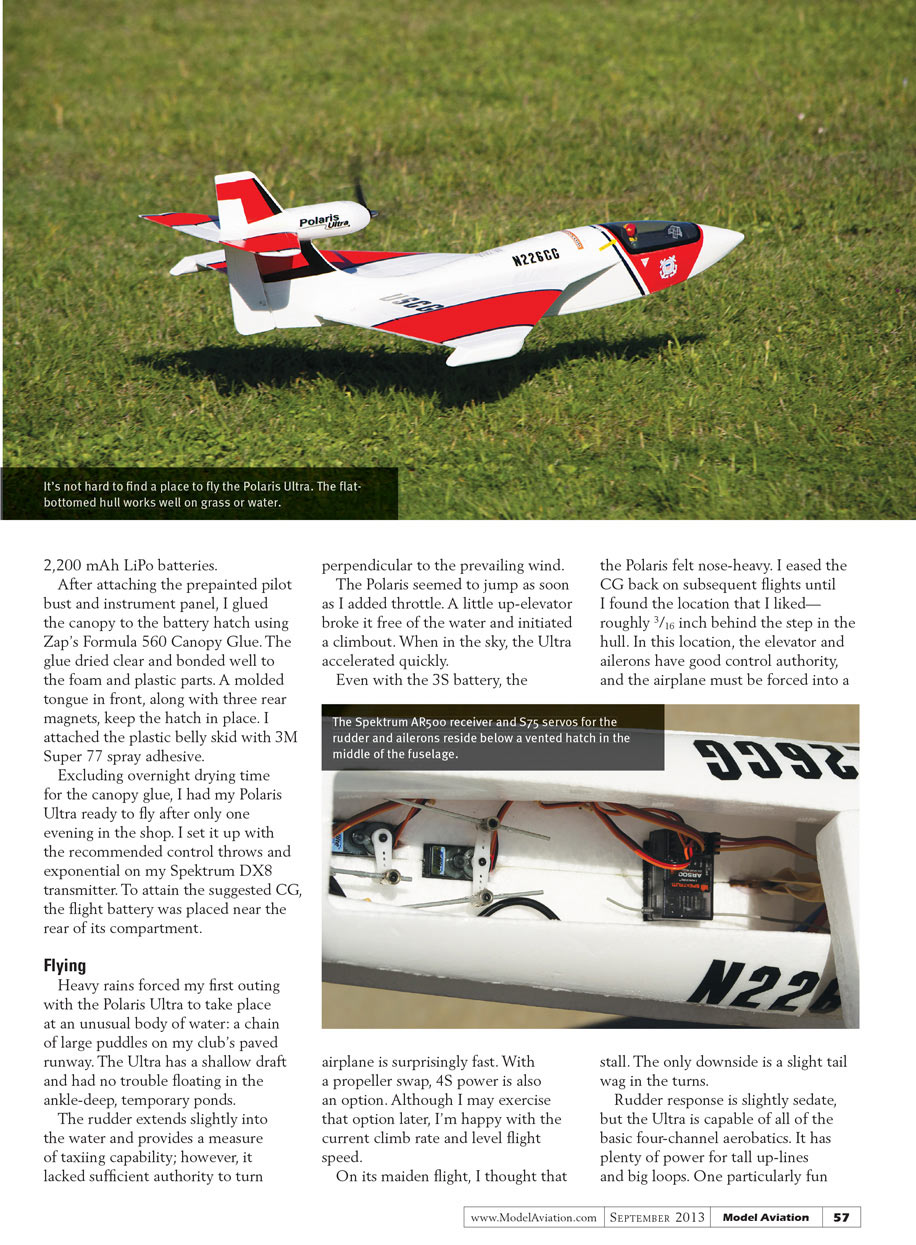
I have also flown the Polaris off of grass runways. It scoots along easily for takeoffs or slide-and-gos. Just as on the water, the rudder isn't quite powerful enough to point the nose away from the wind while "taxiing."
Conclusion
I've been having fun with my Polaris Ultra. I appreciate its wide speed envelope and its ability to fly from grass or water. It is a versatile sport model with many tricks up its sleeve.
The only problem I've had so far occurred when I left it setting for several hours on a sunny flightline. The glue holding the canopy magnets in place oozed out and tried to permanently attach the canopy to the fuselage!
Other than that little issue, the Polaris Ultra has been nothing but good times. I can see why Laddie's original design has lasted for so long.
Terry Dunn [email protected]
MANUFACTURER/DISTRIBUTOR: Model Aero (419) 966-2230 www.modelaero.com
SOURCES: Spectrum DX8 (800) 338-4639 www.spektrumrc.com
Windsor Propeller Company (Master Airscrew) [email protected] www.masterairscrew.com
E-flite (800) 338-4639 www.e-fliterc.com
Transcribed from original scans by AI. Minor OCR errors may remain.

