
Model Aviation Hall of Fame
Class of 2008
Established in 1969, the Model Aviation Hall of Fame honors those men and women who have made significant contributions to the sport of aeromodeling.
The list of members is long and distinguished. These people have made contributions to model aviation through volunteer or administrative activities, product development, competition performance, or a variety or combination of activities.
The Hall of Fame Selection Committee is composed of past AMA presidents and one Hall of Fame member selected from each of the 11 districts by the respective vice presidents.
Each year a new class is inducted into the Model Aviation Hall of Fame and the winners are announced in MA. Anyone may submit a Hall of Fame nomination form.
For a nomination form or further information:
- Contact Jackie Shalberg at (765) 287-1256, ext. 511.
- Find the current form online at www.modelaircraft.org (document 152).
The committee has selected the following people for the 2008 Model Aviation Hall of Fame.
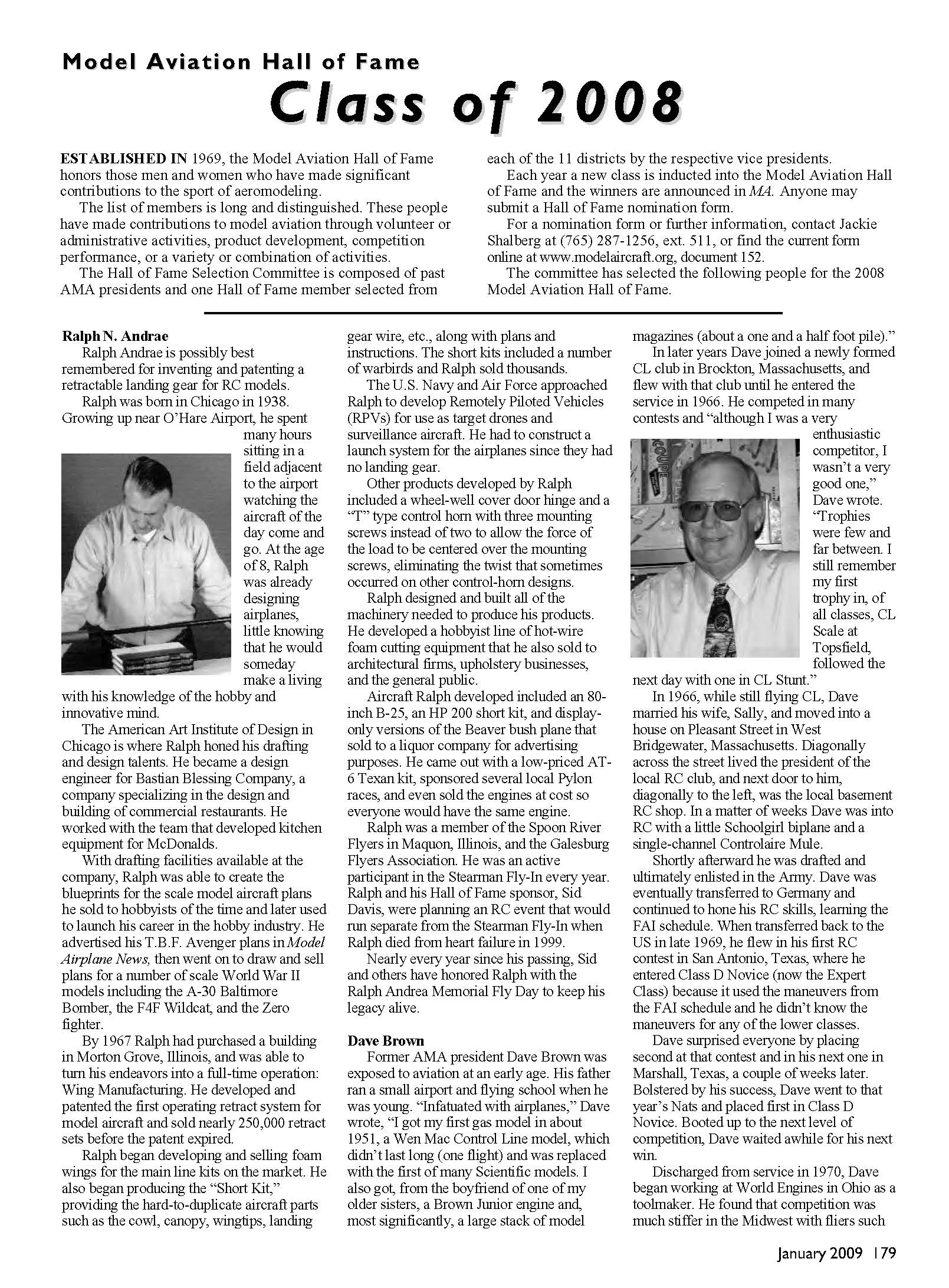
Ralph N. Andrae
Ralph Andrae is possibly best remembered for inventing and patenting a retractable landing gear for RC models.
Ralph was born in Chicago in 1938. Growing up near O'Hare Airport, he spent many hours sitting in a field adjacent to the airport watching the aircraft of the day come and go. At the age of 8, Ralph was already designing airplanes, little knowing that he would someday make a living with his knowledge of the hobby and innovative mind.
The American Art Institute of Design in Chicago is where Ralph honed his drafting and design talents. He became a design engineer for Bastian Blessing Company, a company specializing in the design and building of commercial restaurants. He worked with the team that developed kitchen equipment for McDonald's.
With drafting facilities available at the company, Ralph was able to create the blueprints for the scale model aircraft plans he sold to hobbyists of the time and later used to launch his career in the hobby industry. He advertised his TBF Avenger plans in Model Airplane News, then went on to draw and sell plans for a number of scale World War II models including the A-30 Baltimore Bomber, the F4F Wildcat, and the Zero fighter.
By 1967 Ralph had purchased a building in Morton Grove, Illinois, and was able to turn his endeavors into a full-time operation: Wing Manufacturing. He developed and patented the first operating retract system for model aircraft and sold nearly 250,000 retract sets before the patent expired.
Ralph began developing and selling foam wings for the main line kits on the market. He also began producing the "Short Kit," providing the hard-to-duplicate aircraft parts such as the cowl, canopy, wingtips, landing gear wire, etc., along with plans and instructions. The short kits included a number of warbirds and Ralph sold thousands.
The U.S. Navy and Air Force approached Ralph to develop Remotely Piloted Vehicles (RPVs) for use as target drones and surveillance aircraft. He had to construct a launch system for the airplanes since they had no landing gear.
Other products developed by Ralph included a wheel-well cover door hinge and a "T" type control horn with three mounting screws instead of two to allow the force of the load to be centered over the mounting screws, eliminating the twist that sometimes occurred on other control-horn designs.
Ralph designed and built all of the machinery needed to produce his products. He developed a hobbyist line of hot-wire foam cutting equipment that he also sold to architectural firms, upholstery businesses, and the general public.
Aircraft Ralph developed included an 80-inch B-25, an HP 200 short kit, and display-only versions of the Beaver bush plane that sold to a liquor company for advertising purposes. He came out with a low-priced AT-6 Texan kit, sponsored several local pylon races, and even sold the engines at cost so everyone would have the same engine.
Ralph was a member of the Spoon River Flyers in Maquon, Illinois, and the Galesburg Flyers Association. He was an active participant in the Stearman Fly-In every year. Ralph and his Hall of Fame sponsor, Sid Davis, were planning an RC event that would run separate from the Stearman Fly-In when Ralph died from heart failure in 1999.
Nearly every year since his passing, Sid and others have honored Ralph with the Ralph Andrae Memorial Fly Day to keep his legacy alive.
Dave Brown
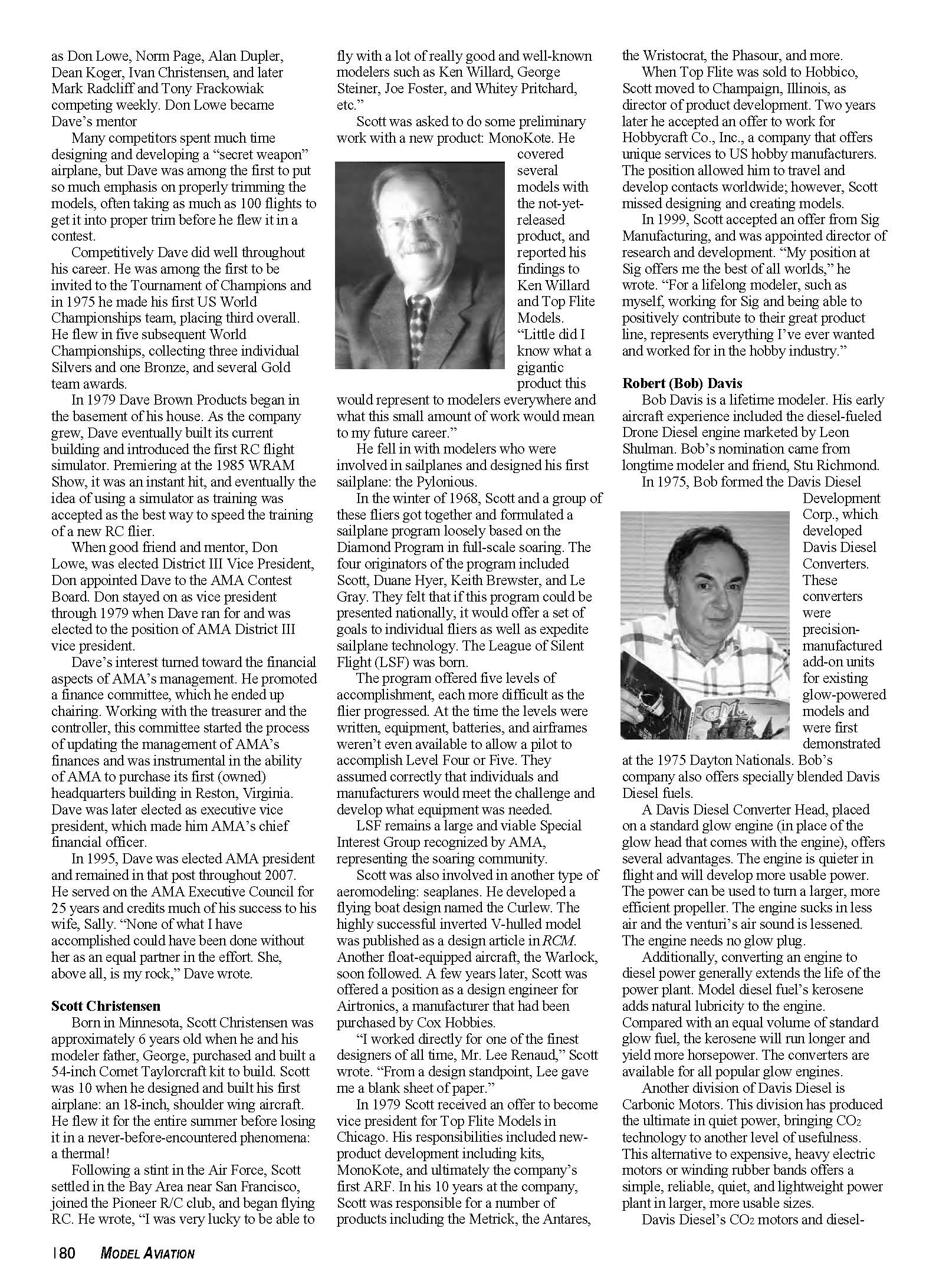
Former AMA president Dave Brown was exposed to aviation at an early age. His father ran a small airport and flying school when he was young. "Infatuated with airplanes," Dave wrote, "I got my first gas model in about 1951, a Wen Mac control-line model, which didn't last long (one flight) and was replaced with the first of many Scientific models. I also got, from the boyfriend of one of my older sisters, a Brown Junior engine and, most significantly, a large stack of model magazines (about a one and a half foot pile)."
In later years Dave joined a newly formed control-line club in Brockton, Massachusetts, and flew with that club until he entered the service in 1966. He competed in many contests and "although I was a very enthusiastic competitor, I wasn't a very good one," Dave wrote. "Trophies were few and far between. I still remember my first trophy in, of all classes, CL Scale at Topsfield, followed the next day with one in CL Stunt."
In 1966, while still flying control line, Dave married his wife, Sally, and moved into a house on Pleasant Street in West Bridgewater, Massachusetts. Diagonally across the street lived the president of the local RC club, and next door to him, diagonally to the left, was the local basement RC shop. In a matter of weeks Dave was into RC with a little Schoolgirl biplane and a single-channel Controlaire Mule.
Shortly afterward he was drafted and ultimately enlisted in the Army. Dave was eventually transferred to Germany and continued to hone his RC skills, learning the FAI schedule. When transferred back to the US in late 1969, he flew in his first RC contest in San Antonio, Texas, where he entered Class D Novice (now the Expert Class) because it used the maneuvers from the FAI schedule and he didn't know the maneuvers for any of the lower classes.
Dave surprised everyone by placing second at that contest and in his next one in Marshall, Texas, a couple of weeks later. Bolstered by his success, Dave went to that year's Nats and placed first in Class D Novice. Booted up to the next level of competition, Dave waited awhile for his next win.
Discharged from service in 1970, Dave began working at World Engines in Ohio as a toolmaker. He found that competition was much stiffer in the Midwest.
Scott Christensen
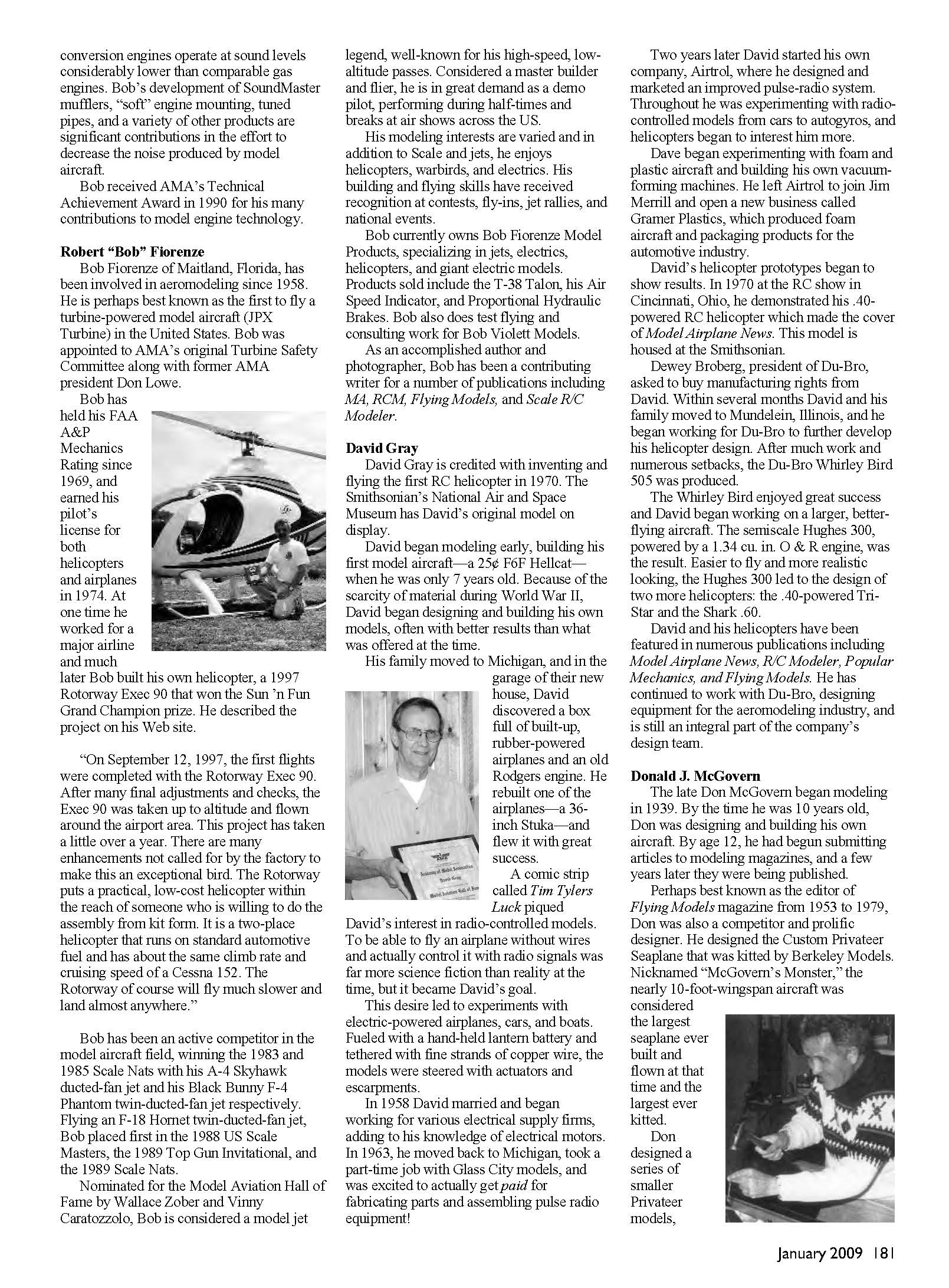
Born in Minnesota, Scott Christensen was approximately 6 years old when he and his modeler father, George, purchased and built a 54-inch Comet Taylorcraft kit. Scott was 10 when he designed and built his first airplane: an 18-inch shoulder-wing aircraft. He flew it for the entire summer before losing it in a never-before-encountered phenomenon: a thermal!
Following a stint in the Air Force, Scott settled in the Bay Area near San Francisco, joined the Pioneer R/C Club, and began flying RC. He wrote, "I was very lucky to be able to fly with a lot of really good and well-known modelers such as Ken Willard, George Steiner, Joe Foster, and Whitey Pritchard, etc."
Scott was asked to do some preliminary work with a new product: MonoKote. He covered several models with the not-yet-released product, and reported his findings to Ken Willard and Top Flite Models. "Little did I know what a gigantic product this would represent to modelers everywhere and what this small amount of work would mean to my future career."
He fell in with modelers who were involved in sailplanes and designed his first sailplane: the Pylonius.
In the winter of 1968, Scott and a group of these fliers got together and formulated a sailplane program loosely based on the Diamond Program in full-scale soaring. The four originators of the program included Scott, Duane Hyer, Keith Brewster, and Le Gray. They felt that if this program could be presented nationally, it would offer a set of goals to individual fliers as well as expedite sailplane technology. The League of Silent Flight (LSF) was born.
The program offered five levels of accomplishment, each more difficult as the flier progressed. At the time the levels were written, equipment, batteries, and airframes weren't even available to allow a pilot to accomplish Level Four or Five. They assumed correctly that individuals and manufacturers would meet the challenge and develop what equipment was needed.
LSF remains a large and viable Special Interest Group recognized by AMA, representing the soaring community.
Scott was also involved in another type of aeromodeling: seaplanes. He developed a flying-boat design named the Curlew. The highly successful inverted V-hulled model was published as a design article in RCM. Another float-equipped aircraft, the Warlock, soon followed. A few years later, Scott was offered a position as a design engineer for Airtronics, a manufacturer that had been purchased by Cox Hobbies.
"I worked directly for one of the finest designers of all time, Mr. Lee Renaud," Scott wrote. "From a design standpoint, Lee gave me a blank sheet of paper."
In 1979 Scott received an offer to become vice president for Top Flite Models in Chicago. His responsibilities included new-product development including kits, MonoKote, and ultimately the company's first ARF. In his 10 years at the company, Scott was responsible for a number of products including the Metrick, the Antares, the Wristocrat, the Phasour, and more.
When Top Flite was sold to Hobbico, Scott moved to Champaign, Illinois, as director of product development. Two years later he accepted an offer to work for Hobbycraft Co., Inc., a company that offers unique services to US hobby manufacturers. The position allowed him to travel and develop contacts worldwide; however, Scott missed designing and creating models.
In 1999, Scott accepted an offer from Sig Manufacturing and was appointed director of research and development. "My position at Sig offers me the best of all worlds," he wrote. "For a lifelong modeler, such as myself, working for Sig and being able to positively contribute to their great product line, represents everything I've ever wanted and worked for in the hobby industry."
Robert (Bob) Davis
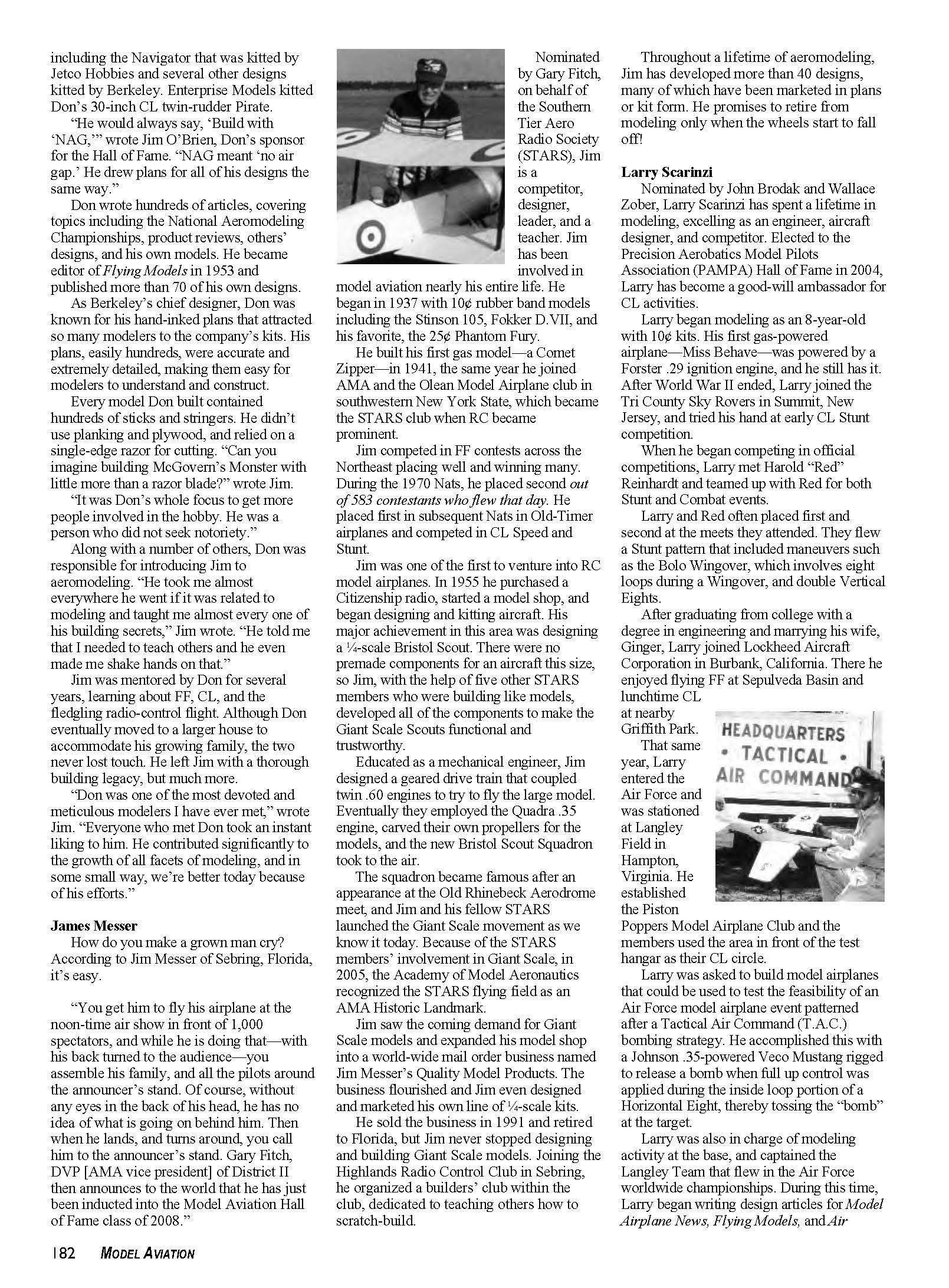
Bob Davis is a lifetime modeler. His early aircraft experience included the diesel-fueled Drone diesel engine marketed by Leon Shulman. Bob's nomination came from longtime modeler and friend, Stu Richmond.
In 1975, Bob formed the Davis Diesel Development Corp., which developed Davis Diesel Converters. These converters were precision-manufactured add-on units for existing glow-powered models and were first demonstrated at the 1975 Dayton Nationals. Bob's company also offers specially blended Davis Diesel fuels.
A Davis Diesel Converter head, placed on a standard glow engine (in place of the glow head that comes with the engine), offers several advantages. The engine is quieter in flight and will develop more usable power. The power can be used to turn a larger, more efficient propeller. The engine sucks in less air and the venturi's air sound is lessened. The engine needs no glow plug.
Additionally, converting an engine to diesel power generally extends the life of the power plant. Model diesel fuel's kerosene adds natural lubricity to the engine.
Compared with an equal volume of standard glow fuel, the kerosene will run longer and yield more horsepower. The converters are available for all popular glow engines.
Another division of Davis Diesel is Carbonic Motors. This division has produced the ultimate in quiet power, bringing CO2 technology to another level of usefulness. This alternative to expensive, heavy electric motors or winding rubber bands offers a simple, reliable, quiet, and lightweight power plant in larger, more usable sizes.
Davis Diesel's CO2 motors and diesel-conversion engines operate at sound levels considerably lower than comparable gas engines. Bob's development of SoundMaster mufflers, "soft" engine mounting, tuned pipes, and a variety of other products are significant contributions in the effort to decrease the noise produced by model aircraft.
Bob received AMA's Technical Achievement Award in 1990 for his many contributions to model engine technology.
Robert "Bob" Fiorenze
Bob Fiorenze of Maitland, Florida, has been involved in aeromodeling since 1958. He is perhaps best known as the first to fly a turbine-powered model aircraft (JPX Turbine) in the United States. Bob was appointed to AMA's original Turbine Safety Committee along with former AMA president Don Lowe.
Bob has held his FAA A&P mechanic's rating since 1969, and earned his pilot's license for both helicopters and airplanes in 1974. At one time he worked for a major airline and much later Bob built his own helicopter, a 1997 Rotorway Exec 90 that won the Sun 'n Fun Grand Champion prize. He described the project on his web site.
"On September 12, 1997, the first flights were completed with the Rotorway Exec 90. After many final adjustments and checks, the Exec 90 was taken up to altitude and flown around the airport area. This project has taken a little over a year. There are many enhancements not called for by the factory to make this an exceptional bird. The Rotorway puts a practical, low-cost helicopter within the reach of someone who is willing to do the assembly from kit form. It is a two-place helicopter that runs on standard automotive fuel and has about the same climb rate and cruising speed of a Cessna 152. The Rotorway of course will fly much slower and land almost anywhere."
Bob has been an active competitor in the model aircraft field, winning the 1983 and 1985 Scale Nats with his A-4 Skyhawk ducted-fan jet and his Black Bunny F-4 Phantom twin-ducted-fan jet respectively. Flying an F-18 Hornet twin-ducted-fan jet, Bob placed first in the 1988 US Scale Masters, the 1989 Top Gun Invitational, and the 1989 Scale Nats.
Nominated for the Model Aviation Hall of Fame by Wallace Zober and Vinny Caratozzolo, Bob is considered a model jet legend, well-known for his high-speed, low-altitude passes. Considered a master builder and flier, he is in great demand as a demo pilot, performing during half-times and breaks at air shows across the US.
His modeling interests are varied and in addition to scale and jets, he enjoys helicopters, warbirds, and electrics. His building and flying skills have received recognition at contests, fly-ins, jet rallies, and national events.
Bob currently owns Bob Fiorenze Model Products, specializing in jets, electrics, helicopters, and giant electric models. Products sold include the T-38 Talon, his Air Speed Indicator, and proportional hydraulic brakes. Bob also does test flying and consulting work for Bob Violett Models.
As an accomplished author and photographer, Bob has been a contributing writer for a number of publications including MA, RCM, Flying Models, and Scale R/C Modeler.
David Gray
David Gray is credited with inventing and flying the first RC helicopter in 1970. The Smithsonian's National Air and Space Museum has David's original model on display.
David began modeling early, building his first model aircraft—a 25¢ F6F Hellcat—when he was only 7 years old. Because of the scarcity of material during World War II, David began designing and building his own models, often with better results than what was offered at the time.
His family moved to Michigan, and in the garage of their new house, David discovered a box full of built-up, rubber-powered airplanes and an old Rodgers engine. He rebuilt one of the airplanes—a 36-inch Stuka—and flew it with great success.
A comic strip called Tim Tyler's Luck piqued David's interest in radio-controlled models. To be able to fly an airplane without wires and actually control it with radio signals was far more science fiction than reality at the time, but it became David's goal.
This desire led to experiments with electric-powered airplanes, cars, and boats. Fueled with a hand-held lantern battery and tethered with fine strands of copper wire, the models were steered with actuators and escapements.
In 1958 David married and began working for various electrical supply firms, adding to his knowledge of electrical motors. In 1963, he moved back to Michigan, took a part-time job with Glass City Models, and was excited to actually get paid for fabricating parts and assembling pulse radio equipment!
Two years later David started his own company, Airtrol, where he designed and marketed an improved pulse-radio system. Throughout he was experimenting with radio-controlled models from cars to autogyros, and helicopters began to interest him more.
David began experimenting with foam and plastic aircraft and building his own vacuum-forming machines. He left Airtrol to join Jim Merrill and open a new business called Gramer Plastics, which produced foam aircraft and packaging products for the automotive industry.
David's helicopter prototypes began to show results. In 1970 at the RC show in Cincinnati, Ohio, he demonstrated his .40-powered RC helicopter which made the cover of Model Airplane News. This model is housed at the Smithsonian.
Dewey Broberg, president of Du-Bro, asked to buy manufacturing rights from David. Within several months David and his family moved to Mundelein, Illinois, and he began working for Du-Bro to further develop his helicopter design. After much work and numerous setbacks, the Du-Bro Whirley Bird .505 was produced.
The Whirley Bird enjoyed great success and David began working on a larger, better-flying aircraft. The semiscale Hughes 300, powered by a 1.34 cu. in. O & R engine, was the result. Easier to fly and more realistic looking, the Hughes 300 led to the design of two more helicopters: the .40-powered Tri-Star and the Shark .60.
David and his helicopters have been featured in numerous publications including Model Airplane News, R/C Modeler, Popular Mechanics, and Flying Models. He has continued to work with Du-Bro, designing equipment for the aeromodeling industry, and is still an integral part of the company's design team.
Donald J. McGovern
The late Don McGovern began modeling in 1939. By the time he was 10 years old, Don was designing and building his own aircraft. By age 12, he had begun submitting articles to modeling magazines, and a few years later they were being published.
Perhaps best known as the editor of Flying Models magazine from 1953 to 1979, Don was also a competitor and prolific designer. He designed the Custom Privateer Seaplane that was kitted by Berkeley Models. Nicknamed "McGovern's Monster," the nearly 10-foot-wingspan aircraft was considered the largest seaplane ever built and flown at that time and the largest ever kitted.
Don designed a series of smaller Privateer models, including the Navigator that was kitted by Jetco Hobbies and several other designs kitted by Berkeley. Enterprise Models kitted Don's 30-inch control-line twin-rudder Pirate.
"He would always say, 'Build with NAG,'" wrote Jim O'Brien, Don's sponsor for the Hall of Fame. "NAG meant 'no air gap.' He drew plans for all of his designs the same way."
Don wrote hundreds of articles, covering topics including the National Aeromodeling Championships, product reviews, others' designs, and his own models. He became editor of Flying Models in 1953 and published more than 70 of his own designs.
As Berkeley's chief designer, Don was known for his hand-inked plans that attracted so many modelers to the company's kits. His plans, easily hundreds, were accurate and extremely detailed, making them easy for modelers to understand and construct.
Every model Don built contained hundreds of sticks and stringers. He didn't use planking and plywood, and relied on a single-edge razor for cutting. "Can you imagine building McGovern's Monster with little more than a razor blade?" wrote Jim.
"It was Don's whole focus to get more people involved in the hobby. He was a person who did not seek notoriety."
Along with a number of others, Don was responsible for introducing Jim to aeromodeling. "He took me almost everywhere he went if it was related to modeling and taught me almost every one of his building secrets," Jim wrote. "He told me that I needed to teach others and he even made me shake hands on that."
Jim was mentored by Don for several years, learning about free flight, control line, and the fledgling radio-control flight. Although Don eventually moved to a larger house to accommodate his growing family, the two never lost touch. He left Jim with a thorough building legacy, but much more.
"Don was one of the most devoted and meticulous modelers I have ever met," wrote Jim. "Everyone who met Don took an instant liking to him. He contributed significantly to the growth of all facets of modeling, and in some small way, we're better today because of his efforts."
James Messer
How do you make a grown man cry? According to Jim Messer of Sebring, Florida, it's easy.
"You get him to fly his airplane at the noon-time air show in front of 1,000 spectators, and while he is doing that—with his back turned to the audience—you assemble his family, and all the pilots around the announcer's stand. Of course, without any eyes in the back of his head, he has no idea of what is going on behind him. Then when he lands, and turns around, you call him to the announcer's stand. Gary Fitch, DVP [AMA vice president] of District II then announces to the world that he has just been inducted into the Model Aviation Hall of Fame class of 2008."
Nominated by Gary Fitch, on behalf of the Southern Tier Aero Radio Society (STARS), Jim is a competitor, designer, leader, and a teacher. Jim has been involved in model aviation nearly his entire life. He began in 1937 with 10¢ rubber band models including the Stinson 105, Fokker D.VII, and his favorite, the 25¢ Phantom Fury.
He built his first gas model—a Comet Zipper—in 1941, the same year he joined AMA and the Olean Model Airplane Club in southwestern New York State, which became the STARS club when RC became prominent.
Jim competed in free-flight contests across the Northeast placing well and winning many. During the 1970 Nats, he placed second out of 583 contestants who flew that day. He placed first in subsequent Nats in Old-Timer airplanes and competed in control-line speed and stunt.
Jim was one of the first to venture into RC model airplanes. In 1955 he purchased a Citizens' Band radio, started a model shop, and began designing and kitting aircraft. His major achievement in this area was designing a 1/4-scale Bristol Scout. There were no premade components for an aircraft this size, so Jim, with the help of five other STARS members who were building like models, developed all of the components to make the Giant Scale Scouts functional and trustworthy.
Educated as a mechanical engineer, Jim designed a geared drive train that coupled twin .60 engines to try to fly the large model. Eventually they employed the Quadra .35 engine, carved their own propellers for the models, and the new Bristol Scout Squadron took to the air.
The squadron became famous after an appearance at the Old Rhinebeck Aerodrome meet, and Jim and his fellow STARS launched the Giant Scale movement as we know it today. Because of the STARS members' involvement in Giant Scale, in 2005, the Academy of Model Aeronautics recognized the STARS flying field as an AMA Historic Landmark.
Jim saw the coming demand for Giant Scale models and expanded his model shop into a worldwide mail-order business named Jim Messer's Quality Model Products. The business flourished and Jim even designed and marketed his own line of 1/4-scale kits.
He sold the business in 1991 and retired to Florida, but Jim never stopped designing and building Giant Scale models. Joining the Highlands Radio Control Club in Sebring, he organized a builders' club within the club, dedicated to teaching others how to scratch-build.
Throughout a lifetime of aeromodeling, Jim has developed more than 40 designs, many of which have been marketed in plans or kit form. He promises to retire from modeling only when the wheels start to fall off!
Larry Scarinzi
Nominated by John Brodak and Wallace Zober, Larry Scarinzi has spent a lifetime in modeling, excelling as an engineer, aircraft designer, and competitor. Elected to the Precision Aerobatics Model Pilots Association (PAMPA) Hall of Fame in 2004, Larry has become a goodwill ambassador for control-line activities.
Larry began modeling as an 8-year-old with 10¢ kits. His first gas-powered airplane—Miss Behave—was powered by a Forster .29 ignition engine, and he still has it. After World War II ended, Larry joined the Tri County Sky Rovers in Summit, New Jersey, and tried his hand at early control-line stunt competition.
When he began competing in official competitions, Larry met Harold "Red" Reinhardt and teamed up with Red for both stunt and combat events.
Larry and Red often placed first and second at the meets they attended. They flew a stunt pattern that included maneuvers such as the Bolo Wingover, which involves eight loops during a wingover, and double vertical eights.
After graduating from college with a degree in engineering and marrying his wife, Ginger, Larry joined Lockheed Aircraft Corporation in Burbank, California. There he enjoyed flying free flight at Sepulveda Basin and lunchtime control-line at nearby Griffith Park.
That same year, Larry entered the Air Force and was stationed at Langley Field in Hampton, Virginia. He established the Piston Poppers Model Airplane Club and the members used the area in front of the test hangar as their control-line circle.
Larry was asked to build model airplanes that could be used to test the feasibility of an Air Force model airplane event patterned after a Tactical Air Command (T.A.C.) bombing strategy. He accomplished this with a Johnson .35-powered Veco Mustang rigged to release a bomb when full-up control was applied during the inside loop portion of a horizontal eight, thereby tossing the "bomb" at the target.
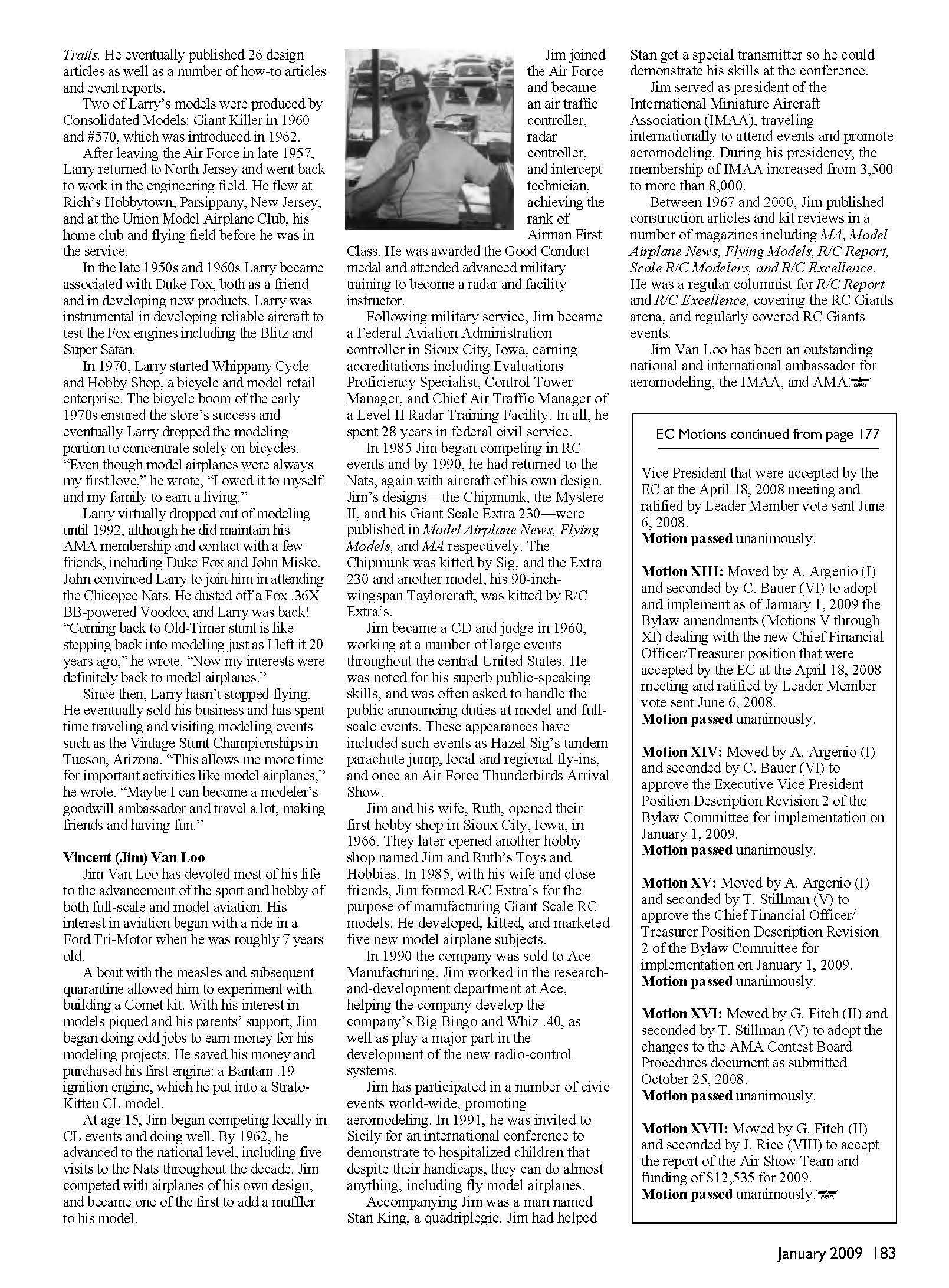
Vincent (Jim) Van Loo
Jim Van Loo has devoted most of his life to the advancement of the sport and hobby of both full-scale and model aviation. His interest in aviation began with a ride in a Ford Tri-Motor when he was roughly 7 years old.
A bout with the measles and subsequent quarantine allowed him to experiment with building a Comet kit. With his interest in models piqued and his parents' support, Jim began doing odd jobs to earn money for his modeling projects. He saved his money and purchased his first engine: a Bantam .19 ignition engine, which he put into a Strato-Kitten control-line model.
At age 15, Jim began competing locally in control-line events and doing well. By 1962, he advanced to the national level, including visits to the Nats throughout the decade. Jim competed with airplanes of his own design, and became one of the first to add a muffler to his model.
Jim joined the Air Force and became an air traffic controller, radar controller, and intercept technician, achieving the rank of Airman First Class. He was awarded the Good Conduct Medal and attended advanced military training to become a radar and facility instructor.
Following military service, Jim became a Federal Aviation Administration controller in Sioux City, Iowa, earning accreditations including Evaluations Proficiency Specialist, Control Tower Manager, and Chief Air Traffic Manager of a Level II Radar Training Facility. In all, he spent 28 years in federal civil service.
In 1985 Jim began competing in RC events and by 1990, he had returned to the Nats, again with aircraft of his own design. Jim's designs—the Chipmunk, the Mystere II, and his Giant Scale Extra 230—were published in Model Airplane News, Flying Models, and MA respectively. The Chipmunk was kitted by Sig, and the Extra 230 and another model, his 90-inch-wingspan Taylorcraft, were kitted by R/C Extra's.
Jim became a contest director and judge in 1960, working at a number of large events throughout the central United States. He was noted for his superb public-speaking skills, and was often asked to handle the public announcing duties at model and full-scale events. These appearances have included such events as Hazel Sig's tandem parachute jump, local and regional fly-ins, and once an Air Force Thunderbirds arrival show.
Jim and his wife, Ruth, opened their first hobby shop in Sioux City, Iowa, in 1966. They later opened another hobby shop named Jim and Ruth's Toys and Hobbies. In 1985, with his wife and close friends, Jim formed R/C Extra's for the purpose of manufacturing Giant Scale RC models. He developed, kitted, and marketed five new model airplane subjects.
In 1990 the company was sold to Ace Manufacturing. Jim worked in the research-and-development department at Ace, helping the company develop the Big Bingo and Whiz .40, as well as playing a major part in the development of new radio-control systems.
Jim has participated in a number of civic events worldwide, promoting aeromodeling. In 1991, he was invited to Sicily for an international conference to demonstrate to hospitalized children that despite their handicaps, they can do almost anything, including fly model airplanes.
Accompanying Jim was a man named Stan King, a quadriplegic. Jim had helped Stan get a special transmitter so he could demonstrate his skills at the conference.
Jim served as president of the International Miniature Aircraft Association (IMAA), traveling internationally to attend events and promote aeromodeling. During his presidency, the membership of IMAA increased from 3,500 to more than 8,000.
Between 1967 and 2000, Jim published construction articles and kit reviews in a number of magazines including MA, Model Airplane News, Flying Models, R/C Report, Scale R/C Modelers, and R/C Excellence. He was a regular columnist for R/C Report and R/C Excellence, covering the RC Giants arena, and regularly covered RC Giants events.
Jim Van Loo has been an outstanding national and international ambassador for aeromodeling, the IMAA, and AMA.
Transcribed from original scans by AI. Minor OCR errors may remain.

