


Model Aviators' Academy
Chuck Jennings
Every weekend and holiday for nearly 20 years, SLO FLYERS, Inc. enjoyed the use of a beautiful, smooth 110 x 600-foot asphalt runway on Camp San Luis Obispo of the California National Guard. It was a beginner's paradise. Modelers came from miles away to enjoy a facility that was ideal for a new model or for that detailed scale beauty that deserved the very best.
Our annual scale fly-ins typically attracted an impressive number of advanced entries because we offered a big, flat, safe facility in the California climate. A modeler's Camelot on the West Coast!
But suddenly, without warning, in January 1992 the National Guard denied our access and converted the decommissioned fixed-wing runway to an active helicopter pad. Our repeated appeals for shared usage went unanswered.
Our members plunged into despair and disbelief. Membership dropped from more than 100 to less than 40 in the first year.
For the next five years, the club struggled to maintain enough enthusiasm and membership to remain a viable organization, with only one goal: find another site.
Although our active membership plummeted to less than 20 loyal souls, we desperately considered the possibility of purchasing our own land. We went so far as to run ads in local newspapers and to consult with several real estate agents who specialized in undeveloped acreage. We studied land-survey maps and researched county use permits. But with our annual dues at $20 per member and with pricey central California real estate, we soon abandoned the notion of ownership.
We turned to county and state government. The Department of Parks and Recreation seemed a reasonable avenue, but we soon found ourselves in a quagmire of long-range government planning and a complex political bureaucracy.
More importantly, five years of struggling homelessness and endless hours of negotiations with all sorts of municipal and private entities left us with a poignant realization: all the years we were blissfully and naively privileged with the use of the National Guard's facility, we had never cultivated a positive community image. In 20 years we had built no community merit. We were thought of as "those big boys with expensive radio-controlled toys."
A local paper ran a full-page story with an impressive photograph, but the writer focused on the expense of the models and how often they crashed. The article generated no support; it may have created more destructive publicity than good.
Our search
Our search for sympathetic ears became a lesson in the value of community service. We began to shift our self-image and we broadened our focus.
As professors at Cal Poly State University in San Luis Obispo, colleague Bob van't Riet and I examined nearly all of the university's 5,000 acres of agricultural land in search of a suitable site for what we initially called a "model testing flight range." We outlined a plan to mentor the students in the Aeronautical Engineering program.
After seemingly endless hours of tedious negotiations and after identifying at least a dozen possible locations, the university granted SLO FLYERS, Inc., in partnership with the Aeronautical Engineering Department, a four-acre site to develop an "Educational Flight Range."
SLO FLYERS, Inc. agreed to raise the funds, design and construct the facility, and serve as mentors to the Aeronautical Engineering students. We raised more than $40,000 and the facility was opened in June of 1998. It may well be one of the best model flight facilities in California.
Success! End of story? Right? We hope not.
The arduous, frustrating process of searching and begging for community support for a home for our club's activities awakened a new awareness in our membership. It became clear that for our long-term survival and our sense of self-worth, we needed to build a significant community service mission into our self-image.
The partnership with the Aeronautical Engineering program at Cal Poly became the initial cornerstone for a commitment to community education, not only of college-age youth but all the youth of our community.
A second cornerstone for this commitment came from the Academy of Model Aeronautics. In late 1997, as part of our fund-raising efforts toward construction of the Educational Flight Range, we contacted our District X Vice President, Rich Hanson. We discussed our need for financial assistance in building a facility and also shared our renewed commitment to community service through supporting educational programs.
Rich suggested that we look into AMA's Youth Aeromodeling Encampment Program as a prototype for a program we might put together on the West Coast. By this time we were involved as classroom mentors in the Big Brothers/Big Sisters program of San Luis Obispo County. The Youth Aeromodeling Encampment Program seemed to be a logical progression of our educational service goals.
In January 1998, Rich Hanson presented a proposal to AMA's Executive Council for a $10,000 matching grant in support of the construction of the Educational Flight Range, and in support of the opportunity to establish a West Coast site for the Youth Aeromodeling Encampment Program. The following February the AMA Executive Council awarded a $10,000 matching grant to SLO FLYERS, Inc.
After the Educational Flight Range was constructed and in service in July 1998, it was time to turn our attention toward building a youth education program. A committee of a half-dozen SLO FLYERS members began to meet on a regular basis to organize the first phase of a youth modeling academy program, planned to be offered during the summer of 1999.
The prototype for the Youth Aeromodeling Encampment Program seemed quite ambitious for our first year's program. The YAEP prototype called for the recruitment of kids from all over the country to a weeklong program that would require arrangements for transportation, housing, and around-the-clock supervision.
Not counting our experience as Big Brothers, only two of us on the committee had teaching experience, and that was limited to college-age youths. The prospect of taking full responsibility for 20 energetic youths away from their homes and their parents in a 24-hours-a-day, weeklong encampment seemed to be a terrifying challenge.
For our first effort, we needed a startup program that assured a great chance of success. With experience, we could confidently expand into the challenge of a more-ambitious program.
By January 1999, we had developed a fairly clear definition for what we thought the academy should be: a one-day, Saturday program for local youth that would introduce basic aeromodeling and aeronautical concepts, include hands-on building of a simple trainer, provide flight demonstrations and tethered R/C flight experiences, involve parents as observers, emphasize safety and fun, and be available at no cost or minimal cost to participants.
We called the program the Model Aviators' Academy and scheduled our first session for a Saturday in June 1999. Publicity was handled through local schools, community organizations, and the SLO FLYERS club. Registration was limited to keep instructor-to-student ratios reasonable and to ensure close supervision.
The day began with brief classroom sessions on the history of flight, forces of flight, and the basics of radio control. These were followed by hands-on workshops where teams of youngsters built simple rubber-band-powered and free-flight models, as well as a short-kit trainer. Club members served as mentors and instructors, guiding the students through construction and preflight checks.
In the afternoon, participants were treated to flight demonstrations by experienced R/C pilots and given the opportunity to experience tethered dual-control flights. Safety briefings were conducted before each flying session, and helmets and eye protection were provided where appropriate.
The first Model Aviators' Academy was an overwhelming success. The youngsters were enthusiastic, parents were appreciative, and club volunteers found the experience rewarding. We learned valuable lessons about scheduling, materials preparation, and the need for clear, age-appropriate instruction.
Following the inaugural session, we refined the curriculum, expanded our volunteer base through further outreach, and sought modest sponsorships to cover materials and liability insurance. These steps allowed us to offer additional academy sessions the following year and to begin planning for a multi-day summer camp format as our confidence and capabilities grew.
The plan called for a five-day day camp for kids of two age groups (ages 7-10 and 11-14). Enrollees had the option of:
- Morning session for $75
- All-day session for $100
Enrollment was limited to 18 youths and required:
- A letter of recommendation from a teacher
- A letter of interest from the child
Fees included:
- Lunch for the all-day sessions
- A Delta Dart kit
- Materials for a foam glider
- Materials and a Norvel .061 engine (donated by Horizon) for a 1/4A profile control-line model
- A full day of radio-control flight instruction on our trainers at the Educational Flight Range
As a finale, local Experimental Aircraft Association officer Carl Daughters arranged for a day of full-scale flight through the San Luis Obispo chapter of the EAA Young Eagles Program.
We mailed recruitment letters with a packet of application materials to every elementary and middle school in San Luis Obispo County. We received several applications as a result of this effort, but our most successful strategy came from two programs—one we had in place for the past three years.
The city of San Luis Obispo is famous for its downtown Thursday night Farmers' Market. Thousands of county youths and adults jam into five city blocks to buy produce, eat beans and ribs, listen to live music, and learn about community organizations at information booths.
SLO FLYERS president Ron Burn and members Ed Swain and Tom Bade faithfully set up a booth every second and fourth Thursday of the month. The booth has been a wonderful success in recruiting new members and in raising our community image.
One feature of our Farmers' Market program involves AMA's Delta Dart. We offer kids and parents a Delta Dart kit for $1.50, with the condition that if they come back to a subsequent Farmers' Market with a completed Delta Dart, SLO FLYERS, Inc. returns their money. This program provided the perfect conditions for recruiting kids for the Model Aviators' Academy; several of the applications came from this effort.
As a result of our visibility through our Farmers' Market program, we were asked by the San Luis Obispo County Library to conduct three after-school programs in aeronautical modeling. Two programs were held in the San Luis Obispo City Library and another was held in the library of the neighboring community of Atascadero. These programs were so successful that SLO FLYERS, Inc. has been asked to repeat the programs on a regular basis, and several of the library kids enrolled in our first summer academy.
The first academy
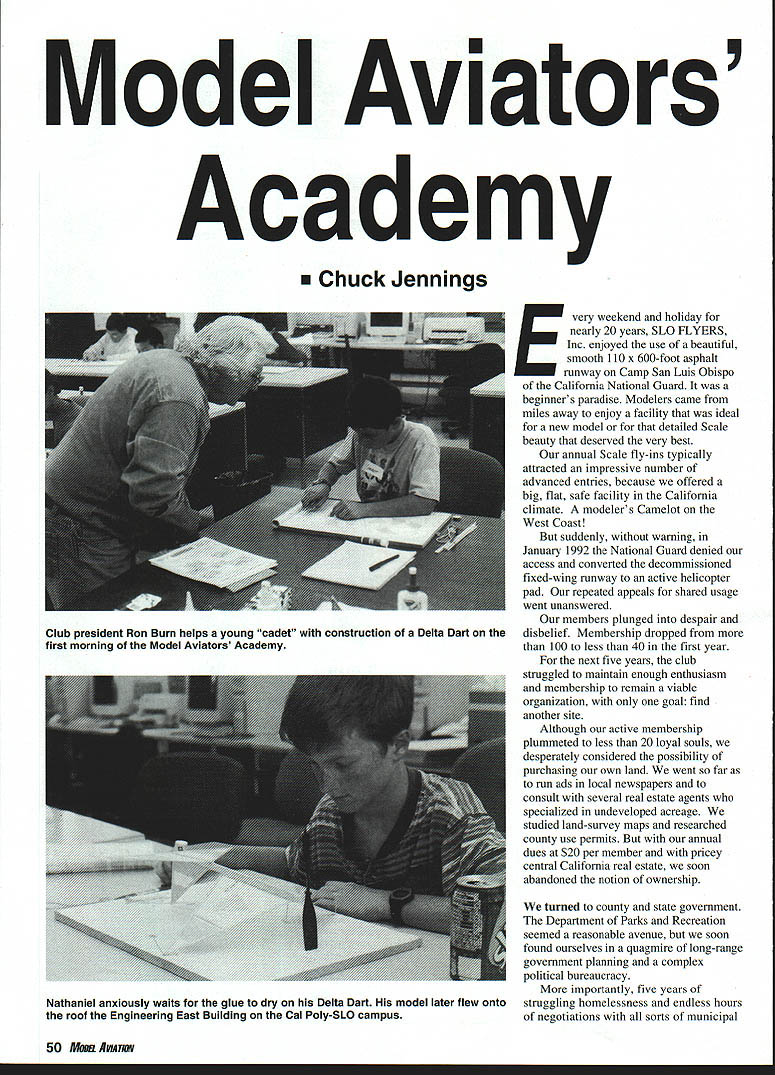
Our first session of the SLO FLYERS Model Aviators' Academy started at 9 a.m., Monday, August 2. Twenty boys were enrolled, including two eight-year-olds, one nine-year-old, five 10-year-olds, six 11-year-olds, four 12-year-olds, and two 13-year-olds.
From the beginning, the kids and the parents were enthusiastic and in great anticipation of an exciting experience. Class sessions were held in the fixed-wing design lab of the Aeronautical Engineering Department at Cal Poly State University. Rob Carn conducted the first session in basic principles of aerodynamics; that resulted in the construction of Delta Darts. The test flights of 20 Delta Darts on the lawn of the Cal Poly University Library was a marvelous sight of wide-eyed joy and controlled chaos.
At the lunch break of the first day, one of the eight-year-olds who had signed up for the morning sessions begged his mother to enroll him in the all-day session.
That afternoon we started the construction of the 1/4A control-line model. The Norvel engines were so noisy that the kids learned quickly to remove the glow plugs during the run-in period. The foam gliders were constructed by nearly every student and provided many hours of flying fun.
The R/C portion of the program was held at the SLO FLYERS Educational Flight Range where students received instruction on flight safety, radio operation, and dual-control flights. The volunteer flight instructors were patient and competent. The highlight of the program came on the final day when each student had the opportunity to fly solo under the supervision of an instructor.
At the conclusion of the academy, we surveyed the parents and the students. The response was overwhelmingly positive. Suggestions for improvement included smaller class sizes for the younger group, more hands-on time for R/C flight instruction, and additional take-home projects.
We learned that with careful planning, enthusiastic volunteers, and modest funding, a local club can conduct a successful aviation academy for youth. We now plan to conduct two sessions next year and to expand the program to include night flights and a model rocketry segment.
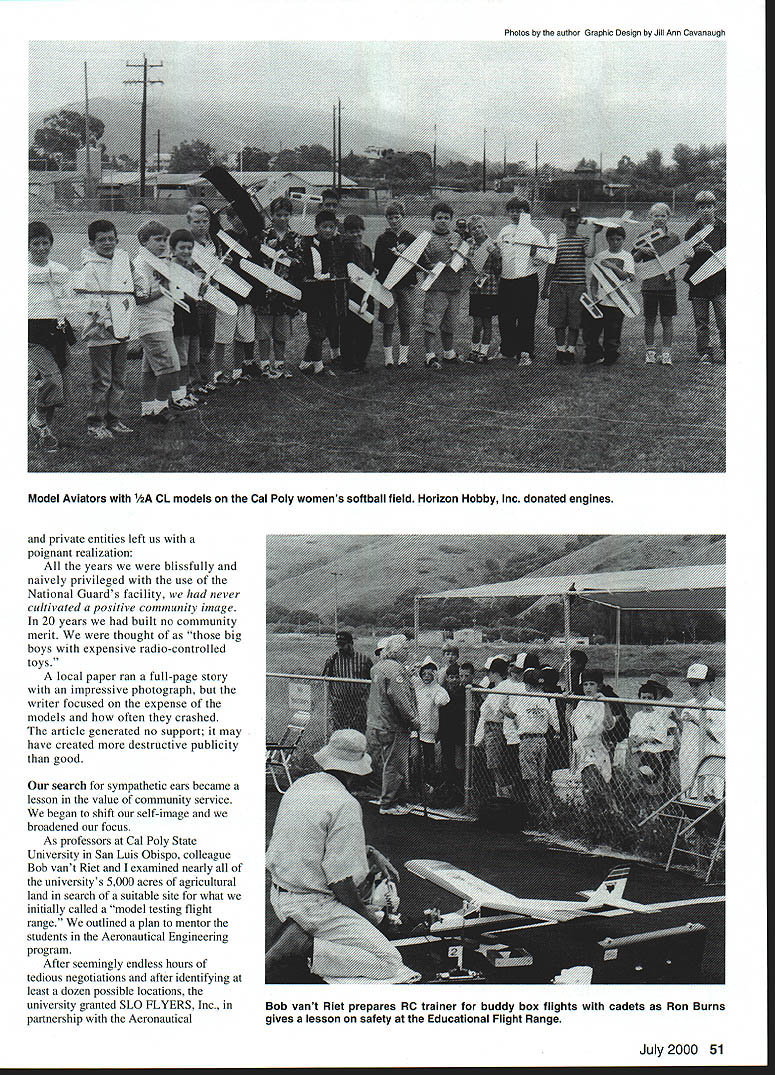
On Wednesday, the cadets built their 1/2A profile control-line models.
On Thursday, the kids were given SLO FLYERS T-shirts and caps, and we went flying. The university allowed us the use of the women's softball field as a perfect venue for three control-line circles.
The last day, Friday, was spent at the Educational Flight Range with each cadet taking at least two turns on the buddy box of three club R/C trainers.
Saturday was an "optional" day at the San Luis Obispo Municipal Airport. "Optional" turned out to be "sensational," with 19 of the 20 cadets taking flights in full-scale aircraft piloted by EAA members.
Our first Model Aviators' Academy far exceeded our expectations. A post-session evaluation form mailed to the cadets and their parents returned with unexpected praise and appreciation for the program. Many of the kids begged for an "advanced" program to follow in the summer of 2000. Indeed, SLO FLYERS, Inc. is planning a two-week academy: the first week for beginners and a second week for returning "advanced cadets." If similar success follows in our second year, SLO FLYERS will be well on the way toward building not only an exciting and valuable youth program, but also a significant community service.
MA
Chuck Jennings 431 Highland Dr. Los Osos, CA 93402
Transcribed from original scans by AI. Minor OCR errors may remain.

