
Modeling in Korea 1953-55
After my recent move to Huntington Beach, California, I was unpacking things and found some old photos of airplanes that I built during my tour of duty in the U.S. Army Signal Corps in Korea in the mid-1950s.
I was a corporal in an Army Reserve artillery battalion during the Korean War and was going to be drafted soon, so I decided it would be in my best interest to go on active duty. After receiving orders to report to Fort Ord, California, for 16 weeks of intensive infantry training, I was assigned to a company. After graduating, the commanding officer gave me the Soldier of the Company Award. I then received orders to proceed to FECOM (Far East Command Headquarters).
Upon arriving by ship at the port of Pusan in December, I found the weather very damp and cold indeed. Things looked bleak to this California soldier. I soon was assigned to the 205th Signal Repair Co. in Chun-Chon and was put in command of a wire van with two other repairmen. Our job was to repair switchboards and telephone equipment.
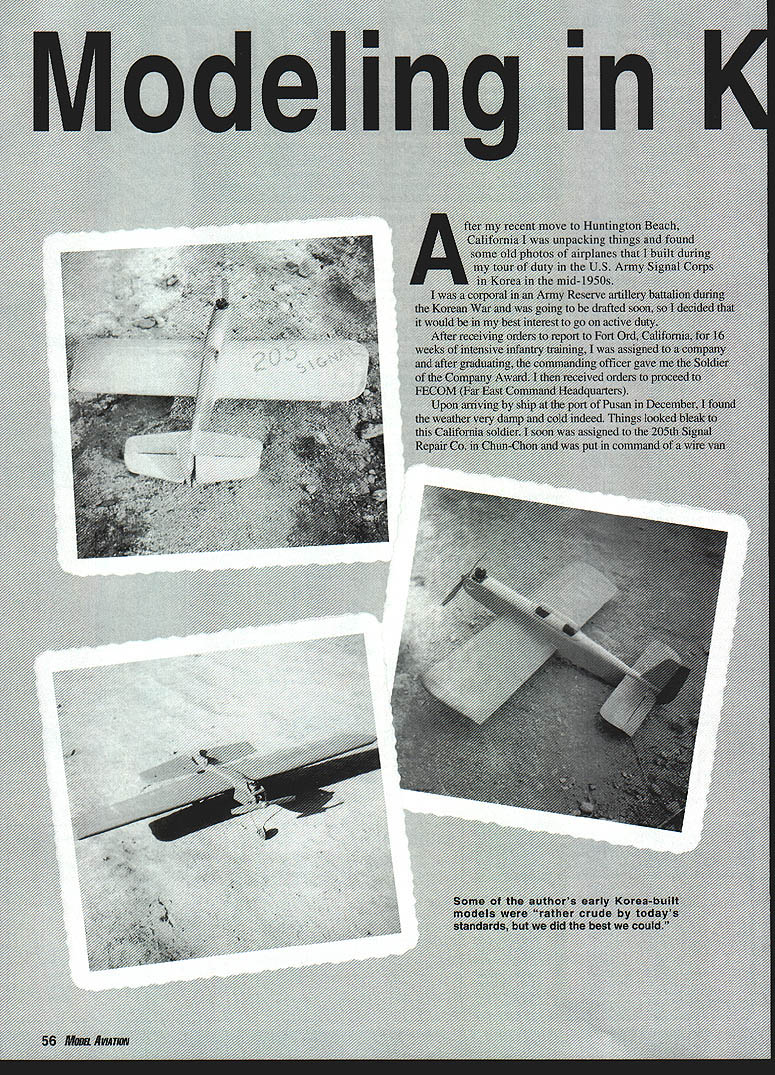
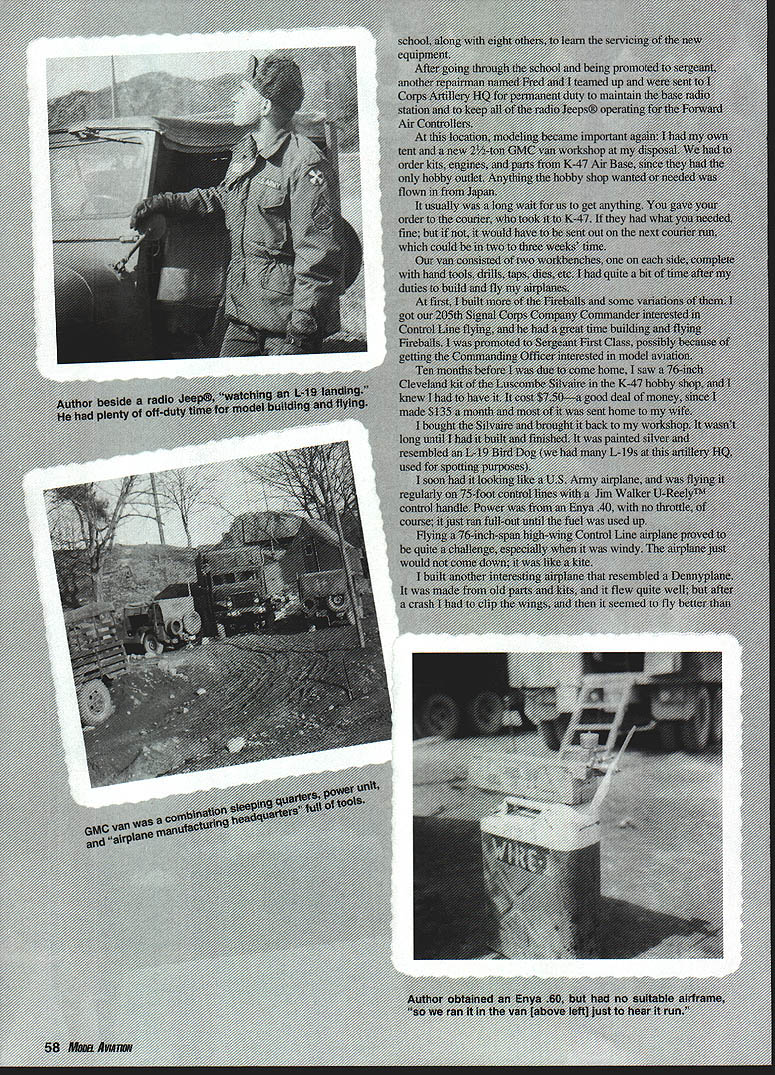
We traveled around in an old 2½-ton GMC van, pulling a PE-95 power unit behind; so we always had 115-volt power. During this time I found that the K-47 Air Force Base had model supplies, and after stopping by there, we had enough stuff to build some airplanes. Since the three of us slept inside the van, it was rather hard to build and keep the airplanes from damage, but we lashed them to the workbenches during travel.
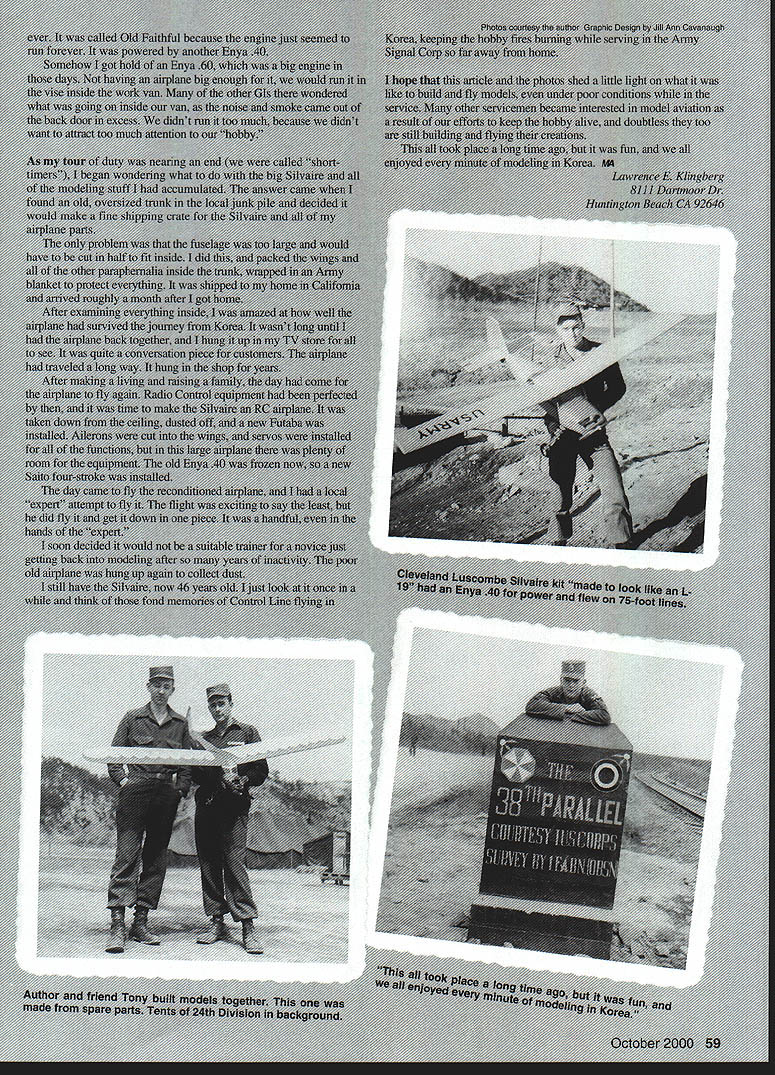
My first airplane was a control-line Fireball with an Enya .40. (Free flight was out of the question because of mine fields, and radio control was only a dream then.) My buddy Tony built some too, and we had lots of fun on the wires.
This duty lasted roughly six months. Then a tech rep from the Air Force came to our unit and asked if there would be any "volunteers" for a new unit to be formed to service air-to-ground radio equipment. This new group was called TAC-AIR and it was to help the Forward Air Controllers (FACs) maintain and keep their equipment in good operating condition under field use.
Since I was a television repairman in civilian life, this sounded like a good deal to me. I signed up and went to the TAC-AIR unit and was sent to the First Fighter Wing at Kimpo. There I was assigned to the Flight Control Section with two other men. My boss (a tech-sergeant) had been a modeler in civilian life and we had a small shop with benches inside a Quonset hut.
Training and TAC-AIR duty
I went to school, along with eight others, to learn the servicing of the new equipment. After going through the school and being promoted to sergeant, another repairman named Fred and I teamed up and were sent to I Corps Artillery HQ for permanent duty to maintain the base radio station and to keep all of the radio jeeps operating for the Forward Air Controllers.
At Kimpo my first project was to build a control-line model for the group's recreation. It was a small low-wing ship with a .35 engine. It flew pretty well on the local soccer field. We also built gliders and rubber-powered models for the kids at the base school. I remember making a batch of balsa gliders with 18-inch wings for the children. We would take them out to the playground and have contests.
During this period I met other modelers from the Air Force and Army and we formed a small club. We would get together on weekends and fly at the football field. The models were simple by today's standards but we had a great time.
Workshop at I Corps Artillery HQ
At I Corps Artillery HQ, modeling became important again. I had my own tent and a new 2½-ton GMC van workshop at my disposal. We had to order kits, engines, and parts from K-47 Air Base, since they had the only hobby outlet. Anything the hobby shop wanted or needed was flown in from Japan.
It usually was a long wait for us to get anything. You gave your order to the courier, who took it to K-47. If they had what you needed, fine; but if not, it would have to be sent out on the next courier run, which could be two to three weeks.
Our van consisted of two workbenches, one on each side, complete with hand tools, drills, taps, dies, etc. I had quite a bit of time after my duties to build and fly my airplanes.
At first, I built more of the Fireballs and some variations of them. I got our 205th Signal Corps company commander interested in control-line flying, and he had a great time building and flying Fireballs. I was promoted to sergeant first class, possibly because of getting the commanding officer interested in model aviation.
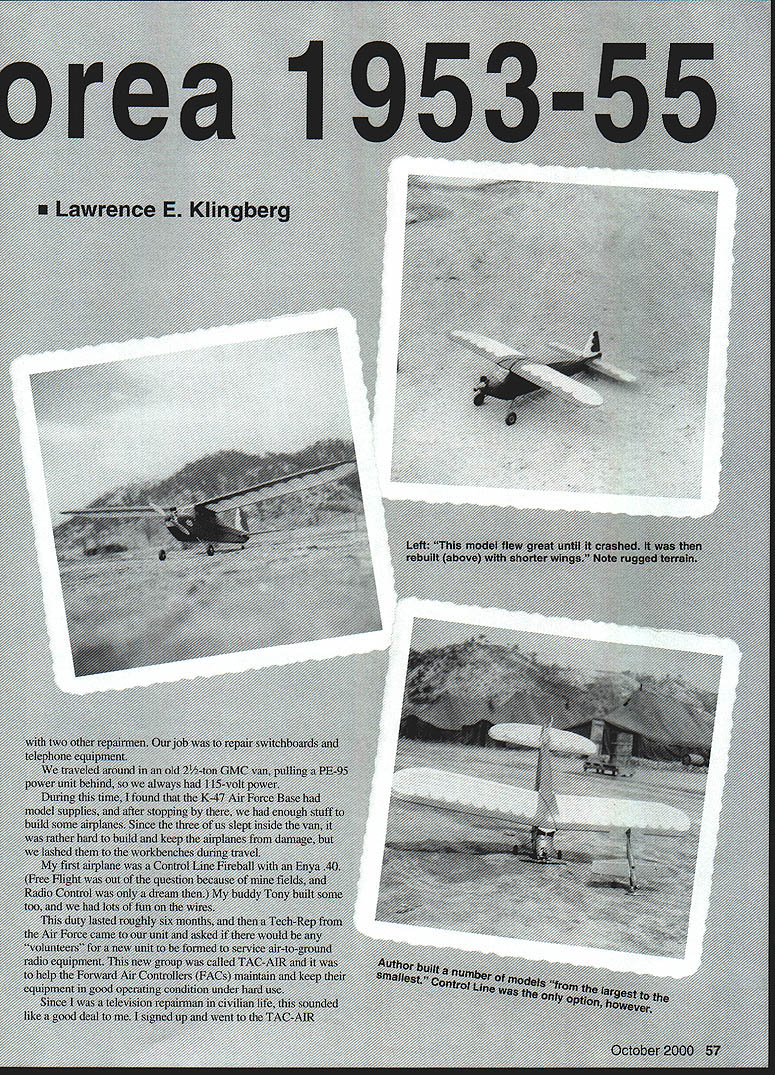
Ten months before I was due to come home, I saw a 76-inch Cleveland kit at the Luscombe air base in the K-47 hobby shop, and I knew I had to have it. It cost $7.50, a good deal of money since I made $135 a month and most of it was sent home to my wife. I bought the Silvane and brought it back to my workshop. It wasn't long until I had it built and finished. It was painted silver and resembled an L-19 Bird Dog (we had many L-19s at the artillery HQ used for spotting purposes).
I soon had it looking like a U.S. Army airplane, and was flying it regularly on 75-foot control lines with a Jim Walker U-Reely control handle. Power was from an Enya .40, with no throttle, of course; it just ran full-out until the fuel was used up. Flying a 76-inch span high-wing control-line airplane proved to be quite a challenge, especially when it was windy. The airplane just would not come down; it was like a kite.
I built another interesting airplane that resembled a Denny plane. It was made from old parts and bits and it flew quite well, but after a crash I had to clip the wings, and then it seemed to fly better than before. It was called Old Faithful because the engine just seemed to run forever. It was powered by another Enya .40.
Somehow I got hold of an Enya .60, which was a big engine in those days. Not having an airplane big enough for it, we would run it in the vise inside the work van. Many of the other GIs there wondered what was going on inside our van, as the noise and smoke came out of the back door in excess. We didn't run it too much, because we didn't want to attract too much attention to our "hobby."
Shipping the Silvane home
As my tour of duty was nearing an end (we were called "short-timers"), I began wondering what to do with the big Silvane and all of the modeling stuff I had accumulated. The answer came when I found an old, oversized trunk in the local junk pile and decided it would make a fine shipping crate for the Silvane and all of my airplane parts.
The only problem was that the fuselage was too large and would have to be cut in half to fit inside. I did this, and packed the wings and all of the other paraphernalia inside the trunk, wrapped in an Army blanket to protect everything. It was shipped to my home in California and arrived roughly a month after I got home.
After examining everything inside, I was amazed at how well the airplane had survived the journey from Korea. I wasn't long until I had the airplane back together, and I hung it up in my TV store for all to see. It was quite a conversation piece for customers. The airplane had traveled a long way. It hung in the shop for years.
After making a living and raising a family, the day had come for the airplane to fly again. Radio control equipment had been perfected by then, and it was time to make the Silvane an RC airplane. It was taken down from the ceiling, dusted off, and a new Futaba was installed. Ailerons were cut into the wings, and servos were installed for all of the functions, but in this large airplane there was plenty of room for the equipment. The old Enya .40 was frozen now, so a new Saito four-stroke was installed.
The day came to fly the reconditioned airplane, and I had a local "expert" attempt to fly it. The flight was exciting to say the least, but he did fly it and get it down in one piece. It was a handful, even in the hands of the "expert." I soon decided it would not be a suitable trainer for a novice just getting back into modeling after so many years of inactivity. The poor old airplane was hung up again to collect dust.
I still have the Silvane, now 46 years old. I just look at it once in a while and think of those fond memories of control-line flying in Korea, keeping the hobby fires burning while serving in the Army Signal Corps so far away from home.
I hope that this article and the photos shed a little light on what it was like to build and fly models, even under poor conditions while in the service. Many other servicemen became interested in model aviation as a result of our efforts to keep the hobby alive, and doubtless they too are still building and flying their creations.
This all took place a long time ago, but it was fun, and we all enjoyed every minute of modeling in Korea.
- <REDACTED>
- <REDACTED>
Transcribed from original scans by AI. Minor OCR errors may remain.

