
Modeling Spoken Here
"Welcome aboard, Bob!"
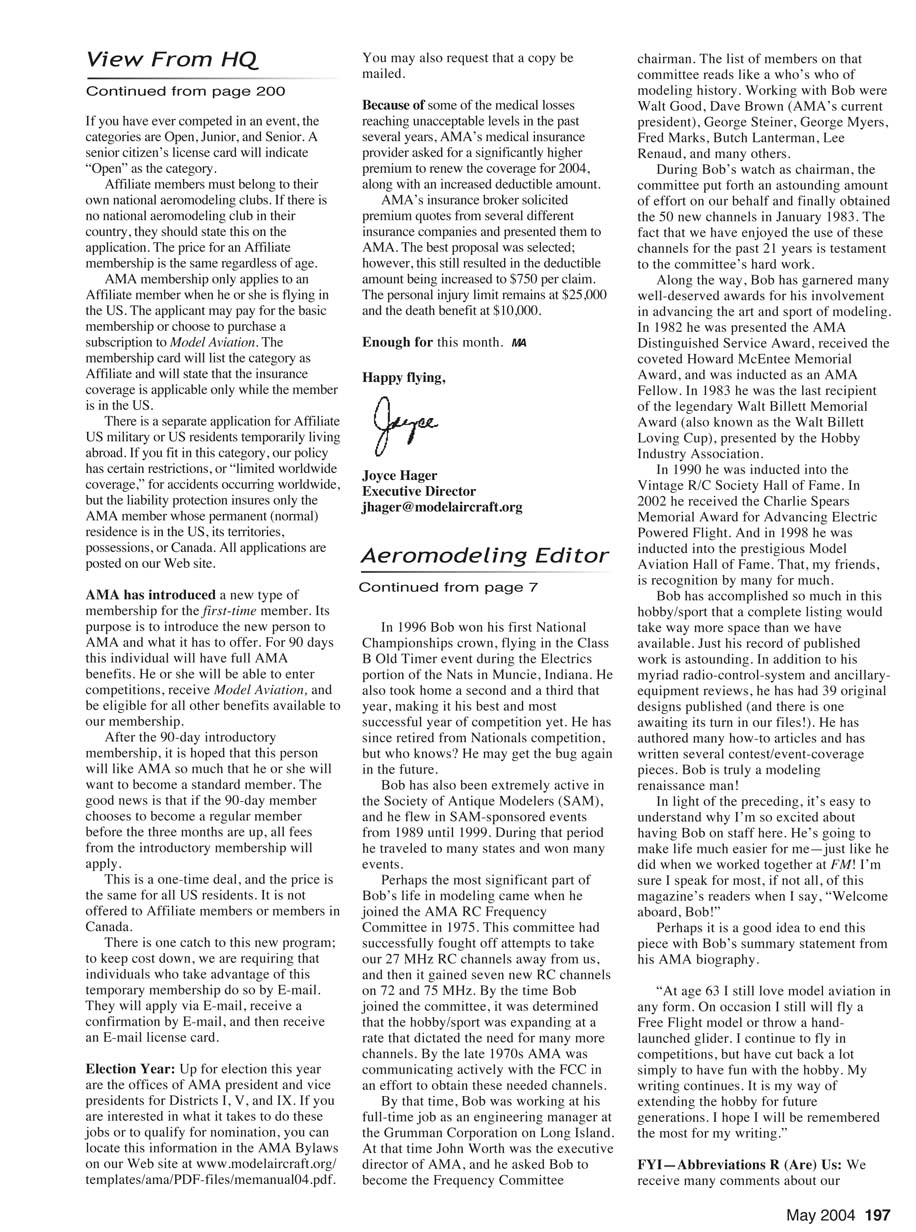
Some editorials are easier than others to write. This one will be a snap. It is my distinct pleasure to announce that with this issue, Mr. Robert (Bob) Aberle is coming on board officially as Model Aviation's technical editor.
My history with Bob goes back approximately 24 years. When I came on staff at Flying Models (FM) magazine as the associate editor in 1979, Bob was already well established there as a technical writer. His reviews of radio-control systems were (and remain to this day) the standard of our industry.
Bob's secret is that although he's technically schooled, he writes in a down-to-earth manner and presents the facts and figures about technical items in a way that those of us who are not so technically minded can understand and use. This is a gift.
When I took over as the editor of FM in 1980, Bob and I really began to get to know each other, and the working bond formed then resulted in our publishing hundreds of pages of Bob's material on a wide range of technical subjects during the next 16 years. Without him I would have been lost in my position there.
In preparing to write this piece, I did a bit of studying to see just where this Aberle fellow came from and what his modeling accomplishments are. I wrote a similar piece for FM many years ago, but Bob's achievements since then have been many, and I really wanted you all to get to know and appreciate him as I have.
Bob started modeling at age 12 in 1950. At that time his family lived in Rosedale, Queens, in New York City. Living there qualified Bob to attend the Brooklyn Technical High School, from which he graduated in 1955.
His home was only a short walk from the old, abandoned Curtiss Airport in Valley Stream, New York. It was there that Bob first saw model airplanes in action. These were mostly Free Flight and Control Line models, but the hook was set by watching them fly. He spent lots of his free time as a youth at that field.
His first model was a Joe Wagner (yes — MA's famous engine columnist)–designed Dakota from the Henry Engineering Veco kit. This design is a great-flying 1/2A biplane, and Bob flew his for a full summer before losing it in some tall swamp grass along the edge of the Curtiss Airport site.
In roughly 1952, Bob discovered another budding modeling discipline: radio control (RC). A group of pioneer RC fliers began flying at the airport, and Bob met the leader of that group, Norm Rosenstock (the current AMA historian). The RC models of that era were primitive, single-channel, escapement-operated types.
In 1953, Don Logue, a Long Island Gas Monkeys club member, befriended Bob. At that time Don was constructing his first RC system. Soon after that, Bob constructed one with Don from surplus military radio parts that were purchased on what was then called "Radio Row" on Canal Street in New York City. You could buy almost anything on Canal Street in those days!
Don instructed Bob on how to read an electrical schematic diagram, cut and bend metal chassis parts, wind coils, and perform other procedures that would allow him to build his own radio equipment. Together they constructed a pair of 27.255 MHz single-channel transmitters from plans by Howard McEntee in the old Air Trails magazine. The receivers were the Miller hard-tube circuit type, and they incorporated surplus heating-blanket relays.
Bob's first RC model was a Guillow's Trixter Beam that was designed by the late, great Lou Andrews. By 1957, Bob was seriously into RC modeling and was using the Lorenz two-tube receiver that was published in Model Airplane News. It was a much more reliable system. Around that time Bob also passed the required test and received his amateur radio (HAM) license. He has maintained his assigned call sign, W2QPP, to this day.
Bob did lots of competition flying all along the Eastern Seaboard and attended his first Nats in Willow Grove, Pennsylvania, in 1957. He didn't win anything that year, but he has always enjoyed the competition aspect of modeling, and in recent years he has won many awards at major meets.
In 1996 Bob won his first National Championship crown, flying in the Class B Old Timer event during the Electrics portion of the Nats in Muncie, Indiana. He also took home a second and a third that year, making it his best and most successful year of competition yet. He has since retired from Nationals competition, but who knows? He may get the bug again in the future.
Bob has also been extremely active in the Society of Antique Modelers (SAM). He was active in SAM-sponsored events from 1989 until 1999. During that period he traveled to many states and won many events.
Perhaps the most significant part of Bob’s life in modeling came when he joined the AMA RC Frequency Committee in 1975. This committee had successfully fought off attempts to take our 27 MHz RC channels away from us, and then it gained seven new RC channels on 72 and 75 MHz. By the time Bob joined the committee, it was determined that the hobby/sport was expanding at a rate that dictated the need for many more channels. By the late 1970s AMA was communicating actively with the FCC in an effort to obtain these needed channels.
By then Bob was working as the technical manager at the Grumman Corporation on Long Island. John Worth was the executive director of AMA, and he asked Bob to become the Frequency Committee chairman. The list of members on that committee reads like a who’s who of modeling history. Working with Bob were Walt Good, Dave Brown (AMA’s current president), George Steiner, George Myers, Fred Marks, Butch Lanterman, Lee Renaud, and many others.
During Bob’s watch as chairman, the committee put forth an astounding amount of effort on our behalf and finally obtained the 50 new channels in January 1983. The fact that we have enjoyed the use of these channels for the past 21 years is testament to the committee’s hard work.
Along the way, Bob has garnered many well-deserved awards for his involvement in advancing the art and sport of modeling. In 1982 he was presented the AMA Distinguished Service Award, received the coveted Howard McEntee Memorial Award, and was inducted as an AMA Fellow. In 1983 he was the last recipient of the legendary Walt Billett Memorial Award (also known as the Walt Billett Loving Cup), presented by the Hobby Industry Association.
In 1990 he was inducted into the Vintage R/C Society Hall of Fame. In 1998 he was inducted into the Model Aviation Hall of Fame. In 2002 he received the Charlie Spears Memorial Award for Advancing Electric Powered Flight. Those honors represent wide recognition for much service and achievement.
Bob has accomplished so much in this hobby/sport that a complete listing would take way more space than we have available. Just his record of published work is astounding. In addition to his many radio-control-system and ancillary-equipment reviews, he has had 39 original design publications (and there is one awaiting its turn in our files!). He has authored many how-to articles and has written several contest/event-coverage pieces. Bob is truly a modeling renaissance man!
In light of the preceding, it’s easy to understand why I’m so excited about having Bob on staff here. He’s going to make life much easier for me — just like he did when we worked together at FM! I’m sure I speak for most, if not all, of this magazine’s readers when I say, “Welcome aboard, Bob!”
Perhaps it’s a good idea to end this piece with Bob’s own summary statement from his AMA biography:
"At age 63 I still love model aviation in any form. On occasion I still will fly a Free Flight model or throw a hand-launched glider. I continue to fly in competition (albeit I have cut back a lot simply to have fun with the hobby). My writing continues. It is the way of extending the hobby to future generations. I hope I will be remembered the most for my writing."
Modeling Spoken Here - 2004/05
We have adopted an editorial style in respect to our policy of including modeling terms followed by their abbreviations in parentheses. We do this the first time a given term is used in an article or column. For instance, when the term center of gravity is used, we follow it up with "(CG)."
Many from whom we hear don't like this policy; they feel that all modelers should know these common term abbreviations and that this is a waste of space, ink, and time. The fact is that many new members read MA each month, and unless we clue them in and educate them about our unique lexicon, they might miss an important aspect of an article or column just because they don't know the meaning of a particular abbreviation, acronym, or term.
Starting in this issue we are going to include a glossary of the most often used terms so that new members/readers can quickly learn and understand the shorthand of the modeling vocabulary. Now we can begin to leave some of the parenthetical explanations of terms out of our articles and columns.
We will add to this list as often as is required and include its location on our table of contents page so that it can be found quickly. If you think we are missing an important term on this list, please do not hesitate to inform us.
The only caveat to the preceding is the specialized terminology of a specific special-interest group. Our columnists will cover explanations of terms that relate to their particular interest areas when they feel the need to do so.
It is our desire to ensure that any and all who want to know all there is to know about our hobby/sport have the means to satisfy their curiosity and catch up with the rest of us as quickly as possible. That makes all of this more fun for all of us.
As always, if you feel the need to communicate, I can be reached several different ways:
- Address: Box 68, Stockertown, PA 18083
- Phone: (610) 614-1747
- E-mail: [email protected]
MA
Transcribed from original scans by AI. Minor OCR errors may remain.

