
Modeling Spoken Here - 2006/04
Next to hosting and administrating the Nats, the biggest annual event for AMA is our convention, held in Ontario, California, each January.
Far more than a trade or consumer show, the AMA Convention is truly a multifaceted affair at which several significant things happen each year. Among these is the centerpiece consumer exposition where the newest and best modeling merchandise can be seen and, in many — and in most cases — purchased.
Other convention elements include:
- A rich and diverse series of informational symposiums and forums
- An extremely well-conceived, staffed, and executed educational program
- A safe and spacious demonstration area
- A static display competition with classes for all types of models
- Scheduled district and other official AMA meetings
This affair is continually growing and evolving to serve the membership of the entire West Coast area. In this issue there is a complete and detailed report of the 2006 edition of the AMA Convention.
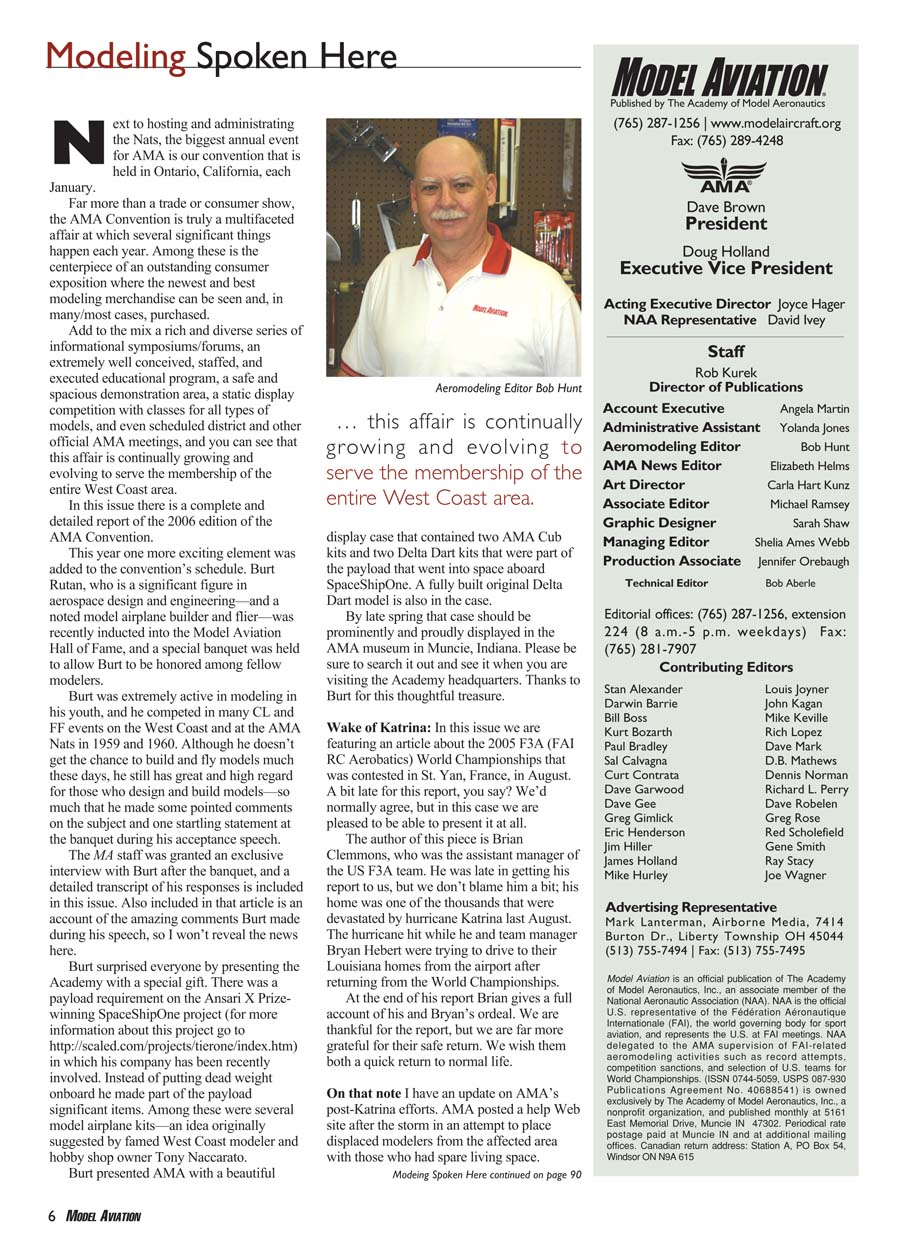
This year one more exciting element was added to the convention’s schedule. Burt Rutan, a significant figure in aerospace design and engineering—and a noted model airplane builder and flier—was recently inducted into the Model Aviation Hall of Fame, and a special banquet was held to honor him among fellow modelers.
Burt was extremely active in modeling in his youth, competing in many CL and FF events on the West Coast and at the AMA Nats in 1959 and 1960. Although he doesn’t get the chance to build and fly models much these days, he still holds model designers and builders in high regard. He made some pointed comments and one startling statement during his acceptance speech at the banquet.
The MA staff was granted an exclusive interview with Burt after the banquet; a detailed transcript of his responses is included in this issue. Also included is an account of the amazing comments Burt made during his speech, so I won’t reveal the news here.
Burt surprised everyone by presenting the Academy with a special gift. There was a payload requirement on the Ansari X Prize–winning SpaceShipOne project (for more information about this project see http://scaled.com/projects/tierone/index.htm), in which his company has been recently involved. Instead of putting dead weight onboard, he made part of the payload significant items. Among these were several model airplane kits — an idea originally suggested by famed West Coast modeler and hobby shop owner Tony Naccarato.
Burt presented AMA with a beautiful display case that contained two AMA Cub kits and two Delta Dart kits that were part of the payload that went into space aboard SpaceShipOne. A fully built original Delta Dart model is also in the case.
By late spring that case should be prominently and proudly displayed in the AMA museum in Muncie, Indiana. Please be sure to search it out and see it when you are visiting the Academy headquarters. Thanks to Burt for this thoughtful treasure.
Wake of Katrina
In this issue we are featuring an article about the 2005 F3A (FAI RC Aerobatics) World Championships that was contested in St. Yan, France, in August. A bit late for this report, you say? We’d normally agree, but in this case we are pleased to be able to present it at all.
The author of this report is Brian Clemmons, who was the manager of the US F3A team. He was late in getting his report to us, but we don’t blame him a bit; his home was one of the thousands that were devastated by Hurricane Katrina last August.
The hurricane hit while he and team manager Bryan Hebert were driving to their Louisiana homes from the airport after returning from the World Championships. At the end of this report Brian gives a full account of his and Bryan’s ordeal. We are thankful for the report, but we are far more thankful for their safe return. We wish them both a quick return to normal life.
On that note I have an update on AMA’s post-Katrina efforts. AMA posted a help Web site after the storm in an attempt to place displaced modelers from the affected area with those who had spare living space. Thankfully not too many people had to use that service, but there were a few, and I'm certain they are thankful for the efforts and hospitality of their fellow modelers.
This seems like an appropriate place and time to write about a personal Katrina-related experience. I was given the opportunity recently to go to Gulfport, Mississippi, to spend a week with the North Carolina Baptist Men (NCBM), which is fielding and funding disaster relief teams. This is but one of many faith-based and civil groups that have dedicated themselves to helping in the affected region.
My brother James C. Hunt is a member of the NCBM group, and he arranged for me to go along as a guest helper for a week. It's certainly one I will never forget.
The NCBM has committed itself to staying in the Gulfport area for two years and restoring/rebuilding 500 homes. This is a volunteer group, and it supplies all the labor and required materials at no charge to the homeowners.
Much of the material comes from donations from large home-improvement companies and other sources, but much of it is also purchased by the organizations that do the work. Those who had no flood or disaster insurance were eligible to request help from these groups.
The home my work crew was assigned to, and all the others in the development around it, had been flooded during the storm. It sat approximately 15 feet above the normal waterline but had at least 9 feet of water in it during the worst of the storm.
When the water subsided, all the homes in the area were water damaged to the point that many of the roofs had to be completely rebuilt and reshingled, and all the wallboard, insulation, and most of the doors and windows had to be torn out. Then the wood framing had to be treated with chemicals to kill existing mold and inhibit growth of new mold.
After that, each home had to be inspected before new construction could proceed. Once okayed by the building inspector, the work crews could go in and:
- Reinsulate
- Rewallboard
- Rewindow and redoor
- Refloor
- Repaint
The six-man crew I was on was assigned the task of completing the wallboarding of a large ranch home and taping, spackling, and sanding the seams. My brother, who was our crew chief, knew of my supposed expertise with a sanding block, so when the time came I was drafted to block-sand the walls. This is just another example of how modeling skills can benefit us in other parts of life.
The rewarding part of this experience was seeing the joy in the face of the 80-plus-year-old woman who owned the house we were rebuilding. The sad reality was in the realization that we were not even making a tiny dent in the overall need of the region.
Katrina devastated a larger area than the total square miles of the country of England. No matter how much disaster footage you watched on television in the weeks after the hurricane hit, you'll never get an accurate picture of the amount and depth of the wreckage unless you go and see it for yourself.
If you have the time and wherewithal to volunteer, I strongly suggest that you do so. The work is challenging and the days are long, but the rewards are great and the need is immediate. It will take generations to restore this area, and the media's focus is off the region to a great degree. They need help—lots of it—and soon.
If you cannot commit to going down there and working with a volunteer group, please do whatever you can in terms of donations to your favorite faith-based or civil group.
Soapbox rebuilt, re-sanded, repainted, and put away.
When I'm not applying liniment to my aching shoulders I can be reached at (610) 614-1747, or via E-mail at [email protected]. Snail mail does finally reach me at Box 68, Stockertown PA 18083.
MA
Transcribed from original scans by AI. Minor OCR errors may remain.

