
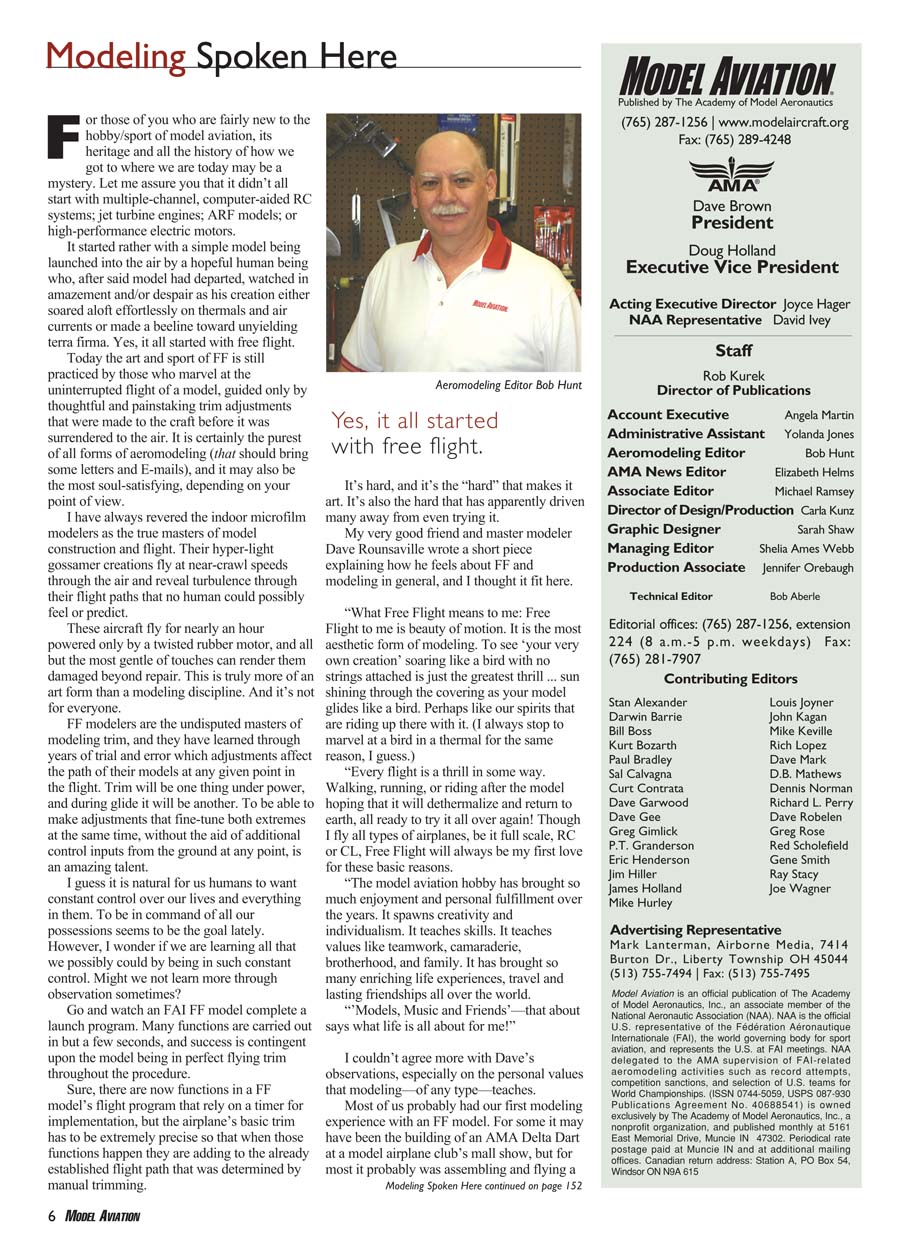
Modeling Spoken Here - 2006/10
For those of you who are fairly new to the hobby/sport of model aviation, its heritage and all the history of how we got to where we are today may be a mystery. Let me assure you that it didn't all start with multiple-channel, computer-aided RC systems; jet turbine engines; ARF models; or high-performance electric motors.
It began with a simple model being launched into the air by a hopeful human being who, after said model had departed, watched in amazement and/or despair as his creation either soared aloft effortlessly on thermals and air currents or made a beeline toward unyielding terra firma. Yes, it all started with free flight.
Today the art and sport of free flight (FF) is still practiced by those who marvel at the uninterrupted flight of a model, guided only by thoughtful and painstaking trim adjustments that were made to the craft before it was surrendered to the air. It is certainly the purest of all forms of aeromodeling (that should bring some letters and e-mails), and it may also be the most soul-satisfying, depending on your point of view.
I have always revered the indoor micromodelers as the true masters of model construction and flight. Their hyper-light, gossamer creations fly at near-crawl speeds through the air and reveal turbulence through their flight paths that no human could possibly feel or predict. These aircraft fly for nearly an hour powered only by a twisted rubber motor, and all but the most gentle of touches can render them damaged beyond repair. This is truly more of an art form than a modeling discipline. And it's not for everyone.
FF modelers are the undisputed masters of modeling trim, and they have learned through years of trial and error which adjustments affect the path of their models at any given point in the flight. Trim will be one thing under power, and during glide it will be another. To be able to make adjustments that fine-tune both extremes at the same time, without the aid of additional control inputs from the ground at any point, is an amazing talent.
I guess it is natural for us humans to want constant control over our lives and everything in them. To be in command of all our possessions seems to be the goal lately. However, I wonder if we are learning all that we possibly could by being in such constant control. Might we not learn more through observation sometimes?
Go and watch an FAI FF model complete a launch program. Many functions are carried out in but a few seconds, and success is contingent upon the model being in perfect flying trim throughout the procedure. Sure, there are now functions in a FF model's flight program that rely on a timer for implementation, but the airplane's basic trim has to be extremely precise so that when those functions happen they are adding to the already established flight path that was determined by manual trimming.
It's hard, and it's the "hard" that makes it art. It's also the hard that has apparently driven many away from even trying it.
What Free Flight Means to Me
My very good friend and master modeler Dave Rounsaville wrote a short piece explaining how he feels about free flight and modeling in general, and I thought it fit here.
"What Free Flight means to me: Free Flight to me is beauty of motion. It is the most aesthetic form of modeling. To see 'your very own creation' soaring like a bird with no strings attached is just the greatest thrill ... sun shining through the covering as your model glides like a bird. Perhaps like our spirits that are riding up there with it. (I always stop to marvel at a bird in a thermal for the same reason, I guess.)
"Every flight is a thrill in some way. Walking, running, or riding after the model hoping that it will dethermalize and return to earth, all ready to try it all over again! Though I fly all types of airplanes, be it full scale, RC or CL, Free Flight will always be my first love for these basic reasons.
"The model aviation hobby has brought so much enjoyment and personal fulfillment over the years. It spawns creativity and individuality. It teaches skills. It teaches values like teamwork, camaraderie, brotherhood, and family. It has brought so many enriching life experiences, travel and lasting friendships all over the world.
"'Models, Music and Friends,' that about says what life is all about for me!"
I couldn't agree more with Dave's observations, especially on the personal values that modeling—of any type—teaches.
Most of us probably had our first modeling experience with an FF model. For some it may have been the building of an AMA Delta Dart at a model airplane club's small show, but for most it probably was assembling and flying a simple rubber-powered free-flight model.
Transcribed from original scans by AI. Minor OCR errors may remain.

