
Modeling Spoken Here
Bob Hunt Aeromodeling Editor
Nothing beats the real thing when it comes to airplanes on film, it seems.
When I was very young, I was occasionally allowed to stay up late and watch selected movies on TV. These were mainly movies with airplane themes. In the early 1950s, a number of World War II movies were released for television viewing. Among them were two of my all-time favorites: Wing and a Prayer and Air Force. Of the two, Air Force made the biggest impression on me, and it was the first of its type that I would get to watch.
The storyline was about a B-17 bomber that was part of a group of B-17s flying to Hickham Field in Hawaii from a base east of San Francisco, California. They left the United States the evening of December 6, 1941, and were due to arrive in Hawaii the morning of December 7. They flew right into the raid that was in progress at Pearl Harbor.
The movie centered around a specific B-17 and its crew. The airplane was nicknamed the "Mary Ann," and the character development took place during the long night flight. The movie was roughly 100 minutes long, but to a wide-eyed youngster it seemed like it went on for hours, and I came to feel that each member of that crew was a personal friend.
Some actual full-scale airplane footage was used in the movie, but many specific-scene shots had to be "faked" using B-17 model hangar sets in a studio. Even to a young aviation enthusiast, it was obvious that many of the scenes were shot using a model.
However, the story was so compelling that it was easy to suspend disbelief and accept the staged model shots as real. The mind filled in the details, and the hokey, faked shots in no way detracted from the story. In fact, looking back, they were somewhat endearing.
Through the years, airplane moviemaking has come a long way. Of late, computer graphics, or "CG" as it's known in the industry, has enabled directors to produce previously impossible flight scenarios on film. The movie Pearl Harbor made good use of this technology.
Still, even the untrained eye knows CG images at a glance, and no matter how well they are produced, there is still a need for the suspension-of-disbelief process. Nothing beats the real thing when it comes to airplanes on film, it seems.
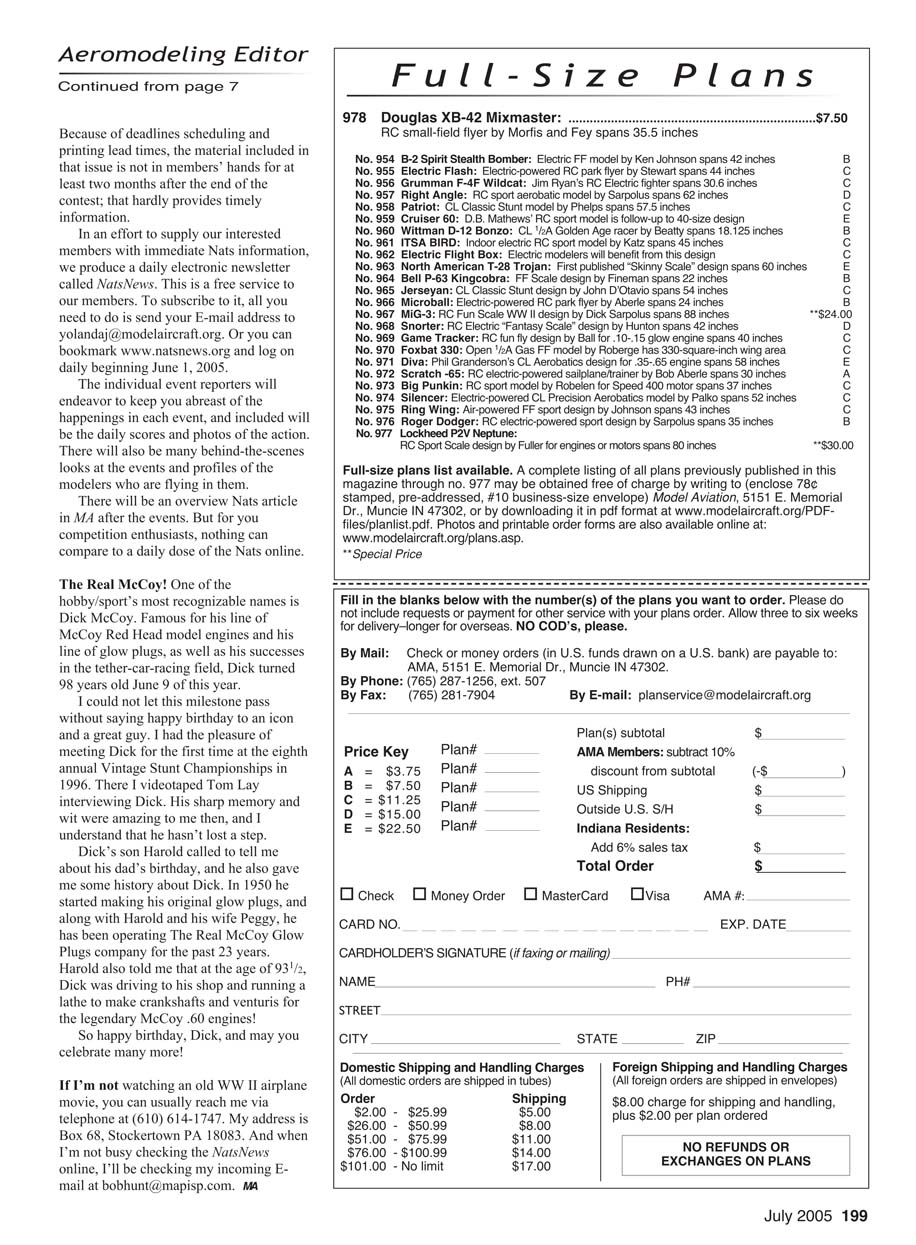
Martin Scorsese apparently felt that way to a great degree when he set about to direct the Academy Award-winning blockbuster hit The Aviator. Sure, some CG effects had to be used here and there, but many of the shots in the film were staged using large model airplanes. The models had to be big enough to be as stable in the air as full-scale airplanes would appear.
To accomplish this, Mr. Scorsese enlisted the services of AMA member Joe Bock. Joe owns a company called Aero Telemetry, and his main business is designing and producing Unmanned Aerial Vehicles (UAVs) for the US military. The technology that he and his crew have developed enabled them to produce convincing large models that could perform in a strikingly prototypical manner on film.
If you've seen the movie, you know how outstandingly well Joe's crew performed and how much their contribution added to the project. What you may not know is how difficult and time-consuming the design, development, production, and flying aspects of the job were.
In this issue we are presenting the first of three exclusive articles that are really excerpts from an upcoming book about Joe Bock by Walt Nowotny. These articles will give you a feel for the challenges and pitfalls of, and deadlines for, this type of film project. Each of the three models that Joe's company built will be covered in a segment of this series.
I found it to be fascinating reading, and I hope you will too. The crossover of modeling technology and RC flying skills makes this series one that will hopefully inspire other AMA members to become involved with the film industry.
Instant Nats News:
Okay, almost instant. This year we are instituting a new method of covering the events at the annual AMA National Aeromodeling Championships, or Nats. In the past we have dedicated one issue of MA each year to Nats coverage.
Continued on page 199
Because of deadlines scheduling and printing lead times, the material included in that issue is not in members' hands for at least two months after the end of the contest; that hardly provides timely information.
In an effort to supply our interested members with immediate Nats information, we produce a daily electronic newsletter called NatsNews. This is a free service to our members. To subscribe to it, all you need to do is send your E-mail address to [email protected]. Or you can bookmark www.natsnews.org and log on daily beginning June 1, 2005.
The individual event reporters will endeavor to keep you abreast of the happenings in each event, and included will be the daily score sheets and photos of the action. There will also be many behind-the-scenes looks at the events and profiles of the modelers who are flying in them.
There will be an overview Nats article in MA after the events. But for you competition enthusiasts, nothing can compare to a daily dose of the Nats online.
The Real McCoy!
One of the hobby/sport’s most recognizable names is Dick McCoy. Famous for his line of McCoy Red Head model engines and his line of glow plugs, as well as his successes in the tether-car-racing field, Dick turned 98 years old June 9 of this year.
I could not let this milestone pass without saying happy birthday to an icon and a great guy. I had the pleasure of meeting Dick for the first time at the eighth annual Vintage Stunt Championships in 1996. There I videotaped Tom Lay interviewing Dick. His sharp memory and wit were amazing to me, and I understand that he hasn’t lost a step.
Dick’s son Harold called to tell me about his dad’s birthday, and he also gave me some history about Dick. In 1950 he started making his original glow plugs, and along with Harold and his wife Peggy, he has been operating The Real McCoy Glow Plugs company for the past 23 years. Harold also told me that at the age of 93½, Dick was driving to his shop and running a lathe to make crankshafts and venturis for the legendary McCoy .60 engines!
So happy birthday, Dick, and may you celebrate many more!
If I’m not watching an old WW II airplane movie, you can usually reach me via telephone at (610) 614-1747. My address is Box 68, Stockertown PA 18083. And when I’m not busy checking the NatsNews online, I’ll be checking my incoming E-mail at [email protected]. MA
Transcribed from original scans by AI. Minor OCR errors may remain.

