
Modeling Spoken Here
Bob Hunt — Aeromodeling Editor
One of your original designs may appear someday as a construction feature ...
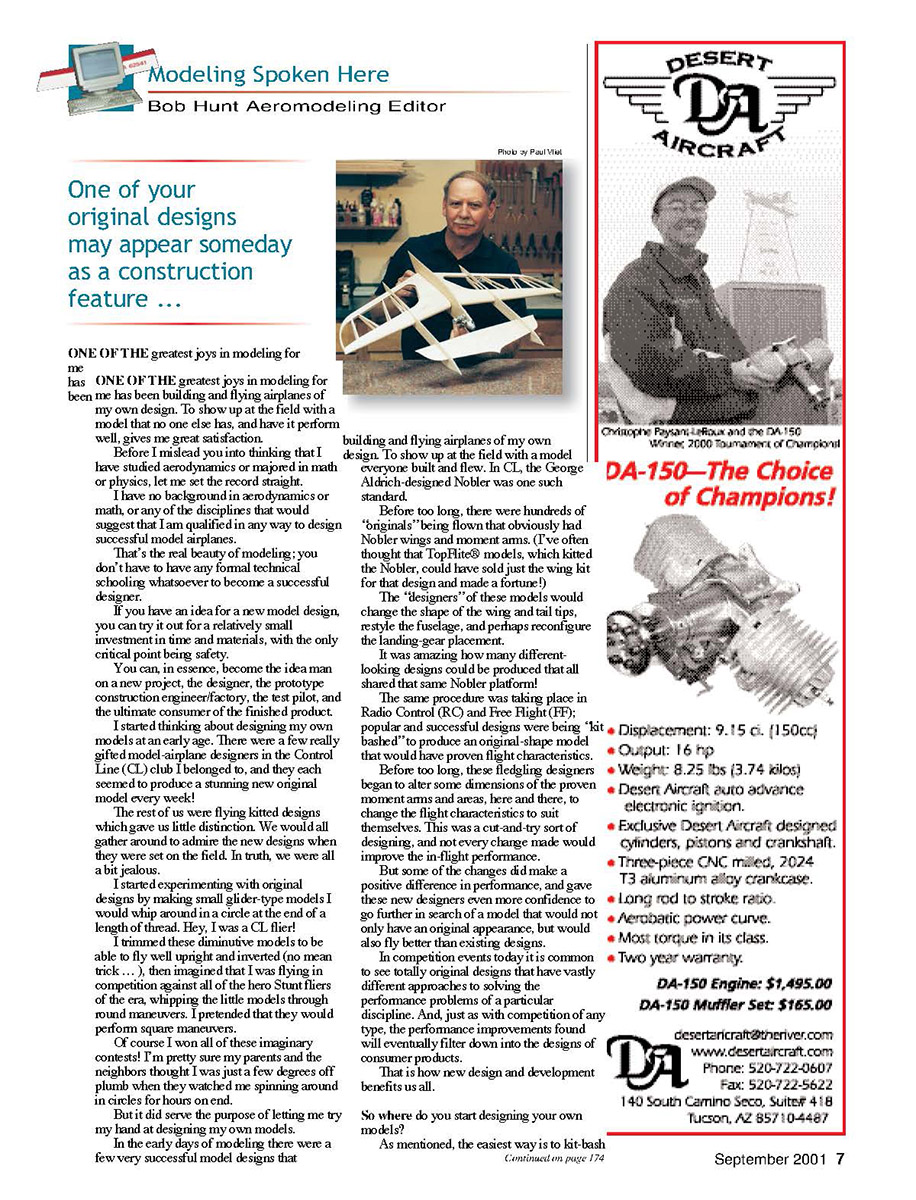
One of the greatest joys in modeling for me has been building and flying airplanes of my own design. To show up at the field with a model that no one else has, and have it perform well, gives me great satisfaction.
Before I mislead you into thinking that I have studied aerodynamics or majored in math or physics, let me set the record straight. I have no background in aerodynamics or math, or any of the disciplines that would suggest that I am qualified in any way to design successful model airplanes.
That’s the real beauty of modeling; you don’t have to have any formal technical schooling whatsoever to become a successful designer. If you have an idea for a new model design, you can try it out for a relatively small investment in time and materials, with the only critical point being safety.
You can, in essence, become the idea man on a new project, the designer, the prototype construction engineer/factory, the test pilot, and the ultimate consumer of the finished product.
I started thinking about designing my own models at an early age. There were a few really gifted model-airplane designers in the Control Line (CL) club I belonged to, and they each seemed to produce a stunning new original model every week! The rest of us were flying kitted designs which gave us little distinction. We would all gather around to admire the new designs when they were set on the field. In truth, we were all a bit jealous.
I started experimenting with original designs by making small glider-type models I would whip around in a circle at the end of a length of thread. Hey, I was a CL flier! I trimmed these diminutive models to be able to fly well upright and inverted (no mean trick...), then imagined that I was flying in competitions against all of the hero stunt fliers of the era, whipping the little models through round maneuvers. I pretended that they would perform square maneuvers.
Of course I won all of these imaginary contests! I’m pretty sure my parents and the neighbors thought I was just a few degrees off plumb when they watched me spinning around in circles for hours on end. But it did serve the purpose of letting me try my hand at designing my own models.
In the early days of modeling there were a few very successful model designs that became standard designs in their respective classes. Designers would often build and fly airplanes of their own design. In CL, the George Aldrich-designed Nobler was one such standard.
Before too long, there were hundreds of “originals” being flown that obviously had Nobler wings and moment arms. (I’ve often thought that TopFlite® models, which kitted the Nobler, could have sold just the wing kit for that design and made a fortune.)
The “designers” of these models would change the shape of the wing and tail tips, restyle the fuselage, and perhaps reconfigure the landing-gear placement. It was amazing how many different-looking designs could be produced that all shared that same Nobler planform!
The same procedure was taking place in Radio Control (RC) and Free Flight (FF); popular and successful designs were being “kit-bashed” to produce an original-shape model that would have proven flight characteristics.
Before too long, these fledgling designers began to alter some dimensions of the proven moment arms and areas, here and there, to change the flight characteristics to suit themselves. This was a cut-and-try sort of designing, and not every change made would improve the in-flight performance.
But some of the changes did make a positive difference in performance, and gave the new designers even more confidence to go further in search of a model that would not only have an original appearance, but would also fly better than existing designs.
In competition events today it is common to see totally original designs that have vastly different approaches to solving the performance problems of a particular discipline. And, just as with competition of any type, the performance improvements found will eventually filter down into the designs of consumer products. That is how new design and development benefits us all.
Where to Start
So where do you start designing your own models?
As mentioned, the easiest way is to kit-bash.
Transcribed from original scans by AI. Minor OCR errors may remain.

