
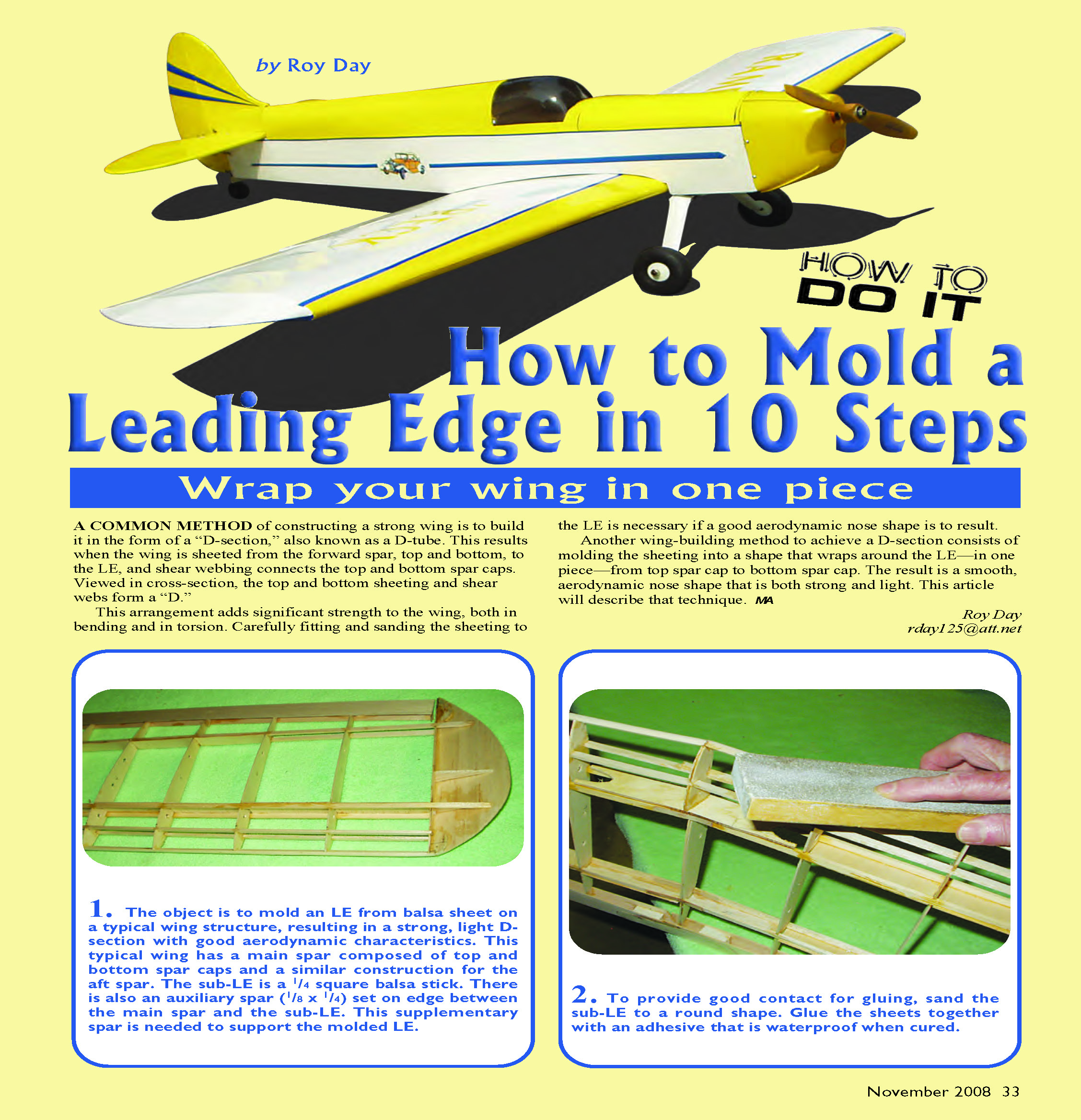
How to Mold a Leading Edge in 10 Steps
by Roy Day
A COMMON METHOD of constructing a strong wing is to build it in the form of a "D-section," also known as a D-tube. This results when the wing is sheeted from the forward spar, top and bottom, to the LE, and shear webbing connects the top and bottom spar caps. Viewed in cross-section, the top and bottom sheeting and shear webs form a "D."
This arrangement adds significant strength to the wing, both in bending and in torsion. Carefully fitting and sanding the sheeting to the LE is necessary if a good aerodynamic nose shape is to result.
Another wing-building method to achieve a D-section consists of molding the sheeting into a shape that wraps around the LE—in one piece—from top spar cap to bottom spar cap. The result is a smooth, aerodynamic nose shape that is both strong and light. This article will describe that technique. MA
Roy Day <REDACTED>
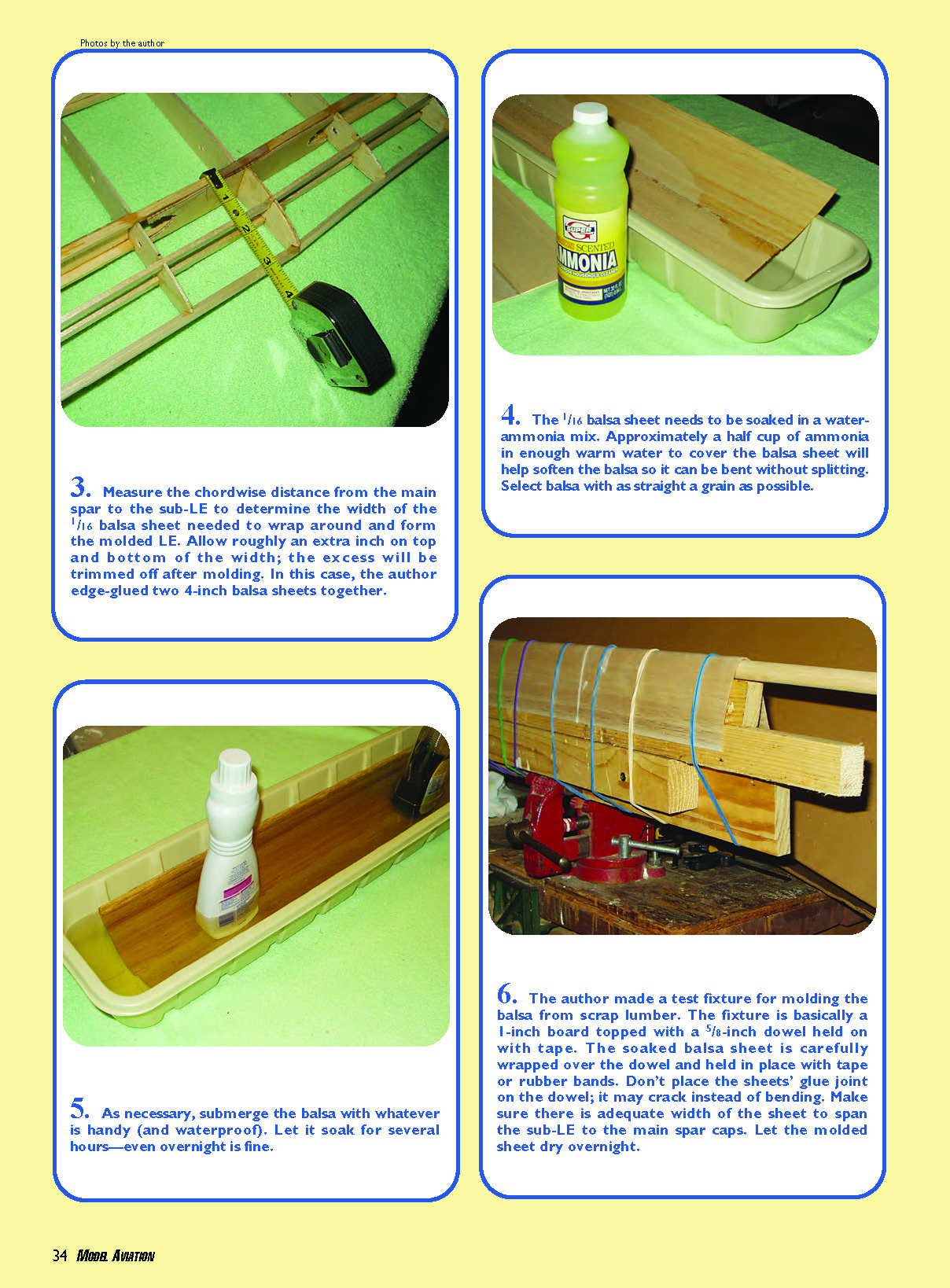
- The object is to mold an LE from balsa sheet on a typical wing structure, resulting in a strong, light D-section with good aerodynamic characteristics. This typical wing has a main spar composed of top and bottom spar caps and a similar construction for the aft spar. The sub-LE is a 1/4 square balsa stick. There is also an auxiliary spar (1/8 x 1/4) set on edge between the main spar and the sub-LE. This supplementary spar is needed to support the molded LE.
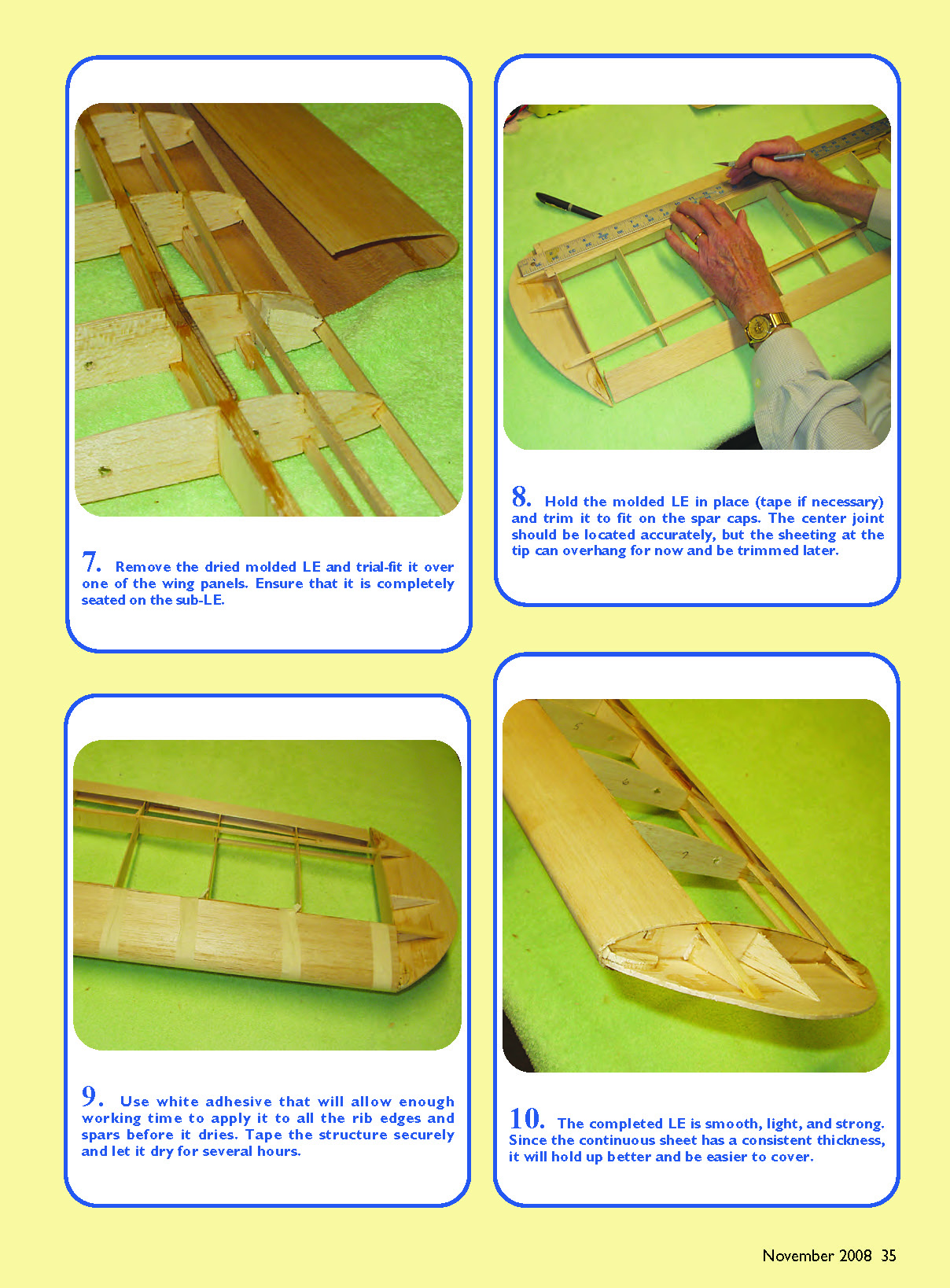
- To provide good contact for gluing, sand the sub-LE to a round shape. Glue the sheets together with an adhesive that is waterproof when cured.
- Measure the chordwise distance from the main spar to the sub-LE to determine the width of the 1/16 balsa sheet needed to wrap around and form the molded LE. Allow roughly an extra inch on top and bottom of the width; the excess will be trimmed off after molding. In this case, the author edge-glued two 4-inch balsa sheets together.
- The 1/16 balsa sheet needs to be soaked in a water-ammonia mix. Approximately a half cup of ammonia in enough warm water to cover the balsa sheet will help soften the balsa so it can be bent without splitting. Select balsa with as straight a grain as possible.
- As necessary, submerge the balsa with whatever is handy (and waterproof). Let it soak for several hours—even overnight is fine.
- The author made a test fixture for molding the balsa from scrap lumber. The fixture is basically a 1-inch board topped with a 5/8-inch dowel held on with tape. The soaked balsa sheet is carefully wrapped over the dowel and held in place with tape or rubber bands. Don't place the sheet's glue joint on the dowel; it may crack instead of bending. Make sure there is adequate width of the sheet to span the sub-LE to the main spar caps. Let the molded sheet dry overnight.
Mold a Leading Edge in 10 Steps
Roy Day
- Remove the dried molded LE and trial-fit it over one of the wing panels. Ensure that it is completely seated on the sub-LE.
- Hold the molded LE in place (tape if necessary) and trim it to fit on the spar caps. The center joint should be located accurately, but the sheeting at the tip can overhang for now and be trimmed later.
- Use white adhesive that will allow enough working time to apply it to all the rib edges and spars before it dries. Tape the structure securely and let it dry for several hours.
- The completed LE is smooth, light, and strong. Since the continuous sheet has a consistent thickness, it will hold up better and be easier to cover.
Transcribed from original scans by AI. Minor OCR errors may remain.

