
Museum News & Views
Michael Smith
National Model Aviation Museum Curator
Tel.: (765) 287-1256 Ext. 500 [email protected]
The year 2003 has arrived and with it the centennial of one of, if not the most important, events in aviation history. I am referring to the remarkable accomplishments of the Wright brothers, whose tireless efforts led them to a quiet, sand-covered North Carolina beach on December 7, 1903. There, at 10:35 a.m., Orville Wright made the first flight in a man-carrying, powered, heavier-than-air vehicle. While that first flight lasted only 12 seconds and covered a mere 120 feet, it marked the beginning of an extraordinary developmental history. In a relatively short time, aircraft were able to stay aloft for hours, metal replaced fabric, and then we were suddenly flying faster than the speed of sound.
This year, groups around the world have planned events to celebrate the Wrights’ accomplishments. Whether through museum exhibits, air shows, or standalone events, each will in some way help the public better understand and appreciate what the Wright brothers achieved.
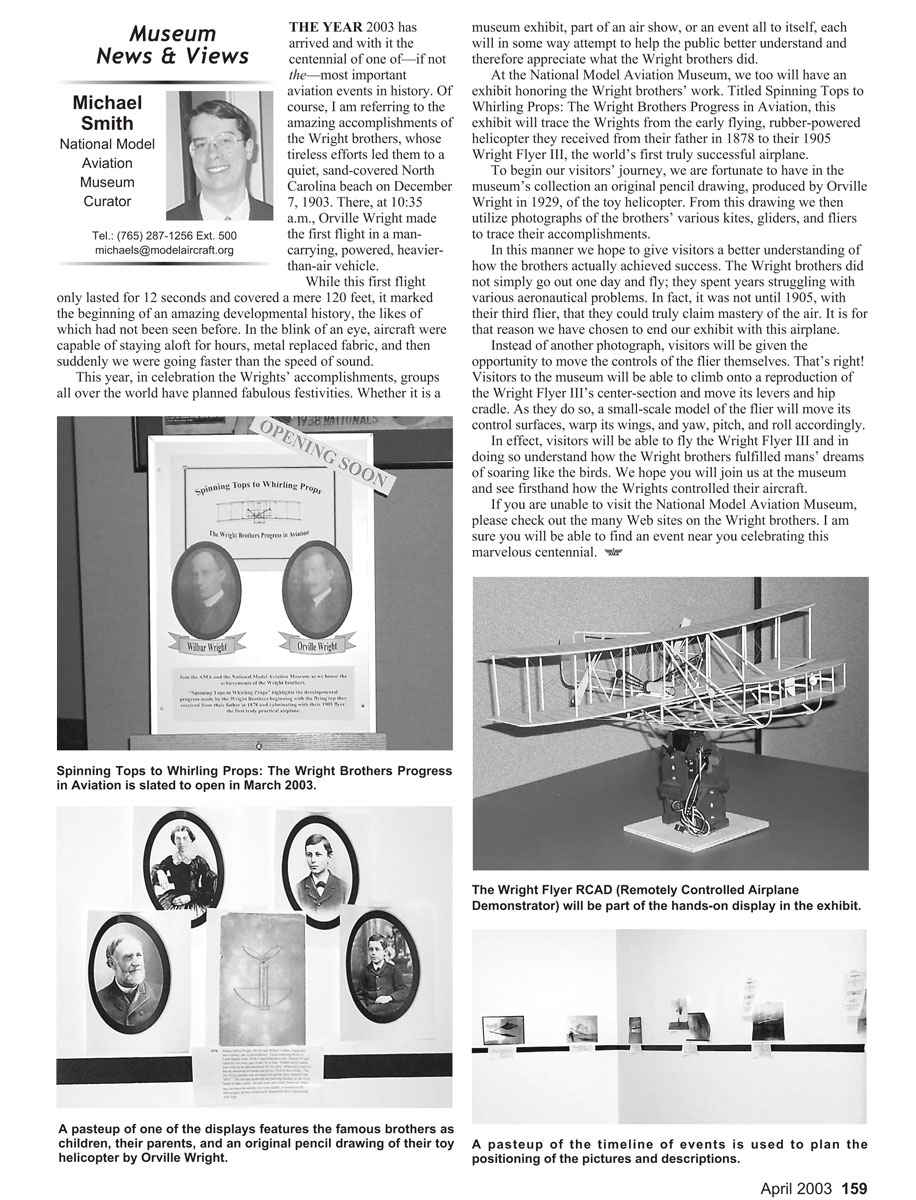
At the National Model Aviation Museum, we will present an exhibit honoring the Wright brothers’ work. Titled Spinning Tops to Whirling Props: The Wright Brothers' Progress in Aviation, the exhibit traces the brothers from the early flying, rubber-powered helicopter they received from their father in 1878 to their 1905 Wright Flyer III, the world’s first truly successful airplane.
To begin visitors’ journey, the museum is fortunate to have an original pencil drawing produced by Orville Wright in 1929 of the toy helicopter. From this drawing, we use photographs of the brothers’ various kites, gliders, and fliers to trace their accomplishments.
We hope to give visitors a clearer understanding of how the brothers actually achieved success. The Wright brothers did not simply go out one day and fly; they spent years struggling with various aeronautical problems. In fact, it was not until 1905, with their third flier, that they could truly claim mastery of the air. For that reason, we have chosen to end our exhibit with this airplane.
Instead of another photograph, visitors will be given the opportunity to move the controls of the flier themselves. Visitors will be able to climb onto a reproduction of the Wright Flyer III’s center section and operate its levers and hip cradle. As they do so, a small-scale model of the flier will move its control surfaces, warp its wings, and yaw, pitch, and roll accordingly.
In effect, visitors will be able to "fly" the Wright Flyer III and, in doing so, understand how the Wright brothers fulfilled humanity’s dream of soaring like the birds. We hope you will join us at the museum to see firsthand how the Wrights controlled their aircraft.
If you are unable to visit the National Model Aviation Museum, please check the many websites devoted to the Wright brothers. You will likely find an event near you celebrating this marvelous centennial.
Exhibit highlights
- Original 1929 pencil drawing by Orville Wright of the toy helicopter
- Photographs of kites, gliders, and early fliers
- Reproduction center section of the Wright Flyer III with interactive controls
- Small-scale model demonstrating control-surface movement and aircraft responses
Transcribed from original scans by AI. Minor OCR errors may remain.

