
Museum News & Views
Michael Smith
National Model Aviation Museum Curator Tel.: (765) 287-1256 Ext. 500 [email protected]
Museum Web Site
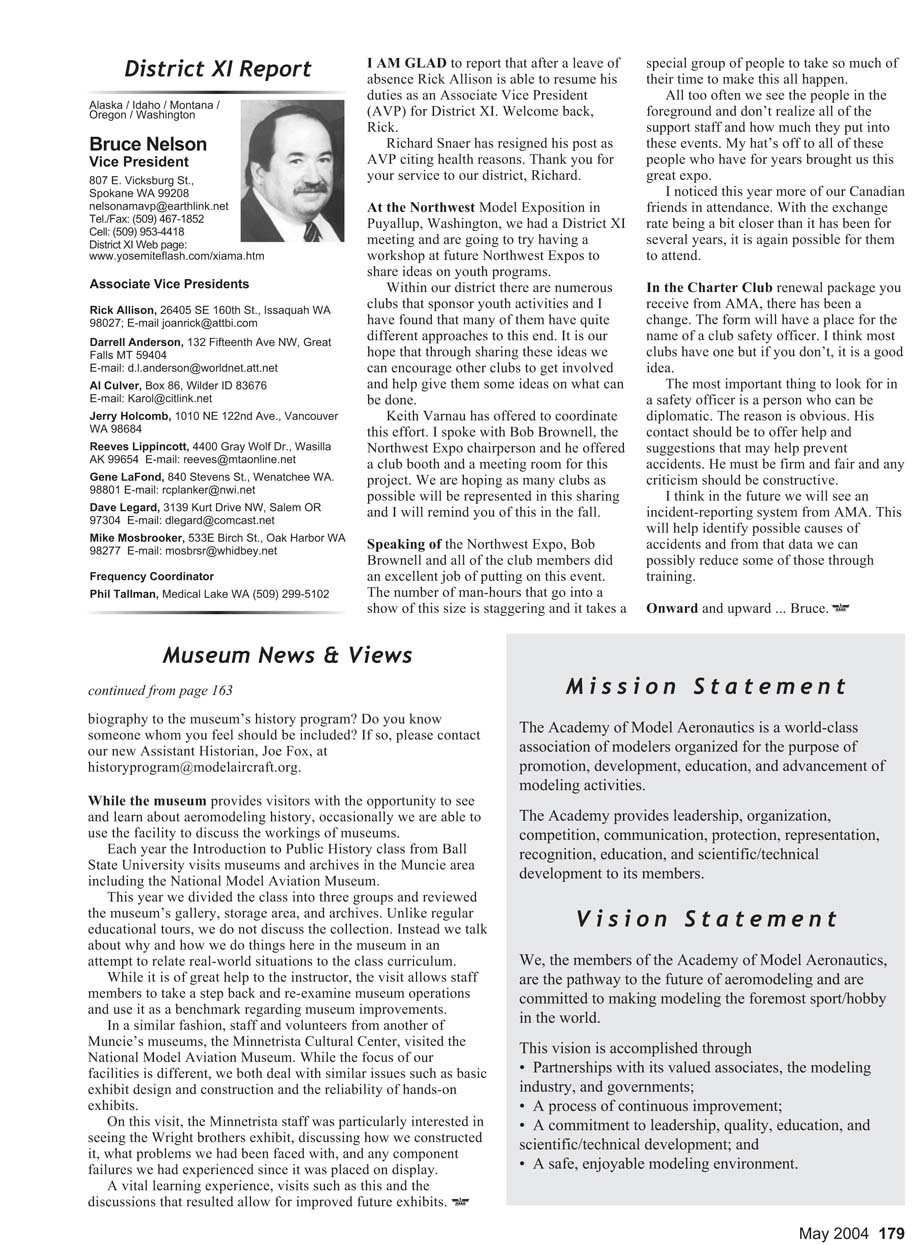
Have you been to the National Model Aviation Museum? If not, visit the museum’s Web page at www.modelaircraft.org/museum/index.asp. Yes, it is a long title, but it is worth the visit!
For years we have addressed how to make the museum’s collection more accessible to members, many of whom will never be able to make the trip to Muncie, Indiana. Articles in Model Aviation and Cloud 9, our Museum Patron newsletter, offer opportunities for coverage, but the Web site provides the best solution. The site allows us to give visitors a glimpse into the holdings of the museum.
Presently our Wright brothers exhibit and our student aviation art contest are highlighted on the front page. The navigation menu on the left side of the page provides visitors access to a wealth of information.
Site navigation and content
- Exhibits
- Overview of key displays focusing on Free Flight, Control Line, and Radio Control.
- Each display is highlighted with photographs and accompanying text.
- As time allows, categories will be subdivided to cover various aeromodeling specialties so visitors worldwide can appreciate aircraft such as Elmer Wasman’s 1937 radio-controlled White Mystery, George Aldrich’s control-line Nobler, and Carl Goldberg’s free-flight sailplane.
- New Acquisitions
- Highlights new additions to the collection before they are placed on display.
- Library
- Will eventually outline the holdings of the Lee Renaud Memorial Library, providing researchers with a list of available materials such as magazines.
- Theater
- Information about the film(s) being shown in the museum and any scheduled lectures or seminars.
- Restoration Shop
- Details on projects under construction or newly completed.
- Museum Store
- Links to AMA’s online WebStore and photos of Cloud 9, the museum’s store.
- Education & Community
- Highlights of programs presented through the museum’s outreach program.
- Information and prices for scheduling a group tour or educational trip.
- Patrons
- Overview of the Museum Patron program, explaining the need for patrons and the benefits of becoming one.
- Donations
- Outlines requirements for donating artifacts to the museum and includes a PDF of the artifact-submission form.
- History Program
- Information about efforts to document the history of model aviation through personal stories of aeromodelers.
- Many biographies and autobiographies have been collected—now more than 330—and are available.
- Biography writing guides and instructions are provided.
- Museum Information
- Directions to the museum and listings of hotels, motels, and restaurants in the area.
- Links to information about the museum’s Steering Committee and staff contact information.
If you happen to be online, please stop by the site and visit.
By the way, have you sent in your biography to the museum’s history program? Do you know someone who should be included? If so, please contact our Assistant Historian, Joe Fox, at [email protected].
Educational Outreach and Professional Visits
While the museum provides visitors the opportunity to see and learn about aeromodeling history, we also use the facility to discuss the workings of museums.
Each year the Introduction to Public History class from Ball State University visits museums and archives in the Muncie area, including the National Model Aviation Museum. This year we divided the class into three groups and reviewed the museum’s gallery, storage area, and archives. Unlike regular educational tours, we do not discuss the collection in depth. Instead we explain why and how we do things at the museum to relate real-world situations to the class curriculum.
These visits are of great help to the instructor and allow staff members to step back, re-examine museum operations, and use the experience as a benchmark for museum improvements.
Similarly, staff and volunteers from another Muncie institution, the Minnetrista Cultural Center, visited the National Model Aviation Museum. Although our focuses differ, we both face similar issues such as basic exhibit design and construction and the reliability of hands-on exhibits. The Minnetrista staff showed particular interest in the Wright brothers exhibit, discussing its construction, the problems we encountered, and any component failures experienced since it was placed on display.
Visits and discussions like these are vital learning experiences that lead to improved future exhibits.
Transcribed from original scans by AI. Minor OCR errors may remain.

